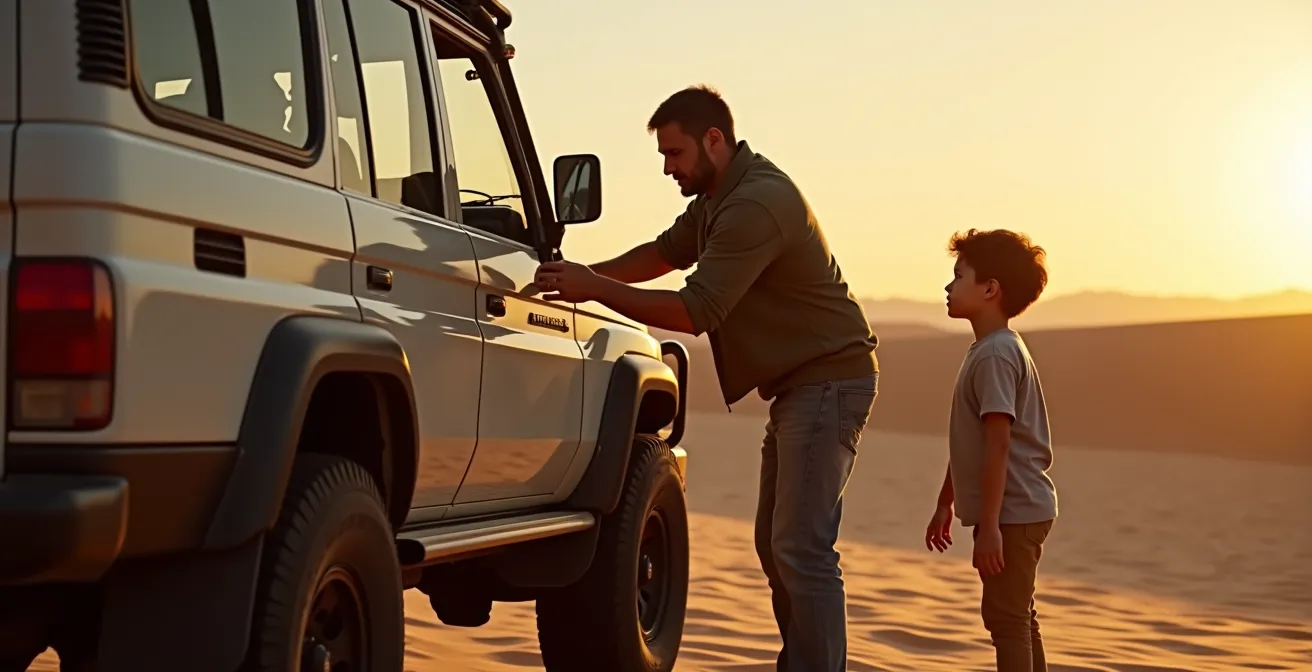
Dune bashing is not just a ‘bumpy ride’ for a child under six; from a pediatric safety perspective, it’s a high-risk activity that exposes their underdeveloped spine to dangerous, uncontrolled whiplash-like forces.
- The primary danger is severe injury to the cervical spine due to a child’s large head-to-body ratio and immature neck muscles.
- Standard vehicle safety features, including roll cages and seatbelts, are engineered for adult bodies and are inadequate for protecting a small child from multi-directional jolts.
Recommendation: The only medically sound and safe option for families with children under the age of six is to opt for a gentle desert drive or “dune driving,” explicitly avoiding the high-intensity, off-road rollercoaster of dune bashing.
As a parent, the desire to share incredible experiences with your children is natural. The thrill of a desert safari, with its vast landscapes and unique activities, is a powerful draw. However, when considering dune bashing, a question of paramount importance arises: is this activity safe for a child under six years old? Many tour operators provide vague warnings or age suggestions, but these often lack the critical medical context needed to make a truly informed decision. The advice can feel generic, centered on choosing a “good company” or ensuring the vehicle has a roll cage.
But the core of the issue is not just about the quality of the tour; it’s a fundamental conflict between vehicle dynamics and pediatric physiology. The forces at play during dune bashing are significant, and official Dubai tourism safety guidelines state that pregnant women, the elderly, and individuals with back, neck, or heart conditions should avoid it. A young child, due to their ongoing physical development, falls into an even more vulnerable category. Their musculoskeletal system is not simply a smaller version of an adult’s; it is fundamentally different and far more susceptible to injury from the violent, unpredictable movements inherent to this activity.
This article moves beyond generic advice to provide a pediatric safety specialist’s analysis. We will dissect the specific biomechanical risks, focusing on why a young child’s body—particularly their cervical spine—is uniquely unprepared for the experience. We will explore the mismatch between a vehicle’s safety engineering and a child’s biology, and equip you with the clinical knowledge to understand not just *that* it’s unsafe, but precisely *why* the risk of severe, life-altering injury is unacceptably high.
To help you make the safest choice for your family, this guide breaks down the critical safety factors, from vehicle checks and driver expertise to the stark realities of what happens when things go wrong. We will analyze the forces your child’s body would endure and explain why alternative desert experiences are the only responsible choice for this age group.
Summary: Assessing the Real Risks of Dune Bashing for Young Children
- Roll Cages and Tire Pressure: What Safety Checks Should You See?
- How to Spot an Inexperienced Driver Before Entering the Big Dunes?
- How to Prevent Lower Back Pain After 30 Minutes of Bashing?
- Can You Rent a Buggy to Drive Yourself Instead of Being a Passenger?
- What Happens if the Car Gets Stuck or Tips Over?
- The Scratch Scam: How to Document the Jet Ski Condition Before Riding?
- Why You Should Declare High Blood Pressure Before Ziplining?
- Why Sandboarding Is Exhausting: The Reality of Walking Back Up
Roll Cages and Tire Pressure: What Safety Checks Should You See?
Before even considering a desert tour, a parent must shift their mindset from a passive passenger to an active safety inspector. The visible safety features of a 4×4 are the first line of defense, but understanding what you’re looking for is critical. While a roll cage is a non-negotiable feature, its mere presence is not enough. It must be a government-standard installation, properly welded and free of rust or damage. The interior should be scrutinized for any loose objects, exposed metal fittings, or malfunctioning seatbelts that could become projectiles or hazards during extreme movements.
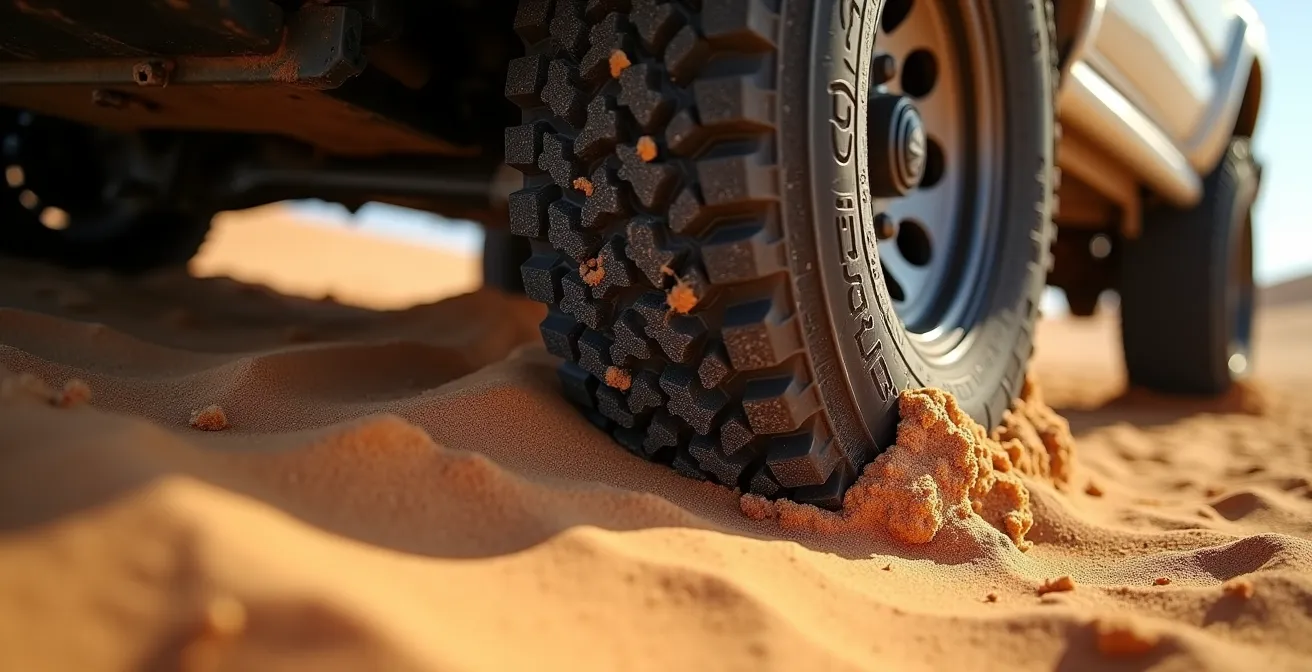
One of the most crucial, yet often overlooked, pre-ride checks is tire pressure. For safe sand navigation, tires must be significantly deflated to a pressure of around 15-18 PSI. This increases the tire’s footprint, allowing it to “float” on the sand rather than digging in. An overinflated tire is a primary cause of vehicles getting stuck or losing control on steep dunes. You should be able to see a visible “squat” or bulge in the sidewall of the tires. The illustration below shows the critical difference between a properly prepared tire and a dangerously overinflated one for desert conditions.
However, even with perfect vehicle preparation, it is essential to recognize that these measures are designed to protect adult occupants in a rollover. They do little to mitigate the internal, multi-directional forces that pose the greatest threat to a small child. Official regulations underscore the risk, as Dubai’s official safety regulations mandate that children must be at least 12 years old for standard dune bashing. This isn’t an arbitrary number; it reflects an understanding that pre-teen bodies are not equipped for these forces.
Essential Pre-Ride Safety Inspection Checklist: A Parent’s Protocol
- Tire Pressure: Visually confirm that tires are deflated and have a wide, “squatted” footprint suitable for sand (15-18 PSI).
- Vehicle Interior: Inspect for any loose objects, exposed sharp metal, and ensure all seatbelts retract properly.
- Child Seat Security: If a car seat is present, verify it is tightly secured using the “one-inch wiggle test” at the belt path.
- Roll Cage Integrity: Check that the safety cage is a robust, professionally installed unit that meets local government standards.
- Emergency Equipment: Confirm the mandated presence of a first aid kit, fire extinguisher, and a functional communication or GPS device.
How to Spot an Inexperienced Driver Before Entering the Big Dunes?
The single most important safety component in a dune bashing vehicle is not the roll cage or the tires; it is the driver. An experienced, professional desert driver possesses a unique skillset that combines vehicle control, dune navigation, and an unwavering commitment to safety protocols. Conversely, an inexperienced or reckless driver is the greatest liability and a direct threat to every passenger. Spotting the signs of inexperience before the vehicle leaves the tarmac is a critical parenting responsibility in this high-risk environment.
A professional will begin with a clear, rehearsed safety briefing that is not rushed. Crucially, they should ask about the ages of any children present and explicitly state how they will adjust the ride (or if they will proceed at all) based on that information. Observe their driving on flat roads; it should be smooth and controlled, not aggressive. The vehicle itself is another clue: a professional’s 4×4 will have neatly organized recovery gear, such as shovels, tow ropes, and deflation tools, indicating a preparedness for predictable challenges. Regulations are clear, as the DTCM regulations require that all desert safari drivers must be trained and licensed for this specific activity.
The consequences of being with an inexperienced or negligent driver can be catastrophic, particularly when a child is involved. The margin for error in the dunes is zero.
Cautionary Tale: The Devastating Outcome of Improper Restraint
A tragic, widely discussed incident in the desert safari community serves as a harrowing reminder of the stakes. A four-year-old child was participating in a dune bashing tour while sitting on her mother’s lap, not in a proper child restraint. When the vehicle overturned—a known risk of the activity—the child was ejected from the 4×4 and sustained fatal injuries. This heartbreaking event underscores a brutal reality: in a rollover, an adult’s arms are physically incapable of restraining a child against the immense forces involved. It highlights the absolute, non-negotiable need for age-appropriate car seats and the failure of operators who allow such unsafe practices.
A parent must be prepared to cancel the tour immediately if the driver seems unprofessional, dismisses safety concerns, or fails to provide a clear, child-specific safety plan. Your child’s life is not worth the risk of politeness or avoiding confrontation.
How to Prevent Lower Back Pain After 30 Minutes of Bashing?
The very question of preventing adult back pain reveals the intense physical nature of dune bashing. Operators openly warn that the activity involves significant bouncing and jumping that can cause physical strain. For an adult, this translates to muscle fatigue and potential spinal compression, leading to soreness. For a child under six, these same forces present a much more sinister threat, moving from a risk of discomfort to a risk of severe, permanent injury.
The core of the problem lies in musculoskeletal immaturity. A young child has a disproportionately large and heavy head relative to their body size, supported by underdeveloped neck and core muscles. During dune bashing, the vehicle is subjected to violent, unpredictable, multi-directional forces—up, down, and side-to-side. For an adult, consciously bracing core muscles and using their developed musculature can help stabilize the torso. A child lacks this ability. Their head is violently thrown around, creating powerful whiplash-like forces on their fragile cervical spine. This can lead to outcomes far worse than back pain, including spinal cord injury, ligament damage, and neurological trauma.
Furthermore, an adult can strategically choose a seat between the vehicle’s axles to minimize the jarring vertical movements. A child, even if in a car seat, is still subjected to these forces, and their delicate intervertebral discs lack the resilience of an adult’s. The issue is not about preventing pain; it’s about preventing a catastrophic biomechanical failure. The forces strong enough to cause an adult back pain are more than capable of causing a life-altering injury to a young child.
Can You Rent a Buggy to Drive Yourself Instead of Being a Passenger?
Faced with the risks of a standard tour, some parents consider renting a dune buggy to control the intensity themselves. From a pediatric safety standpoint, this is an exponentially more dangerous option. It replaces a trained professional (however flawed) with a tourist who has zero experience in desert navigation or recovery. It puts the family in an isolated situation, often without the crucial support of a convoy system for when—not if—the vehicle gets stuck or encounters a mechanical failure.
The vehicles themselves are fundamentally different. A professional tour uses a modified Land Cruiser or similar large 4×4, chosen for its stability, weight, and robust safety features. As the Dubai government mandates the use of safety cages for all commercial off-road vehicles, these tour 4x4s are built with occupant survival in mind. Rental buggies, in contrast, are lightweight with a high center of gravity, making them far more prone to tipping over. Their safety features are often minimal, and they lack the space and fittings for a securely installed, age-appropriate child car seat. Furthermore, most travel insurance policies explicitly exclude coverage for injuries sustained while self-driving off-road vehicles, leaving a family financially and medically exposed in a worst-case scenario.
The professional convoy system is a safety net you lose when driving alone. This system ensures that if one vehicle gets stuck or has an issue, others are immediately available to assist with recovery and provide support.

The following table, based on an analysis of desert adventure options, clearly illustrates the safety disparity between a professional tour and a self-drive rental, reinforcing why neither is a suitable choice for a family with a young child.
| Factor | Self-Drive Rental Buggy | Professional Tour 4×4 |
|---|---|---|
| Safety Features | Basic roll cage, minimal protection | Government-mandated safety cage, airbags, child seats |
| Insurance Coverage | Travel insurance typically excludes self-driven off-road | Full operator liability coverage |
| Driver Experience | Tourist with no desert experience | Licensed professional with desert navigation skills |
| Support System | Alone if stuck or mechanical failure | Convoy system with immediate rescue support |
| Vehicle Type | Lightweight, high center of gravity | Modified Land Cruiser with superior stability |
What Happens if the Car Gets Stuck or Tips Over?
Even with the most experienced driver and best-maintained vehicle, getting stuck or a vehicle tipping over are known and accepted risks of dune bashing. For a parent, knowing the correct emergency protocol is not just reassuring; it is a critical component of safety preparedness. Panic is the enemy in these situations, and a calm, step-by-step response is essential, especially when a child’s well-being is at stake.
First, if the vehicle is simply stuck in the sand but stable and upright, the rule is to stay inside the vehicle with seatbelts fastened. Exiting the vehicle can be dangerous, as other vehicles in the convoy may be maneuvering to assist. Wait for the driver’s instructions and for the support vehicle to execute the recovery. In a professional tour, this is a routine event. The presence of a well-trained crew is paramount, and as tour operators confirm, all tour vehicles must carry first-aid kits and have guides trained in emergency procedures.
In the more serious event of a tip-over, the response changes. If the vehicle is on its side but stable, the first action is to turn off the engine to minimize fire risk. Before any movement, a parent’s priority is to assess their child. Speak to them calmly and check for alertness, obvious signs of injury, and their crying pattern. Only after this initial assessment should you carefully unbuckle yourself and your child, bracing for a potential drop, and exit through an upper door or window. Immediately signal for help. Having a clear mental decision tree can make all the difference in the critical moments following an incident.
The Scratch Scam: How to Document the Jet Ski Condition Before Riding?
While unrelated to dune bashing, the “scratch scam” is a common issue at water sports rental locations that travelers should be aware of. This scam involves the rental company charging a tourist for pre-existing damage on a jet ski or other watercraft upon its return. Protecting yourself from this fraudulent charge requires a simple but diligent documentation protocol before you even start the engine.
The most effective method is to use your smartphone to take a continuous video, not just photos. A video is harder to dispute. Begin the video by stating the current date and time out loud and, if possible, capturing the rental agent’s face to establish a clear record. Slowly and methodically, walk around the entire jet ski, zooming in on any existing scratches, scuffs, or dents. Pay special attention to three “scam hot zones”: the underside of the hull near the nose, the rubber bumpers along the sides, and the delicate intake grate and propeller housing at the back.
Before signing any rental form, write a clear note on it, such as “Subject to all damages noted in the video taken at [TIME].” Finally, insist on seeing the jet ski started in the water—the “wet test”—before you take possession. This proves the engine is in working order and prevents you from being blamed for pre-existing mechanical issues. This small amount of due diligence can save you from a significant and unfair expense.
Why You Should Declare High Blood Pressure Before Ziplining?
Participating in any high-adrenaline activity, like ziplining, requires an honest assessment of one’s own health. Declaring a condition like high blood pressure (hypertension) is not a mere formality; it is a critical safety measure. The physiological effects of these activities can pose a serious risk to individuals with underlying cardiovascular conditions.
The primary reason for declaration is the body’s natural response to thrill and fear: a massive adrenaline surge. Adrenaline causes blood vessels to constrict (vasoconstriction), which can cause a sudden and dangerous spike in blood pressure that an already hypertensive system cannot handle. This could potentially trigger a cardiovascular event, such as a heart attack or stroke, mid-activity. In ziplining specifically, the harness itself compresses major arteries around the torso and thighs, altering blood flow and adding another layer of stress on the circulatory system.
Many people are unaware they have high blood pressure as it is often asymptomatic. The first sign could be the catastrophic event itself. By declaring the condition, you allow the guides to make an informed decision about your participation. It also enables them to be prepared, know what to look for, and have emergency protocols ready. It is an act of personal responsibility that ensures the safety of yourself and allows the operational team to manage risk effectively.
Key Takeaways
- The primary danger of dune bashing for a child under 6 is not the external impact of a crash, but the internal whiplash-like forces on their fragile, developing cervical spine.
- A child’s disproportionately large head and weak neck muscles create a high risk of severe spinal injury from the violent, multi-directional jolts of the activity.
- Standard vehicle safety systems, including seatbelts and even car seats, are not designed or tested to protect against the unique physics of dune bashing, making them insufficient.
Why Sandboarding Is Exhausting: The Reality of Walking Back Up
Sandboarding is often presented as a lighthearted and fun part of a desert safari package, suitable for all ages. While the ride down is a low-risk thrill, the activity’s true physical challenge lies in a simple, unavoidable reality: there is no ski lift. The effort required to walk back up a steep, soft sand dune after each short ride is surprisingly and profoundly exhausting, especially in the desert heat.
The biomechanics of walking on sand are incredibly inefficient. Your feet sink with every step, forcing your leg muscles—particularly your quadriceps and calves—to work much harder to lift your body weight out of the sand and propel you forward. It requires significantly more energy than walking on a hard surface. For children or less-fit adults, this can lead to rapid fatigue, muscle soreness, and even dehydration if not managed properly. The fun of a 30-second slide down can be quickly outweighed by the five-to-ten-minute slog back to the top.
However, you can employ strategies to conserve energy. Walking along the dune’s ridge line, where the wind has compacted the sand, is far easier than ascending the soft face. Using a zigzag pattern rather than a straight-up approach can also reduce the effort. Taking short, regular breaks and maintaining a rhythmic breathing pattern are essential to prevent lactic acid buildup and exhaustion.
Your Action Plan: Energy Conservation for Dune Ascents
- Choose Your Path: Walk along the compacted sand of the dune’s ridge line, not the soft face, to save energy.
- Zigzag Ascent: Avoid climbing straight up; a shallower, zigzagging path reduces ankle sink and muscle strain.
- Pace Your Breathing: Adopt a rhythmic breathing pattern, such as inhaling for two steps and exhaling for two steps, to maintain oxygen flow.
- Minimize Sink: Use a slightly wider stance and a rolling foot placement (heel-to-toe) to better distribute your weight.
- Take Micro-Breaks: Prevent excessive muscle fatigue by pausing for 15-20 seconds every 20-30 steps on a steep ascent.
For the absolute safety and well-being of your child, always prioritize their unique physical vulnerabilities over the thrill of an activity. A gentle desert drive offers the same magnificent views and cultural experiences without the unacceptable risk. Choose to protect your child’s future by making the medically sound decision today, and save the high-adrenaline adventures for when their body is fully developed and ready.