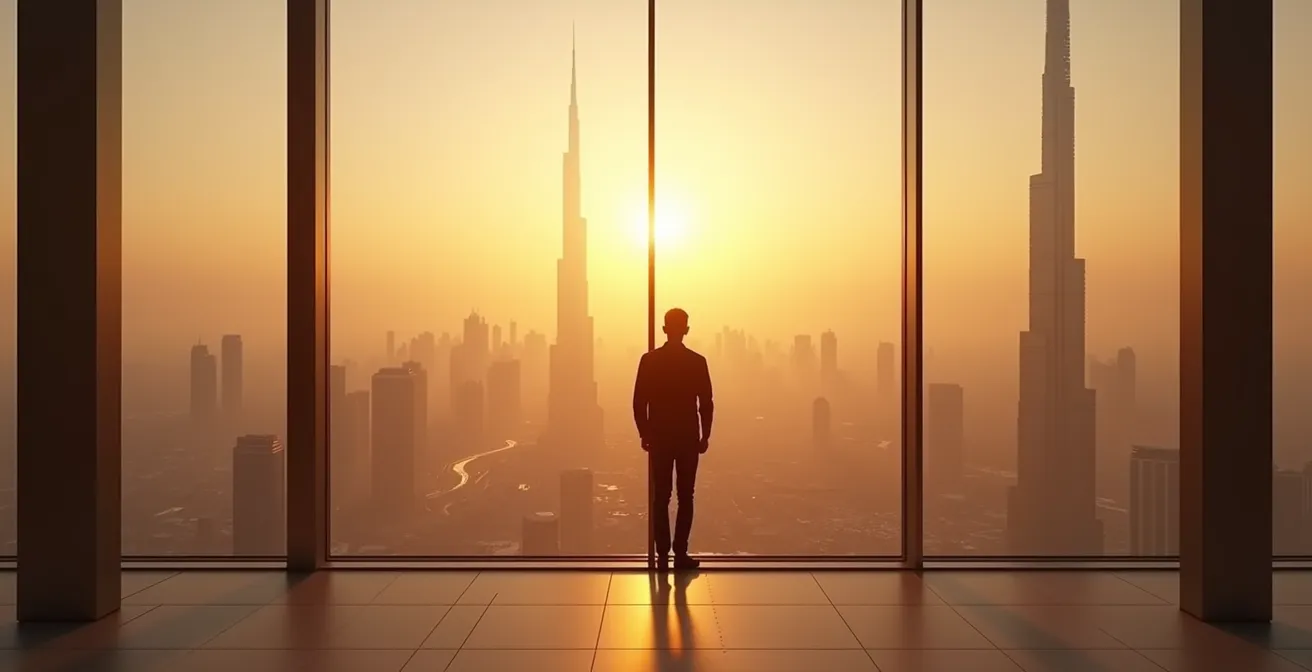
The $100 upgrade to Burj Khalifa’s SKY experience is less about the view and more about buying immunity from the three biggest “experience killers”: queues, crowds, and poor photo conditions.
- The primary value is in “queue-arbitrage,” saving up to two hours on exit, a commodity potentially worth more than the ticket cost for time-crunched tourists.
- While the view from Level 148 isn’t dramatically different, the exclusive, quieter environment provides far superior “photographic equity” and a less stressful visit.
Recommendation: For photographers, first-time visitors sensitive to crowds, or those on a tight schedule, the SKY ticket is a justifiable luxury. For repeat visitors or extreme budget travelers, the standard ticket, booked strategically, remains sufficient.
For any traveler visiting Dubai, the Burj Khalifa is a non-negotiable landmark. The question isn’t *if* you should go, but *how*. You’re presented with a choice: the standard “At The Top” ticket for Levels 124 and 125, or the premium “SKY” experience that adds access to the exclusive Level 148 for a significant price jump—often over $100 more. Most guides will tell you the premium ticket offers a higher view, fewer crowds, and complimentary refreshments. While true, this surface-level analysis misses the core of the value proposition.
This isn’t just about paying for altitude; it’s about paying to mitigate the critical pain points of a world-famous attraction. The real value of the SKY upgrade must be audited through the lens of what it saves you: time, stress, and compromised memories. The standard advice often revolves around the view, but the most significant differences are felt in logistics and personal space. Is the upgrade a smart investment in experience quality, or is it an unnecessary expense for a marginally better vantage point? This audit dissects every component of the visit, from elevator wait times to photographic opportunities, to deliver a definitive verdict.
We will analyze the key operational differences and strategic choices you can make, regardless of your ticket type. By breaking down the visit into its most crucial moments, you can make an informed decision based on your budget, priorities, and tolerance for the typical frustrations of mass tourism. This is a deep dive into the practical realities of visiting the world’s tallest building, moving beyond the marketing to determine if the premium price truly delivers a premium experience.
To help you navigate this decision, this article breaks down the most critical questions and strategies for optimizing your visit to the Burj Khalifa, whether you choose the standard or premium experience.
Summary: An Auditor’s Verdict on the Burj Khalifa Experience
- What Time to Book Your Slot to Catch Both Day and Night Views?
- How Fast Is the Elevator and Will It Pop Your Ears?
- How to Eliminate Reflections When Shooting Through Burj Khalifa Windows?
- The Post-View Queue: How to Exit the Burj Khalifa in Under 15 Minutes?
- Why Visiting on a Foggy Morning Might Be Better Than a Clear Day?
- Creek Tower vs Burj Khalifa: Why Cable-Tied Towers Don’t Count as Buildings?
- Corner vs Center: Where to Stand for the Best GoPro Footage?
- Why Ain Dubai Stops Moving: Is It a Breakdown or Boarding Protocol?
What Time to Book Your Slot to Catch Both Day and Night Views?
The single most impactful decision for any Burj Khalifa visitor is choosing the right time slot. The coveted “magic hour” allows you to witness the city transform from sun-drenched daylight to a glittering nocturnal landscape. However, booking directly at sunset often incurs premium pricing. The key is strategic timing to get the full experience without the highest cost. The goal is to arrive while it’s still bright, witness the sunset, and stay long enough for the city lights to fully emerge. This requires careful planning around the seasonal changes in Dubai’s sunset times.
According to visitor data analysis, the optimal strategy involves arriving well before the sun actually sets. This buffer accounts for security checks, the elevator journey, and finding a good viewing spot before the main crowds converge. A common mistake is booking a slot too close to sunset and missing the daylight portion entirely. The consensus among travel experts is clear: an early arrival is crucial. In fact, visitor experience data shows that arriving around 90 minutes before sunset is the sweet spot for maximizing your viewing window while avoiding the peak-hour surcharge.
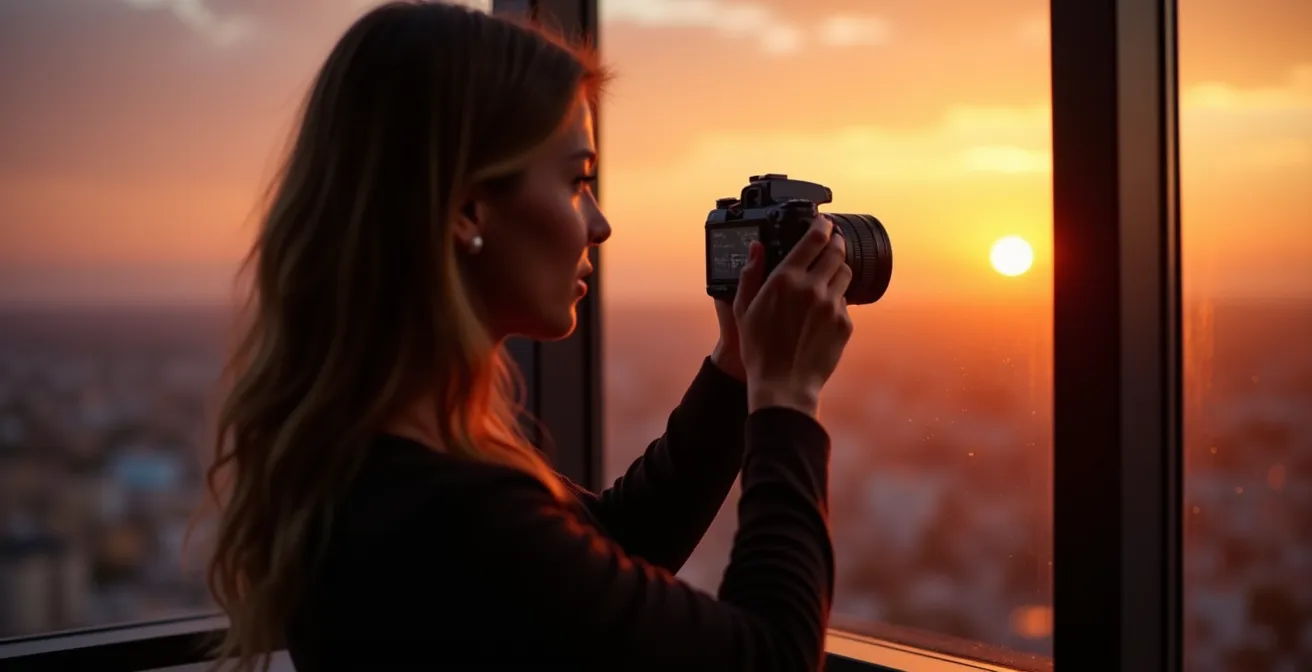
As the image above illustrates, this timing allows you to capture the golden hour, when the light is soft and warm, painting the cityscape in dramatic hues. This is the prime time for photography, and having that pre-sunset buffer ensures you’re not scrambling for a position at the windows. Below is a practical plan to execute this strategy perfectly.
Your Action Plan: Booking for the Ultimate Day-to-Night View
- Check the official Dubai sunset time for your exact date of visit, as it varies significantly throughout the year (from 5:30 PM in winter to 7:15 PM in summer).
- Book your entry slot for 90 minutes prior to the official sunset time to secure a non-premium price and ample viewing time.
- Arrive at the Burj Khalifa entrance at least 15-20 minutes before your scheduled slot to clear security and entrance queues without feeling rushed.
- Spend the first 30 minutes enjoying the full daylight views and identifying landmarks before the viewing deck becomes more crowded.
- Position yourself for golden hour photography, which typically occurs in the 45 minutes leading up to and just after sunset.
- Remain for at least another 30 minutes after sunset to experience the “blue hour” and see the city’s lights come to life.
How Fast Is the Elevator and Will It Pop Your Ears?
One of the unsung marvels of the Burj Khalifa is its vertical transport system. The journey to Level 124 is an integral part of the experience, designed to be as impressive as the view itself. Concerns about speed, G-forces, and ear-popping discomfort are common, but largely unfounded thanks to sophisticated engineering. The elevators are among the fastest in the world, but the design focuses on a smooth, almost imperceptible ascent rather than raw, stomach-churning velocity. The entire cabin is a multimedia experience, with projections on the walls that build anticipation as you rise.
The Otis-engineered elevators travel at a staggering 10 meters per second, meaning the 452-meter journey to the main observation deck takes only about 60 seconds. However, the brilliance lies not in the top speed, but in the acceleration. The elevator’s advanced control system creates a gentle acceleration curve that minimizes the feeling of G-force. Most visitors describe it as a sensation of floating or a “flying carpet” ride rather than a rapid ascent. Regarding ear pressure, the cabin is fully pressurized, and the gradual, smooth climb means the vast majority of visitors experience no discomfort or “popping” at all. It’s a testament to engineering that makes a high-speed journey feel remarkably serene.
This focus on a seamless experience is a core part of the Burj Khalifa’s premium positioning. It’s not just about getting you to the top; it’s about making the journey itself a memorable and comfortable part of the attraction, eliminating a potential “experience killer” before you even reach the view. This engineering feat ensures the visit starts on a high note, free from physical discomfort.
How to Eliminate Reflections When Shooting Through Burj Khalifa Windows?
One of the most common frustrations for any visitor to an observation deck is battling the reflections in the glass. The floor-to-ceiling windows at the Burj Khalifa offer breathtaking panoramas, but they also act as mirrors, capturing the interior lights, other visitors, and your own reflection in every shot. This “photographic killer” can ruin what should be a perfect memory. Fortunately, with a few simple techniques, you can drastically reduce or even eliminate these reflections to get clean, professional-looking photos.
The fundamental principle is to create a seal between your camera lens and the glass, blocking out stray light from behind you. Here are the most effective methods:
- Use a Circular Polarizing Lens (CPL): This is the most professional solution. A CPL filter screws onto the front of your camera lens and, when rotated, can cut out a significant amount of reflected light and glare, while also enhancing the blue of the sky.
- Press the Lens Against the Glass: The simplest and most effective trick. Gently press the front of your camera or smartphone lens directly against the window. This physically blocks most of the ambient light from reflecting into your shot. Using a flexible rubber lens hood can create a perfect seal.
- Wear Dark Clothing: Reflections are caused by light. By wearing a dark, non-reflective shirt or jacket, you minimize the amount of light bouncing off your body and onto the glass in front of your lens. You can even hold a jacket or dark cloth around your camera to create a small “tent.”
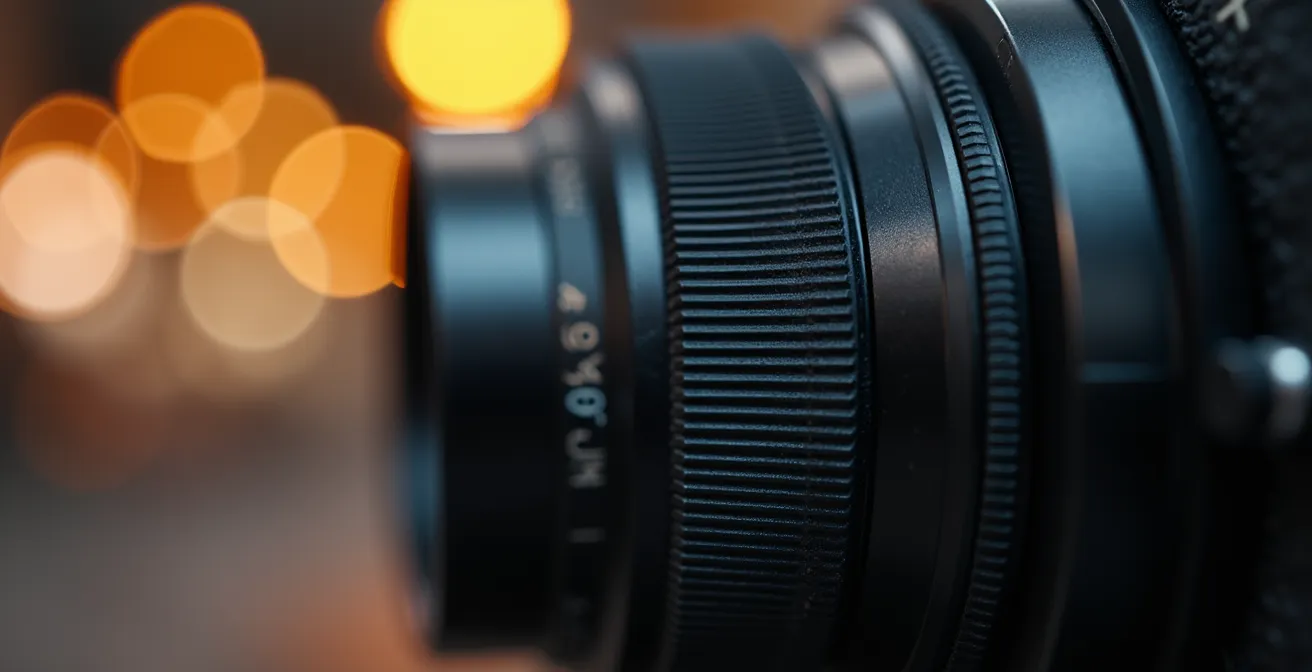
The image above demonstrates the core principle of creating a light-proof seal. By pressing a rubber lens hood firmly against the window, you isolate the lens from the interior’s ambient light, allowing it to capture only the scene outside. This technique is surprisingly effective and requires no expensive equipment. Mastering it ensures your photos reflect the stunning view, not the person standing behind you.
The Post-View Queue: How to Exit the Burj Khalifa in Under 15 Minutes?
While much of the focus is on the ascent, the biggest “experience killer” at the Burj Khalifa is often the descent. After enjoying the views, visitors on the standard “At The Top” ticket are funneled into a single queue for the elevators down. During peak times, especially after sunset, this line can snake around the entire floor, leading to waits of 60 minutes or more. This frustrating and tedious wait can sour an otherwise incredible experience. This is where the SKY ticket offers its most significant and quantifiable value proposition: queue-arbitrage.
SKY ticket holders are granted priority access to a separate, dedicated elevator for their descent from Level 148 and are then escorted past the main queues on Level 124/125. This privilege is not just a minor convenience; it’s a massive time-saver. Visitors who purchase the premium ticket consistently report saving an average of 1-2 hours just on the descent. For a tourist on a tight schedule, this “Value-for-Time” (VfT) can be worth far more than the $100 upgrade cost. Imagine having two extra hours to explore the Dubai Mall, watch another fountain show, or have a relaxed dinner instead of standing in a crowded line.
The frustration of the standard exit queue is a well-documented issue, as highlighted by visitors who were caught off guard. One traveler shared their experience, which perfectly encapsulates the problem:
A TripAdvisor reviewer shares: ‘Definitely pay up for the At the Top SKY experience, it gets you there the fastest, by passing all the other lines. You still have to wait to get back down, no one tells you that. I heard there might be an express ticket back down too, but missed where you buy it.’
– TripAdvisor User Review, Burj Khalifa Reviews
This is the hidden cost of the standard ticket. While you can’t buy an express ticket down separately, the SKY ticket effectively includes it. If your time in Dubai is limited or your patience for queues is low, the upgrade becomes a logical and highly valuable investment in your overall holiday experience.
Why Visiting on a Foggy Morning Might Be Better Than a Clear Day?
While most tourists chase crystal-clear skies for their visit, a select few know that one of Dubai’s most magical sights is the city shrouded in morning fog. This weather phenomenon, most common in the cooler winter months, creates a surreal, almost otherworldly experience where the city’s tallest skyscrapers pierce through a dense blanket of low-lying clouds. From the vantage point of the Burj Khalifa, you are literally above the clouds, looking down on a “city floating in heaven.” This rare event transforms the typical cityscape into a photographer’s dream.
This isn’t your average fog. It’s typically an advection fog that forms when cool, moist air from the Arabian Gulf moves over the warmer desert land, often combined with a temperature inversion. The result is a thick, uniform layer of white that can last for several hours after sunrise. For photographers, capturing the tips of iconic buildings like the Address Sky View or the Gevora Hotel emerging from this sea of white is a bucket-list shot. The experience is ethereal and profoundly different from the standard clear-day view, offering a sense of peace and wonder that a bustling, fully visible city cannot replicate.
Catching this phenomenon requires planning and a bit of luck. If you’re visiting between December and March, it’s worth monitoring the weather forecast for the right conditions.
- Monitor the Humidity: Look for forecasts predicting overnight humidity levels above 85% or 90%.
- Check for Temperature Inversions: Cooler ground temperatures with a warmer air layer above are prime conditions.
- Book the Earliest Slot: The fog is thickest at sunrise and typically burns off by mid-morning, so book the first available time slot (e.g., 8:30 AM).
- Confirm Refund/Rebooking Policy: Ensure your ticket allows for rebooking in case of zero visibility, though from above the fog, visibility is the main attraction.
- Bring a Lens Cloth: Condensation can form on your camera lens when moving from the humid outdoor air into the air-conditioned interior.
A foggy morning offers a unique and arguably more memorable view, proving that a “perfect” clear day isn’t the only way to experience the magic of the Burj Khalifa.
Creek Tower vs Burj Khalifa: Why Cable-Tied Towers Don’t Count as Buildings?
In the world of supertall structures, definitions matter. With projects like the proposed Dubai Creek Tower, questions often arise about whether they will “dethrone” the Burj Khalifa as the world’s tallest building. The answer lies in the strict architectural criteria set by the Council on Tall Buildings and Urban Habitat (CTBUH), the official arbiter of such records. The distinction comes down to one key factor: habitable space.
The CTBUH differentiates between a “building” and a “tower.” A structure is only classified as a building if at least 50% of its height is comprised of occupiable floor space. The Burj Khalifa, with its apartments, hotel rooms, and corporate suites spread across its 828-meter height, easily meets this criterion. It is a true vertical city. In contrast, structures like the CN Tower in Toronto or the planned Dubai Creek Tower are primarily “supported towers.” They achieve their incredible height largely through slender concrete cores and extensive cable-stayed systems, much like a broadcast antenna mast.
While these towers may have small observation decks or function rooms at the top, the vast majority of their structure is non-habitable engineering. According to CTBUH standards, for a structure to be considered a ‘building’, it must have over 50% of its volume as occupiable floor space. Because supported towers do not meet this 50% threshold, they fall into a different category and do not compete for the “World’s Tallest Building” title. Therefore, even if another structure stretches higher into the sky, the Burj Khalifa’s status as the tallest *building* is secure until another true skyscraper surpasses its height with habitable floors.
Corner vs Center: Where to Stand for the Best GoPro Footage?
Capturing the immense scale of the Dubai skyline from the Burj Khalifa with a wide-angle camera like a GoPro requires more than just pointing and shooting. The position you choose on the observation deck can dramatically change the impact of your footage. While the center of a window panel offers an unobstructed view, the corners and structural elements provide opportunities for more dynamic and professional-looking shots. Thinking like a filmmaker can elevate your simple vacation video into something truly cinematic.
The key is to use the environment to create depth, movement, and reveals. A GoPro’s wide field-of-view is perfect for this. Instead of a static shot, plan your movements to add a narrative flow to your footage. Here are five strategic positions and shots to try for the best GoPro results:
- The Corner Spot: Position yourself in the corner where two glass panels meet. This is the most valuable real estate as it allows you to capture a two-sided panoramic vista in a single frame, conveying a much greater sense of scale and immersion.
- The Frame Reveal: Start your recording with the lens aimed at one of the metal window mullions (the vertical frames). Then, pan smoothly away from the frame to reveal the sprawling city. This “reveal” technique adds a dramatic opening to your shot.
- The Low-Angle Sweep: Using a 3-way grip or selfie stick fully extended, hold the GoPro low to the ground and sweep it upwards in a smooth arc. This creates a mini-crane shot effect that feels grand and cinematic.
- The Corner Time-lapse: Set up your GoPro on a small tripod in a corner spot during the sunset transition. A 30-minute time-lapse capturing the shift from daylight to city lights will be your most epic clip.
- The Hyperlapse Walk: Set your GoPro to Hyperlapse mode and walk slowly and steadily along the perimeter of the observation deck. This creates a dynamic, stabilized video that shows the changing perspective as you move.
By using these different positions and techniques, your footage will be far more engaging than a simple, static view from the center of a window.
Key takeaways
- The SKY ticket’s primary value is not the view but the time saved, especially by skipping the 1-2 hour exit queue.
- Photographic opportunities are significantly better on Level 148 due to fewer crowds and a calmer environment, a factor photographers should weigh heavily.
- Strategic booking (90 minutes before sunset) can provide the full day-to-night experience on a standard ticket without paying premium sunset prices.
Why Ain Dubai Stops Moving: Is It a Breakdown or Boarding Protocol?
When comparing Dubai’s iconic observation attractions, it’s useful to understand their fundamental operational differences. Visitors to Ain Dubai (when it was operational) often noticed it would periodically stop, leading to speculation about breakdowns. In reality, this is part of its design, highlighting a key distinction from the Burj Khalifa. Observation wheels operate on a continuous or “pulsed” loading system, requiring them to pause to allow guests to safely board and alight the cabins. The Burj Khalifa, however, uses a completely different model: a “batch processing” system.
This system relies on high-speed elevators to move large groups (batches) of people from the ground to the observation decks in self-contained journeys. This allows for continuous, reliable operation without the need for routine stops, which is a major reason for the Burj Khalifa’s decade-plus record of dependable daily service. This operational superiority is part of the inherent value of the ticket; the experience is seamless and predictable. However, this efficiency comes with a trade-off in flexibility, particularly for premium ticket holders. As one travel guide points out, the time you get at the very top is not unlimited.
You can stay as long as you want on levels 124/125. Those going to Burj Khalifa SKY at level 148 is limited in time: they can stay on the 148th level for 30-45 minutes.
– Avoid Crowds Travel Guide, Burj Khalifa Visitor Experience Analysis
This is the final, critical data point in our audit. While the SKY ticket buys you priority and a serene environment, it comes with a time limit at the highest point. After your 30-45 minutes, you are invited to descend to Levels 124/125, where you can stay for as long as you wish. This makes the SKY experience a premium, timed appetizer before the main course. For some, this is a fair trade for the benefits. For others, the freedom to linger indefinitely on the still-spectacular main decks might be more valuable.
The final verdict of this audit is clear: the $100 upgrade is a justifiable expense if you define value in terms of time, comfort, and photographic quality. For those on a strict budget who don’t mind queues, a strategically booked standard ticket remains an unforgettable experience. Evaluate your own priorities and book with confidence.