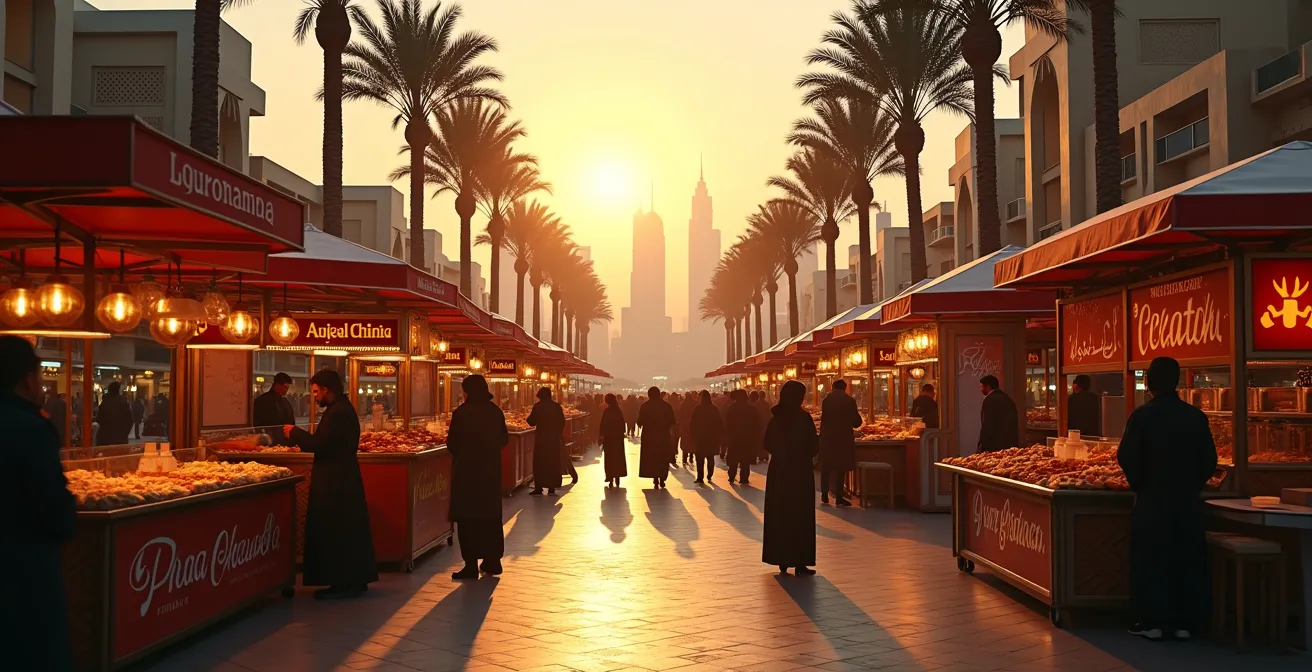
Contrary to the belief that Dubai’s food is merely a “melting pot,” its true culinary identity lies in a dynamic system of ‘culinary code-switching’.
- The city’s food scene is a constant negotiation between deep-rooted tradition, the performance of global luxury, and the hyper-local realities of a desert environment.
- Authenticity is not a static list of dishes but a fluid concept, defined as much by world-class logistics as by Bedouin history.
Recommendation: To understand Dubai’s food, one must analyze the tensions and performances within its culinary landscape, not just catalogue its influences.
To the visiting food anthropologist, Dubai presents a dazzling, almost disorienting, paradox. One can have a Yemeni Mandi for lunch, an Italian truffle pasta for dinner, and a late-night Lebanese manakish, all within a few square kilometers. The city’s culinary narrative is often flattened into convenient platitudes: it’s a “global melting pot,” a playground for celebrity chefs, a shrine to opulent brunches. While true on the surface, these explanations fail to capture the electric, often contradictory, soul of its food scene. They catalogue the ingredients but miss the recipe. Is it possible that the frantic pace of global fusion has erased any semblance of a core identity?
This inquiry moves beyond the superficial. It posits that the key to understanding Dubai’s food is not to search for a singular, static “authentic” cuisine that may no longer exist in a pure form. Instead, the focus must shift to the very mechanisms of its fusion. The city’s identity is found in the act of what can be called culinary code-switching: the remarkable ability of its chefs, diners, and systems to fluidly shift between different food languages—traditional Emirati, pan-Arab street food, and global fine dining—depending on the context and the audience. This is not a weakness or a lack of identity; it is the identity itself.
This exploration will deconstruct this phenomenon. We will dissect the invisible systems that govern taste, the unspoken rules of street food, the competing rituals of coffee, and the technological marvels that redefine “local” in the heart of the desert. By examining these facets, we reveal a culinary landscape defined not by a fixed point of origin, but by a state of constant, high-speed, and often performative negotiation. This is the true taste of Dubai.
This article delves into the critical questions that define Dubai’s food identity, moving from the official ratings that govern its restaurants to the ancient cooking methods still practiced in the desert. The following sections offer a framework for understanding this complex and ever-evolving culinary world.
Summary: Decoding the Culinary Code of Dubai
- What Does the ‘A’ Grade from Dubai Municipality Actually Mean?
- Shawarma vs Manakish: Which Is the Ultimate Late-Night Dubai Snack?
- Specialty Coffee vs Traditional Arabic: Understanding the Two Scenes
- Farm-to-Table in the Desert: Are Local Oysters Really Local?
- How to Get Invited to Underground Supper Clubs in Dubai?
- The Imported Truffle Trap: How to Spot Freshness in Desert Fine Dining?
- Surviving a Desert BBQ as a Vegetarian: What Can You Actually Eat?
- What Exactly Is in an Emirati BBQ Dinner Beyond Chicken Tikka?
What Does the ‘A’ Grade from Dubai Municipality Actually Mean?
The first layer of Dubai’s culinary code is not found on a plate, but in a centralized, data-driven system of governance. The ubiquitous ‘A’, ‘B’, or ‘C’ grade displayed at every food outlet is more than a simple hygiene rating; it is the great equalizer in a city of vast culinary disparities. It’s a standardized language applied to a five-star hotel and a back-alley cafeteria alike, creating a baseline of trust and predictability. This system is a form of structural terroir, shaping the entire food ecosystem through rigorous, transparent standards. Violations are taken seriously; in 2023 alone, over 300 food outlets were fined for various infractions, enforcing a high standard across the board.
This system also fosters a unique form of competition, pushing establishments to improve not just for reputation, but for a quantifiable grade that consumers can check in real-time. As Khalid Mohammed Sharief Al Awadhi, a key figure at Dubai Municipality, explains, this transparency is a strategic choice:
There could be a difference in the food safety rating for one branch of a restaurant chain from another branch. You can check which one has a better rating on the app. This brings a lot of transparency and will make restaurants compete to improve their food safety standards.
– Khalid Mohammed Sharief Al Awadhi, CEO of Health, Safety and Environment Sector at Dubai Municipality
Interestingly, the municipality is evolving from a purely punitive model to an educational one. A digital platform now delivers customized training modules to restaurants with violations, turning infractions into learning opportunities. This reveals a deeper philosophy: the goal is not just to police, but to cultivate a universally high standard of food safety. This regulatory framework is the invisible architecture that allows the city’s diverse and chaotic food scene to function, providing a consistent grammar for the thousands of culinary conversations happening every day.
Shawarma vs Manakish: Which Is the Ultimate Late-Night Dubai Snack?
The question of shawarma versus manakish is less a culinary contest and more an anthropological case study in adopted identity. Neither is originally Emirati, yet both have become so deeply embedded in the city’s rhythm that they function as Dubai’s unofficial late-night communion. This is culinary code-switching at its most democratic. The choice between the two often reflects a subtle difference in need: the shawarma, with its complex layers of spit-roasted meat, garlic-heavy toum, and pickles, offers a dense, satiating meal. The manakish, a simpler flatbread adorned with za’atar or cheese, is a lighter, more comforting snack.
Their ubiquity speaks to the city’s Levantine cultural bedrock, an influence so profound it has become part of the local vernacular. These are not ‘ethnic’ foods; they are simply Dubai foods. This is reflected in their accessible pricing, a rare constant in a city of extremes. A market analysis of street food confirms that typical prices range from 10-20 AED for a shawarma and 8-15 AED for a manakish, placing them firmly in the realm of everyday sustenance for a vast majority of the population.
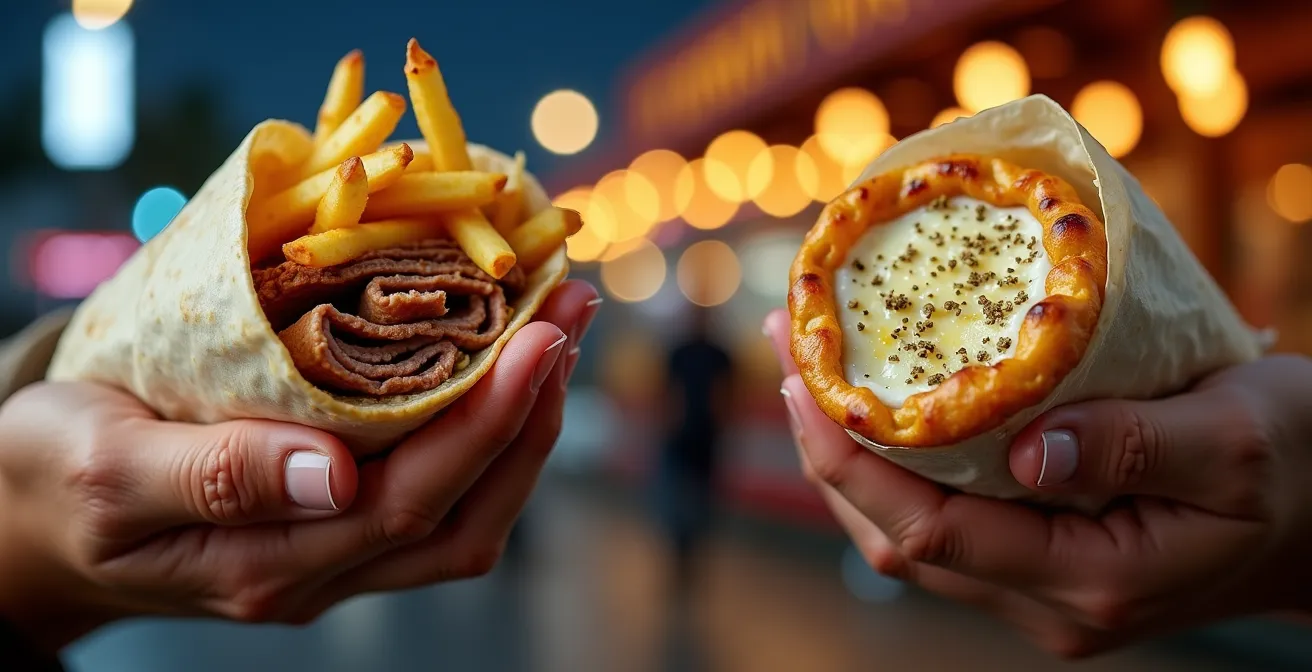
The sensory experience of each is distinct. A great shawarma is a textural triumph—the slight char of the meat, the creaminess of the sauce, the crunch of a stray french fry. A perfect manakish, on the other hand, is an aromatic journey, dominated by the earthy, tangy fragrance of za’atar and the pull of molten akkawi cheese. To argue which is ‘better’ is to miss the point. They represent two dialects of the same adopted street food language, each fluent in satisfying a specific, universal craving in the city’s nocturnal hours. They are the delicious, edible proof that in Dubai, identity is often something you borrow and make your own.
Specialty Coffee vs Traditional Arabic: Understanding the Two Scenes
Nowhere is Dubai’s culinary code-switching more apparent than in its coffee culture. Here, two parallel universes exist in plain sight. One is the world of traditional *gahwa*, the light-roasted, cardamom-infused Arabic coffee that is the cornerstone of Emirati hospitality. It is a deeply symbolic ritual, served in small, handleless cups, always poured for guests as a sign of welcome. It’s a taste rooted in history, a social lubricant governed by centuries of etiquette. Its supply chain even reflects its cultural importance, with key ingredients like cardamom often being government-subsidized.
In stark contrast is the booming specialty coffee scene, a global phenomenon that has found fertile ground in Dubai. This is the world of the ‘third place’ concept, where the café is a hub for work, socializing, and a new kind of connoisseurship. The UAE coffee market now exceeds AED 12 billion ($3.2bn), with Dubai hosting over 4,000 coffee shops. This scene speaks a different language: single-origin beans, precise brewing methods, and a palate that values notes of citrus and berry over spice. It’s a culture driven by a younger demographic and a globalized aesthetic.
As Khalid Al Mulla, Chairman of the UAE’s Specialty Coffee Association, notes, this is more than a trend; it’s a structural shift. He observes that “the pace of growth… is not reflected solely in the proliferation of cafés or consumption figures, but also in the infrastructure being developed across the entire value chain.” This points to my concept of ‘logistical terroir’—Dubai is becoming a hub not just for consuming, but for trading and processing specialty coffee for the entire region.
The tension between these two coffee cultures is a microcosm of the city itself. A recent comparative analysis of the two markets highlights this divergence perfectly.
| Aspect | Traditional Arabic (Gahwa) | Specialty Coffee |
|---|---|---|
| Market Share | Cultural heritage segment | Growing at 10.6% CAGR |
| Primary Consumers | Older generations, traditional settings | 18-24 age group (33.29% market share) |
| Service Context | Social ritual, hospitality | ‘Third place’ concept |
| Supply Chain | Government-subsidized cardamom | Single-origin auctions |
One is a performance of heritage and social connection; the other is a performance of global sophistication and individual taste. Both are authentic expressions of modern Dubai.
Farm-to-Table in the Desert: Are Local Oysters Really Local?
The term “farm-to-table” in Dubai forces a radical redefinition of “local.” In a place where Ministry of Climate Change and Environment data shows the UAE imports nearly 90% of its food supply, the very concept of localism seems like a mirage. Yet, a burgeoning movement of hyper-localism is challenging this dependency, driven by technology and a desire for freshness. This isn’t the rolling-hills terroir of Tuscany; this is a terroir of ingenuity and climate control.
Consider the Dibba Bay oyster. Farmed in the clean waters off the Fujairah coast, these oysters have become a fixture on high-end menus, celebrated for their unique flavour profile shaped by the saline waters of the Gulf. Are they “local”? Absolutely. They represent a successful harnessing of a natural marine environment. But the more dramatic story of hyper-localism is happening on land, in the city’s technologically advanced vertical and hydroponic farms. These facilities are agricultural marvels, producing everything from leafy greens and tomatoes to strawberries in controlled environments that defy the harsh desert outside.
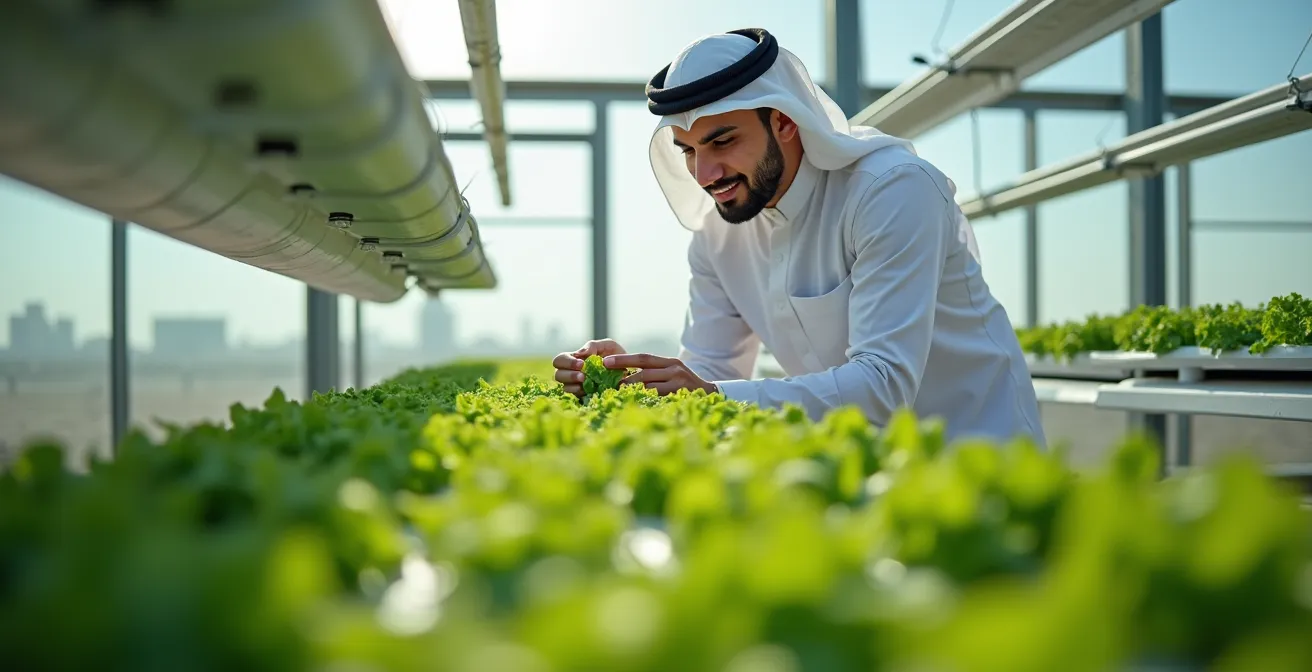
This is where the definition of “local” becomes philosophical. These farms produce food that is geographically local, harvested just hours before it reaches the kitchen. This offers unparalleled freshness. However, the technology, seeds, and nutrients that power these farms are often imported. It creates a fascinating paradox: a product that is simultaneously hyper-local in geography but global in genesis. For the food anthropologist, this is a crucial insight. Dubai’s farm-to-table movement is not about returning to an agrarian past, but about inventing a new, technologically-mediated agricultural future. It’s a performance of sustainability and freshness in one of the world’s most challenging environments.
How to Get Invited to Underground Supper Clubs in Dubai?
Beyond the Michelin stars and the bustling food halls, a more discreet culinary scene thrives in Dubai: the underground supper club. These are not commercial restaurants but private, often unlicensed, gatherings in homes and hidden venues, driven by a passion for food and authentic connection. For the food anthropologist, gaining access to this world offers a glimpse into the city’s culinary subconscious, where chefs experiment and diverse communities converge away from the public gaze. This is where you might find a third-culture chef deconstructing their heritage on a plate, or an expat sharing the authentic flavors of their homeland, unfiltered by commercial demands.
Getting an invitation is not about status or wealth; it’s about social integration and demonstrating genuine interest. It requires a different kind of currency: cultural capital. These are not events you can simply book. They operate on trust and word-of-mouth within niche communities. Breaking into this circle requires a deliberate, patient approach focused on building relationships rather than just networking. It’s a process of becoming part of a conversation, not just observing it. Respect for discretion is paramount, as these events exist in a legal grey area and thrive on their exclusivity.
The journey to a supper club table is an anthropological exercise in itself, requiring observation, participation, and an understanding of social cues. It is the antithesis of the city’s often transactional dining scene, offering a taste of something more personal and ephemeral.
Action Plan: Accessing Dubai’s Supper Club Scene
- Build genuine connections: Focus on specific expat and cultural communities rather than simply seeking social status or networking.
- Follow the digital breadcrumbs: Monitor niche Instagram hashtags related to Dubai’s alternative and third-culture cuisine movements.
- Join private communities: Seek out and join closed Facebook groups dedicated to Dubai’s alternative food scene and culinary enthusiasts.
- Contribute meaningfully: Engage in food-related conversations and online communities to get noticed by hosts and organizers for your passion and knowledge.
- Respect the code of discretion: Understand that these are often unlicensed culinary events and that privacy and subtlety are essential for their survival.
The Imported Truffle Trap: How to Spot Freshness in Desert Fine Dining?
The presence of a fresh Alba or Périgord truffle in a Dubai restaurant is the ultimate act of culinary code-switching—a symbol of European luxury performed in the Arabian desert. For the discerning diner, it’s a moment fraught with both promise and peril. The “truffle trap” is not necessarily a fake, but an old, tired one, its precious aroma faded from a long journey. However, to assume all imported truffles in Dubai are inferior is to misunderstand the city’s unique advantage: its logistical terroir. Dubai’s status as a world-class air cargo hub means that a truffle can, in some cases, travel from a forest in Italy to a kitchen in Dubai faster than it could travel by road to another European city.
The key, therefore, is to know the signs of true freshness and quality service, which is in itself a form of performative authenticity. The ritual matters. A reputable restaurant will present the whole truffle at your table. The aroma should be powerful and immediate—a complex perfume of earth, musk, and garlic. The truffle should then be weighed in front of you, a crucial act of transparency, before being shaved over your dish. This performance is your assurance of quality. The waiter should also be able to specify the truffle’s exact origin, another hallmark of a serious purveyor.
This obsession with imported luxury often overshadows the region’s own native truffles. The indigenous ‘Fagga’ (desert truffles, or *Terfezia*) have a more subtle, nutty flavour profile. While cherished in traditional Emirati and Bedouin cooking, they lack the pungent, high-impact aroma and, crucially, the global prestige demanded by the international fine-dining scene. Their absence from high-end menus is a telling choice, a deliberate code-switch away from the local in favour of a globally recognized symbol of luxury. It’s a perfect example of how in Dubai, value is often determined by narrative and performance as much as by flavour.
Surviving a Desert BBQ as a Vegetarian: What Can You Actually Eat?
A desert BBQ is a quintessential Dubai experience, a romanticized performance of Bedouin heritage for tourists and residents alike. For a vegetarian, however, the invitation can spark a moment of panic. What is there to eat when the main event is grilled meat? The answer reveals another layer of Dubai’s culinary code: the deep and pervasive influence of Levantine cuisine, which provides the backbone of almost every communal meal. To survive a desert BBQ as a vegetarian is to deconstruct the meal and realize the main event is often a sideshow.
The true feast lies in the colourful and abundant mezze spread. This is where a vegetarian can assemble a deeply satisfying and diverse meal. The staples are always present: creamy hummus, smoky *mutabbal* (eggplant dip), and vibrant salads like *fattoush* (with toasted bread) and tabbouleh. These are not mere appetizers; they are central components of the meal. Alongside them, one can often find grilled halloumi cheese, spice-roasted potatoes, and various rice dishes that are typically cooked separately from the meat. The freshly baked *khubz* (flatbread) is a vessel for everything, perfect for dipping or pairing with the accompanying cheeses and olives.
A vegetarian’s guide to a Dubai BBQ is therefore an exercise in focusing on the framework rather than the centerpiece. It involves:
- Building a meal from the extensive mezze selection.
- Identifying carbohydrate-rich rice and potato dishes.
- Seeking out protein alternatives like grilled halloumi or pulses in the salads.
- Using the fresh, warm bread as the foundation of the meal.
This experience proves that even in a seemingly meat-centric ritual, the culinary language is broad enough to accommodate different needs. The “BBQ” is as much about the shared dishes and social context as it is about the grilled chicken tikka.
Key Takeaways
- Dubai’s culinary identity is not a static list of dishes but a dynamic process of “culinary code-switching” between tradition, global trends, and local context.
- “Authenticity” is often a performance, whether in the ritual of traditional coffee service or the tableside presentation of an imported truffle.
- The city’s “terroir” is defined as much by its world-class logistics and technological innovation (hyper-local farms) as by its geography.
What Exactly Is in an Emirati BBQ Dinner Beyond Chicken Tikka?
To ask what lies beyond the ubiquitous chicken tikka at an Emirati BBQ is to finally peel back the layers of adopted and globalized influences to find the cuisine’s quiet, authentic heart. While chicken tikka, a dish of South Asian origin, has been fully absorbed into the popular conception of a local BBQ, truly traditional Emirati cooking involves different techniques, flavours, and a profound sense of patience. The authentic Emirati BBQ is less about the quick char of a grill and more about the slow, deep magic of heat, sand, and time.
The most symbolic expression of this is the *zarb*, a Bedouin method of underground cooking. A fire is built in a pit in the sand, and once it has burned down to embers, a tiered rack of marinated meat (traditionally lamb or goat) and vegetables is lowered into it. The pit is then sealed with a lid and covered with sand, turning the earth itself into an oven. Hours later, the meat emerges impossibly tender and smoky, infused with a flavour that cannot be replicated above ground. This is not fast food; it is a ritual, a testament to a time when cooking was governed by natural elements.

The Enduring Tradition of Harees
Beyond the BBQ, dishes like Harees showcase the core of Emirati celebratory cuisine. This hearty, porridge-like dish is a staple during major family gatherings, weddings, and especially during Ramadan. Wheat is simmered in salted water for hours until it breaks down. In parallel, meat (lamb or chicken) is slow-cooked for at least four hours until it is tender enough to be stirred into the wheat, creating a homogenous, comforting blend. Garnished with a generous drizzle of local clarified butter (ghee), Harees is a dish that speaks of community, patience, and the transformation of simple ingredients into something deeply nourishing.
These dishes—the zarb-cooked lamb, the communal Harees—are the anchors of Emirati cuisine. They may not be on every restaurant menu, and they certainly don’t fit the fast-paced, high-gloss image of modern Dubai. But they are the culinary soul of the place, a reminder that beneath the shimmering surface of global fusion, a deep and resilient food tradition endures. To find it, one must simply know where, and how, to look.
To truly understand Dubai’s food scene, one must therefore act as a critic and an ethnographer, tasting the dishes while decoding the systems that produce them. The next step is to apply this critical lens—to look beyond the menu and question the performance, the context, and the origins of every plate.
Frequently Asked Questions on Dubai’s Culinary Scene
How can Dubai access fresher truffles than some European cities?
Dubai’s status as a major air cargo hub with Dubai International Airport and advanced logistics infrastructure allows for rapid import of fresh truffles, sometimes faster than ground transport within Europe.
What should diners look for during truffle presentation?
Fresh truffles should be weighed at the table, shaved in front of you, and the waiter should specify the origin (Alba, Périgord) – these are indicators of quality and freshness.
Why are indigenous ‘Fagga’ desert truffles rarely used in high-end restaurants?
Despite being native to the region, Terfezia (desert truffles) have a unique flavor profile that differs from European varieties and lack the prestige associated with imported truffles in fine dining settings.