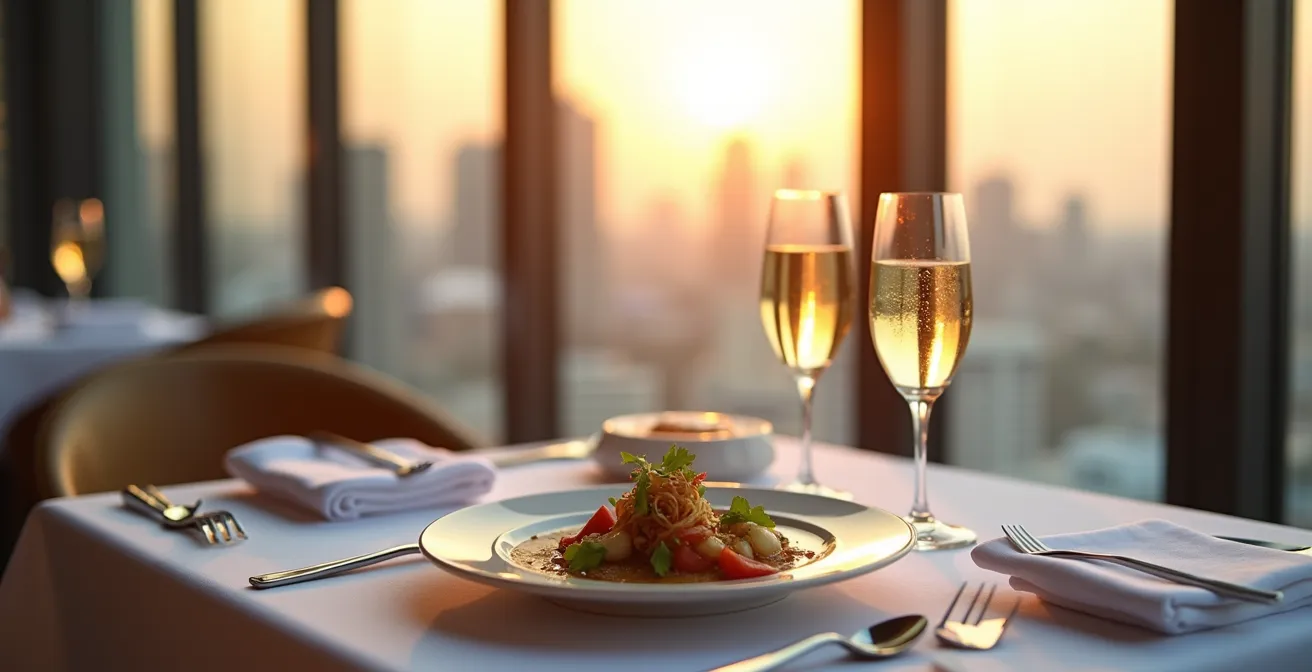
The chance of Gordon Ramsay personally cooking your meal at Hell’s Kitchen Dubai is near zero, but that’s missing the entire point of the experience.
- You’re paying for a meticulously tested culinary system and brand promise, not the celebrity’s physical presence.
- Signature dishes are standardized for global consistency, ensuring the Beef Wellington in Dubai tastes like the one in Las Vegas.
Recommendation: Shift your focus from celebrity-spotting to appreciating the flawless execution of the chef’s vision by the highly-trained on-site team.
The dream is a powerful one for any food lover: booking a table at Hell’s Kitchen in Dubai, the heart of culinary extravagance, and catching a glimpse of the fiery, brilliant Gordon Ramsay himself, perhaps even having him inspect your Beef Wellington. It’s a compelling fantasy, fueled by years of high-stakes television and a global reputation. Many fans book their flights and make reservations with this exact hope, picturing a story they can tell for years to come. But what is the reality of dining at a restaurant that bears the name of a global icon?
The culinary world is often misunderstood. While it’s common to see advice on how to book tables or which signature dishes to order, very few conversations pull back the curtain on the actual business model of these establishments. The truth is, these restaurants are not the personal workshops of their namesakes. They are highly sophisticated, globally-scaled businesses. The key to understanding their value, and managing your own expectations, is not to ask “Is the chef here?” but rather, “How is the chef’s vision present here?”
The answer lies in a concept we’ll call the culinary system. This is the intricate web of standardized recipes, rigorous staff training, supply chain management, and unwavering quality control that forms the restaurant’s DNA. This article will guide you through that system. We’ll explore the reality of who is in the kitchen, how signature dishes maintain their quality across continents, the way global brands adapt to local rules, and whether paying for the name is ultimately worth it. It’s time to look beyond the celebrity and understand what truly makes a high-end restaurant tick.
This guide will deconstruct the celebrity chef phenomenon in Dubai, giving you an insider’s perspective on what to expect. Below is a summary of the topics we will cover to help you dine smarter.
Summary: The Reality of Dining at a Celebrity Chef Restaurant in Dubai
- Celebrity Name vs Kitchen Reality: Is the Chef Actually Cooking Tonight?
- Is the Meat Fruit as Good in Dubai as in London?
- Pork on the Menu: How Celebrity Chefs Adapt to Halal Rules?
- Nobu Dubai vs Nobu London: Where is the Black Cod More Expensive?
- Paying for the Name: Is the Food Actually Better than Local Fine Dining?
- The ‘Pretty Food’ Trap: Is the Pistachio Croissant Actually Good?
- How to Get a Table at Heston’s Dinner Without Booking a Month Ahead?
- How to Secure a Table at Dubai’s Top Michelin Venues Without a 3-Month Wait?
Celebrity Name vs Kitchen Reality: Is the Chef Actually Cooking Tonight?
Let’s address the multi-million-dollar question head-on: no, Gordon Ramsay will almost certainly not be in the kitchen during your visit. The same goes for Nobu Matsuhisa, Heston Blumenthal, or Yannick Alléno. A celebrity chef’s primary role is not that of a line cook but of a brand architect and CEO. They design the concept, develop the menu’s core DNA, and create the operational blueprint. Their name on the door is a guarantee of a standard, not a promise of their physical presence. As Ramsay himself said in a Time Out Dubai interview, his focus is on consistency over flash-in-the-pan trends. He states:
I hate snobbery. We stay away from trends because we’ve never been a trendy restaurant.
– Gordon Ramsay, Time Out Dubai
The person responsible for executing this vision is the Executive Chef, or Chef de Cuisine. This highly skilled professional is the on-site custodian of the brand. They have been rigorously trained in the celebrity chef’s methods, recipes, and philosophy. Their job is to ensure that every plate leaving the kitchen meets the brand’s exacting standards, from ingredient sourcing to final presentation. They are the true guardians of your experience.
Case Study: The Operational Reality of Hell’s Kitchen Dubai
Hell’s Kitchen at Caesars Palace Bluewaters Dubai, which opened in 2018, serves as a perfect example. It was operated not by Ramsay directly, but by his restaurant group, with key personnel like Season 10 winner Christina Wilson helping to establish the kitchen and train the team. This demonstrates the “culinary system” in action: a replicable model managed by a corporate structure and implemented by trusted lieutenants. The restaurant’s eventual closure in November 2023, when Caesars exited Dubai, further underscores the point—these are business entities subject to market forces, not just a chef’s personal passion project.
So, when you dine at a celebrity-branded restaurant, you are experiencing the product of this system. You are tasting the result of years of refinement, captured in a recipe book and executed by a chef who is a master of that specific culinary language. The magic isn’t in one person’s hands, but in the consistency of the entire operation.
Is the Meat Fruit as Good in Dubai as in London?
This question gets to the heart of the brand promise. If the celebrity chef isn’t there, can their most iconic dish—like Heston Blumenthal’s Meat Fruit or Ramsay’s Beef Wellington—truly be the same thousands of miles away? The answer, by design, is a resounding yes. The very foundation of a global restaurant brand is the absolute consistency of its signature dishes. These aren’t just menu items; they are intellectual property, protected by meticulous, non-negotiable specifications.
This standardization covers every conceivable variable: the exact cut and supplier of the beef, the precise temperature and timing for searing the scallops, the specific recipe for the risotto, and the plating technique down to the last microgreen. The goal is to eliminate deviation and ensure a diner in Dubai has the exact same sensory experience as a diner in Las Vegas. This is achieved through centralized training, detailed “recipe bibles,” and regular quality audits by the corporate team. This system is what allows the brand’s culinary DNA to be replicated flawlessly across the globe.
While the provided data is for Hell’s Kitchen, it perfectly illustrates how this principle of consistency is applied across top-tier restaurant groups. It shows that core menu items are not just suggestions, but mandated standards across all locations.
| Location | Opening Year | Key Features | Notable Changes |
|---|---|---|---|
| Hell’s Kitchen Las Vegas | 2018 | Original location, TV show design elements | Original menu from TV show |
| Hell’s Kitchen Dubai | 2018 | 260 diners capacity, indoor/outdoor seating | Closed November 2023 |
| Menu Consistency | All locations | Pan-seared scallops, lobster risotto, beef wellington | Standardized across locations |
As this operational data from Wikipedia shows, signature dishes like the pan-seared scallops and beef wellington are standardized across all locations. Therefore, the “Meat Fruit” you eat in Dubai has undergone the same rigorous process as its London counterpart. You are paying for that certainty—the removal of the gamble that can sometimes come with trying a new, independent fine dining restaurant.
Pork on the Menu: How Celebrity Chefs Adapt to Halal Rules?
While signature dishes are kept consistent, global brands must also be flexible enough to adapt to local laws, customs, and supply chains. In Dubai, the most significant adaptation revolves around Halal requirements. Operating in the UAE means adhering to strict regulations regarding the sourcing, handling, and preparation of food, particularly the exclusion of pork and non-Halal certified meats in many kitchens.
This isn’t a mere suggestion; it’s a legal and cultural necessity. According to restaurant industry data, the UAE enforces comprehensive Halal standards, including a national certification mark that covers the entire food supply chain. For a celebrity chef restaurant, this means making intelligent and respectful adjustments. Often, this involves creating brilliant alternatives that honor the original dish’s spirit while complying with local rules. A pork belly dish might be re-envisioned using slow-cooked, fatty lamb breast, or a charcuterie board might feature exquisite cured beef and duck instead of traditional salami and prosciutto.
Furthermore, these restaurants are masters of catering to a diverse international clientele with varied dietary needs. As noted by travel experts, this adaptability is a hallmark of the Dubai dining scene.
Celebrity chef restaurants in Dubai are quite accommodating when it comes to dietary restrictions, offering a variety of options for those with specific dietary needs such as vegetarian, vegan, gluten-free, and halal diets.
– Forever Tourism, Celebrity Chefs With Restaurants In Dubai
This process of localized execution is a delicate balancing act. It requires the on-site culinary team to be both faithful custodians of the global brand and creative innovators who can work within local constraints. It’s a testament to the skill of the executive chef, who must find a way to deliver the brand’s promised flavor profiles using a different set of ingredients, all while respecting the cultural context of the location.
Nobu Dubai vs Nobu London: Where is the Black Cod More Expensive?
It’s a common observation for international travelers: the same dish at the same branded restaurant can have a very different price tag in another city. A Black Cod with Miso at Nobu Dubai is likely more expensive than at Nobu London. This isn’t arbitrary price-gouging; it’s a direct reflection of the vastly different operating costs associated with running a high-end restaurant in a city like Dubai.
Several key factors contribute to this price disparity. Firstly, commercial real estate in prime Dubai locations is among the most expensive in the world. Recent market data reveals that Dubai’s rental market saw a 10% increase in rents in the first half of 2024 alone. This overhead is directly factored into the menu prices. Secondly, Dubai’s climate means that a significant portion of high-quality ingredients—from Japanese fish to European vegetables and prime beef—must be imported by air freight, a costly logistical challenge.
Finally, there are staff costs. Building a world-class service team in a competitive market like Dubai often involves providing accommodation, visas, and other benefits, adding to the operational budget. When you combine rent, import logistics, and labor costs, the financial equation of running a restaurant in Dubai is fundamentally different from that in London or New York. The higher price on your bill is not just for the name; it’s paying for the complex and expensive operation required to deliver that specific, high-quality experience in one of the world’s most dynamic cities.
Paying for the Name: Is the Food Actually Better than Local Fine Dining?
This is the ultimate question of value. Is a meal at a celebrity-branded restaurant inherently “better” than one at a top-tier, homegrown Dubai restaurant run by a less famous but equally talented chef? The answer is more nuanced than a simple yes or no. It’s not necessarily about being objectively better, but about being predictably excellent. When you book a table at a Gordon Ramsay or a Jamie Oliver restaurant, you are buying a guarantee of a certain standard. You know the service will be polished, the ambiance will be superb, and the food will be executed to a proven, consistent level.
This doesn’t mean local chefs aren’t producing more innovative or exciting food—many are. Dubai has a thriving independent fine dining scene with chefs pushing culinary boundaries. However, dining at these establishments can sometimes be a gamble. A celebrity brand removes that gamble. You are paying for the peace of mind that comes from a globally vetted and tested product. The value proposition also varies; not all celebrity brands are positioned at the same peak of luxury. As some analyses note, a chef like Jamie Oliver provides a more accessible entry point.
Choosing between a celebrity restaurant and a local gem depends on your priority. If you want a guaranteed, world-class, and consistent experience that you know will deliver on its promise, the celebrity brand is a safe and often spectacular bet. If you are an adventurous diner seeking a unique, potentially groundbreaking culinary discovery and are willing to take a small risk, exploring Dubai’s independent scene might be more rewarding. One is not better than the other; they simply serve different purposes for different occasions.
The ‘Pretty Food’ Trap: Is the Pistachio Croissant Actually Good?
Beyond the realm of Michelin-starred restaurants, Dubai’s food scene is famous for another phenomenon: hyper-visual, “Instagrammable” dishes. From gravity-defying milkshakes to glistening, perfectly filled croissants, the pressure to create food that looks as good as it tastes is immense. This trend is driven by a fiercely competitive market; Dubai’s cafe scene continues expanding with over 3200 coffee shops and thousands more cafeterias, all vying for attention on social media feeds.
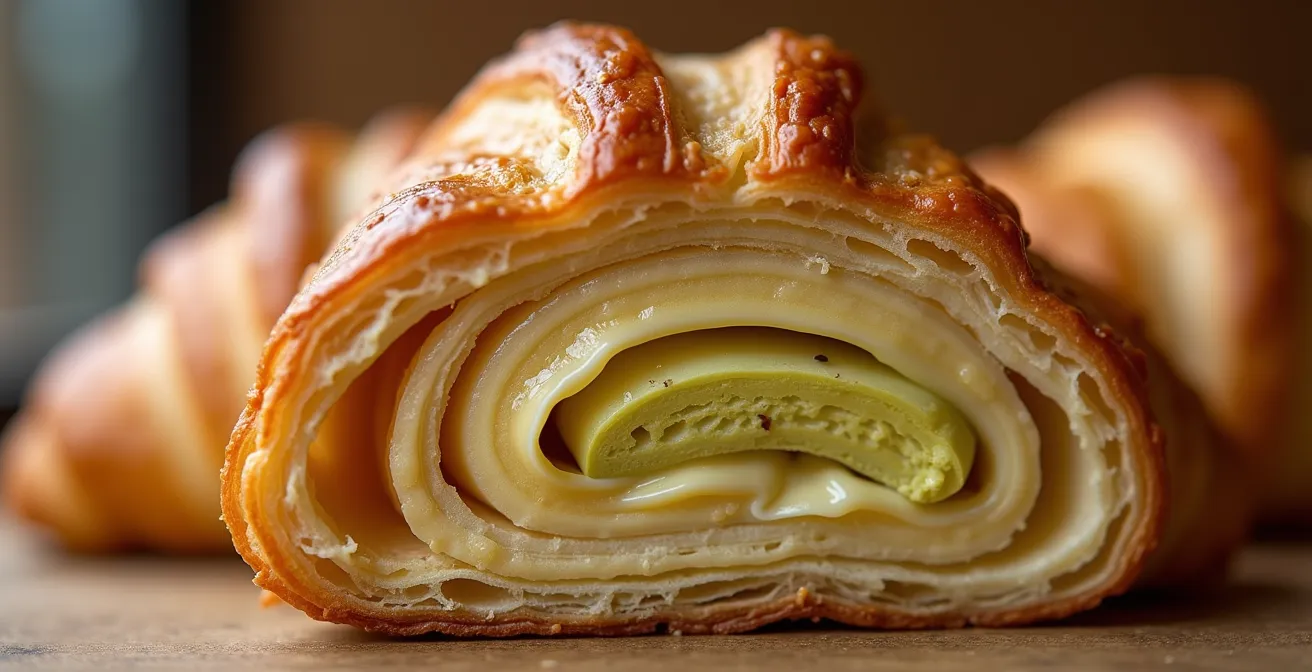
This creates the “pretty food” trap. While a beautiful dish can be a sign of meticulous craftsmanship, it can also be a mask for mediocre quality. A pistachio croissant might have a vibrant, photogenic filling but be made with a bland, greasy pastry that lacks the delicate, flaky layers of a true Viennoiserie. The visual appeal generates buzz and gets customers in the door, but the substance is what determines if they will ever return.
The best establishments—whether a celebrity-run patisserie or a humble local bakery—understand that style must serve substance. The visual artistry should enhance, not replace, the fundamental quality of the ingredients and the skill of the technique. When you see a viral food item, the discerning diner’s question shouldn’t be “Does it look good?” but rather “Does the beauty signal genuine quality, or is it a distraction?” Learning to spot the difference is a key skill for navigating Dubai’s dazzling and sometimes deceptive culinary landscape.
How to Get a Table at Heston’s Dinner Without Booking a Month Ahead?
The demand for celebrity chef restaurants is intense, especially in a city that, with Dubai experiencing record tourism numbers of over 18 million visitors, has a constant influx of eager diners. Securing a prime-time weekend dinner reservation often requires booking weeks, if not months, in advance. However, for the spontaneous or less-organized diner, all is not lost. Getting a table is possible if you are willing to be flexible and strategic.
The most effective strategy is to avoid peak hours. Restaurants are often much quieter during weekday lunch services or early in the week (Sunday to Tuesday evenings). Showing up during these off-peak times dramatically increases your chances of getting a table as a walk-in. Another excellent tactic is to inquire about bar or lounge seating. Many fine dining establishments reserve their bar area for walk-ins on a first-come, first-served basis. This allows you to enjoy the same kitchen’s food and the restaurant’s ambiance without a formal reservation.
Being flexible with your party size can also help. A restaurant is far more likely to have an unreserved small table for two than to accommodate a larger group at the last minute. While advance booking is always the safest bet for a guaranteed spot, a combination of timing, flexibility, and a little charm can often unlock a memorable dining experience you thought was out of reach.
Your Action Plan for Snagging a Last-Minute Table
- Target Off-Peak Times: Aim for weekday lunches or early-week dinners (Sun-Tues) when demand is lower.
- Inquire About Bar Seating: Ask the host if the bar or lounge area is available for walk-ins to access the full menu.
- Be Flexible with Party Size: Walk-in chances are highest for individuals or couples; larger groups are much harder to accommodate.
- Check for Late Cancellations: Call the restaurant an hour or two before you plan to go; last-minute cancellations can open up prime slots.
- Dine Early or Late: Try for a very early dinner (around 6 PM) or a late one (after 9:30 PM) to avoid the peak rush.
Key Takeaways
- The celebrity chef’s name is a promise of a standardized, high-quality culinary system, not their physical presence.
- Signature dishes are meticulously replicated worldwide, ensuring consistency is the core of the brand experience.
- Navigating the booking system requires flexibility; targeting off-peak hours and bar seating are effective strategies for last-minute tables.
How to Secure a Table at Dubai’s Top Michelin Venues Without a 3-Month Wait?
While the general strategies work for many popular restaurants, securing a table at Dubai’s most exclusive, Michelin-starred venues requires a more advanced approach. These are often intimate spaces with extremely limited seating, making them the toughest reservations in the city. Getting into a two or three-star establishment like STAY by Yannick Alléno or Björn Frantzén’s 27-seater dining room demands insider knowledge.
One of the most effective pro-tips is to target newly-starred restaurants. The moment the annual Michelin Guide is released, identify the new one-star recipients. Book immediately, before the global hype builds and their reservation books fill for the next six months. Another savvy move is to leverage restaurant groups. If you can’t get into the flagship two-star venue, book a table at its more accessible sister restaurant within the same group. Building a relationship with the staff there can sometimes grant you priority access to the main event.
Case Study: The Exclusivity of Dubai’s Michelin Elite
Dubai’s top tier is small and highly sought-after. According to an insider’s guide to celebrity chef restaurants, establishments like STAY by Yannick Alléno have held Two Michelin Stars for years, creating sustained high demand. Meanwhile, new Three Michelin Star venues like the one from celebrated chef Björn Frantzén, which offers an intimate, 27-seater experience, become nearly impossible to book overnight. This proves the need for strategic booking tactics beyond simply calling ahead.
Finally, don’t underestimate the power of lunch. Many of the world’s top fine dining restaurants, including those in Dubai, offer lunch services that are often easier to book and can be slightly more affordable than their dinner counterparts. It provides the same culinary genius from the same kitchen, but with better availability. For the truly dedicated diner, mastering these advanced strategies is the key to unlocking the most coveted culinary experiences in the city.
Ultimately, dining in Dubai is about understanding what you value. Whether you seek the guaranteed excellence of a global brand or the thrill of a local discovery, the city offers a world of flavor. By approaching your reservations with this insider knowledge, you can move beyond the simple hope of a celebrity sighting and instead learn to appreciate the incredible system of talent, logistics, and passion that brings a world-class meal to your table.