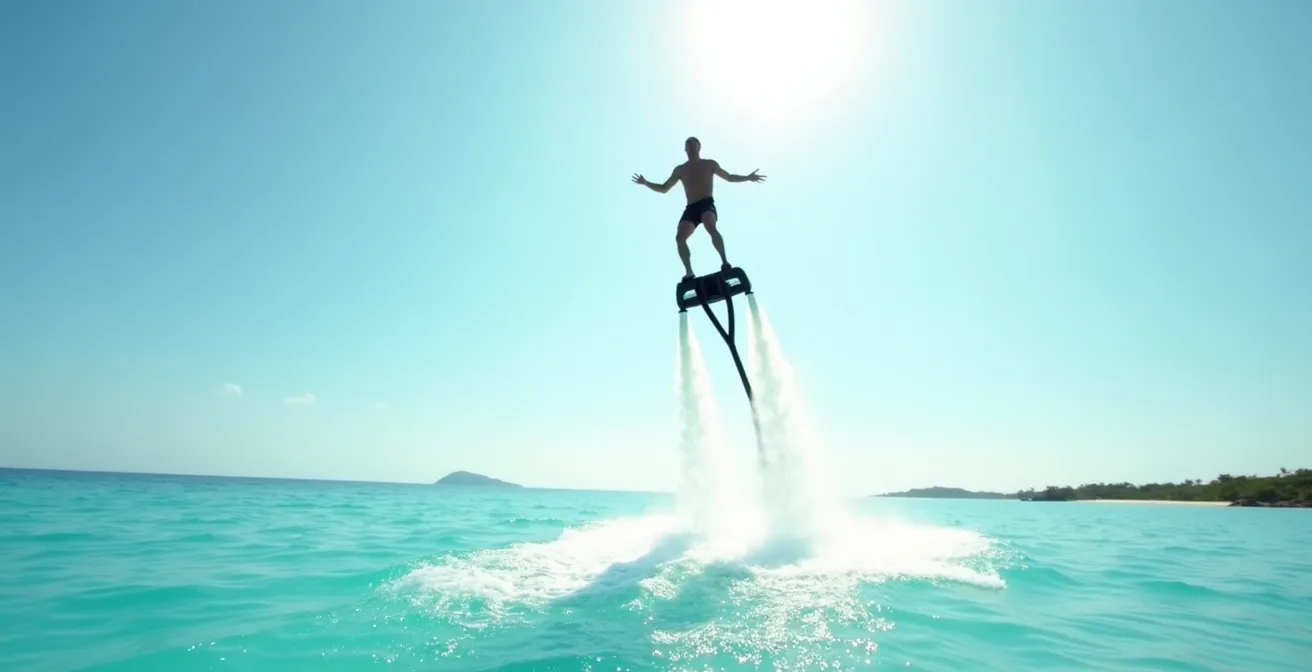
Your adventure sports insurance is not a safety net; it is a rigid contract you are likely to breach, transferring all financial liability to you.
- Ignoring safety rules (weight, BMI, equipment) is considered contributory negligence, a contractual breach that automatically voids most claims.
- Undeclared medical conditions or participating in “provoked” wildlife encounters nullify your policy from its inception, rendering it useless when you need it most.
Recommendation: Before any activity, audit your policy against the operator’s rules. You, not the insurer, are assuming 100% of the financial liability in the event of a breach.
The allure of adrenaline is potent. You envision yourself soaring on a flyboard, ziplining across a canyon, or diving into the azure depths. In the back of your mind, a comforting thought persists: “I have travel insurance; I’m covered.” This assumption is not just misguided; it is financially dangerous. Most travelers believe that purchasing a policy, perhaps with an “adventure sports” rider, grants them a blanket of security. They are fundamentally mistaken.
From an underwriter’s perspective, a travel insurance policy is not a promise of unconditional support. It is a meticulously crafted legal contract based on a specific, declared level of risk. Every rule, limit, and exclusion is a cornerstone of that contract. When you, the policyholder, knowingly or unknowingly violate these terms—by failing to declare a medical condition, exceeding a weight limit, or using unapproved equipment—you are not making a simple mistake. You are committing a material breach of contract. This action systematically dismantles your coverage, voiding the policy and transferring the full, often catastrophic, financial liability for any resulting incident directly onto your shoulders. As it stands, a staggering amount of people are already exposed, with market data showing that 62% of travelers remain uninsured or underinsured, unaware of these contractual realities.
This document will not offer comforting platitudes. It will dissect the cold, hard mechanics of insurance policy enforcement for extreme activities. We will analyze the specific clauses and operational limits that, when ignored, result in claim denials and policy voiding, leaving the adventurous traveler exposed to devastating financial consequences.
To fully understand the liabilities you assume, this article breaks down the contractual realities of adventure sports coverage. The following sections detail the specific scenarios where policyholders inadvertently void their own protection.
Summary: Why Your Adventure Insurance Is a Contract, Not a Safety Net
- Why You Should Declare High Blood Pressure Before Ziplining?
- The 100kg Limit: Why Is It Strictly Enforced on the XLine?
- Feeding Time vs Dive Time: When Is It Safest to Dive with Sharks?
- Wind Speed Cancellations: How to Get a Refund for Your Skydive?
- Why You Cannot Use Your Own Camera on Certain Extreme Rides?
- Why Strict BMI Limits Are Enforced for Tandem Skydivers?
- The ‘Off-Road’ Clause: Why Your Luxury Rental Insurance Void on Sand?
- How to Manage Pre-Jump Anxiety When Waiting at the Skydive Dropzone?
Why You Should Declare High Blood Pressure Before Ziplining?
The requirement to declare pre-existing medical conditions is not a bureaucratic formality; it is the foundational principle of insurance underwriting. A policy is priced and issued based on a disclosed risk profile. Withholding information, such as a diagnosis of hypertension, constitutes non-disclosure of a material fact. This is a form of misrepresentation that allows an insurer to treat the policy as if it never existed. The sudden changes in altitude and adrenaline surges during an activity like ziplining can significantly elevate blood pressure, creating a risk of a cardiovascular event that the insurer did not agree to cover.
An operator’s waiver, which you sign on-site, is a separate contract that primarily protects the operator from liability. It has no bearing on your travel insurance policy. Should a medical emergency occur, the insurer will investigate. Upon discovering the undeclared condition, they have the legal right to void the policy *ab initio* (from the beginning). This means not only will the claim for the ziplining incident be denied, but any other claim under that same policy, even for unrelated events like lost luggage, could also be rejected. You are left personally liable for all medical and evacuation costs.
Transparency is not optional. It is a contractual obligation. To ensure your policy remains valid, you must provide a complete medical history. This includes:
- All diagnosed medical conditions, even if managed with medication.
- A full list of current medications and dosages.
- Any recent hospitalizations or specialist consultations.
- Conditions you deem “minor,” as the insurer alone determines their relevance.
Failure to disclose pre-existing medical conditions is one of the primary reasons claims are invalidated. The responsibility for full and frank disclosure rests entirely with you, the policyholder.
The 100kg Limit: Why Is It Strictly Enforced on the XLine?
Weight limits posted for attractions like the XLine are not suggestions; they are critical safety parameters derived from engineering specifications. The cables, harnesses, and braking systems are designed and certified to operate safely within a specific load range. Exceeding this limit, even by a small margin, exponentially increases stress on the equipment and fundamentally alters the dynamics of the ride, particularly braking distances and forces. From an insurance standpoint, willfully ignoring a posted weight limit is an act of contributory negligence.
By stepping onto the platform knowing you exceed the limit, you have breached the implicit terms of your insurance contract, which requires you to take reasonable steps to avoid injury and to follow all safety guidelines. You are no longer an unforeseen victim of an accident; you are an active participant in creating a high-risk scenario that the insurer never agreed to underwrite. This distinction is critical.

As the image of these mechanical components suggests, the integrity of every single part is calculated based on defined operational loads. An excessive load compromises this entire safety system. Should an incident occur, the insurer’s investigation will immediately focus on compliance with the operator’s rules. Discovery of a weight limit violation provides clear grounds for claim denial. The insurer will argue that your actions, not a failure of the equipment under normal operating conditions, were the proximate cause of the injury. The financial consequences of this are severe, as you assume full liability.
This principle extends beyond weight limits to all operator instructions. As a comparative analysis shows, any deviation from safety protocols is viewed as a breach of policy terms, leading to predictable and unfavorable claim outcomes.
| Violation Type | Insurer’s Perspective | Claim Impact |
|---|---|---|
| Exceeding Posted Weight Limit | Contributory Negligence | Full Claim Denial |
| Not Following Safety Instructions | Breach of Policy Terms | Claim Rejection |
| Operating Without Proper Equipment | Reckless Endangerment | Coverage Void |
| Ignoring Operator Guidelines | Assumption of Unnecessary Risk | Partial or Full Denial |
Feeding Time vs Dive Time: When Is It Safest to Dive with Sharks?
Participating in a shark dive requires a level of insurance scrutiny that goes far beyond standard tourism. Most basic travel insurance policies, and even many adventure sports policies, contain specific exclusions for “hazardous activities” or interactions with dangerous wildlife. Diving with sharks almost always falls into this category, necessitating a specialized policy or rider that explicitly names the activity.
However, even with a specialized policy, a critical distinction is made between two types of encounters: natural observation and provoked interaction. A dive where sharks are observed in their natural state carries a calculated, albeit high, level of risk. A dive that involves baiting, chumming, or feeding to attract sharks is classified differently. This is considered a “provoked encounter.” By artificially creating a feeding frenzy, the risk profile of the activity is fundamentally altered and amplified. Many insurers will explicitly exclude any incident arising from a provoked encounter, as it is no longer an accident but a foreseeable consequence of an artificially hazardous situation.
Before undertaking such an activity, your due diligence must be absolute. You must verify if your policy makes this distinction. The time of the dive is relevant only in its relation to the operator’s practices. If “feeding time” is part of the tourist experience, your coverage is likely void. Your contract obligates you to avoid reckless endangerment. Participating in a baited shark dive can be legally interpreted as such, giving the insurer clear grounds to deny any claim resulting from an attack or other incident. The onus is on you to confirm not just that “scuba diving” is covered, but that “scuba diving with baited sharks” is not an explicit or implicit exclusion.
Wind Speed Cancellations: How to Get a Refund for Your Skydive?
The cancellation of a skydive due to high winds presents a common point of confusion regarding insurance coverage. It is essential to differentiate between the operator’s responsibility and the insurer’s role. If a skydive operator cancels the activity for safety reasons, they are typically responsible for refunding the direct cost of the jump itself. This is a commercial transaction between you and the operator.
Travel insurance, specifically under a “Trip Interruption” or “Activity Cancellation” benefit, does not cover the cost of the activity that the operator has already refunded. Instead, its purpose is to reimburse you for other non-refundable, pre-paid expenses associated with the cancelled event. This could include a non-refundable taxi fare to the remote dropzone, a pre-paid hotel night near the site that you no longer need, or other similar costs that are now forfeited because the primary activity did not proceed.
To make a successful claim, you must provide documentation. This includes proof from the operator that the skydive was cancelled due to adverse weather—a condition that must meet the policy’s definition, often requiring a formal meteorological warning or a clear statement from the operator citing safety. You must also provide receipts for the non-refundable expenses you are claiming. Without this chain of evidence, the claim will be denied. The insurance policy is not a replacement for the operator’s refund policy; it is a complementary tool to cover ancillary financial losses, provided the conditions of the policy are met.
Why You Cannot Use Your Own Camera on Certain Extreme Rides?
The prohibition of personal cameras, phones, or GoPro-style devices on many extreme rides is not a scheme to sell you on-ride photos. It is a strict liability-control measure. The primary risk is that of a dropped object. A device dropped from height or at high speed becomes a projectile, capable of causing serious injury or death to people below, or significant damage to property. A secondary risk involves the user becoming entangled in straps or mounts during the ride, leading to direct injury.
From an underwriting perspective, bringing your own unapproved equipment onto a ride constitutes a breach of safety protocol. As the travel insurance guide from GoCompare notes, a common reason for claim denial is when “You weren’t wearing the appropriate safety gear for your chosen sport”. Unauthorized equipment falls under this category. It introduces a risk that was not part of the operator’s safety assessment and therefore not covered by their liability insurance or, by extension, your own travel insurance.
You weren’t wearing the appropriate safety gear for your chosen sport
– GoCompare Travel Insurance Guide, Extreme Sports Insurance Exclusions
Should your camera fall and cause an injury, you could be held personally liable for a third-party claim. Your travel insurance policy will almost certainly reject your request for legal assistance or coverage, citing your direct violation of the operator’s rules. You willfully introduced an unauthorized hazard. The legal and financial responsibility is yours alone. The only cameras permitted are those integrated by the operator, which have been engineered and tested to be secure under the specific forces of the ride.

The experience is designed to be just that—an experience, unmediated by personal devices that pose a significant and uninsurable liability risk. Adhering to this rule is non-negotiable for maintaining any semblance of insurance coverage.
Why Strict BMI Limits Are Enforced for Tandem Skydivers?
Body Mass Index (BMI) and weight limits for tandem skydiving are not arbitrary rules of discrimination. They are critical risk-management parameters based on two factors: equipment safety and landing impact forces. Tandem skydiving harnesses are designed to fit securely on a specific range of body shapes and sizes. An improper fit due to a high BMI can lead to the passenger slipping in the harness during freefall or under canopy, a catastrophic equipment failure.
Furthermore, increased weight directly translates to increased terminal velocity and, more critically, a higher landing force. A heavier pair (instructor and passenger) will descend faster under the canopy and land with significantly more force. This magnifies the risk of leg, ankle, and spinal injuries for both the passenger and the instructor. Insurers view this from a purely statistical standpoint: a higher BMI correlates directly with a higher probability and severity of landing injuries. It changes the entire risk equation.
Misrepresenting your weight or BMI to an operator is a material breach of contract with your insurer. You are knowingly exposing yourself and the instructor to a level of risk the policy was not designed or priced to cover. As the data clearly shows, the risk assessment shifts dramatically as BMI increases, often moving a person from a standard risk to an excluded one.
The following table, based on common underwriting principles for adventure sports, illustrates the direct impact of BMI on risk and insurability.
| BMI Range | Equipment Compatibility | Landing Force Multiplier | Insurance Risk Assessment |
|---|---|---|---|
| Under 25 | Standard Harness Fits | 1.0x baseline | Standard Coverage |
| 25-30 | Extended Harness May Be Needed | 1.3x baseline | May Require Declaration |
| Over 30 | Special Equipment Required | 1.5x+ baseline | Often Excluded or Premium Required |
This is not a matter of opinion but of physics and liability. Any claim arising from an incident where the passenger’s actual BMI exceeded the declared or permitted limit will be subject to immediate and rigorous scrutiny, and is highly likely to be denied on grounds of contributory negligence and non-disclosure.
The ‘Off-Road’ Clause: Why Your Luxury Rental Insurance Void on Sand?
The exhilarating image of driving a luxury 4×4 on a sandy beach or desert dune is a common fantasy. The reality is a contractual minefield. Virtually every standard vehicle rental agreement contains an “off-road” clause that explicitly forbids operating the vehicle on unpaved surfaces, including beaches, dirt tracks, and fields. Violating this clause immediately voids the rental agreement and any insurance provided by the rental company, such as the Collision Damage Waiver (CDW).
Many travelers assume their credit card insurance or personal travel insurance will act as a backstop. This is a critical error in understanding the hierarchy of insurance contracts. The primary contract is the rental agreement. All other forms of insurance are secondary or tertiary and are bound by the terms of that primary contract. If you violate the rental agreement by driving off-road, you have also violated the conditions of your credit card and travel insurance policies, as they do not cover prohibited uses of a rental vehicle.
Driving on sand introduces extreme and specific risks for which a standard vehicle is not designed: saltwater corrosion, engine damage from sand ingestion, and a high likelihood of getting stuck, requiring expensive recovery. Should any damage or incident occur while off-road, you are 100% personally liable for the full cost of repairs, recovery, and any loss of use for the rental company. The cost to repair a luxury vehicle can easily exceed tens of thousands of dollars. Your insurance will offer no assistance, as your first action of leaving the pavement was a material breach of the governing contract.
The hierarchy is absolute and must be understood before you turn the ignition key:
- Level 1: Rental Agreement Terms – The supreme contract that forbids off-road use.
- Level 2: Collision Damage Waiver (CDW) – Voided by breach of the rental agreement.
- Level 3: Credit Card Coverage – Honors the exclusions of the primary CDW and rental agreement.
- Level 4: Travel Insurance – Cannot override the rental contract; will deny claims for prohibited use.
- Level 5: Personal Auto Insurance – Also typically excludes use in non-permitted areas.
Key Takeaways
- Your travel insurance is a contract; violating safety rules (weight, health declarations, equipment) is a breach that voids coverage.
- Insurers distinguish between unforeseen accidents and foreseeable consequences. Ignoring rules is seen as contributory negligence, shifting liability to you.
- The financial responsibility for an incident following a policy breach, including medical evacuation and third-party liability, rests solely on you.
How to Manage Pre-Jump Anxiety When Waiting at the Skydive Dropzone?
Pre-jump anxiety is a natural response to a high-stakes activity. While many focus on managing the emotional aspect with breathing techniques, the perspective of an underwriter frames this anxiety differently: as a rational response to unassessed financial risk. The most effective way to manage pre-jump anxiety is not through mindfulness, but through meticulous pre-jump financial and contractual preparation. True peace of mind comes from knowing you have done everything contractually possible to ensure your insurance policy is valid and robust.
Before you even arrive at the dropzone, your focus should be on converting your policy from an abstract document into a verified tool. This involves a systematic check of your coverage against the specifics of the activity. Are you covered for tandem skydiving up to a specific altitude? Is the dropzone a certified operator as required by your policy? Is your medical evacuation coverage sufficient for the location? Answering these questions transforms a vague sense of security into a concrete, verified position. The anxiety of the “what if” is substantially mitigated when you have already addressed the financial ramifications.
This approach reframes anxiety as a productive signal, prompting you to take control of the one aspect you can: your contractual and financial readiness. The emotional calm you seek is a direct byproduct of this rigorous, logical preparation.
Action Plan: Verify Your Financial Security Before a Skydive
- Confirm your policy explicitly lists ‘tandem skydiving’ as a covered activity and note any altitude limits.
- Save your insurer’s 24/7 emergency assistance number in your phone’s contacts for immediate access.
- Screenshot your policy number and key coverage details for offline access on your phone.
- Verify your medical evacuation coverage amount; a minimum of $100,000 is the standard recommendation, but remote locations may require more.
- Check if your policy requires operator certification (e.g., USPA in the US) and confirm your chosen dropzone meets this standard.
By completing this checklist, you have actively managed the largest, most catastrophic risks associated with the activity, allowing you to focus on the instructions of your tandem master and the experience itself.
Ultimately, the responsibility to read, understand, and adhere to the terms of your insurance contract rests entirely with you. Do not assume you are covered. Verify it. Your financial future depends on it.
Frequently Asked Questions About Adventure Sports Insurance Cancellations
What constitutes ‘adverse weather’ for insurance claims?
Adverse weather must typically involve formal meteorological warnings or documented conditions that make the activity unsafe according to the operator’s official guidelines and statements. A simple forecast is insufficient; you need proof of a safety-based cancellation.
Can I claim for pre-paid transport if my skydive is cancelled?
Yes, if your policy includes Trip Interruption coverage. This benefit is designed to reimburse non-refundable, pre-paid associated costs, such as taxi fares or specific hotel bookings, that are forfeited due to the cancellation of the main activity.
What’s the difference between operator refund and insurance coverage?
The operator’s refund covers the direct cost of the activity itself (e.g., the price of the skydive). Insurance coverage is designed to handle ancillary, non-refundable costs (e.g., transport, accommodation) that you lose as a result of the cancellation.