
For non-morning people, the Dubai hot air balloon experience is only worth the brutal 4 AM wakeup call if you understand and accept the operational trade-offs involved.
- Weather is a major factor; fog can cause delays, but premium operators turn this into a luxury breakfast experience while you wait.
- The pre-dawn desert is cold, and the landing is intentionally “bumpy.” These are not flaws, but necessary parts of the physics of ballooning.
Recommendation: Choose an operator based on their detailed safety and weather contingency protocols, not just their breakfast menu. True luxury is flawless logistics, not just ground-level glamour.
Let’s be honest. The alarm goes off at an hour that feels more like a typo than a time. It’s cold, it’s dark, and the very idea of leaving a comfortable hotel bed to stand in a desert seems questionable at best. This is the central dilemma for any non-morning person considering a hot air balloon ride in Dubai: is the reward of a majestic sunrise from 4,000 feet genuinely worth the significant upfront cost of fatigue? Most travel guides gloss over this, showering you with images of golden light and happy, wide-awake tourists.
They talk about the magical sunrise and the champagne breakfast, but they rarely deconstruct the mechanics of the experience. They don’t detail the very real possibility of a fog delay, the surprising desert chill, or the specific techniques for a firm but safe landing. These aren’t minor details; they are the fundamental trade-offs you make. The unglamorous truth is that a 5-star balloon flight isn’t just about the view; it’s about how meticulously these operational realities are managed.
But what if the key to deciding isn’t focusing on the perfect, glossy outcome, but on understanding the “why” behind the process? This guide takes a different approach. We will dissect the logistical and experiential hurdles of the journey, from the moment your alarm rings to the second the basket bumps back to earth. By understanding the operational trade-offs—why you need a jacket, what happens if it’s foggy, and how to brace for landing—you can make an informed decision, transforming from a skeptical sleeper into a prepared passenger who can truly appreciate the spectacle.
This article provides an honest, step-by-step review of the experience, focusing on the practical questions that determine if the reward is truly worth the effort for you. The following sections break down each component of the journey.
Summary: Deconstructing the Dubai Hot Air Balloon Experience
- What Happens if Fog Rolls in After You’ve Driven to the Site?
- Why You Need a Jacket in the Desert Even in April Mornings?
- The ‘Bumpy Landing’ Brace Position: Why You Need Core Strength?
- Why Are Falcons Flown from Balloons and Is It Cruel?
- Corner vs Center: Where to Stand for the Best GoPro Footage?
- Uber Chopper: Is It a Gimmick or a Viable Commute to Yas Island?
- Why Visiting on a Foggy Morning Might Be Better Than a Clear Day?
- Why Can’t You Enter the Conservation Reserve with Your Own Car?
What Happens if Fog Rolls in After You’ve Driven to the Site?
The biggest fear after that 4 AM wakeup is arriving at the launch site only to be grounded by weather. Fog is a common character in Dubai’s winter mornings, and the operational response to it is the first major differentiator between a 4-star and a true 5-star experience. It’s a significant factor, as weather-dependent delays affect 15-20% of scheduled departures during the September to May flying season. A lesser operator might have you waiting awkwardly in a van. A premium operator, however, initiates a “reverse sequence” protocol.
Instead of delaying the best part of the morning, they immediately pivot. You’re driven from the launch site to a private, traditional Bedouin camp deep in the desert. There, you’ll enjoy the gourmet breakfast—typically planned for after the flight—in a relaxed setting while the pilot and ground crew continuously monitor conditions. This isn’t just killing time; it’s a strategic move that preserves the luxury experience and manages expectations. If the fog is low-lying, there’s often a window for an incredible “above the clouds” flight as the sun rises, an opportunity many miss.
If the flight is ultimately cancelled, the policy should be clear and customer-centric: an immediate offer to rebook for the next available day or a full, no-questions-asked refund. The key is that a top-tier company has a robust, guest-focused plan for this very scenario. Understanding their specific protocol before booking is crucial.
Action Plan: How 5-Star Operators Handle Fog Delays
- The pilot assesses fog depth, wind speed above the fog layer, and visibility forecasts using real-time weather monitoring tools.
- If conditions are deemed unsafe, they implement the ‘reverse sequence’ protocol: guests are driven to the Bedouin camp for breakfast while the crew waits for a potential clearing.
- The team continuously monitors for an ‘above the clouds’ flight opportunity, which can offer uniquely spectacular views if the fog is low-lying.
- If a window opens, the launch proceeds after sunrise, providing different but equally beautiful lighting conditions for the flight.
- If cancellation is unavoidable, a full refund is processed within 24 hours or an immediate rebooking is offered for the next day.
Why You Need a Jacket in the Desert Even in April Mornings?
It seems counterintuitive. You’re in Dubai, a city synonymous with heat, yet every balloon operator insists you bring a jacket. This isn’t an overstatement; it’s a matter of physics. The desert air is incredibly dry, meaning it can’t hold onto the previous day’s heat. Temperatures can plummet overnight. But the real temperature drop happens as you ascend. The burner of the balloon warms your head, but it does little for the rest of your body as you climb thousands of feet into the pre-dawn sky.
The science is straightforward: for every thousand feet you climb, the temperature drops. In fact, aviation meteorology data confirms a temperature drop of about 3.5°F (2°C) per 1,000 feet of altitude. When your balloon reaches a cruising height of 4,000 feet, a pleasant 15°C (59°F) on the ground can feel like a biting 5°C (41°F). For a non-morning person already running on low energy, being cold is a surefire way to ruin the magic. The right clothing isn’t about fashion; it’s a critical part of the effort-to-reward ratio.
Layering is the most effective strategy. A t-shirt, a fleece or sweater, and a light windbreaker will allow you to adjust as the sun rises and the air warms. This preparation ensures your focus remains on the stunning views, not on shivering in the basket. Don’t underestimate the cold; it’s a rookie mistake that can detract from an otherwise incredible experience.

As you can see from the textures of fleece and wool, proper attire is a non-negotiable part of the pre-flight preparation. Comfortable, warm layers are your best defense against the high-altitude chill, ensuring your full attention is on the horizon.
The ‘Bumpy Landing’ Brace Position: Why You Need Core Strength?
Hot air balloons don’t have wheels, brakes, or a steering wheel. They land by descending into an open area and, often, tipping over as the basket drags to a halt. Pilots will brief you on a “bumpy landing,” but the term can be an understatement. It’s more of a controlled, multi-stage impact. This is where the experience can feel a bit scary for first-timers, but understanding the mechanics and the brace position turns fear into informed participation. Your body becomes part of the landing gear.
The brace position isn’t a casual suggestion; it’s a safety-critical instruction designed to use your body and the basket as a unified system to absorb the landing force. You’ll be told to face backward, bend your knees, and hold on tight to the ropes inside the basket. The most overlooked instruction, however, is to engage your core muscles. A strong core (your abdominal and lower back muscles) stabilizes your spine and prevents you from being jolted around. Bending your knees acts as the primary shock absorption, but your core holds everything together.
Here’s the simple technique pilots will instruct you to follow:
- Face backward in your compartment to protect your face and reduce the sensation of forward momentum.
- Bend your knees significantly, keeping feet shoulder-width apart. They are your personal shock absorbers.
- Hold the basket ropes firmly, not the basket edge, to unite your body’s mass with the basket’s movement.
- Engage your core by tightening your stomach and lower back muscles to maintain stability throughout the landing sequence.
This isn’t about being an athlete; it’s about using your body intelligently. A prepared passenger who properly executes the brace position will find the landing to be an exhilarating, if bumpy, end to the flight, rather than a jarring one.
Why Are Falcons Flown from Balloons and Is It Cruel?
As you drift silently over the dunes, a new element is introduced: a world-class falconry demonstration at 4,000 feet. This is a uniquely Dubai addition to the ballooning experience. The falconer releases the bird, which circles the balloon, diving and climbing in a breathtaking display of aerial mastery against the sunrise. But it raises two questions: why do it, and is it ethical for the bird? The “why” is rooted in deep cultural heritage. Falconry is a cornerstone of Bedouin tradition, a hunting practice that has been part of desert life for centuries. Performing it from a balloon connects this ancient art with modern tourism in a way that is both spectacular and educational.
The concern about cruelty is valid, but it stems from a misunderstanding of the birds’ nature and training. These falcons are not pets; they are elite avian athletes. They are trained using positive reinforcement, and flying is their natural instinct. The bond between a falconer and their bird is profound. The demonstration allows the falcon to fly in wide, open skies at high altitudes, a stimulating and enriching activity for the bird. A truly professional experience goes beyond the spectacle, focusing on education.
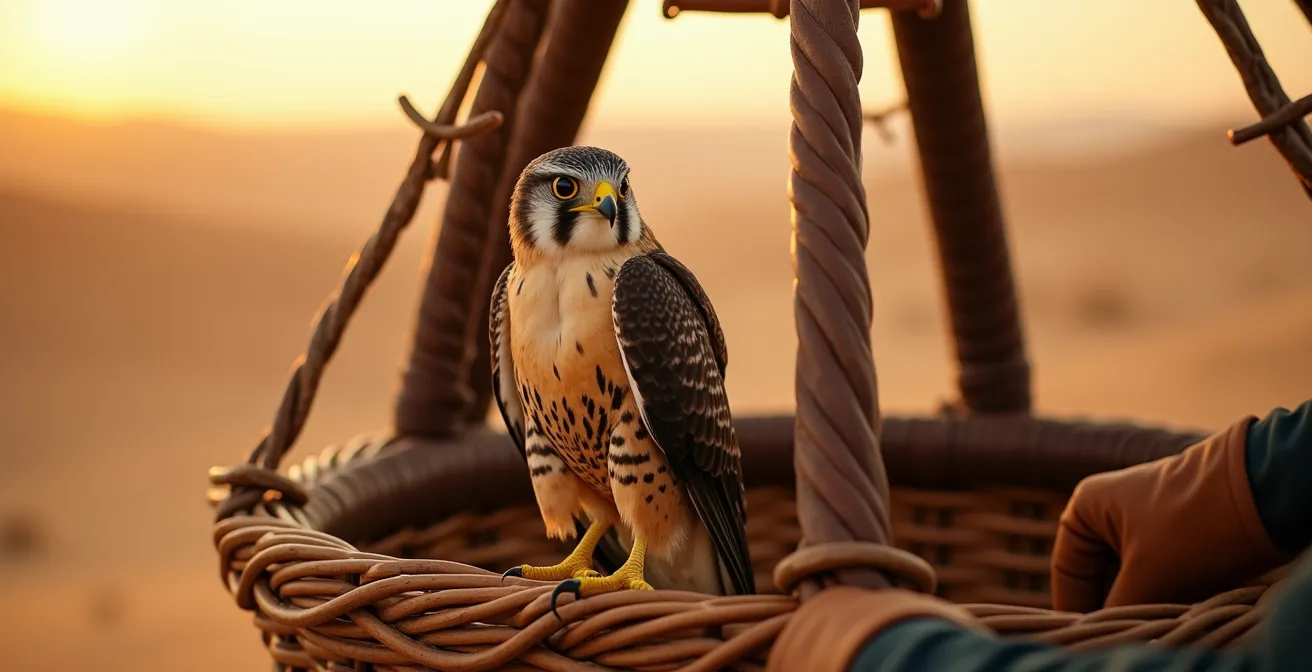
The difference between a gimmick and an authentic cultural experience lies in the expertise of the handler. As the official guidelines for high-end desert safaris note:
A 5-star experience features a knowledgeable falconer who can explain the bird’s species, its training, its bond, and its history
– Dubai Desert Conservation Guidelines, Luxury Desert Safari Standards
When done correctly, the in-flight falcon show is a powerful and humane tribute to Emirati heritage, offering a perspective on the desert ecosystem that you simply can’t get from the ground. It becomes one of the key “reward” components that helps justify the early start.
Corner vs Center: Where to Stand for the Best GoPro Footage?
The hot air balloon basket is divided into compartments, and where you stand has a significant impact on your view and your photos. For the GoPro enthusiast determined to capture the perfect shot, the choice between a corner spot and a central one is a strategic decision. There’s no single “best” spot; it depends on what you want to film. The corners offer stability and sweeping views, while the center offers rotational access and unique angles of the balloon itself.
A corner position is arguably the most coveted. You can brace yourself against two walls of the basket, providing a stable platform for smooth video. It gives you a breathtaking, unobstructed 270-degree panoramic view, ideal for wide-angle landscape shots as the sun crests the horizon. The center position, while offering less stability, provides a 360-degree rotational view. This is the best place to capture shots of the pilot working the burners—creating dramatic bursts of flame—or to get symmetrical shots looking up into the vast canopy of the balloon. Quality operators will slowly rotate the entire basket during the flight, ensuring everyone gets a 360-degree view eventually, but your immediate perspective is dictated by your position.
To get the best of both worlds, don’t stay in one place. A good strategy is to start in a corner for the stable, wide-angle shots during takeoff and the initial ascent. As the flight progresses, move towards the center to capture the action and the internal architecture of the balloon. Then, return to a corner for the landing sequence to capture the approach and brace your camera for the bumpy touchdown. The following table breaks down the pros and cons of each position.
| Position | View Angle | Best For | Stability |
|---|---|---|---|
| Corner | 270-degree panoramic | Wide landscape shots, sunrise/sunset captures | Can brace against two basket walls |
| Center | 360-degree rotational | Pilot action shots, burner flames, group photos | More movement but full access to all angles |
Uber Chopper: Is It a Gimmick or a Viable Commute to Yas Island?
While a hot air balloon offers a serene, floating experience, the “Uber Chopper” represents the other end of Dubai’s luxury aerial spectrum: speed and efficiency. The idea of summoning a helicopter like a taxi to hop from Dubai to Abu Dhabi’s Yas Island for a concert or F1 race sounds like the ultimate gimmick. However, when you analyze it purely from a time-is-money perspective for a certain clientele, it starts to look surprisingly viable. A luxury car journey can take 90 minutes or more, depending on traffic. A helicopter makes the same trip in about 20 minutes.
The raw cost is, of course, astronomical for most people. But for those to whom an hour of wasted time is more expensive than the flight, the math changes. A travel cost-benefit analysis reveals a value of about $7 per minute saved when choosing the 20-minute helicopter ride over the 90-minute luxury car transfer. It’s a stark example of a purely transactional aerial experience, designed to solve a logistical problem (traffic) with overwhelming force.
This comparison highlights the fundamentally different purpose of a hot air balloon ride. The balloon’s value is in its slowness, its silence, and its connection to the landscape. It’s an experience where the journey *is* the destination. An Uber Chopper is the exact opposite; its entire purpose is to obliterate the journey. While one is a poetic indulgence, the other is a pragmatic tool for a hyper-efficient itinerary. For the non-morning person, this reinforces that the balloon ride’s reward is experiential, not practical, and must be judged on those terms.
Why Visiting on a Foggy Morning Might Be Better Than a Clear Day?
A forecast of fog is usually met with disappointment. It feels like you’re being robbed of the classic, clear sunrise view over the desert. However, for those whose flights proceed, a foggy morning can offer a more magical, surreal, and photographically unique experience than a perfectly clear day. The trade-off for a potential delay is a view that few people ever get to witness: floating above a sea of clouds.
When the balloon breaks through the top layer of a low-lying fog bank, the world is transformed. Below you is a vast, white, fluffy blanket stretching to the horizon, with only the peaks of the highest dunes or the tips of the Hajar mountains visible in the distance. The rising sun illuminates this cloud sea from below, creating an ethereal glow and soft, diffused light that is a photographer’s dream. It eliminates the harsh shadows of a clear day, producing painterly, otherworldly images. It’s a moment of profound peace and isolation, as if you’re floating in a world entirely separate from the one below.
This “bonus” view is a perfect example of how an operational challenge can yield an exceptional reward. It requires patience and a bit of luck, but travelers who have experienced it often describe it as the highlight of their trip. One such traveler recounted their initial concern turning into awe:
There was concern that foggy weather would prevent our trip but just before sunrise, the fog dissipated and our trip was on. It was a fabulous experience and one I would happily do again.
– Traveler Review, TripAdvisor
So, if you wake up to a foggy forecast, don’t despair. You might be on the verge of an even more exclusive and memorable experience than the one you originally planned for. It’s a powerful reminder that in the desert, the most beautiful moments are often the most unexpected.
Key Takeaways
- The 4 AM wakeup call is a serious commitment; the experience is only worthwhile if you choose an operator with proven contingency plans for weather.
- Practical comfort is crucial. The desert is cold at altitude, and the landing is intentionally bumpy. Prepare for both with proper layers and by mastering the brace position.
- A 5-star experience is defined by flawless logistics and deep cultural context (like expert falconry), not just surface-level luxury.
Why Can’t You Enter the Conservation Reserve with Your Own Car?
A final piece of the operational puzzle is understanding why the entire experience is so structured. You can’t just drive your own 4×4 to the launch site. Instead, you are picked up from your hotel and chauffeured in an approved vehicle. This isn’t a logistical choice; it’s a conservation mandate. The balloon launches take place within the protected boundaries of the Dubai Desert Conservation Reserve (DDCR), a vast and fragile ecosystem.
The DDCR is not a public park. The Dubai Desert Conservation Reserve encompasses 225 square kilometers, designated as the UAE’s first national park. Its primary mission is to protect the desert’s native flora and fauna, including the Arabian Oryx, which was brought back from the brink of extinction through efforts centered here. Unrestricted vehicle access would cause irreversible damage to the delicate vegetation and disrupt wildlife habitats. Access is strictly limited to a handful of approved tour operators who are trained in responsible desert driving and adhere to strict environmental guidelines.
This controlled environment is what allows you to see herds of gazelles or oryx roaming freely from the balloon. By participating in a tour with an approved operator, you are indirectly contributing to the conservation efforts that make these sightings possible. Your access is a privilege, granted under the condition that the human footprint is kept to an absolute minimum. Understanding this adds a layer of purpose to your journey; you are not just a tourist but a temporary, respectful guest in a protected wilderness.
So, is the 4 AM balloon ride worth it for someone who hates mornings? The answer is a conditional yes. It is worth it if you value serene, unforgettable moments over an extra hour of sleep, and if you go in with your eyes open to the operational realities. By choosing a top-tier operator who manages the trade-offs of weather, comfort, and safety with seamless professionalism, the effort is transformed. It becomes a small price to pay for the immense reward of floating silently in the vast, golden expanse of the Arabian desert at dawn.