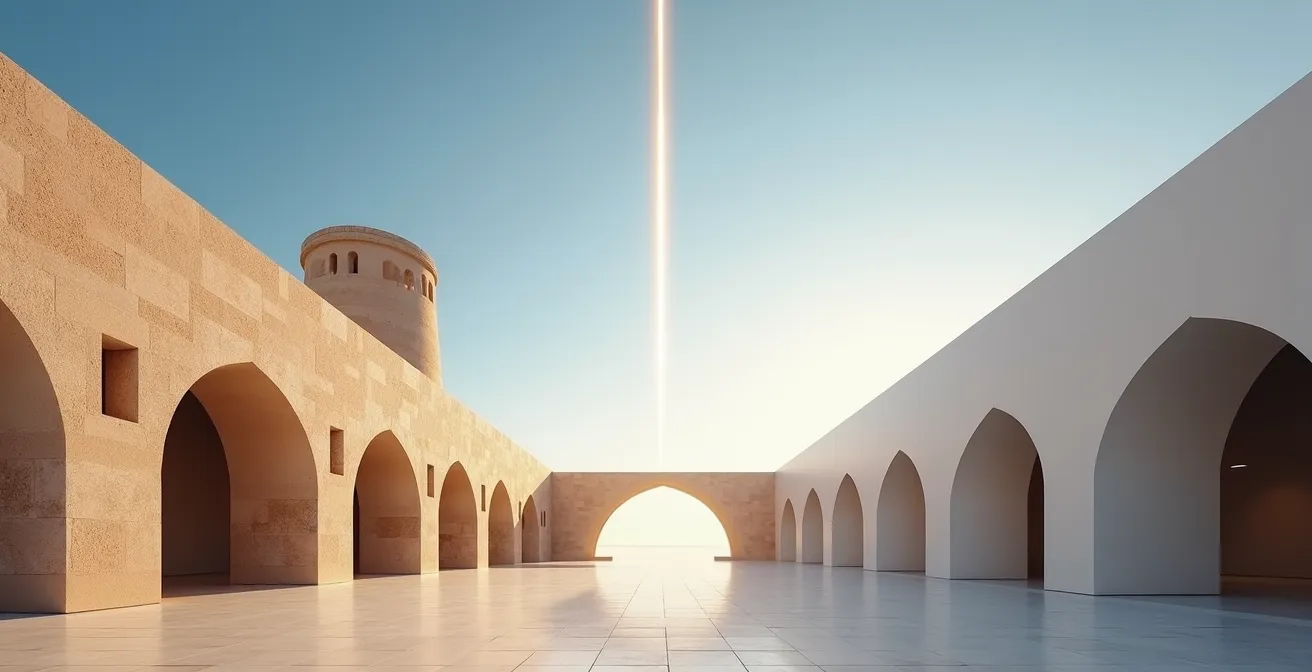
The best choice between Etihad and Dubai Museum depends on the story you want to learn: the political event of the Union or the socio-economic context that made it possible.
- Etihad Museum offers a focused, state-driven narrative of the 1971 unification, detailing the political negotiations and key figures.
- Dubai Museum provides immersive context on the pre-oil economy (trade, pearling) that shaped the Emirates’ society and foundation.
Recommendation: For the political “how,” choose Etihad Museum. For the socio-economic “why,” choose the Dubai Museum and the surrounding historical district.
For the history buff visiting Dubai with only enough time for one major cultural institution, the choice often comes down to two pillars: the sleek, modern Etihad Museum and the historic Dubai Museum, housed in the Al Fahidi Fort. The common advice is simple: choose Etihad for modern history and Dubai Museum for ancient history. This, however, is a gross oversimplification. The real difference lies not in the time period, but in their fundamental pedagogical philosophy and the narrative they choose to tell about the United Arab Emirates.
Selecting between them is a choice about how you wish to understand the nation’s origin story. Do you want to study the precise political machinations that led to the treaty of 1971? Or do you seek to immerse yourself in the social and economic fabric of the Trucial States, understanding the world of trade, pearling, and tribal life that necessitated and ultimately enabled the Union? One tells the story of the state; the other tells the story of its people.
This guide offers an academic comparison to help you make an informed choice. To do so, we will not only analyze the core offerings of Etihad and Dubai Museum but also address the crucial ancillary questions a discerning visitor must consider. We will explore the effectiveness of museum technology, the value of tourist passes, the authenticity of souvenirs, and delve into the deeper historical currents, like the coffee trade and the human cost of pearling, that provide the essential context for the main event of unification.
This comprehensive overview will equip you to move beyond the surface-level descriptions and select the museum experience that best aligns with your intellectual curiosity. The following sections will break down these key considerations, providing the data and context needed for a truly strategic decision.
Summary: A History Buff’s Guide to Dubai’s Museums
- Is the Audio Guide Essential for Understanding the Saruq Al-Hadid Museum?
- Shindagha Museum: Is it Interactive Enough for bored Teenagers?
- The Museum Pass: Does it Save Money for Short Trips?
- How Long Does it Take to Fully Read the Constitution Exhibits?
- Made in China vs Made in UAE: Checking Museum Shop Souvenirs
- AquaExpress Pass: Is It Worth the Extra $100 for a Family of Four?
- Why Ethiopian Coffee Ceremony Is Part of Dubai’s History?
- Why Did Pearl Diving Cause Blindness and Deafness in Divers?
Is the Audio Guide Essential for Understanding the Saruq Al-Hadid Museum?
For a site as complex as the Saruq Al-Hadid Archaeology Museum, which presents artifacts from a remote desert trading hub without much inherent physical context, the question of an audio guide’s necessity is paramount. The answer is an unequivocal yes, particularly for the history buff seeking more than a superficial viewing. The artifacts—intricate gold jewelry, iron tools, and pottery—are visually impressive but their historical significance is unlocked through detailed narration. An audio guide provides the crucial narrative scaffolding, explaining the metallurgical processes, trade connections, and ritualistic importance that are impossible to glean from display cases alone.
The effectiveness of such guides is not merely anecdotal. In fact, research from the Museum Studies journal demonstrates that participants using audio descriptive guides show significantly better recall of details a month after their visit. For a serious student of history, this retention of information is the ultimate goal. The guide transforms a passive viewing experience into an active learning session, making it an essential tool, not an optional extra. The key, however, is selecting the right type of guide for your intellectual needs.
Different guides serve different pedagogical purposes, from basic orientation to deep academic exploration. Understanding these options is key to maximizing your visit.
| Guide Type | Target Audience | Key Benefits | Limitations |
|---|---|---|---|
| Standard Audio Guide | General Tourists | Basic orientation and facts | May lack depth for experts |
| Expert Mode/Academic Papers | History Buffs | Deep scientific context | Requires preparation, less narrative |
| Creative Storytelling Guide | Families & Children | Emotional engagement, memorable | May oversimplify archaeological data |
Ultimately, for Saruq Al-Hadid, the audio guide is not just helpful; it is the interpretive key to the entire collection. Without it, one is merely looking at objects; with it, one is understanding a civilization.
Shindagha Museum: Is it Interactive Enough for bored Teenagers?
The Shindagha Museum, particularly its “Perfume House” and “Crossroads of Civilizations” wings, represents a significant investment in modern, interactive museology. For a history buff traveling with family, especially teenagers who may not share the same passion for static displays, its level of engagement is a critical question. The museum largely succeeds by shifting the pedagogical focus from passive observation to sensory and participatory experiences. Touchscreen displays, olfactory stations for traditional scents, and multimedia projections create a dynamic environment that can captivate a younger audience.
However, “interactive” does not always equate to deep learning. The key to Shindagha’s success with teenagers is not just the technology itself, but how it’s used to tell a human story. The Perfume House, for example, doesn’t just list ingredients; it allows visitors to smell them and watch videos of their traditional preparation. This approach prioritizes emotional connection and memory over rote memorization of facts, a strategy proven to be effective with younger visitors.
Case Study: The Power of Sensory Engagement
A study on children’s engagement highlights the impact of interactive elements. While audio guides alone may not always improve learning outcomes compared to human-led tours, they significantly boost the desire to revisit. At the Whale Museum in Madeira, interactive dialogues designed for children led to enthusiastic reactions like “I loved it!” and “It’s funny!” This demonstrates that enhancing engagement through sensory experiences fosters a positive emotional connection to the subject matter, which is often the first step to genuine interest for a reluctant learner.

As you can see, the environment is designed for collaboration and discovery rather than solitary reading. While a history aficionado might desire more textual depth, this interactive approach serves as an excellent ‘gateway drug’ to history. It provides enough context to be educational but enough stimulation to prevent boredom, making it a strategic compromise for a mixed-interest group.
In conclusion, while Shindagha may not have the academic rigor of a university archive, it is more than interactive enough to hold a teenager’s attention. It masterfully uses technology not as a gimmick, but as a tool for storytelling and sensory immersion.
The Museum Pass: Does it Save Money for Short Trips?
For a time-crunched history buff on a short trip to Dubai, efficiency is as important as cost. The question of whether a multi-attraction pass saves money is complex and depends entirely on your itinerary. Generally, these passes are designed to offer value if you visit a minimum of two or three major attractions. For a solo traveler focused purely on historical sites, the savings may be marginal, as individual museum tickets are relatively inexpensive. However, the calculus changes if your interests are broader.
For instance, recent pricing analysis shows that a pass can yield significant savings on combined itineraries, such as a 33% savings on a popular museum combo including the Museum of the Future. The primary benefit for the serious visitor is not always monetary but logistical. Many passes offer queue-skipping privileges, which can save hours during peak season (November to March). On a two or three-day trip, that saved time can mean an extra museum or historical site, a value that far exceeds the ticket price difference.
To determine if a pass is right for your specific trip, a systematic cost-benefit analysis is required. The following checklist provides a framework for making a data-driven decision rather than a hopeful guess.
Your Action Plan: Is a Museum Pass Worth It?
- Calculate available time: Most passes require use on consecutive days. Map out your schedule realistically. How many museums can you truly absorb in one day?
- Compare individual vs. pass prices: List the individual entry fees for your must-see sites (e.g., Etihad Museum, Dubai Museum, Saruq Al-Hadid). A pass typically requires at least two major attractions to break even.
- Factor in logistical benefits: Assign a value to queue-skipping and included transport options. During a short trip, saving two hours in line can be invaluable.
- Consider themed itineraries: Some passes are better suited for specific routes. Analyze if the pass favors a “Union Story” route (Etihad) or a “Historical Dubai Creek” route (Dubai Museum, Shindagha, Souks).
- Book ahead for reserved-entry attractions: For popular sites like the Museum of the Future, pass holders may still need to reserve a time slot. Check this policy and book 2-3 weeks in advance.
In short, a museum pass is not an automatic money-saver. It is a strategic tool that, when used correctly, can save both time and money, but it demands careful planning to justify its cost for a short, focused trip.
How Long Does it Take to Fully Read the Constitution Exhibits?
This question, focused on the Etihad Museum, gets to the heart of its pedagogical mission. Unlike a sprawling museum of general history, Etihad is a highly focused institution. Its purpose is to narrate one of the most pivotal moments in the nation’s timeline. As Dubai Culture, the managing authority, officially states, the museum’s core purpose is to explore a specific, critical period.
The various pavilions house experience-driven exhibitions that explore the chronology of events that culminated in the unification of the Emirates in 1971, with a key emphasis on the period between 1968 and 1974.
– Dubai Culture, Etihad Museum Official Description
To “fully read” the constitution exhibits, therefore, means engaging with a dense but finite amount of information. A cursory walk-through can be done in 90 minutes. However, for a history buff aiming for comprehensive understanding, the time commitment expands significantly. A dedicated visitor should budget at least three to four hours. This allows for time to watch the documentary films, examine the artifacts (like the original passports of the Founding Fathers), study the interactive timelines, and absorb the symbolic architecture of the museum itself.
Visitor Experience Timeline at Etihad Museum
The visitor journey is structured chronologically, guiding you through the years leading up to unification. The experience combines various media: documentary films, archival photographs, personal artifacts, and interactive displays that detail the negotiation process. A key part of the experience is the adjacent Union House, where the 1971 agreement was actually signed. A full visit includes the free tour of this historic building. The museum’s design itself is part of the story: the parabolic roof represents the parchment of the declaration, and seven golden columns symbolize the pens used by the Founding Fathers to sign it. “Fully reading” the exhibits means engaging with this entire, multi-layered narrative.
Therefore, the time required is not a measure of square footage, but of intellectual engagement. A “full read” is an immersive academic exercise that goes far beyond simply reading wall text; it involves absorbing a multi-faceted story told through film, artifact, and architecture.
Made in China vs Made in UAE: Checking Museum Shop Souvenirs
For the discerning visitor, a museum gift shop is more than a place for trinkets; it’s an extension of the educational experience. The question of authenticity—whether a souvenir is a meaningful, locally made craft or a mass-produced item from overseas—is a valid concern in a global hub like Dubai. The quality and provenance of souvenirs can vary dramatically between museums, reflecting their core mission.
Museums with a strong commercial focus might offer a wider range of generic, albeit popular, souvenirs. In contrast, institutions with a deep cultural or historical mandate, like the Dubai Museum or the Shindagha Museum, often make a concerted effort to partner with local artisans. Here, a history buff is more likely to find items that tell a story: replicas of historical artifacts, hand-woven textiles using traditional Al Sadu weaving techniques, or curated books by local historians. These items function as tangible extensions of the museum’s narrative.
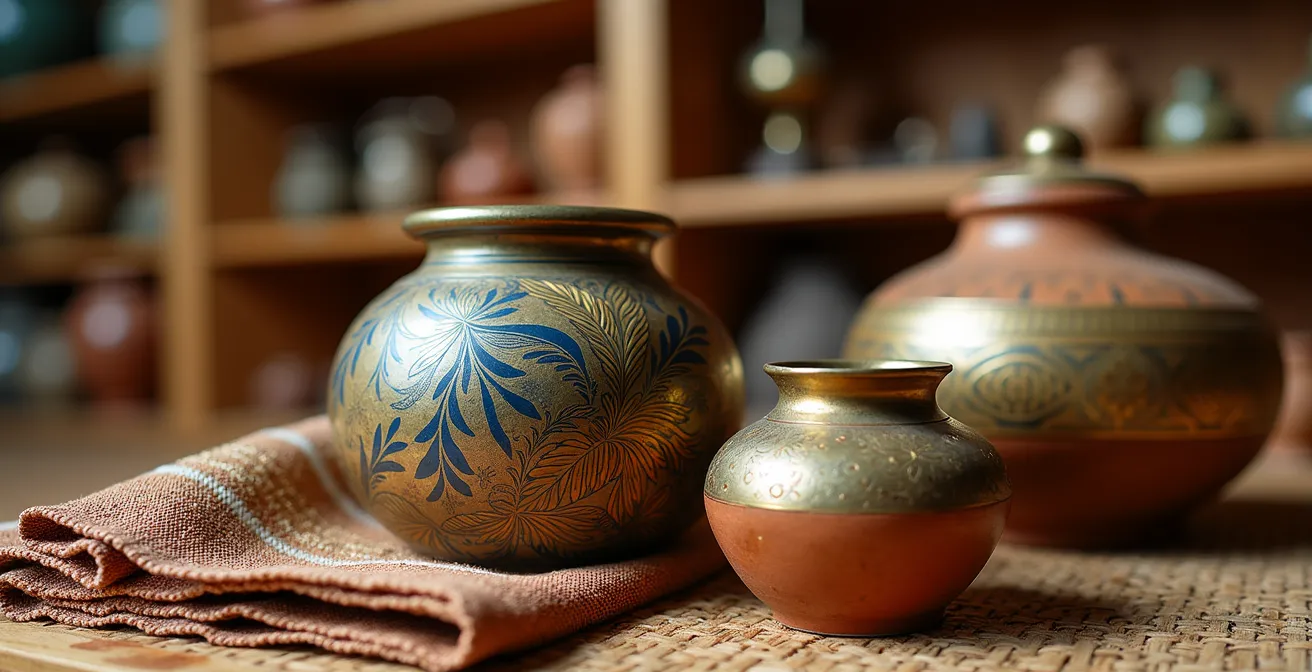
Identifying truly authentic crafts requires a discerning eye. One must look beyond the surface and check for signs of genuine craftsmanship. A key strategy is to engage with the shop staff. Asking about the origin of an item, the artisan who made it, or the story behind its design can quickly separate a meaningful piece from a generic product. Authentic items often come with small imperfections that signal they are handmade, and may include information about their provenance.
Ultimately, a thoughtful souvenir purchase is the final act of curating your own historical journey. It requires the same critical eye used when analyzing the exhibits themselves, ensuring the memory you take home is as authentic as the history you came to learn.
AquaExpress Pass: Is It Worth the Extra $100 for a Family of Four?
A search for visitor passes in Dubai will inevitably surface options like the “AquaExpress Pass,” which is primarily designed for waterparks like Aquaventure. For the history buff, this is an immediate non-starter. The relevant transportation question is not about theme parks but about navigating the historic heart of the city efficiently and authentically. The real question is: what is the most effective way to travel between the cluster of museums in Bur Dubai and Deira, including the Dubai Museum, Shindagha Museum, and the Gold and Spice Souks?
While no formal “Museum AquaExpress” exists, one can compare the modern, expensive options (like a full-day taxi hire) with traditional, cost-effective methods. For a family of four, a single taxi ride between museums might seem convenient. However, this approach completely bypasses the historical context of the area. The Dubai Creek is not an obstacle to be crossed; it is the central artery of the city’s history. To understand Dubai’s origins as a trading port, one must experience the creek as the merchants did.
The most authentic and remarkably inexpensive method is the traditional Abra water taxi. This provides a valuable history lesson in itself, offering a waterside view of the Dhows and historic architecture. As of 2024, 14% of Dubai’s 18.7 million visitors came for family time, highlighting the importance of cost-effective and engaging travel options.
The following analysis compares the practical options, demonstrating that the most historically enriching choice is also the most economical.
| Transport Option | Cost (Family of 4) | Historical Context Value | Time Required |
|---|---|---|---|
| Traditional Abra Water Taxi | AED 4 total (≈$1) | Authentic creek experience, visual history lesson | 10-15 minutes per crossing |
| Taxi between Museums | AED 30-50 (≈$8-14) | No historical context | 5-10 minutes |
| Museum-to-Museum Walking + Abra | AED 4 + free walking | Full immersion in historic district | 45-60 minutes total |
Therefore, forget the expensive, hypothetical passes. The combination of walking through the Al Fahidi historical neighborhood and taking a one-dirham Abra across the creek is not only the cheapest option but also the richest in terms of historical immersion, transforming transit from a chore into a highlight of the visit.
Why Ethiopian Coffee Ceremony Is Part of Dubai’s History?
The inclusion of global traditions, like the Ethiopian coffee ceremony, within the narrative of Dubai’s history is not a random multicultural flourish. It is a direct and crucial acknowledgment of the economic and social foundations upon which the modern Emirates were built. To understand why a coffee ritual from the Horn of Africa is part of Dubai’s story is to understand that long before the discovery of oil, Dubai’s lifeblood was global trade. The Dubai Museum and the Shindagha Museum excel at telling this pre-Union story.
Dubai’s strategic location on the creek made it a natural hub for maritime trade routes connecting the Arabian Peninsula with Persia, the Indian subcontinent, and East Africa. Coffee, originating from Ethiopia, was one of the key commodities that flowed through these networks. The trade was about more than just economics; it was built on relationships, trust, and shared cultural rituals. The coffee ceremony, a symbol of hospitality and social bonding, became an integral part of business culture in the region.
Case Study: Coffee’s Role in the Pre-Union Economy
The Etihad Museum, despite its focus on the political Union, is built on land that itself speaks to this older history. Located in Jumeirah, its very existence is predicated on the economic strength that Dubai’s leaders derived from this merchant economy. The museum explores how ancient trade networks, including the coffee trade connecting Africa and Arabia, provided the economic foundation and influence necessary for Dubai’s leaders to play a pivotal role in the formation of the UAE. These trade relationships, cemented through rituals like the coffee ceremony, are a testament to a long history of globalization that predates the modern city.
This historical context is vital. It explains that the wealth and influence required to negotiate the Union in 1971 did not appear overnight with the discovery of oil. They were cultivated over centuries of trade, where cultural exchanges and commodities like coffee were the currency of power and connection.
Therefore, the Ethiopian coffee ceremony is part of Dubai’s history because it represents the entire ecosystem of trade, hospitality, and international relationships that defined the emirate for centuries and created the very platform from which the modern nation could be launched.
Key takeaways
- Museum choice depends on your learning goal: the political event of unification (Etihad) versus the socio-economic context that enabled it (Dubai Museum).
- Modern museology employs tools like audio guides and interactive exhibits to cater to different learning styles and age groups, enhancing engagement beyond static displays.
- Practical planning around museum passes, transport, and souvenir authenticity is crucial for a short, intellectually rewarding trip.
- A true understanding of the UAE’s formation requires appreciating the deep history of trade and hardship that shaped the region long before 1971.
Why Did Pearl Diving Cause Blindness and Deafness in Divers?
To fully grasp the significance of the UAE’s unification and its subsequent “turbo-evolution from fishing and pearling village to global centre of commerce,” one must confront the profound human cost of its foundational industry: pearl diving. Before the discovery of oil, this dangerous profession was the backbone of the region’s economy. The Dubai Museum does an excellent job of illustrating this life, but understanding the specific physiological reasons for the divers’ ailments reveals the true extent of their hardship.
The primary causes of blindness and deafness were directly related to the extreme conditions of the job. Divers would descend to depths of over 100 feet, multiple times a day, with no equipment other than a nose clip (ftam), a leather finger protector, and a stone weight to speed their descent. The recurring, rapid changes in water pressure inflicted severe and cumulative damage on their bodies.
The Human Cost of Pearl Diving in Pre-Oil UAE
The transformation from a collection of sovereign emirates to a unified nation post-1971 is a story of radical change. Before oil and the British withdrawal, the pearl diving industry was a cornerstone of the economy. This traditional industry, however, came at an extreme human cost. Medically, divers suffered from several conditions. Barotrauma, injury caused by pressure differences between the middle ear and the outside environment, frequently led to ruptured eardrums and chronic infections, resulting in permanent deafness. Furthermore, repeated exposure to cold, deep water caused exostosis, or “surfer’s ear,” the abnormal growth of bone within the ear canal, which also contributed to hearing loss and infections. Blindness was often a consequence of eye infections, untreated in the harsh, unhygienic conditions aboard the dhows for months at a time.
Understanding this brutal reality provides a crucial counter-narrative to a sanitized view of the past. It highlights the desperation and resilience of the people and frames the discovery of oil not just as a source of wealth, but as a liberation from a life of extreme physical suffering. This context is essential for appreciating the monumental leap the society made in a single generation following the Union.
Armed with this comparative framework—understanding both the political narrative of Etihad Museum and the deep socio-economic context offered by the Dubai Museum and its surrounding history—you can now construct a visit that aligns precisely with your intellectual goals, ensuring a truly educational journey into the story of the UAE.
Frequently Asked Questions about Museum Souvenirs in Dubai
Do Dubai museums have gift shops with authentic local products?
Yes, many museums have gift shops where you can purchase souvenirs, books, and memorabilia related to their themes and exhibits. However, authenticity varies significantly between museums. Institutions focused on heritage, like Dubai Museum and Shindagha Museum, tend to offer more locally sourced and authentic crafts.
What types of educational souvenirs extend learning beyond the visit?
Look for items that continue the museum’s narrative. This includes replicas of historical documents from Etihad Museum, which tell the political story, curated spice boxes from Dubai Museum that evoke the history of trade, and books by local historians that provide deeper context on UAE heritage.
How can visitors identify truly authentic crafts versus mass-produced items?
To identify authentic crafts, check for certification labels if available, ask staff directly about their partnerships with local artisans, and look for items that come with detailed provenance information or even the signature of the craftsperson. Small imperfections can also be a sign of a handmade item versus a machine-made one.