The advertised fine is merely the entry point; the true financial risk of mishandling a jet ski in Dubai’s jurisdictional waters involves thousands in liability from voided insurance and damage scams.
- Operating a jet ski is not a recreational activity but a temporary submission to strict maritime law, enforced by GPS geofencing and immediate penalties.
- Your greatest liabilities are not just fines, but contractual breaches with the rental company, such as beaching the craft or causing impeller damage.
Recommendation: Treat every rental as a legally binding contract. Your primary objective must shift from seeking thrills to mitigating liability through meticulous documentation and strict operational discipline.
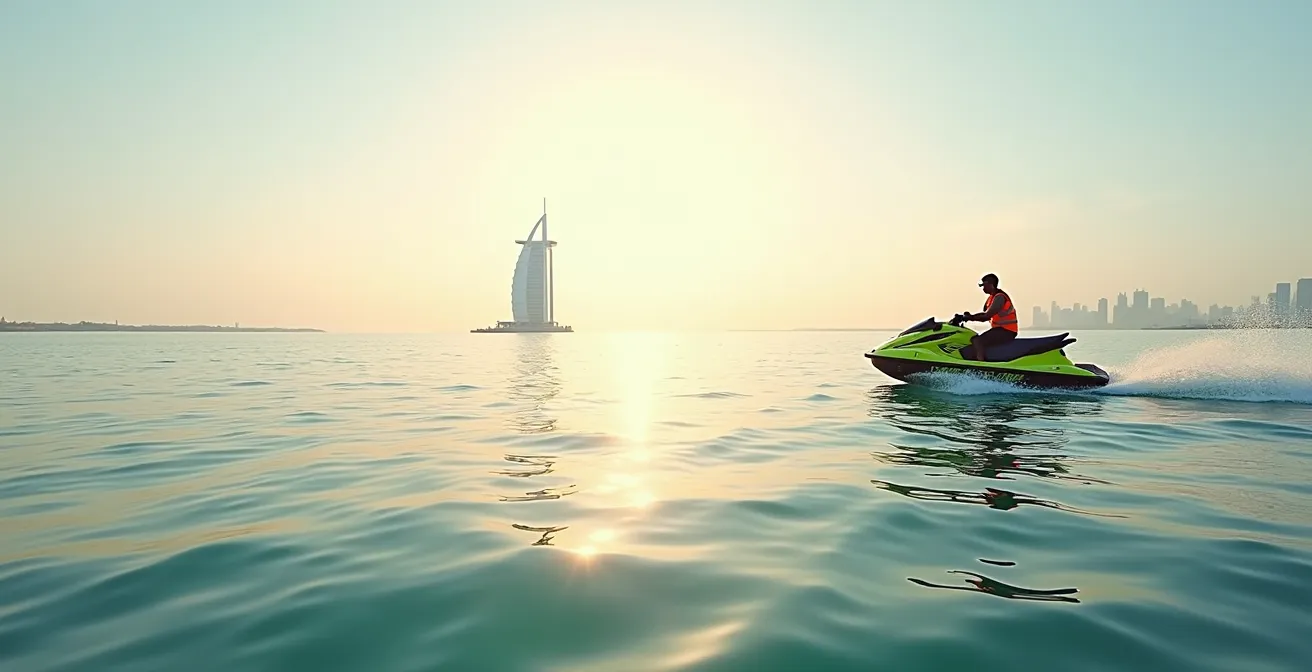
The image of a jet ski carving through azure waters with the iconic Burj Al Arab in the background is a powerful marketing tool for Dubai tourism. However, this idyllic picture omits a critical legal reality: the water is not an open playground but a tightly controlled maritime jurisdiction. For the thrill-seeking tourist, a moment’s inattention or ignorance of an invisible boundary can trigger an immediate fine, often starting at AED 1,836 (approximately $500), and escalate into catastrophic financial liability. Most guides offer generic safety advice about wearing life vests or staying hydrated. This is insufficient.
This document is not a travel guide; it is a legal briefing. It proceeds from the foundational premise that when you sign a rental waiver, you are not merely hiring a machine; you are accepting strict liability within a regulated space. The common defense of “I didn’t see the line” or “I didn’t know” holds no legal weight. The enforcement is technological, the penalties are swift, and the secondary risks—from damage scams to voided insurance policies—can far exceed the initial government fine. We will dissect the regulations, the contractual traps, and the operational discipline required to navigate these waters without incident.
This analysis will deconstruct the specific risks you assume, from the moment you choose your watercraft’s engine power to the complex right-of-way rules in crowded channels. By understanding the legal framework and enforcement mechanisms, you can protect yourself from consequences that can ruin far more than just a holiday.
Summary: Navigating Dubai’s Jet Ski Regulations and Liabilities
- 700cc vs 1100cc: Do You Really Need the Extra Power for a 1-Hour Rental?
- Why Freestyle Rentals Are Restricted to Small Zones Only?
- The Scratch Scam: How to Document the Jet Ski Condition Before Riding?
- Forearm Fatigue: Why You Should Book 30 Minutes Instead of 60?
- Where to Put Your Car Keys While Riding at 80km/h?
- The ‘Off-Road’ Clause: Why Your Luxury Rental Insurance Void on Sand?
- Starboard Tack Rule: How to Avoid Collisions in Crowded Waters?
- Why Kite Beach Is Dangerous for Beginners on Weekends?
700cc vs 1100cc: Do You Really Need the Extra Power for a 1-Hour Rental?
The first decision presented by a rental operator—choosing between a standard (approx. 700cc) and a high-power (approx. 1100cc) jet ski—should be viewed through the lens of control and liability, not performance. In Dubai’s jurisdictional waters, both models are frequently electronically limited to the same top speed for insurance and regulatory compliance. The “extra power” of an 1100cc engine therefore does not translate to higher speed, but to more aggressive acceleration and reduced maneuverability for a novice operator. This heightened torque increases the risk of an unintentional zone violation, as you can cross a geo-fenced boundary in seconds.
Furthermore, the physical demand of controlling a higher-powered machine in the constant, sharp chop created by yacht wakes is substantially greater. This leads to premature biomechanical failure, specifically in the forearms, impairing your ability to maintain precise control. From a liability perspective, the 700cc model offers superior control and a reduced risk profile for no practical loss in top-end performance, making it the legally prudent choice for any session under an hour. The higher rental cost of the 1100cc model buys you increased risk, not increased speed.
The following table outlines the critical differences from a risk-management perspective. As the data shows, the primary distinction is not performance but the operational burden and associated risk of violation.
| Feature | 700cc Jet Ski | 1100cc Jet Ski |
|---|---|---|
| Top Speed (GPS Limited) | 53 mph (85 kph) | 53 mph (85 kph) – Often electronically limited |
| Fuel Consumption | 3-4 gallons/hour | 5-7 gallons/hour |
| Control in Choppy Waters | More manageable for beginners | Requires experienced handling |
| Physical Fatigue (30 min) | Moderate | High – amplified by yacht wakes |
| Rental Cost/Hour | AED 400-500 | AED 600-800 |
| Risk of Zone Violation | Lower – easier to control speed | Higher – can cross boundaries in seconds |
Why Freestyle Rentals Are Restricted to Small Zones Only?
The concept of “freestyle” riding is a misnomer in Dubai’s maritime jurisdiction. All personal watercraft (PWC) operations are confined to strictly defined, non-negotiable zones enforced by technology. The reason is one of public safety and maritime order. Dubai’s coastal waters are a highway for commercial vessels, private superyachts, and tourist ferries, all operating under complex maritime traffic rules. Unrestricted PWC activity would create unacceptable levels of collision risk. To mitigate this, Dubai Police and the Dubai Maritime Authority (DMA) mandate that rental operators use GPS geofencing technology to create virtual perimeters.
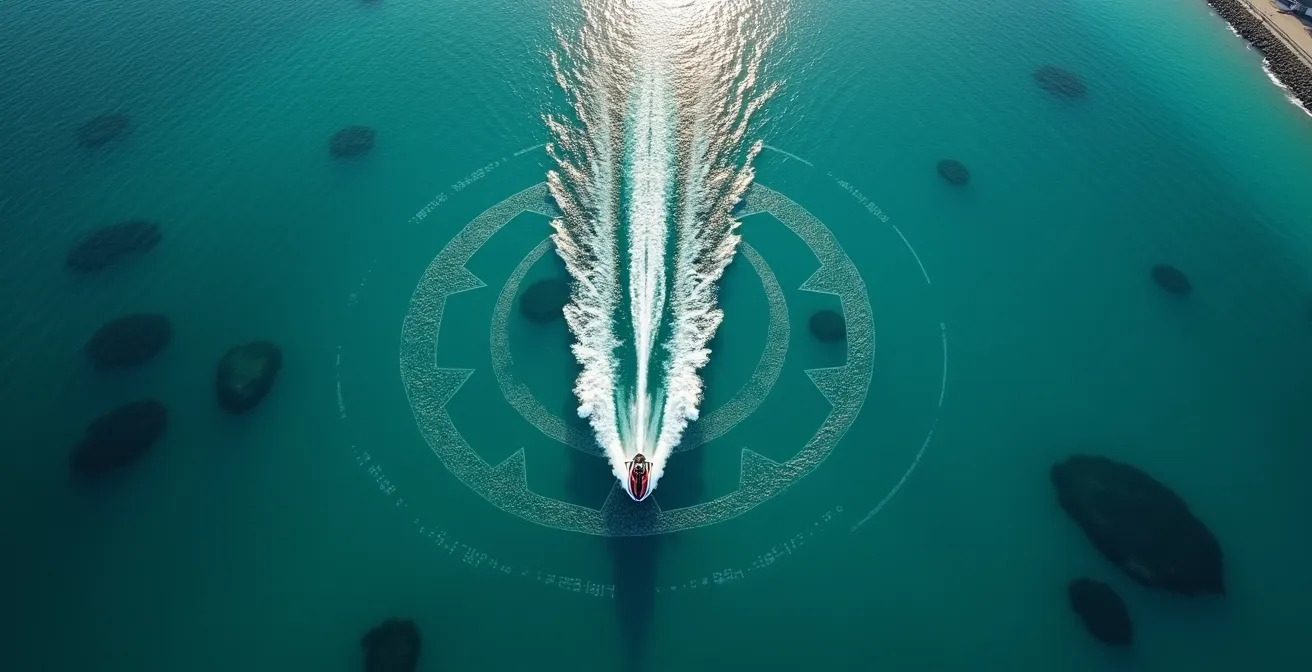
This system functions as an invisible electronic barrier. As a rider approaches the boundary of the approved zone, the jet ski’s onboard system will issue audible warnings. If the rider proceeds to cross this boundary—for example, by approaching too close to the Burj Al Arab or entering a shipping lane—the system is programmed to automatically reduce engine power or shut it down completely. The operator at the rental station is monitored in real-time. This is not a matter of discretion; it is an automated enforcement mechanism. Recent data from Dubai Police’s enforcement crackdown, which saw 431 fines issued and 41 jet skis seized, underscores the seriousness of these violations. The small size of the zone is a deliberate safety constraint, not a suggestion.
The Scratch Scam: How to Document the Jet Ski Condition Before Riding?
Beyond regulatory fines, a significant financial risk comes from commercial disputes with rental operators over pre-existing damage. The “scratch scam” is a common scenario where a renter is blamed—and charged exorbitant fees—for minor cosmetic damage that was already present on the jet ski’s hull. Upon your return, the attendant “discovers” a scratch and demands immediate payment, leveraging your position as a tourist with a flight to catch. Without objective proof to the contrary, you have little recourse. Your defense must be prepared before you start the engine.
The only effective countermeasure is to create a non-repudiable video record of the vessel’s condition prior to departure. This is not a casual walkaround; it is the creation of forensic evidence. You must operate under the assumption that you will need to prove your innocence later. Your phone’s video camera is your legal tool. By meticulously documenting every existing scratch, dent, and mark, you create an evidentiary baseline that makes it impossible to be falsely charged for pre-existing damage. This procedure is non-negotiable for any PWC rental.
Your Forensic Video Documentation Checklist
- Timestamp the Record: Begin the video by clearly showing your phone’s lock screen with the current date and time, then briefly film the rental agreement.
- Involve the Attendant: Politely get the rental agent’s face on camera and state, “I am just documenting the ski’s condition before we go.” Ask them to confirm they are present for your inspection.
- Conduct a 360-Degree Hull Inspection: Walk slowly around the entire jet ski, narrating and zooming in on every single scratch, scuff, or piece of damaged trim you see.
- Document High-Risk and Hidden Areas: Pay special attention to the bumpers, the underside of the hull, and critically, the jet intake grate at the rear, where debris damage is often claimed.
- Obtain Verbal Confirmation: Point your camera directly at a significant existing scratch and ask the attendant, “Can you just confirm for the video that this damage is already here?” Their verbal agreement is powerful evidence.
Forearm Fatigue: Why You Should Book 30 Minutes Instead of 60?
The decision to book a 60-minute session over a 30-minute one is often based on a perceived value-for-money calculation. This is a critical error in judgment. From a legal and safety standpoint, the second half of an hour-long session represents a period of significantly elevated risk. The primary cause is not boredom, but a predictable biomechanical failure: forearm and grip fatigue. Dubai’s coastal waters are not calm. The constant, unpredictable chop created by the wakes of innumerable superyachts places an immense and sustained load on the rider’s core, forearms, and hands.
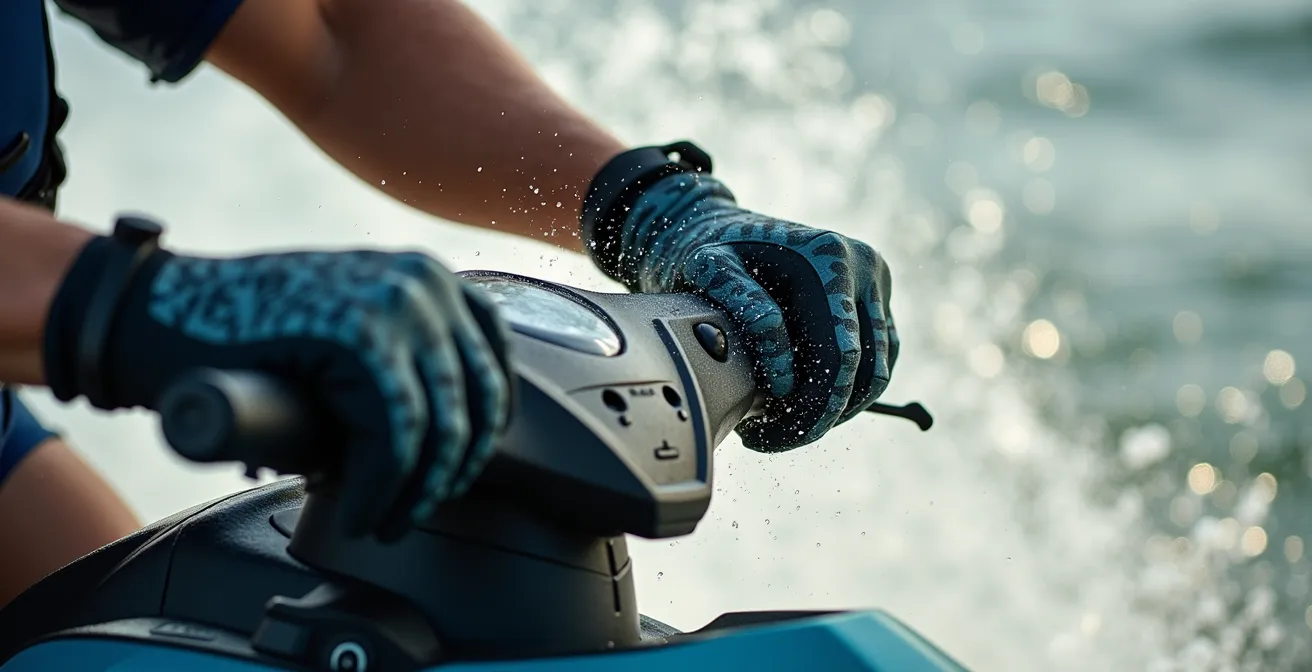
For a novice rider, this physical demand is unsustainable for a full hour. Safety experts and rental operators consistently observe that after 25-30 minutes of intense riding, decision-making quality significantly decreases. Fatigue impairs reaction time, degrades the ability to maintain a steady course, and increases the likelihood of an unintentional error, such as crossing into a restricted zone or failing to observe right-of-way rules. Most accidents and violations occur during this latter half of the rental period. Booking a 30-minute session ensures you operate the craft during your peak physical and cognitive state, drastically reducing your liability profile. Opting for 60 minutes means you are consciously choosing to operate the PWC in a state of degradation, which is legally indefensible in the event of an incident.
Where to Put Your Car Keys While Riding at 80km/h?
The question of where to store valuables—specifically modern electronic car keys and smartphones—is a critical point of failure with severe financial consequences. A standard waterproof pouch is not a reliable solution. The combination of high-speed impacts against waves, intense sun, and the corrosive nature of saltwater creates a high probability of failure for simple plastic pouches. The loss of a modern electronic car key fob is not a minor inconvenience; replacement and reprogramming can cost upwards of AED 3,000 and may require the vehicle to be towed to a dealership.
The only legally sound protocol is to assume any item you take with you will be lost or destroyed. Therefore, the primary solution is to leave all valuables on shore. Reputable rental operators provide secure lockers for this exact purpose. Do not carry your car key, wallet, or primary phone. If you must carry a device for photos, it should be a secondary, waterproof device for which you accept the full risk of loss. Never place your car key and phone in the same container; a single point of failure should not result in a total loss of communication and transportation.
During our Dubai jet ski rental, the operator provided secure lockers at the marina which gave us complete peace of mind. We left our car keys, wallets, and phones safely on shore. The rental company even provided a waterproof phone case for taking photos, but we decided to leave our phones in the locker after hearing about another customer whose ‘waterproof’ bag failed and destroyed their iPhone and Mercedes key fob – a AED 3,000 replacement cost.
– Jet Ski Rental Customer, TripAdvisor Review
The most effective risk mitigation strategies include:
- Shore Storage: Utilize the operator’s secure lockers as the default. This is the only zero-risk option.
- Redundancy: If you must take items, use two separate, high-quality waterproof containers. Never consolidate all critical items into one bag.
- Hard Case Solution: For essential items like medication, a crush-proof and truly waterproof hard case (e.g., Pelican Micro Case) attached securely to your life vest is a far superior option to a soft pouch.
- Backup Plan: Always have a contingency. Leave a spare car key with a friend who is not riding or secured in a lockbox on your vehicle.
The ‘Off-Road’ Clause: Why Your Luxury Rental Insurance Void on Sand?
A common misconception is that the rental fee includes comprehensive insurance covering any eventuality. This is false. The insurance provided is conditional and contains critical exclusions. The most significant of these is what can be termed the “off-road” clause: the policy is immediately and irrevocably voided the moment the jet ski is operated outside of its intended environment—the water. This specifically includes beaching the craft on sand, whether on the shoreline or a sandbar, even for a moment to take a photograph. This action constitutes gross negligence under the terms of most rental agreements.
The legal and financial consequences are twofold. First, you become personally and fully liable for any damage to the watercraft. The most common and catastrophic damage is impeller and engine destruction from sand ingestion. When a beached jet ski is started, its powerful jet pump acts as a vacuum, sucking in sand, shells, and gravel. This is mechanically equivalent to throwing rocks into a jet engine, causing thousands of dollars in damage that you will be required to pay out of pocket.
Case Study: The AED 12,000 Sandbar Photograph
A rental customer beached their jet ski on a sandbar near Palm Jumeirah for photos, instantly voiding their insurance. Upon restarting the engine, the impeller ingested sand, causing catastrophic damage to the propulsion system and internal cooling lines. The repair bill exceeded AED 12,000. Additionally, the customer was subject to environmental fines from Dubai authorities for disturbing a protected shallow water area. The entire financial burden fell upon the renter due to the single act of beaching the craft.
Second, operating in this manner is a violation of maritime regulations. Dubai Police enforcement records show fines up to AED 5,000 for operating jet skis in unauthorized manners or zones. By beaching the PWC, you expose yourself simultaneously to massive commercial liability and significant regulatory penalties. The hull of the jet ski must never touch sand.
Starboard Tack Rule: How to Avoid Collisions in Crowded Waters?
Avoiding fines from zone violations is only one aspect of maritime liability. Preventing collisions in the congested waters around areas like the Dubai Marina and the Palm Jumeirah requires adherence to the international maritime ‘rules of the road’. These are not suggestions; they are laws governing right-of-way. The most fundamental principle is the hierarchy of vessels: a small, maneuverable PWC must always give way to any larger, less maneuverable vessel. This includes yachts, ferries, and commercial boats. Their inability to stop or turn quickly gives them absolute right of way.
Beyond this overarching rule, specific protocols must be followed:
- Vessel Hierarchy: Large vessels always have priority. Assume they cannot see you and cannot avoid you. Your duty is to stay clear.
- Speed in Marinas: Within all marina zones, harbor entrances, and channels, you must maintain a slow, 5-knot (9 km/h) speed. This is a strict “no wake” zone.
- Crossing Wakes: When you must cross the wake of a larger boat, slow down to near-idle speed and approach the wake at a 90-degree angle to prevent the PWC from being flipped or destabilized.
- The Stand-On Vessel (Green Light): If you are approaching another vessel and you see its green (starboard side) light, you are the “stand-on” vessel. You should maintain your course and speed with caution.
- The Give-Way Vessel (Red Light): If you see the other vessel’s red (port side) light, you are the “give-way” vessel. You are legally obligated to take early and substantial action to keep well clear, either by slowing down, stopping, or altering your course to pass behind them.
- Safe Distance: Maintain a minimum distance of 100 meters from any anchored vessel, designated swimming area, or maritime infrastructure.
Failure to abide by these rules, particularly the give-way obligation, which results in a collision, will place you at 100% legal fault. Ignorance of the starboard tack rule is not a defensible position.
Key Takeaways
- Your rental insurance is conditional and instantly voided by negligent acts like beaching the jet ski on sand.
- Physical fatigue directly translates to legal liability; most violations and accidents occur after 30 minutes of riding.
- The only reliable method to counter damage scams is to create a forensic video record of the jet ski’s condition before departure.
Why Kite Beach Is Dangerous for Beginners on Weekends?
Kite Beach is an iconic location, but for a novice jet ski operator, it represents one of the most hazardous environments in Dubai, especially on a weekend afternoon. The danger is multi-faceted, combining environmental, traffic, and equipment-specific risks into a chaotic and unpredictable scenario. The primary hazard is not the jet skis, but the kitesurfers themselves. Local watersports data indicates that Kite Beach sees over 200 active kitesurfers on weekend afternoons during peak season.

This high traffic density creates two specific and severe risks. First is the danger of line entanglement. Kitesurfers are attached to their kites by up to 25 meters of high-tensile Kevlar lines. These lines are nearly invisible against the water and sky and have enough strength to cause severe lacerations or decapitation. A jet ski crossing a kite line at speed is a potentially lethal scenario for both the rider and the kitesurfer. Second, the movement of kites is dictated by wind gusts and is therefore erratic and instantaneous. A kitesurfer can change direction or drop from the sky with no warning, leaving a PWC operator with zero reaction time. While kitesurfers have an informal, unmarked launch and landing zone at the water’s edge, entering this area on a jet ski is a severe breach of safety protocol and invites a high probability of collision. The chaotic water state, churned up by wind and dozens of boards, further complicates navigation for an inexperienced rider.
Ultimately, operating a personal watercraft in Dubai’s jurisdictional waters demands a paradigm shift from a recreational mindset to one of rigorous legal and operational discipline. The allure of speed and scenery must be secondary to a constant awareness of boundaries, rules, and liabilities. By internalizing the protocols outlined—from pre-ride documentation to understanding the physical limits of fatigue—you are not diminishing the experience, but rather insulating it from catastrophic financial and legal consequences. Your best insurance policy is your own diligence.