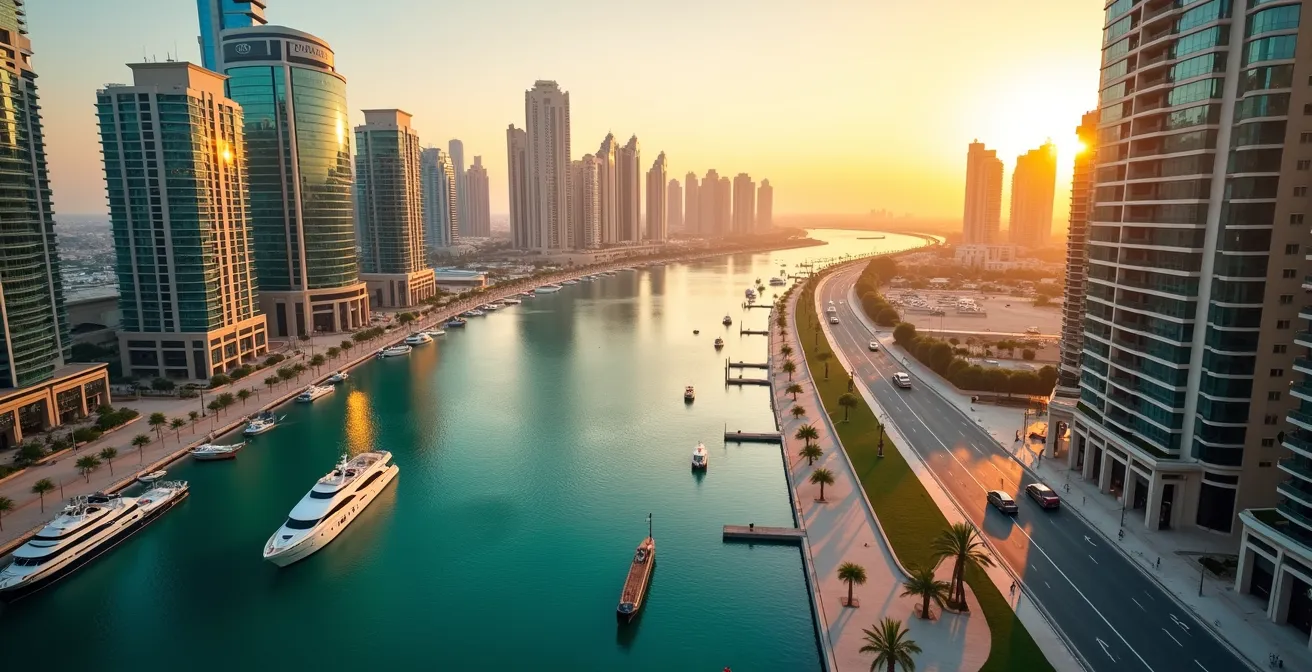
Contrary to popular belief, a traffic-free life in Dubai Marina is possible, but it has nothing to do with being close to Sheikh Zayed Road.
- Success lies in mastering the “last 500 meters”—the specific entry/exit points and internal loops around your chosen tower.
- Key factors are your tower’s position relative to bridge chokepoints and lifestyle-driven traffic corridors (like the Thursday night rush).
Recommendation: Prioritize towers with direct access to less-congested side bridges and those on the quieter, western side of the Marina loop.
The vision of living in Dubai Marina is seductive: sparkling waterways, a skyline of architectural marvels, and a vibrant waterfront lifestyle at your doorstep. For many expats, it represents the Dubai dream. Yet, this dream often clashes with a frustrating reality: the notorious, soul-crushing traffic. The common advice you’ll hear is to “live near a metro station” or “pick a tower with easy access to Sheikh Zayed Road.” While not wrong, this advice is dangerously incomplete. It ignores the fundamental truth of Marina life: the biggest traffic headaches don’t happen on the highway; they happen in the last 500 meters to your building’s car park.
As a relocation specialist, I’ve seen countless residents choose a stunning apartment with a perfect view, only to find their daily life dictated by gridlock. The real challenge is navigating the internal one-way systems, the bridge chokepoints, and the weekend tourist swells that can turn a five-minute drive into a thirty-minute ordeal. This is not just about convenience; it’s about your quality of life. Getting this choice wrong means dreading every trip out, avoiding social plans, and feeling trapped in your own home during peak hours.
This guide offers a different perspective. We will move beyond the generic map view and provide you with the on-the-ground intelligence needed to make a strategic choice. We will deconstruct the Marina’s micro-traffic patterns, focusing on the nuanced factors that determine whether your building is a sanctuary or a trap. By understanding the specific lifestyle corridors and access points, you can select a tower that offers all the benefits of Marina living without the daily frustration. This is your blueprint for outsmarting the traffic and truly enjoying one of Dubai’s most incredible communities.
In this detailed analysis, we’ll cover the critical questions that go beyond simple location mapping. From the real difference between sea and marina views on a noisy evening to the smartest ways to navigate the area on foot and by water, you’ll gain the insider knowledge to choose your home with confidence.
Summary: A Strategic Guide to Selecting a Traffic-Free Dubai Marina Tower
- Marina View vs Sea View: Which Side Is Quieter on Thursday Nights?
- Where to Run in Dubai Marina Without Dodging Tourists Every 5 Meters?
- Water Bus vs Water Taxi: Which Is the Real Commuter Hack?
- How to Spot a ‘Tourist Trap’ Restaurant on the Marina Walk?
- Which Bridge connects JBR to Marina Fastest on Foot?
- Living on Bluewaters: Is It Too Noisy for Families?
- Downtown Address vs Marina Address: Which Offers Better Walkability?
- How to Find Free Parking at JBR Beach Walk on a Weekend?
Marina View vs Sea View: Which Side Is Quieter on Thursday Nights?
The choice between a Marina view and a sea view seems purely aesthetic, but it has significant lifestyle implications, especially regarding noise. A Marina-facing apartment places you front and center for the area’s vibrant energy, but this energy translates to noise. With a dense population of over 70,550 residents in a compact area, sound travels and amplifies, particularly on busy evenings like Thursdays.
The Marina side acts as an ‘acoustic canyon,’ where the sounds from the promenade, restaurants (especially around Pier 7), and road traffic bounce between the tall towers. This can create a constant, low-level hum punctuated by louder events. A sea-facing apartment, on the other hand, generally offers a buffer from this internal activity. You’ll hear the distant sound of the surf rather than the specifics of street-level life. However, be mindful of proximity to JBR beach clubs, which can generate their own brand of noise.
The key is to conduct your own due diligence. Visiting a prospective apartment is not enough; you must visit it at the time you’re most concerned about. For most working professionals, this is Thursday night, the start of the weekend in Dubai. Before signing any lease, use a systematic approach to assess the real-world noise levels you’ll be living with.
Your Thursday Night Noise Assessment Checklist
- On-Site Visit: Schedule a viewing around 10 PM on a Thursday to experience peak weekend noise.
- Orientation Check: Determine if the unit’s windows and balcony face a main road, a busy promenade section, or a quieter side street.
- Floor Level Test: Noise dissipates with height. Test apartments on lower floors versus those above the 30th floor to gauge the difference.
- Entertainment Proximity: Identify the direct line of sight and distance to major noise sources like Pier 7 and popular beach clubs.
- Acoustic Environment: Stand on the balcony and listen specifically for the ‘acoustic canyon’ effect—the echo and amplification of sound between buildings.
Ultimately, the “quieter” side depends on your tolerance and lifestyle. If you thrive on the buzz of the city, the Marina view is for you. If you prioritize tranquility after a long week, a high-floor, sea-facing unit is the safer bet.
Where to Run in Dubai Marina Without Dodging Tourists Every 5 Meters?
The 7-kilometer Dubai Marina Walk is one of the area’s greatest assets—a scenic, pedestrianized loop perfect for a morning run or evening stroll. However, for residents, it can quickly become an obstacle course of tourists, strollers, and rental e-scooters, especially during peak hours (after 9 AM and on weekends). The secret to a peaceful run isn’t giving up on the Walk, but knowing which parts to use and when.
The most effective strategy is to run early. Before 8 AM, the promenade is almost exclusively used by fellow residents and fitness enthusiasts. The light is beautiful, the air is cooler, and the pathways are clear. This is the golden hour for anyone looking to enjoy the Marina’s beauty without the crowds. The experience is completely different from a midday jog.

Furthermore, not all parts of the Walk are created equal. The main stretch of the promenade, particularly the area adjacent to Dubai Marina Mall and the surrounding cafes, is the most congested. For a quieter route, head to the western side of the Marina, opposite the mall. This section is generally less crowded and offers the same stunning views. Many runners create their own circuits by incorporating the various bridges, which add welcome elevation changes to an otherwise flat workout.
By simply adjusting your timing and route, you can transform the Marina Walk from a frustrating tourist thoroughfare into your own private running track. It’s a prime example of how local knowledge can dramatically improve your quality of life in a bustling district.
Water Bus vs Water Taxi: Which Is the Real Commuter Hack?
When road traffic feels insurmountable, looking to the water is a classic Marina resident’s strategy. The RTA operates both the Water Bus and Water Taxis, but they serve very different purposes. Understanding this distinction is key to using them effectively as a genuine “commuter hack” rather than just a tourist novelty. The Water Bus is the Marina’s equivalent of a public bus service, operating on a fixed route with scheduled stops and low fares. It’s a fantastic option for a leisurely, scenic commute between key points like Marina Terrace, Marina Walk, and Marina Mall.
The Water Taxi, by contrast, is a private, on-demand service. It’s more expensive but offers unparalleled flexibility, speed, and privacy. Think of it as the Uber or Careem of the waterways. It’s the ultimate hack for beating traffic on a deadline, such as getting to a dinner reservation in JBR from the other side of the Marina on a Thursday evening without touching a single road. It can turn a 30-minute stressful drive into a 10-minute pleasant boat ride.
Choosing the right option depends entirely on your needs: cost and routine versus speed and urgency. The following table breaks down the key differences, helping you decide which service best fits your situation. As this data on Dubai’s transport options shows, having multiple modes of transit is essential in a dynamic city.
| Feature | Water Bus | Water Taxi |
|---|---|---|
| Cost per Trip | AED 2-5 | AED 25-75 |
| Wait Time | 15-20 minutes | On-demand (varies) |
| Operating Hours | Fixed schedule | Flexible |
| Best For | Regular scenic commute | Urgent trips, avoiding traffic |
| Walking Distance to Stations | 10-15 minutes from most towers | Various pickup points |
For a daily, predictable journey, the Water Bus is an economical and enjoyable choice. For those moments when time is critical and traffic is at its peak, the Water Taxi is a powerful tool in any Marina resident’s arsenal.
How to Spot a ‘Tourist Trap’ Restaurant on the Marina Walk?
The Marina Walk is lined with dozens of restaurants, but for residents, finding an authentic, high-quality dining experience among the tourist traps can be a challenge. The establishments designed for high-volume tourist turnover often prioritize location and flashy promotions over food quality and service. A true local learns to spot the red flags from a distance.
The most obvious warning sign is a laminated, multi-cuisine photo menu. Restaurants trying to be everything to everyone (serving pizza, curry, and sushi under one roof) rarely excel at anything. Another red flag is the presence of aggressive promoters on the walkway trying to lure you in. The best restaurants don’t need to do this; their reputation speaks for itself. Also, be wary of places where the most prominent signage is for shisha or neon-colored “mocktails” rather than the food itself.
So, where do the locals eat? The real gems are often hidden in plain sight. One of the best strategies is to look one floor up. Many residential towers have fantastic licensed restaurants on their first or second floors. These establishments cater to residents, not passing tourists, and the quality is typically much higher. They offer a more relaxed atmosphere and often provide stunning views away from the noise of the main promenade.
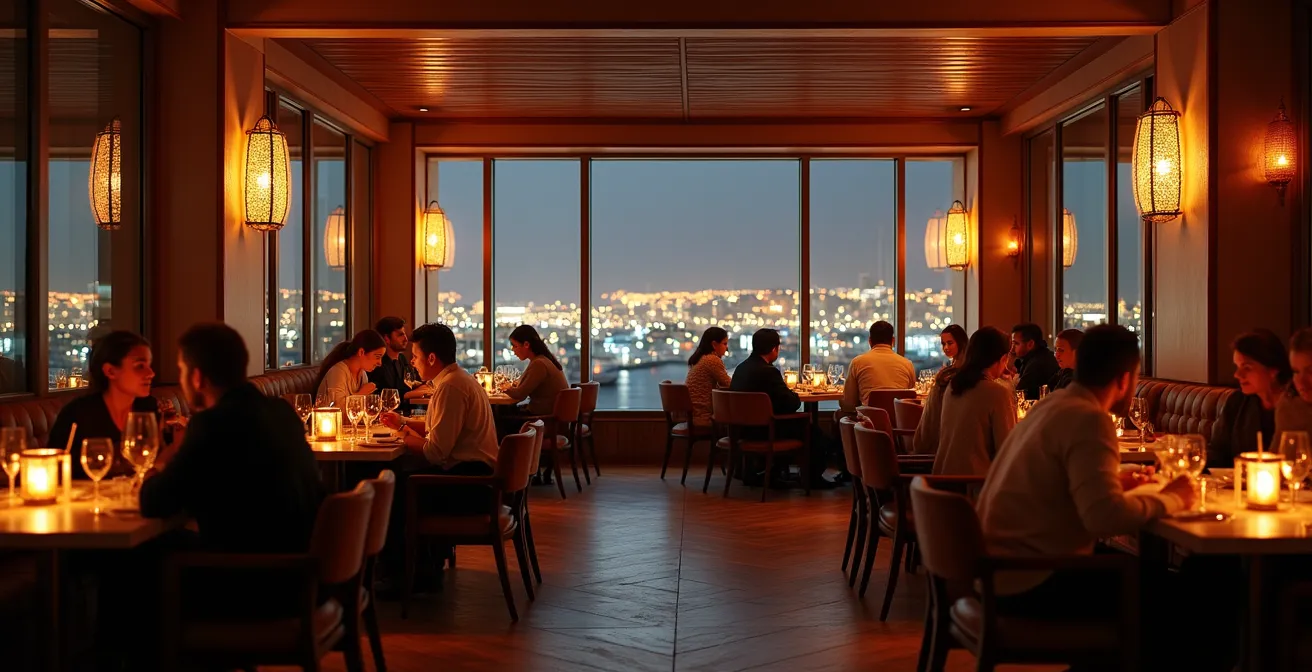
To eat like a local, you must think like one. Ignore the ground-floor chaos and seek out the places that rely on repeat business from the community. A few key indicators can guide you to a much more satisfying meal:
- Check for specialized menus focusing on a single cuisine.
- Observe the clientele; a higher proportion of residents versus tourists is a good sign.
- Look for restaurants tucked away in the lobbies or upper floors of residential towers.
- Favor places with subtle branding over those with flashing lights and aggressive promotions.
Which Bridge connects JBR to Marina Fastest on Foot?
The pedestrian bridges connecting Dubai Marina to Jumeirah Beach Residence (JBR) are essential pieces of infrastructure, but they are not all created equal. From a map, they appear to be simple, direct connections. In reality, they are major access chokepoints where the “last 500 meters” principle is painfully evident. The ‘fastest’ bridge often has less to do with its length and more to do with a critical, often overlooked factor: elevator congestion.
On the JBR side, access to the bridges is almost exclusively via elevators. On a busy weekend evening, the queue for these elevators can easily add 10-15 minutes to your journey. A short walk across the bridge becomes a frustrating waiting game. Residents quickly learn that the most centrally located bridges are often the most congested.
The strategic choice involves a trade-off. You might opt for a bridge that is slightly further from your destination but has less-crowded elevators or better accessibility, such as those with larger cabins or adjacent ramps. This is especially true for families with strollers or individuals with mobility needs. The “fastest” route on paper is irrelevant if you spend most of your time waiting in a queue.
This is a perfect illustration of the micro-geographical intelligence required for a smooth Marina life. Before choosing an apartment based on its “proximity to JBR,” a savvy resident will walk the route during peak times. They will assess not just the bridge, but the entire journey, including the wait times at these critical chokepoints. This firsthand experience is invaluable and something no map can show you.
Living on Bluewaters: Is It Too Noisy for Families?
Bluewaters Island offers a compelling, self-contained community lifestyle with stunning views of Ain Dubai and the JBR skyline. However, for families considering a move here, the primary concern is often noise. As an island destination designed for entertainment, it is inherently exposed to sound from multiple sources. Dubai’s record 18.72 million tourists in 2024 directly impacts destinations like this, meaning what is peaceful on a Tuesday morning can be overwhelming on a Friday night.
The noise on Bluewaters comes from three main sources: the beach clubs on the island itself, the ambient noise from events at the Ain Dubai plaza, and the sound carrying across the water from JBR. The island’s design can create an acoustic bounce effect, where sound reflects off the water and the facades of nearby buildings, amplifying the overall level. Families must be particularly strategic about their apartment’s orientation.
Units facing the mainland or the inner parts of the island are significantly more shielded from the noise of beach clubs and the JBR shoreline. Conversely, apartments with direct sea and JBR views will have a more “active” soundscape. Another critical factor is the island’s single entry and exit point. While this creates a sense of exclusivity, it also becomes a major traffic bottleneck during peak egress times, such as after a major event or on a Friday afternoon. This is a crucial consideration for daily commutes.
For any family, a thorough noise assessment is non-negotiable. This means visiting a potential apartment at different times, especially during peak beach club hours (afternoons and evenings) and on weekends, to understand the worst-case scenario. This diligence ensures the island’s vibrant atmosphere remains a positive feature rather than a daily disturbance.
Downtown Address vs Marina Address: Which Offers Better Walkability?
When choosing between Dubai’s prime residential districts, walkability is a major factor, but “walkability” means two very different things in Dubai Marina versus Downtown Dubai. It’s a choice between two distinct lifestyles: open-air waterfront leisure versus climate-controlled urban efficiency. Neither is inherently better, but one will certainly suit your preferences more.
Dubai Marina’s walkability is defined by its 7km waterfront promenade. It’s an environment designed for leisure: strolling, jogging, and cycling with a sea breeze. In the cooler months, it’s an unparalleled outdoor experience. Even in summer, the shadows cast by the tall towers and the natural breeze off the water provide pockets of relief. Its walkability is self-contained; you can walk to the beach, a mall, and hundreds of restaurants without leaving the “bubble.”

Downtown Dubai offers a completely different proposition. Its walkability is functional and built around climate control. You can move from your apartment tower through air-conditioned tunnels to the Dubai Mall, the Metro, and connected business districts like DIFC. It is a system engineered for comfort during the hottest summer months, prioritizing an efficient, sweat-free commute over scenic leisure. The comparison is clearly illustrated by area guides that analyze prime residential lifestyles.
The table below highlights the core differences in the walking experience between these two iconic neighborhoods.
| Factor | Dubai Marina | Downtown Dubai |
|---|---|---|
| Walking Environment | 7km waterfront promenade, sea breeze | Air-conditioned mall connections |
| Summer Comfort | Shaded walkways, natural breeze | Metro tunnels, mall passages |
| Connectivity | Contained bubble (beach/restaurants/mall) | Links to DIFC, City Walk districts |
| Metro Access | 2 stations (DMCC, Sobha Realty) | Multiple metro connections |
| Best For | Leisure strolls, waterfront lifestyle | Functional commutes, business access |
Your choice depends on your priorities. If your ideal day involves a morning run by the water and a short walk to a beachside cafe, the Marina is unmatched. If your priority is a seamless, climate-controlled walk from your home to your office and the world’s largest mall, Downtown is the logical choice.
Key Takeaways
- The worst traffic is in the “last 500 meters” to your tower, not on the main highways.
- Your apartment’s orientation (Marina vs. Sea view) and floor height are critical for managing noise, especially on weekends.
- Use water transport (Bus for leisure, Taxi for speed) as a strategic hack to bypass road congestion entirely.
How to Find Free Parking at JBR Beach Walk on a Weekend?
For Marina residents, a trip to the neighboring JBR on a weekend can be an exercise in frustration, primarily due to parking. While JBR’s The Walk and The Beach offer a fantastic atmosphere, finding convenient and affordable parking can feel impossible. However, with a bit of local knowledge and strategic timing, you can avoid paying exorbitant fees.
The most straightforward option is to use the Dubai Marina Mall parking. It offers four hours of free parking on weekends and is only a short, 5-10 minute walk across a bridge to JBR. This is often the most reliable and stress-free solution. For those willing to arrive early, free on-street RTA parking spots can be found, but you generally need to be there before 10 AM to secure one.
Another popular “hack” is to use the parking at The Beach mall itself but get it validated. A small purchase at one of the participating cafes or shops can grant you up to 3 hours of free parking, which is usually enough for dinner or a walk. For those who don’t mind a slightly longer walk, the large, informal sandy lots located behind the JBR tram station are always free, though they are becoming less common as development continues. A final, practical strategy for groups is to drop passengers off at the main entrance to The Walk, then have the driver park at Marina Mall and walk back to meet them.
Here is a summary of the most effective strategies:
- Marina Mall Park & Walk: Park for free for 4 hours at Dubai Marina Mall and walk across to JBR.
- Early Bird RTA: Arrive before 10 AM on a Friday or Saturday to find free RTA street parking.
- The Beach Validation: Make a minimum spend purchase at a retailer in The Beach mall to get your parking ticket validated for 3 hours.
- Sandy Lots: Use the free sandy parking areas behind the JBR tram station, which require a 5-10 minute walk.
- Drop & Park: Drop off passengers at the destination, then park elsewhere (like Marina Mall) and rejoin them.
By combining these strategies, you can enjoy everything JBR has to offer without letting the search for parking ruin your weekend plans.
Ultimately, selecting the right home in Dubai Marina is an act of strategic intelligence. It requires you to look beyond the glossy brochures and apply a critical, on-the-ground lens to your search. Start by applying this “last 500 meters” mindset to your shortlist of towers and conduct your own real-world assessments.