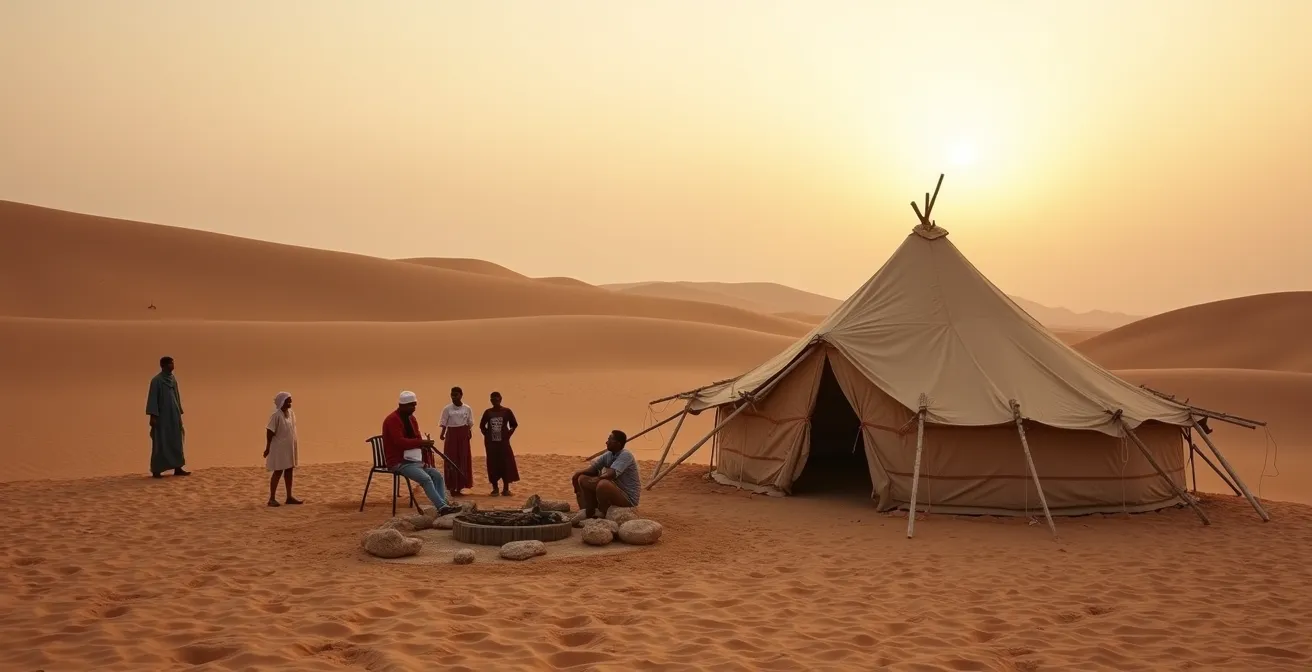
Contrary to popular belief, the authenticity of a desert camp isn’t defined by having belly dancers and a camel ride; it’s revealed in the operational details that most tourists overlook.
- Genuine heritage is evident in the provenance of its entertainment and the method of cooking (e.g., underground Zarb vs. generic grill).
- Authentic hospitality focuses on facilitating connection (intangible heritage) rather than just providing a seat at a table.
Recommendation: Adopt a cultural auditor’s mindset. Question everything—from the water source to the music’s origin—to distinguish a deeply-rooted cultural experience from a shallow, staged performance.
For the culture-seeking traveler, the promise of a night under the stars in a Bedouin camp is magnetic. It evokes images of crackling fires, ancient stories, and genuine connection. Yet, the reality is often a jarring cacophony of neon lights, blaring pop music, and entertainment that has more in common with a Las Vegas revue than desert tradition. The market is saturated with “heritage” experiences that are little more than well-marketed tourist traps, leaving discerning visitors feeling cheated and disconnected.
The common advice—to check reviews or choose smaller camps—barely scratches the surface. These are superficial markers in an industry skilled at manufacturing an illusion of authenticity. The core issue is that most travelers don’t possess the framework to properly audit what is presented to them. They can spot a dirty fork, but they cannot spot a culturally dissonant performance or a menu that betrays its “traditional” claim. This is where the approach must shift from that of a tourist to that of a cultural heritage auditor.
This guide abandons the generic checklist. Instead, it provides a critical framework for deconstruction. We will not just list what to look for; we will explain the cultural logic behind each element. By learning to analyze the operational integrity of a camp—from its buffet hygiene and toilet facilities to the very etymology of its BBQ—you will gain the capacity to see past the marketing veneer and identify the subtle, yet powerful, signals of a truly authentic heritage experience. It’s about learning to read the cultural semiotics of the desert camp, where every choice, no matter how small, tells a story about its true purpose: preservation or profit.
This detailed audit will guide you through the critical checkpoints. The following sections break down the key areas where authenticity is won or lost, equipping you with the questions and observational skills needed to make an informed choice.
Summary: A Critical Framework for Evaluating Desert Camps
- Buffet Hygiene in the Desert: What to Look for Before Eating?
- Will You Feel Awkward at a Shared Camp Table as a Solo Traveler?
- Air-Conditioned Majlis vs Open Air: Which to Choose in September?
- Belly Dancing vs Tanoura: Understanding the Meaning Behind the Shows
- The Toilet Situation in Desert Camps: What to Expect?
- Where to Watch a Live Pearl Diving Demonstration Today?
- Visiting Heritage Sites During Ramadan: What Changes for Tourists?
- What Exactly Is in an Emirati BBQ Dinner Beyond Chicken Tikka?
Buffet Hygiene in the Desert: What to Look for Before Eating?
Before you can assess cultural integrity, you must be confident in a camp’s operational integrity, and nothing reveals that more quickly than its approach to food safety. The desert environment presents unique challenges for food handling, and a camp that cuts corners here is signaling a deeper disregard for guest welfare. While it may seem alarmist, it’s a sobering fact that 800 foodborne outbreaks are reported to the CDC annually, with restaurants and catered events being the primary source. An auditor’s first check is always compliance and safety.
Look beyond the presentation of the buffet line. Are the hot dishes kept on actively heated chafing dishes, not just left to cool in the desert air? Are cold items, especially salads and desserts, presented on chilled plates or beds of ice? These are non-negotiable basics. A key indicator of quality is the presence of live cooking stations. Watching your food being prepared fresh is inherently safer than consuming dishes that may have been pre-cooked hours earlier and transported in less-than-ideal conditions.
Furthermore, an authentic and reputable camp will be transparent about its resources. Don’t hesitate to ask about the source of their drinking water—is it bottled and sealed, or from a questionable tank? Observe the staff. Clean, well-kept uniforms and the diligent use of separate utensils for different dishes reflect a high standard in the kitchen. Finally, assess their pest control. A well-managed camp will have subtle but effective measures to control flies, a major vector for contaminants. The absence of this basic control is a significant red flag.
Will You Feel Awkward at a Shared Camp Table as a Solo Traveler?
The promise of Bedouin hospitality is centered on community and inclusion. A tourist trap processes visitors; an authentic camp welcomes guests. For a solo traveler, the seating arrangement is a powerful litmus test of this philosophy. If you are simply pointed to an empty seat at a long, impersonal table without any introduction, you are in a transactional environment. The camp is merely providing a service, not facilitating an experience of intangible heritage—the living practice of hospitality.
A truly authentic host understands that the essence of a shared meal is shared conversation. As a cultural auditor, observe how the staff manages the social dynamic. Do they actively introduce guests to one another? Do they make an effort to seat people with shared interests or languages together? A prime example can be found in traditional camps like those run by local families in Wadi Rum, where hosts like Saleh see it as their duty to facilitate introductions, turning a collection of strangers into a temporary family. This is the difference between being a customer and being a guest.
The physical layout of the seating area also tells a story. Look for a traditional Majlis-style arrangement, with low cushions and rugs on the ground. This setup is not just for aesthetics; it is designed to create a more intimate, communal, and egalitarian atmosphere, breaking down the formal barriers of tables and chairs.
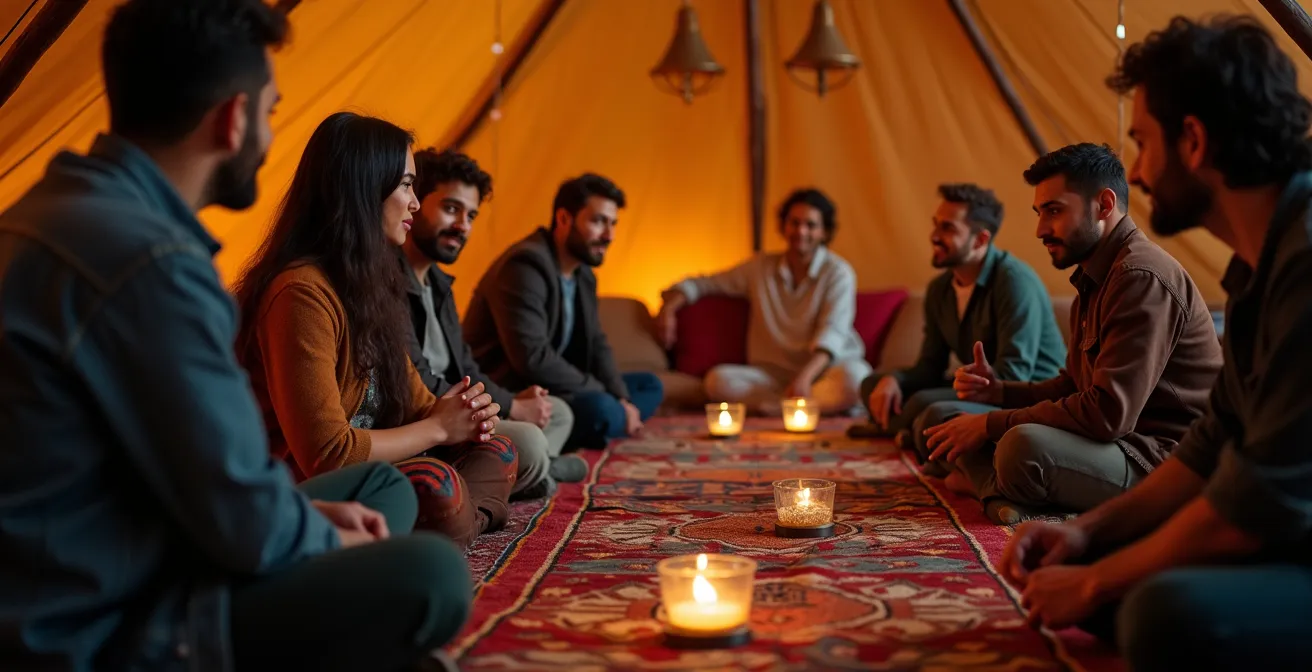
This communal layout inherently encourages interaction and shared experience, making it far less likely for a solo traveler to feel isolated. It reflects a deep-rooted cultural practice where everyone, stranger or friend, is brought into the fold. If you find yourself in a setting that feels more like a school cafeteria than a family gathering, you have your answer about the camp’s authenticity.
Air-Conditioned Majlis vs Open Air: Which to Choose in September?
The choice between an enclosed, air-conditioned tent and a traditional open-air setting is more than a matter of comfort; it’s a philosophical statement about a camp’s priorities. In the heat of September, the allure of a climate-controlled majlis is undeniable. However, a cultural auditor must ask: what is being sacrificed for this modern convenience? The answer is simple: immersion. The desert’s magic is a sensory experience—the feel of the evening breeze, the sound of the shifting sands, the scent of the cool night air. An air-conditioned glass box severs that connection completely.
An authentic heritage camp is built on the principle of living in harmony with the environment, not isolating oneself from it. As Platinum Heritage, a provider of authentic experiences, notes, a heritage camp is for those interested in the real Bedouin lifestyle.
The Heritage camp is a shared camp for 60 guests who want an authentic experience at a camp built in a traditional Bedouin style. This site is great for families and anyone interested in living the Bedouin lifestyle for a night.
– Platinum Heritage Dubai, Desert Safari Comparison Guide
This implies an acceptance of the natural climate. Opting for the open-air setting is a vote for authenticity and sustainability. It demonstrates a willingness to engage with the desert on its own terms. Moreover, the environmental impact of powering large air-conditioning units in a fragile ecosystem is significant. A camp that prioritizes eco-consciousness will almost always favor natural ventilation and traditional architectural designs that promote cooling.
To make an informed decision, it’s crucial to understand the trade-offs involved. This is not just a choice between hot and cold, but between a manufactured environment and a genuine one, as this analysis of the desert experience makes clear.
| Aspect | Air-Conditioned Majlis | Open Air Setting |
|---|---|---|
| Authenticity | Modern comfort prioritized | Historical reality, full immersion |
| Sensory Experience | Climate controlled, isolated | Evening breeze, desert sounds |
| Environmental Impact | Higher energy consumption | Eco-conscious, sustainable |
| Best For | Heat-sensitive guests | Experience seekers |
Belly Dancing vs Tanoura: Understanding the Meaning Behind the Shows
Entertainment is often the most glaring sign of a tourist trap. The ubiquitous belly dancer, while an entertaining and skilled performer, is a culturally misplaced element in an Emirati desert setting. Belly dancing is a pan-Arab art form with roots primarily in Egypt and the Levant, not a traditional Bedouin or Emirati heritage performance. Its presence signals a camp’s willingness to cater to tourist expectations rather than present authentic local culture. A cultural auditor must question the provenance of the performance.
In contrast, the Tanoura dance, often performed by a male dancer in a vibrant, weighted skirt, has deep spiritual roots in Sufism. It is a visually mesmerizing form of meditation and a genuine part of the wider region’s cultural fabric. An authentic camp, such as the Nujum Camp in the UAE, will not only feature appropriate performances but also provide context, explaining the cultural origins and meaning behind what the guests are witnessing. The goal is education, not just spectacle. They might feature local dances like Al-Ayyala or Yowla, which are specific to the UAE and involve synchronized movements with sticks or replica rifles, depicting scenes of communal celebration or battle.
The soundscape is another critical clue. Is the performance backed by a recording, or are there live traditional musicians playing instruments like the Oud or Tabla? The presence of live, local music is a strong indicator of a commitment to preserving and showcasing intangible cultural heritage. To distinguish between a genuine cultural showcase and a staged show, an auditor must apply a specific set of criteria.
Checklist: How to Identify Authentic Cultural Performances
- Contextual Introduction: Verify if performances are introduced with explanations of their cultural origins and significance before the show begins.
- Regional Specificity: Look for local folkloric arts specific to the region, such as Al-Ayyala or Yowla dances, rather than generic entertainment.
- Live Musicians: Assess whether live traditional musicians are present, playing authentic instruments like the Oud, Tabla, or Rababa.
- Accurate Framing: Check if pan-Arab entertainment like belly dance is correctly framed as a modern addition rather than being falsely presented as a local desert tradition.
- Audience Participation: Observe if there are opportunities for respectful audience participation in communal dances, which is a hallmark of genuine cultural sharing.
The Toilet Situation in Desert Camps: What to Expect?
It may seem trivial, but the design and maintenance of a camp’s bathroom facilities offer profound insights into its core values. A discerning traveler should see this not as a mere convenience but as a reflection of the camp’s respect for its guests and the environment. A shoddy, poorly maintained facility signals a business focused on high-volume, low-quality turnover. Conversely, a clean, well-designed, and sustainable facility indicates a deeper commitment to operational integrity and guest comfort.
Top-tier authentic camps, like Magic Camps in Oman, often make sustainability a cornerstone of their identity. They understand that they are stewards of a fragile desert ecosystem. As an auditor, you should look for evidence of this commitment. Are there signs encouraging water conservation? Are the fixtures designed to be water-efficient? Are the structures built with natural, locally sourced materials that blend into the landscape rather than detract from it?
The presence of clean, permanent bathroom structures is a sign of a well-established and professional operation. These facilities should be well-lit, private, and stocked with necessary amenities. They represent a significant investment and a long-term commitment to quality. A camp that makes this investment is demonstrating that it values guest experience over maximizing short-term profit.
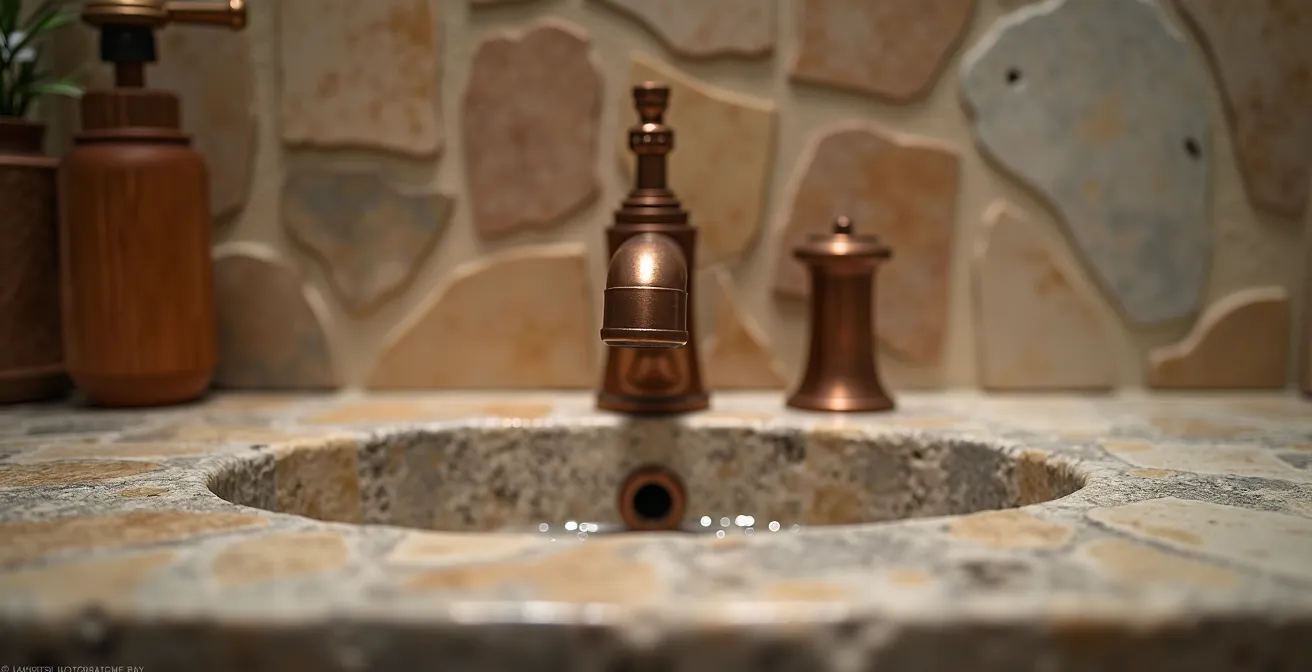
Ultimately, the toilet situation is a microcosm of the camp’s entire philosophy. It reveals their attention to detail, their stance on sustainability, and their fundamental level of respect for their guests and the environment they inhabit. A clean, thoughtful bathroom is not a luxury; it’s a baseline indicator of a quality operation.
Where to Watch a Live Pearl Diving Demonstration Today?
Applying the auditor’s mindset extends beyond the desert. The UAE’s heritage is deeply connected to the sea, and pearl diving was the lifeblood of its economy for centuries. To truly connect with this history, one must seek out experiences that prioritize education and authenticity over mere spectacle. Today, very few places offer a glimpse into this arduous past. Before the oil boom, historical records show that at its peak, nearly 80,000 men worked on pearling vessels, a testament to the industry’s immense scale and importance.
One of the most authentic experiences available is Suwaidi Pearls in Ras Al Khaimah. This is not a theme park reenactment; it is a working pearl farm located on the water. Here, the focus is on historical accuracy and education. Guests are taken on a traditional dhow through the mangroves, a journey that itself is a nod to the past. Along the way, guides, who are often from families with deep roots in the industry, share stories of the divers’ lives. The fact that the entire 2.5-hour experience is the perfect amount to cover everything from live demonstrations to the modern cultivation process shows a well-structured, educational program.
For those seeking a museum context, the Al Shindagha Museum in Dubai is an essential visit. As FZ Heli Tours Dubai points out, its exhibits provide a comprehensive narrative of the nation’s relationship with the sea. Here, you can delve into the technical aspects of the trade and see historical artifacts. The combination of a live demonstration at a place like Suwaidi Pearls and the historical context provided by the museum creates a holistic understanding. This two-pronged approach—witnessing the living practice and studying the historical record—is the hallmark of a true cultural heritage audit.
Visiting Heritage Sites During Ramadan: What Changes for Tourists?
Visiting a Muslim country during the holy month of Ramadan offers an unparalleled opportunity to witness living culture, but it requires a shift in expectations. For a cultural auditor, this period is a test of a heritage site’s true nature. A tourist trap may simply close or continue a watered-down version of its usual program. An authentic camp, however, transforms. It shifts from a place of entertainment to a space of genuine cultural and religious observance.
During Ramadan, many overt forms of entertainment, like belly dancing, are paused out of respect. They are often replaced with more contemplative and culturally specific art forms, such as live Oud music, poetry recitals, or storytelling. The entire rhythm of the camp changes. Daytime operations may be modified to accommodate fasting staff, and the focus of the evening shifts to the breaking of the fast, or Iftar. As the Dubai Tourism Board has noted, this is a moment of profound cultural immersion.
During Ramadan, authentic camps transform from tourist entertainment to living cultural experiences, with Iftar allowing visitors to witness genuine religious and cultural traditions rather than staged performances.
– Dubai Tourism Board, Ramadan Tourism Guidelines 2024
To experience this, look for camps that specifically advertise Iftar experiences. The menu itself becomes a cultural lesson, featuring special Ramadan dishes like Harees (a savory wheat and meat porridge), Sambousek (savory pastries), and traditional juices like Jallab or Qamar al-Din. Participating in an Iftar in the desert, surrounded by those who are observing the fast, is one of the most powerful and authentic experiences a traveler can have. It is a moment of shared humanity that transcends tourism.
Key Takeaways
- True authenticity lies in operational details like hygiene, staff conduct, and environmental respect, not just in superficial decorations.
- Question the provenance of all entertainment; genuine heritage camps showcase local, culturally specific art forms and provide context.
- An authentic menu goes beyond generic “BBQ,” featuring traditional cooking methods like Zarb and specific regional dishes.
What Exactly Is in an Emirati BBQ Dinner Beyond Chicken Tikka?
The final and most flavorful test of a camp’s authenticity lies on your dinner plate. Many desert safaris lure guests with the promise of a “traditional BBQ dinner,” which all too often materializes as a generic buffet of dry chicken tikka, pasta salad, and hot dogs. This is the culinary equivalent of a plastic souvenir. An authentic Emirati barbecue is a rich, complex, and deeply traditional affair, and a cultural auditor should know the key signatures to look for.
The centerpiece of a genuine feast is not the grill, but the ground itself. Look for camps that feature the Zarb or Madfoun cooking methods. This ancient Bedouin technique involves slow-cooking meat (typically lamb or goat) for hours in a sealed underground pit filled with hot embers. The result is incredibly tender, flavorful meat that falls off the bone. A camp that invests the time and skill required for this method is demonstrating a profound commitment to culinary heritage. It is the absolute opposite of firing up a gas grill.
Beyond the main course, the side dishes are equally telling. An authentic spread will feature traditional accompaniments far beyond hummus and pita. Look for Saloona (a hearty vegetable and meat stew), Harees (a savory wheat porridge), and rice spiced with bezar, the quintessential Emirati spice blend. The table should also feature staples of local hospitality: bowls of dates, glasses of Laban (a cooling yogurt drink), and local pickles. The experience should conclude with an Arabic coffee ceremony, where cardamom-infused Gahwa is served in small finjan cups as a sign of welcome and respect. This entire culinary ecosystem is the true taste of Emirati hospitality.
By arming yourself with this auditor’s framework, you can move beyond the surface and confidently select an experience that offers not just a fun evening, but a genuine, respectful, and memorable connection to the rich heritage of the desert.