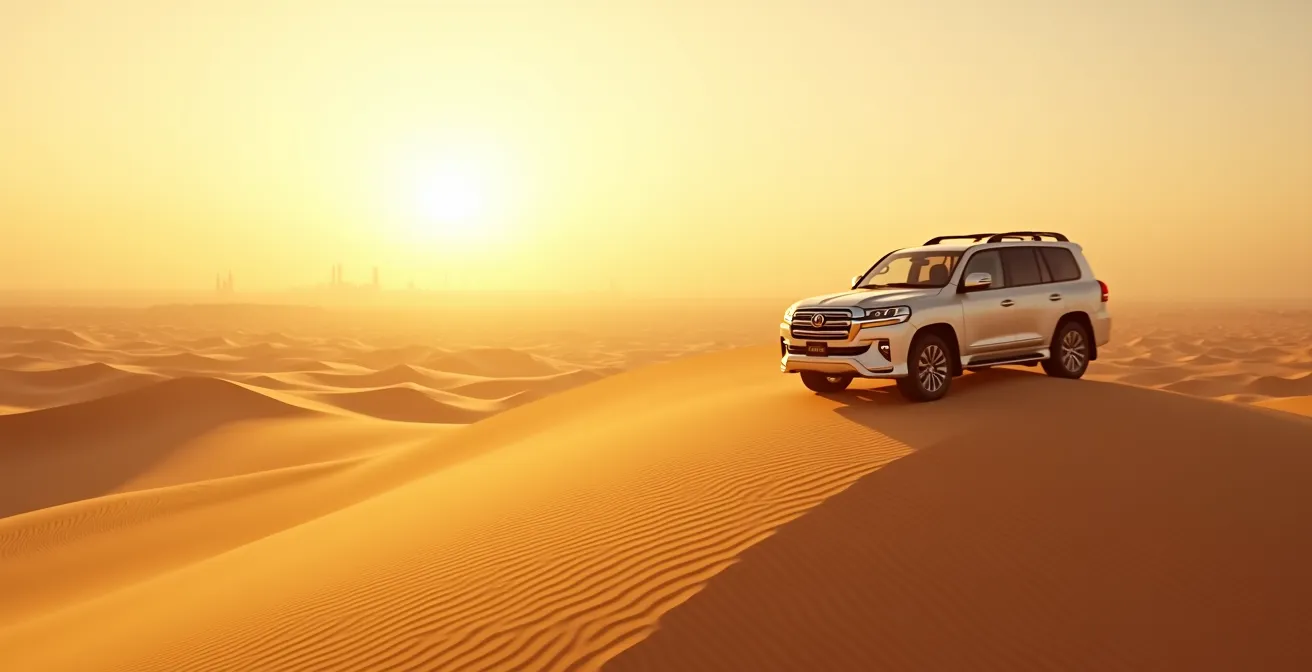
True desert exclusivity isn’t about paying more; it’s about paying for the right things: conservation access, expert guides, and genuine camp intimacy.
- Vetting an operator’s trade license, insurance, and confirming 100% camp privacy are non-negotiable steps to avoid scams.
- The “Hybrid Safari” strategy—a short, high-quality private dune drive combined with a luxury resort day pass—often provides the best value under $500.
Recommendation: Prioritize operators licensed for the Dubai Desert Conservation Reserve (DDCR) and ask about their guide’s credentials, not just the vehicle model.
The Dubai desert safari. It’s an experience that floods social media with a million near-identical images: dramatic sunsets, flowing dresses against golden dunes, and silhouetted camel rides. For the discerning traveler, however, the fear is ending up in the background of someone else’s photoshoot, herded into a sprawling camp of 100+ people where the promise of “VIP service” dissolves into a buffet line and blaring speakers. The market is saturated with offers of “private” safaris that merely provide a private 4×4 journey to the same crowded, low-quality destination.
Most advice centers on checking reviews or looking for specific activities. But what if the true key to exclusivity wasn’t in the marketing brochure, but in the operator’s very DNA? The real difference lies in the unseen operational choices: the specific desert areas they have access to, the qualifications of their guides, their insurance policies, and their definition of “private.” This is the value equation that separates a memorable heritage experience from a mass-market tourist trap. This concierge’s guide will bypass the surface-level promises and give you the tools to decode an operator’s quality from the ground up.
We will dissect the cost structure to show you what you’re really paying for, provide a step-by-step vetting process to secure your deposit, and explore nuanced details from vehicle comfort to the timing of your arrival. By the end, you’ll be able to confidently identify an experience that delivers genuine privacy and value, ensuring your investment results in cherished memories, not regrets.
Summary: A Discerning Guide to Your Dubai Desert Safari
- Why Does a Private Safari Cost 3x More Than a Standard Tour?
- How to Vet Your Safari Provider in 5 Steps Without Losing Your Deposit?
- Land Cruiser vs G-Wagon: Which Vehicle Suits Your Back Pain Best?
- The Hydration Mistake That Ruins 40% of Sunset Safaris
- When to Arrive at the Dunes: The Golden Hour Strategy for Photographers
- Morning vs. Sunset Safari: Which Delivers the Best Experience?
- Al Maha Resort Access: Can You Visit Just for Lunch?
- Distinguishing a Tourist Trap from an Authentic Heritage Experience
Why Does a Private Safari Cost 3x More Than a Standard Tour?
The significant price difference between a standard shared tour and a truly private safari isn’t arbitrary; it reflects a fundamentally different operational DNA. While a standard tour prioritizes volume, a high-quality private safari is built on exclusivity, safety, and authenticity, which carry tangible costs. The most critical factor is location. Premium operators conduct their tours in protected areas like the Dubai Desert Conservation Reserve (DDCR), a pristine 225km² area with only a handful of licensed operators. Access to these untouched dunes, free from the tire tracks and crowds of public areas, comes at a significant premium.
Furthermore, the logistics of “private” extend far beyond just the vehicle. A dedicated camp setup for just 2-6 guests requires a higher staff-to-guest ratio than a mass camp serving over 50 people. You are paying for the expertise of a licensed naturalist guide with in-depth conservation training, not just a driver. These guides cost up to three times more but provide invaluable insights into the desert ecosystem. Finally, legitimate operators invest heavily in comprehensive off-road passenger insurance, a non-negotiable safety measure that adds a considerable percentage to the base cost. This breakdown reveals you are not just paying for a car, but for privacy, expertise, and peace of mind.
This comparative table clearly illustrates the chasm in quality and service between the two options.
| Feature | Standard Tour (AED 150-200) | Private Safari (AED 600-1500) |
|---|---|---|
| Group Size | 50+ guests | 2-6 guests only |
| Desert Location | Public areas | DDCR or private reserves |
| Camp Type | Shared mass camp | 100% private or micro-camp |
| Guide Expertise | Basic driver | Licensed naturalist |
| Vehicle Exclusivity | Shared with 6-7 others | Private 4×4 |
How to Vet Your Safari Provider in 5 Steps Without Losing Your Deposit?
Now that you understand the value behind the price, the next crucial step is verifying an operator’s legitimacy before you commit. The Dubai market is rife with misleading claims, and a discerning eye is your best defense against disappointment and financial loss. The most common pitfall is booking a “private safari” only to find yourself dropped at a crowded, shared camp. Your vetting process must be direct and demand written confirmation. This isn’t about being difficult; it’s about ensuring you receive the exclusive experience you’re paying for. A reputable company will welcome your diligence as a sign of a knowledgeable client.
The process involves checking credentials that separate professional outfits from fly-by-night operations. This includes official licensing, insurance, and transparency in their camp setup. Be wary of operators demanding 100% upfront payment, as this is a significant red flag. Legitimate businesses with confidence in their service will typically require a reasonable deposit secured via a professional payment gateway. Following a structured verification process will not only protect your investment but also give you peace of mind.
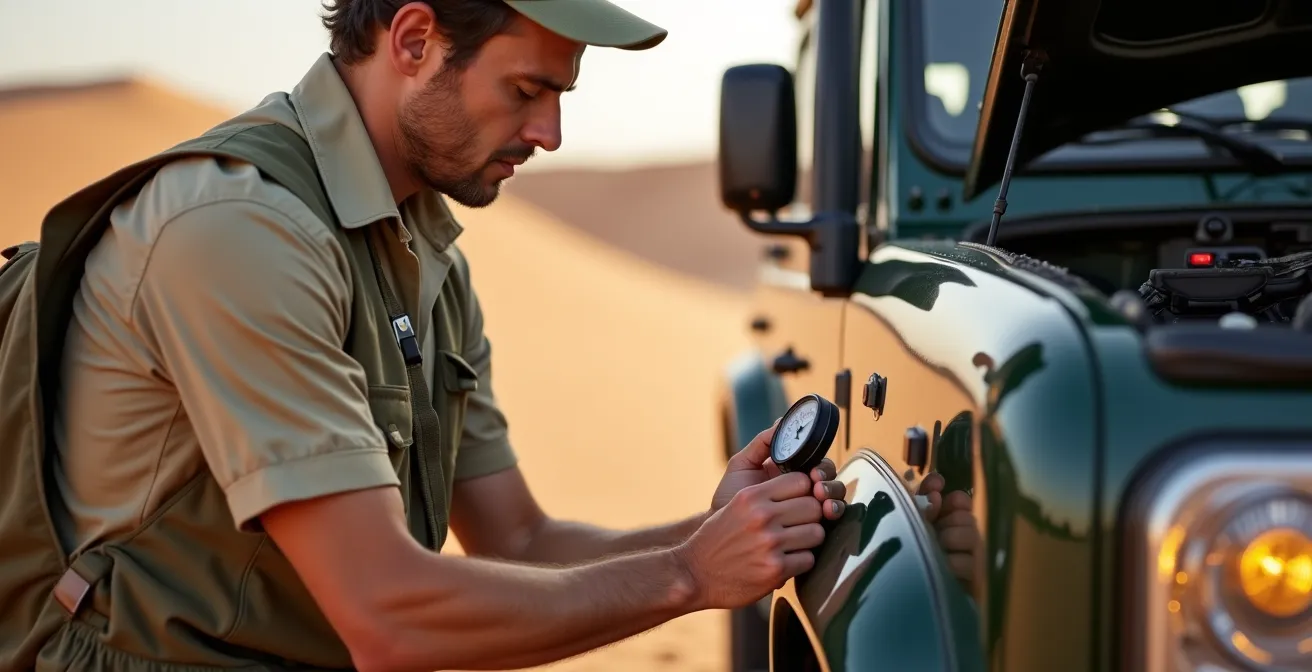
A professional guide’s attention to detail, as seen here, is a hallmark of a quality operator who prioritizes safety over volume. This level of care is a key part of the value you are investing in.
Your Vetting Checklist: 5 Steps to a Secure Booking
- Request Credentials: Ask for their Dubai Department of Economy and Tourism (DET) trade license number. A legitimate business will provide this without hesitation.
- Confirm True Privacy: Ask specifically, “Is the camp 100% private to our group, or is it a shared facility?” Get the answer in writing via email or WhatsApp for your records.
- Verify Location: Enquire if the safari takes place within the DDCR. Remember, only a select few operators are licensed to operate there, making this a key indicator of quality.
- Demand Proof of Insurance: Request to see a copy of their comprehensive off-road passenger insurance certificate. This is a non-negotiable safety standard.
- Check Payment Terms: A reputable operator will ask for a 20-50% deposit via a secure online gateway, not the full amount upfront via a bank transfer or cash.
Case Study: Spotting Marketing Red Flags
Many operators use stock photos and misleading descriptions. Be critical of what you see online. Key red flags include seeing photos of large coach buses (a sign of mass-market tours), spotting crowds in the background of “private” dinner shots, or noticing the same generic falconry or belly dancer images appearing on multiple different company websites. In contrast, as one traveler noted about a legitimate provider, having thousands of authentic, verifiable reviews with consistent imagery is a strong sign of trustworthiness.
Land Cruiser vs G-Wagon: Which Vehicle Suits Your Back Pain Best?
For a luxury traveler, comfort is as important as the experience itself, especially during the dune-bashing portion of a safari. The choice of vehicle can have a significant impact on your physical well-being. The two most common high-end options are the Toyota Land Cruiser and the Mercedes-Benz G-Wagon, and they offer very different ride experiences. While the G-Wagon boasts undeniable brand prestige and a muscular aesthetic, its military-derived chassis with a rigid axle suspension provides a much stiffer, bumpier ride over the dunes. It’s built for rugged capability, not necessarily for passenger comfort.
Conversely, the modern Toyota Land Cruiser is engineered with comfort in mind. Its sophisticated Adaptive Variable Suspension is designed to absorb the undulations of the desert terrain, providing a significantly softer and more cushioned ride. Its wider seats often come with better lumbar support, and the more spacious cabin allows for more room to adjust your position. For any traveler with concerns about back pain or motion sickness, the Land Cruiser is unequivocally the superior choice for a desert safari. Don’t be swayed by a brand name; prioritize the vehicle engineered for comfort in this specific environment.
To make an informed request, it helps to understand the specific mechanical differences that influence comfort levels.
| Vehicle Feature | Land Cruiser | G-Wagon | Impact on Back Pain |
|---|---|---|---|
| Suspension Type | Adaptive Variable | Rigid Live Axle | Land Cruiser softer on dunes |
| Seat Design | Wide, adjustable lumbar | Sport bucket seats | Land Cruiser better for longer rides |
| Cabin Space | More spacious | Compact luxury | More room to adjust position |
| Ride Height | Higher ground clearance | Lower center of gravity | Higher = more body roll |
When booking, don’t hesitate to ask specific questions about the fleet. A quality operator will be able to provide details on their vehicles, including the model year and any comfort-oriented modifications they may offer, such as a “soft-roading” scenic drive instead of aggressive dune bashing.
The Hydration Mistake That Ruins 40% of Sunset Safaris
One of the most common yet overlooked issues that can spoil an otherwise perfect desert experience is dehydration. The mistake many travelers make is underestimating the desert’s effect, particularly due to a phenomenon I call “AC Deception.” Spending the journey from your hotel to the dunes in a cool, air-conditioned 4×4 creates a false sense of security. The cold, dry air feels refreshing, but it masks your body’s increasing thirst. Compounding this, desert safety experts warn that AC systems can increase water loss through respiration by up to 25%.
This “deception” means that by the time you step out into the late afternoon heat for photos, you are already significantly dehydrated. The problem is often exacerbated by consuming diuretics like coffee or sugary sodas at the camp. The result is often a throbbing headache that arrives just as the sun begins to set, turning the magical golden hour into a miserable experience. Proper hydration for a desert safari is not something that starts when you feel thirsty; it is a protocol that should begin 24 hours before your tour. The key is consistent intake of water, ideally with electrolytes, and avoiding all caffeine and alcohol in the 12 hours leading up to the safari.
The Perfect Storm for Dehydration
As noted by travel experts, dune bashing can be nauseating, so it’s wise not to eat for at least three hours prior. However, this is often where the mistake happens. Travelers avoid food but also fail to hydrate properly, creating a dual deficit. The combination of an empty stomach, the “AC Deception,” and the consumption of traditional (and diuretic) Arabic coffee upon arrival at the camp is a perfect storm that frequently leads to dehydration headaches and motion sickness, precisely when you should be enjoying the sunset.
To avoid this common pitfall, follow a structured hydration plan. Sipping small amounts frequently is far more effective than drinking large volumes at once.
When to Arrive at the Dunes: The Golden Hour Strategy for Photographers
For photographers and anyone seeking those iconic, breathtaking desert shots, timing is everything. The “Golden Hour”—the period shortly before sunset—is legendary for its warm, soft light and long, dramatic shadows that sculpt the dunes. However, simply being in the desert at sunset is not enough. A truly exclusive photography experience depends on arriving at the right spot *before* the golden hour begins, giving you time to scout and set up. The goal is to find pristine, untracked dunes, a luxury that is only possible with a private tour that avoids high-traffic areas.
A strategic operator will plan your arrival to coincide with a 90-minute window before sunset. This allows you to work with the changing light. The early phase is ideal for capturing wide, clean landscapes with long shadows creating leading lines. As the sun gets lower, the light becomes warmer and is perfect for side-lit portraits. At the moment of sunset, you can capture dramatic silhouettes. Finally, the “blue hour” just after the sun disappears provides a completely different mood, with a soft, cool light and a lingering warm glow on the horizon. This strategic approach transforms a simple photo stop into a dedicated photographic session.
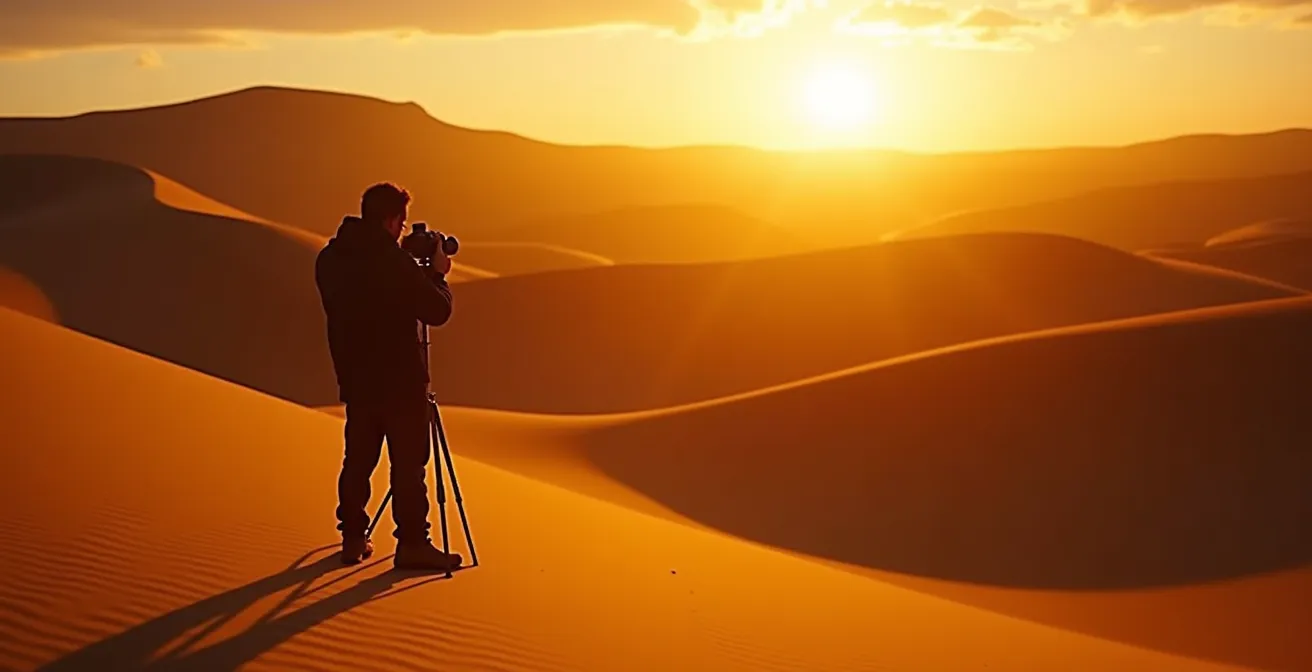
The difference between a snapshot and a masterpiece often lies in capturing the interplay of light and shadow on untouched sand, an opportunity only available through careful planning and exclusive access.
A well-planned timeline allows you to maximize the photographic potential of the experience:
- T-90 minutes before sunset: Arrive and scout for pristine dune ridges without any tire tracks.
- T-60 minutes: Position your camera for dramatic, long-shadow landscape shots that emphasize texture and shape.
- T-30 minutes: Move to portrait locations, using the warm, directional side lighting to your advantage.
- T-0 (Sunset): Focus on capturing silhouettes against the colorful sky and rim lighting on the dune edges.
- T+15 minutes (Blue Hour): Shoot landscapes in the soft, cool light, contrasting with the warm residual glow on the horizon.
Morning vs. Sunset Safari: Which Delivers the Best Experience?
While the sunset safari is the classic choice, the morning safari offers a distinctly different and, for some, superior experience. The decision between the two depends entirely on your priorities. If your goal is photography, tranquility, and seeing wildlife, the morning safari is the undisputed winner. The early morning light bathes the desert in soft pink and orange hues, and most importantly, the dunes are a pristine, untouched canvas. You have the desert almost to yourself, as the vast majority of tours operate in the evening.
This lack of traffic means you can capture 360-degree compositions without a single tire track in sight—a feat nearly impossible during the crowded sunset slot. Furthermore, the cooler morning temperatures make the experience more comfortable, and wildlife such as the Arabian Oryx are often more active. However, morning safaris are typically shorter and focus purely on the desert drive and nature, without the cultural program and dinner. The sunset safari, on the other hand, is a more complete “package” experience, culminating in the camp dinner with entertainment. It offers the iconic deep red and purple sunset hues, but this comes at the cost of sharing the landscape with dozens of other vehicles.
A Photographer’s Morning Success
As many professional photographers have discovered, morning safaris provide the ideal conditions for serious landscape work. They offer cooler temperatures, much quieter dunes, and the opportunity for high-energy activities on fresh sand. One landscape photographer noted that his award-winning shots were only possible during a morning tour because the complete absence of other vehicles allowed for compositions that were simply not available during the busy and heavily tracked evening tours.
This table summarizes the key trade-offs to help you decide which experience aligns with your goals.
| Factor | Morning Safari (6am-12pm) | Evening Safari (3pm-9pm) |
|---|---|---|
| Light Quality | Soft pink/orange hues | Deep reds and purples |
| Crowd Levels | Minimal – pristine dunes | Heavy – multiple tour tracks |
| Wildlife Spotting | Arabian Oryx more active | Limited wildlife visibility |
| Temperature | Cool and comfortable | Hot afternoon transitioning to cool |
| Experience Type | Photography focused | Full cultural program with dinner |
Al Maha Resort Access: Can You Visit Just for Lunch?
For the traveler seeking the pinnacle of desert luxury without the multi-thousand-dollar overnight price tag, the answer is a resounding yes. This leads to what I call the “Hybrid Safari Strategy,” arguably the best way to experience true exclusivity on a sub-$500 budget. Instead of trying to find one operator that does everything perfectly, you combine the best of two worlds: a focused, high-quality private dune drive with a separate day pass to a world-class luxury resort like Al Maha, a Luxury Collection Desert Resort & Spa, or Bab Al Shams.
These resorts, nestled within the conservation reserve, offer day packages that grant access to their stunning infinity pools, gourmet restaurants, and five-star facilities. You can book a 2-3 hour private morning safari with a top-tier operator, focusing purely on the dune driving, wildlife spotting, and photography. Afterwards, your guide drops you at the resort where you can spend the rest of the day relaxing in unparalleled luxury, enjoying a superb lunch, and swimming with a view of the vast desert expanse. This strategy allows you to experience the best private dune drive and the best luxury facilities, rather than compromising on a single “all-in-one” package that often excels at neither.
Financially, this approach is surprisingly effective. A quality 2-hour private morning drive can be secured for around $200-$250. Resort day passes, which typically include pool access and a lunch credit, are available from concession holders for approximately $150-$250 per person. This brings the total for a truly luxurious and private hybrid experience to between $350 and $500, delivering exceptional value by giving you exactly what you want: adventure and opulence, without the crowded camp or mediocre food.
Key Takeaways
- True exclusivity is defined by conservation access (like the DDCR) and camp intimacy, not just a private vehicle.
- The “Hybrid Safari Strategy”—combining a short, private dune drive with a luxury resort day pass—offers the best value under $500.
- Authentic heritage camps prioritize isolation, quiet ambiance, and traditional skills over commercial entertainment like belly dancing and fire shows.
Distinguishing a Tourist Trap from an Authentic Heritage Experience
This is the final and most important test. After all the logistics, the ultimate goal is an authentic experience that connects you with the heritage of the desert, not a theme park caricature. The differences between a tourist trap camp and a genuine heritage camp are stark and can be easily identified if you know what to look for. The primary marker of a tourist trap is scale and noise. These camps are designed for volume, often receiving guests via large coach buses. You will see 50 or more guests, hear announcements over loudspeakers, and be served a generic international buffet.
In contrast, an authentic heritage camp is defined by intimacy and quiet reverence for the surroundings. These camps are intentionally small, often hosting a maximum of 15-20 guests to maintain a personal atmosphere. The only lighting comes from traditional lanterns and a central fire, creating a magical ambiance. The focus is on sharing genuine cultural skills, not passive entertainment. Instead of a belly dancer, you might see a demonstration of traditional bread-making on an open fire or learn about the stars from an expert guide. The menu itself is a test; ask if they serve specific Emirati dishes like Al Harees or Luqaimat. A hesitant answer is a major red flag.
A simple but powerful question to ask your operator is: “How far is the nearest camp?” An authentic provider values isolation and will proudly state that their location is secluded, while a mass-market operator will be situated in a cluster of other noisy camps.
Their love for animals and mission to conserve the original desert is truly admiring and guests feel lucky to contribute to achieving that goal.
– Platinum Heritage Guest Review
This sentiment captures the essence of a true heritage operator. They are driven by a conservation mission, using vintage vehicles to minimize environmental impact and focusing on educational experiences like falconry demonstrations and astronomy sessions that honor Bedouin traditions.
With this knowledge, you are no longer just a tourist but a discerning traveler equipped to see beyond the marketing. Your next step is to apply this framework to vet your options and invest in an experience that delivers genuine memories, not just a photo opportunity.