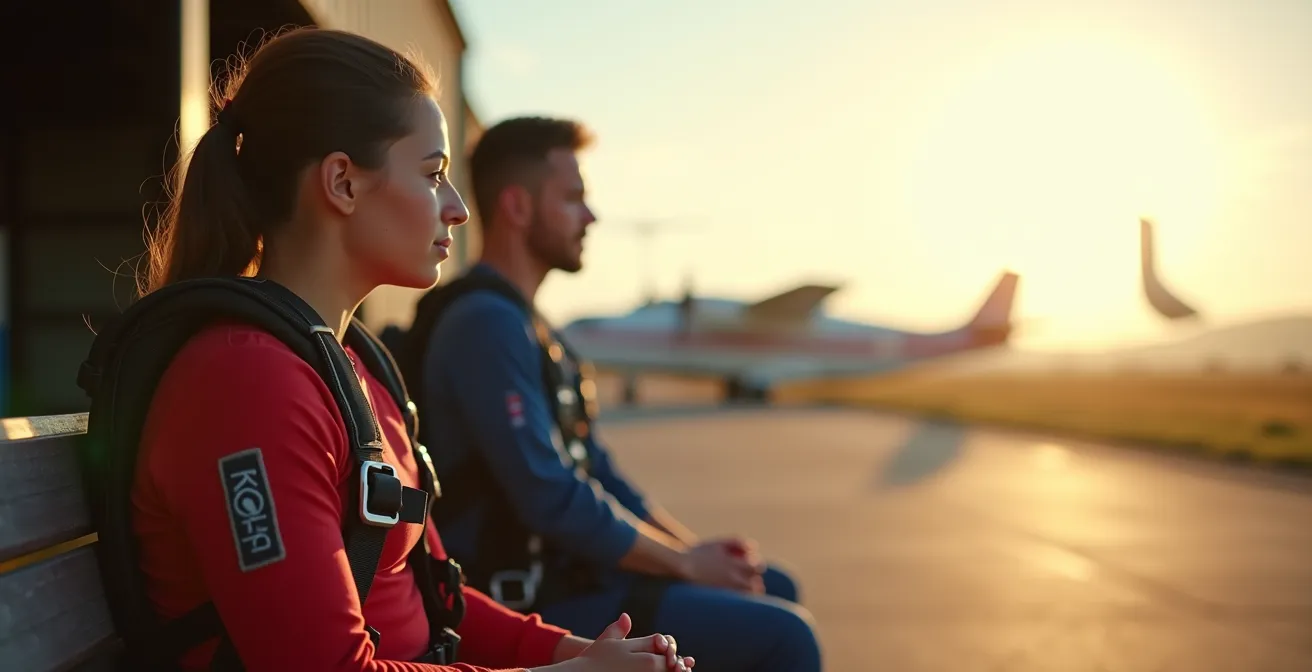
The key to managing pre-jump terror is not to suppress fear, but to reframe it as manageable anticipation through practical mental and physical preparation.
- Anxiety stems from the unknown; arming yourself with knowledge about safety protocols and physical sensations acts as a powerful sedative.
- Proactively managing your body’s state—through proper nutrition, hydration, and clothing—removes physical distractions and conserves mental energy for the experience itself.
Recommendation: Shift your focus from the ‘what if’ of fear to the ‘what is’ of the present moment, using simple mindfulness techniques to stay grounded during the ascent.
The feeling is unmistakable. It’s a cold dread that settles in your stomach the moment you arrive at the dropzone, a stark contrast to the sunny, adrenaline-fueled videos you watched online. For a first-time jumper, the wait can be more terrifying than the jump itself. Your mind races with a thousand “what-ifs,” and the primal urge to flee becomes almost overwhelming. You’re told to “just relax” or “trust your instructor,” but such advice feels hollow when every instinct is screaming danger. This internal battle between your desire for an epic experience and your deep-seated fear of the unknown is the true first challenge of skydiving.
But what if the goal isn’t to eliminate this anxiety? What if, from a sports psychology perspective, we could learn to manage it? The truth is that this intense feeling is a predictable physiological response, not a premonition of disaster. The key isn’t to fight the adrenaline but to channel it. Instead of suppressing your fear, you can transform it into focused energy by understanding exactly what is happening to your mind and body, and by equipping yourself with a toolkit of cognitive and practical strategies. This approach moves you from a passive victim of your anxiety to an active pilot of your own mental state.
This guide is designed to be that toolkit. We will break down the common sources of anxiety—from equipment rules to physical sensations—and provide concrete, psychologist-approved methods to reframe your thinking. We will explore how to prepare your body, what to focus on during the tense ascent, and why seemingly small choices on the ground can have a huge impact on your mental comfort at 13,000 feet. The goal is to walk you to the open door of that plane not without fear, but with the confidence that you have the tools to master it.
This article provides a structured path to reframe your pre-jump nerves. Each section tackles a common anxiety trigger with practical advice and psychological insights to help you regain control and fully embrace the experience.
Summary: Your Guide to Mastering Pre-Jump Nerves
- Why Strict BMI Limits Are Enforced for Tandem Skydivers?
- What Happens to Your Booking if Wind Speed Exceeds 15 Knots?
- Is the Instagram Video Package Worth the Extra $200?
- What to Eat for Breakfast Before Jumping to Avoid Nausea?
- Why Short Shorts Are a Bad Idea for Harness Comfort?
- Wind Speed Cancellations: How to Get a Refund for Your Skydive?
- The Tower of Poseidon Stairs: How Many Steps Before You Drop?
- Does Standard Travel Insurance Cover Flyboarding Accidents?
Why Strict BMI Limits Are Enforced for Tandem Skydivers?
One of the first sources of anxiety can be the weigh-in. Seeing a strict weight or BMI limit can feel judgmental, but from a psychological standpoint, understanding the “why” behind this rule is a powerful tool to reduce fear. This isn’t about body shaming; it’s about physics and predictable safety parameters. Knowing that every rule is designed for a specific safety outcome helps transform a feeling of being scrutinized into a feeling of being protected. The equipment you use is engineered to perform flawlessly within a specific operational range.
The entire system—from the harness to the parachute itself—has a certified maximum load. For instance, most tandem equipment is certified for a total of 500 pounds. This total includes you, your instructor, and all the gear. Exceeding this limit would put undue stress on the equipment, particularly during the high-G force event of parachute deployment. It’s a non-negotiable number that ensures the structural integrity of the entire system remains far beyond the forces it will actually experience during your jump.
Beyond the gear’s limits, weight directly impacts several key phases of the skydive, affecting both your safety and comfort. These factors are crucial for the instructor to manage the jump effectively:
- Freefall Speed: Higher weight increases terminal velocity, which can complicate deployment timing and increase the opening shock of the parachute.
- Parachute Control: Heavier suspended weight makes steering the canopy physically more demanding for the instructor.
- Harness Fit: A secure harness is paramount. The straps must fit correctly without being over-extended, ensuring you remain safely attached to your instructor.
- The Landing: A successful landing often requires you to lift your legs for several seconds. This is significantly more difficult with increased body weight, raising the risk of a sprained ankle or other minor injury.
Seeing the weight limit as a crucial part of a complex safety system, rather than a personal judgment, allows you to reframe it. It is one of the many predictable controls in place that makes skydiving a statistically safe activity. This knowledge acts as a mental anchor, quieting the “what if” voice by providing a concrete, physics-based answer.
What Happens to Your Booking if Wind Speed Exceeds 15 Knots?
Arriving at the dropzone only to be told you’re on a “weather hold” is a common anxiety trigger. The uncertainty can be maddening, making you feel like your day is ruined. However, this is another opportunity for cognitive reframing. A weather hold is not a cancellation; it’s a testament to the dropzone’s uncompromising commitment to safety. Wind is the single most significant environmental factor in skydiving, and strict limits are a non-negotiable part of operations.
Most dropzones adhere to guidelines set by national organizations. For example, the United States Parachute Association (USPA) sets clear wind limits for different skill levels. The USPA recommends a maximum of 14 mph (approximately 12 knots) for student skydivers. While tandem jumps can sometimes operate in slightly higher winds, dropzones will suspend operations when ground winds become too strong or gusty, making landings unpredictable and potentially unsafe. This isn’t a subjective call; it’s a decision based on hard data from on-site instruments.
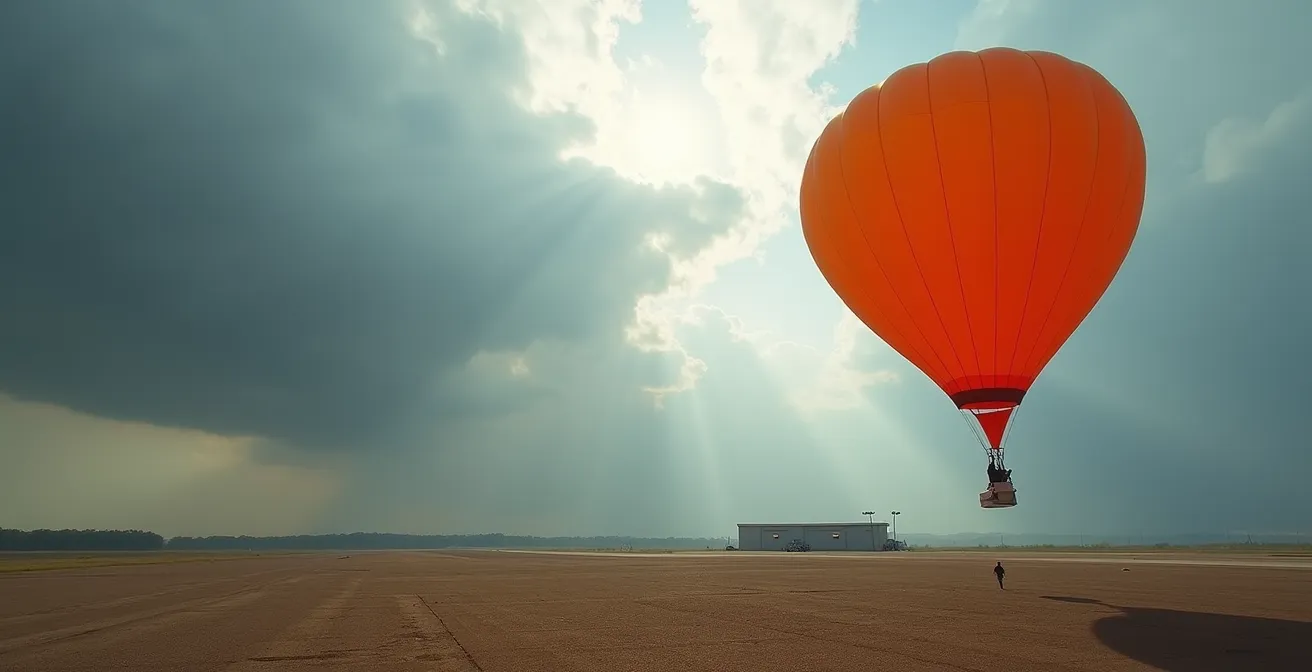
So, what actually happens? You wait. A “wind hold” means operations are temporarily paused. Instructors and staff will constantly monitor weather conditions. If a safe window opens up, jumping resumes. The key is to see this delay not as a frustration, but as active risk management in real-time. Case studies from various dropzones show a consistent policy. For example, at Skydive South Boston, operations are paused when winds top 25mph. If you wait for at least two hours past your scheduled time and still can’t jump, you are typically offered the chance to reschedule for another day at no additional cost. This is the industry standard: your safety is prioritized over the schedule, and you are not penalized financially for it.
Instead of letting the anxiety of waiting build, use this time productively. Observe the operations, talk to your instructor, or practice the breathing techniques discussed later in this guide. View the delay as proof that the system works and that no one will ever compromise your safety for the sake of expediency. This mental shift transforms a period of uncertainty into a moment of reassurance.
Is the Instagram Video Package Worth the Extra $200?
The decision to buy the video package can feel like a purely financial one, adding stress to an already expensive day. However, a sports psychologist would encourage you to reframe this choice as an investment in your mental processing of the event. The value of the video extends far beyond a cool Instagram post; it’s a powerful tool for conquering what is known as “adrenaline amnesia.” During moments of extreme intensity, your brain is so flooded with hormones that it often fails to form clear, sequential memories. Many first-time jumpers land with only a blurry, fragmented recollection of their freefall.
The video helps you process and truly ‘own’ the experience afterward, combating the adrenaline amnesia that can blur the memory of the jump.
– Experienced tandem instructor, Skydiving industry perspective on video packages
This is where the video becomes a crucial psychological tool. It allows you to reconstruct the event in a calm state, integrating the thrilling visuals with your emotional memory. This process helps you “own” the achievement, solidifying it as a real and tangible accomplishment. Furthermore, knowing you’re being filmed can subtly shift your mindset during the jump itself. It gives you a “role” to play—the brave, smiling skydiver—which can be a surprisingly effective way to manage performance anxiety. Instead of being trapped in your internal monologue of fear, you have an external focus.
The psychological benefits are a significant part of the package’s value:
- Memory Reconstruction: It provides a concrete record to fight the blur of adrenaline amnesia.
- Proof of Courage: The video serves as a lasting reminder of your ability to face fear, a powerful anchor to revisit during future life challenges.
- Anxiety Reduction: Having a “role” to play for the camera can provide a helpful distraction from internal fear.
- Shared Experience: It allows you to share the achievement in a tangible way with loved ones who couldn’t be there.
Instead of viewing it as a $200 social media post, consider it a $200 tool for memory consolidation and a permanent certificate of your own resilience. When weighed against the potential for a blurred memory, the investment in cementing this once-in-a-lifetime experience often proves its worth.
What to Eat for Breakfast Before Jumping to Avoid Nausea?
Managing your physical state is one of the most effective ways to manage your mental state. An empty stomach and low blood sugar can mimic and amplify the physical symptoms of anxiety—lightheadedness, shakiness, and nausea. Many first-time jumpers, fearing motion sickness, make the critical mistake of skipping breakfast. This is counterproductive. Your body needs fuel to handle the adrenaline and physical demands of the day. The key is eating the *right* kind of meal at the *right* time.
Think of your pre-jump meal as performance fuel. Your goal is to provide your body with sustained energy without causing digestive distress. The expert consensus is clear: eat a normal, balanced meal about 2-3 hours before your jump. This gives your body time to digest, ensuring you’re neither full nor famished when you gear up. Focus on a combination of complex carbohydrates for energy and lean protein for satiety.
A good pre-jump breakfast might include:
- Oatmeal or whole-grain toast (complex carbs).
- Eggs or Greek yogurt (lean protein).
- A banana or a small portion of fruit.
Equally important is what to avoid. Steer clear of greasy, fatty foods (like a large fried breakfast) or sugary items (like donuts or sugary cereals) that can lead to energy crashes or an upset stomach. And while hydration is crucial, be mindful of your caffeine intake. Coffee can amplify the jitters and physical symptoms of anxiety. Stick to water.
You’ll be at the center for 1-2 hours at least. If you don’t eat something before arriving, you run the risk of your blood sugar dropping, which can exacerbate anxiety. No one wants to be at 12,000 ft when their belly starts rumbling for a granola bar!
By consciously managing your blood sugar and hydration, you eliminate a major source of physical discomfort that your brain could misinterpret as fear. This simple act of self-care is a foundational step in building a calm and resilient mindset for your jump.
Why Short Shorts Are a Bad Idea for Harness Comfort?
Your choice of clothing might seem trivial, but it has a direct impact on your physical comfort, which in turn affects your mental state. Every bit of physical discomfort—chafing, pinching, being too hot or too cold—is a distraction. It consumes cognitive bandwidth that you need to stay present and enjoy the incredible experience. One of the most common clothing mistakes is wearing shorts, especially short shorts.
The reason is simple: the harness. A tandem skydiving harness is an intricate piece of safety equipment with several straps that must be tightened securely. The leg straps, in particular, sit high on the upper thighs. During the parachute ride, when you are suspended under the canopy, your entire body weight rests on these straps. If the straps are against bare skin, the friction and pressure can cause significant chafing and discomfort. This isn’t a minor annoyance; it can be a persistent, painful distraction that pulls your focus away from the breathtaking views and the feeling of accomplishment.
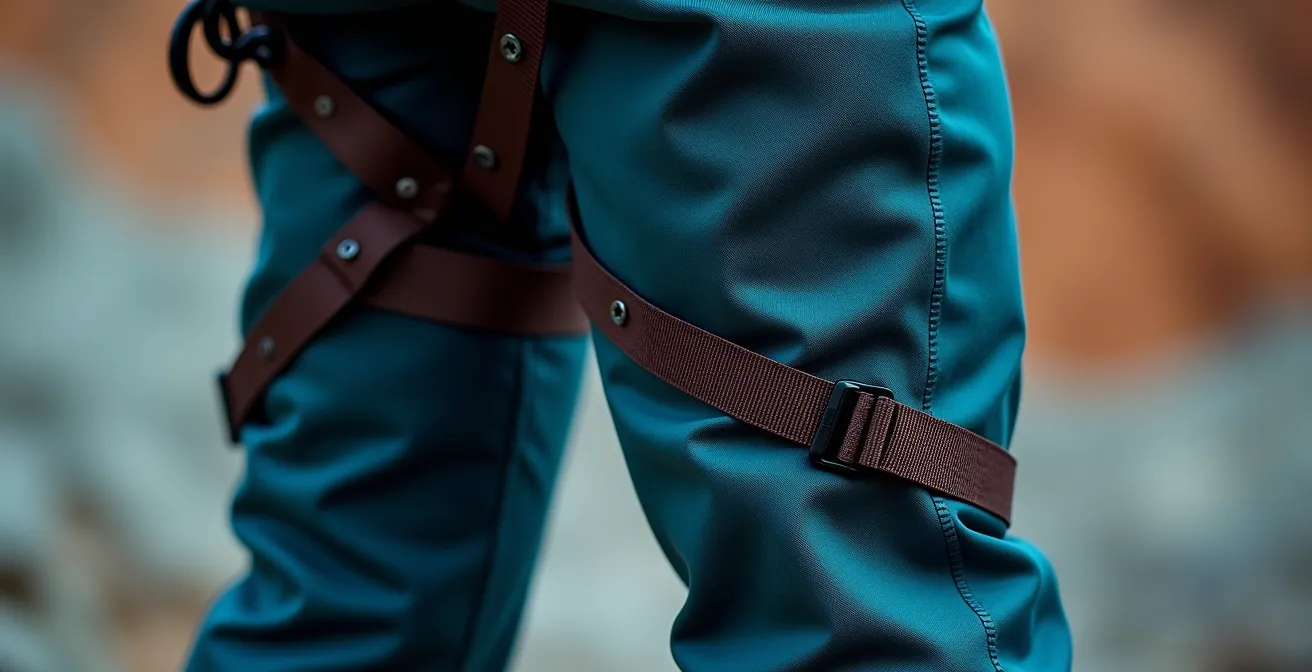
Dropzones consistently recommend comfortable, athletic clothing that covers your legs. The ideal outfit is about function, not fashion. Think of it as an “anti-anxiety” uniform designed to eliminate all potential physical irritants so you can focus your mind. Jeans or athletic pants provide a necessary barrier between your skin and the tough nylon webbing of the harness.
Your pre-jump outfit checklist should focus on comfort and security:
- Bottoms: Athletic pants, leggings, or comfortable jeans that cover your legs.
- Footwear: Securely laced sneakers. No boots with hooks, sandals, or slip-on shoes.
- Top: Layers are smart. It can be chilly at 13,000 feet, even on a warm day. A t-shirt with a long-sleeved shirt or sweatshirt over it is a good combination.
- Accessories: Tie back long hair securely and remove all loose jewelry.
Dressing appropriately is an act of proactive comfort management. By removing the potential for physical distraction, you free up your mental resources to fully engage with and enjoy every moment of your skydive.
Wind Speed Cancellations: How to Get a Refund for Your Skydive?
While a weather hold leads to waiting, a full-blown weather cancellation brings up a new anxiety: “What happens to the money I paid?” Understanding the financial policies beforehand can significantly reduce this stress, allowing you to focus on the experience rather than the logistics. The industry standard is overwhelmingly focused on rescheduling rather than refunding for weather-related issues, as weather is an uncontrollable factor.
Dropzones operate with clear, tiered cancellation policies. Getting a full cash refund is typically only possible if you cancel well in advance (usually 48-72 hours or more), giving them a chance to fill your slot. If the dropzone cancels the jump due to weather, the standard procedure is to issue you a credit or “rain check” to reschedule your jump. This credit is often valid for a year or more, giving you ample flexibility. Full refunds for on-the-day weather cancellations are extremely rare.
This table illustrates a typical dropzone’s policy structure, showing how different scenarios are handled.
| Policy Type | Conditions | Options Available |
|---|---|---|
| Weather Hold | Wind exceeds limits or unsafe conditions | Free reschedule within 1 year |
| Standard Cancellation | 48+ hours notice | Full refund or reschedule |
| Short Notice | Less than 48 hours | Forfeit deposit, reschedule with fee |
| No Show | Failure to arrive | Forfeit full payment |
Knowing this policy ahead of time, as outlined in this breakdown of cancellation policies, is another form of “information as a sedative.” You can relax, knowing that if the weather doesn’t cooperate, you won’t lose your money. You’ll simply get to try again on a better day. The best practice is to always read the specific FAQ or policy page of the dropzone where you booked your jump. This removes all ambiguity and lets you accept a weather cancellation for what it is: a safety measure, not a financial loss.
The Tower of Poseidon Stairs: How Many Steps Before You Drop?
While there is no literal “Tower of Poseidon” in skydiving, the metaphor is surprisingly apt for a first-time jumper. The 15-20 minute plane ride to altitude is a mental ascent with distinct stages, much like climbing a towering staircase to a dramatic drop. Each stage presents a new psychological challenge, and your peak anxiety may not be where you expect. Understanding this “mental staircase” allows you to prepare for each step, rather than being overwhelmed by a single, monolithic feeling of dread.
Experienced instructors recognize these stages and often use them to guide a student’s focus. The journey can be broken down into key moments:
- The Takeoff (Grounding): As the plane accelerates, the noise and vibration are intense. Instead of fighting it, anchor yourself in it. Focus on the physical sensation of the engine’s roar.
- The Mid-Climb (Shifting Focus): Around 5,000-8,000 feet, the world below begins to look like a map. This is the time to shift your focus outward. Look at the clouds, the landscape. Detach from the internal chatter.
- The Approach (Final Checks): As you near jump altitude (10,000-13,000 feet), your instructor will perform final checks. This is a moment of action and procedure. Focus on their calm, methodical movements.
- The Door Opening (Sensory Rush): For most, this is the true moment of peak anxiety. The sudden roar of the wind, the rush of cold air. The key here is not to think, but to breathe and embrace the sensory input.
A powerful technique to manage this ascent is what we can call the “10-Second Interval” mindfulness exercise. At each stage of the climb, consciously shift your focus for just 10 seconds to a specific sensory input. This breaks the climb into manageable, bite-sized chunks and prevents your mind from spiraling.
Your Action Plan: The 10-Second Mindfulness Technique for the Plane Ride
- 0-3,000 feet: For 10 seconds, focus only on the physical vibration of the aircraft through your seat.
- 3,000-6,000 feet: Find a cloud formation outside and observe its shape and texture for 10 seconds.
- 6,000-9,000 feet: Close your eyes and feel the secure, reassuring pressure of the harness against your shoulders and legs for 10 seconds.
- 9,000-12,000 feet: Practice a box breathing exercise for 10 seconds (inhale for 4, hold for 4, exhale for 4, hold for 4).
- 12,000+ feet: With your eyes open, visualize the successful, smiling ‘you’ in freefall for the final 10 seconds before the door opens.
By breaking the nerve-wracking climb into a series of small, manageable mental “steps,” you regain a sense of control. You’re no longer a passive passenger on a terrifying ride, but an active participant managing your own psychological state, one step at a time.
Key Takeaways
- Pre-jump anxiety is a normal physiological response, not a sign you shouldn’t jump. The goal is management, not elimination.
- Knowledge is a sedative. Understanding the ‘why’ behind safety rules (like BMI limits and wind holds) calms the brain’s fear center.
- Proactive physical management—through proper food, clothing, and hydration—removes distractions and conserves mental energy for the experience.
Does Standard Travel Insurance Cover Flyboarding Accidents?
It’s a valid question: does standard travel insurance cover niche adventure sports like flyboarding? This line of thinking is even more crucial when considering the ultimate aerial activity: skydiving. A simple “yes” or “no” from your policy can be the difference between true peace of mind and a lingering background anxiety. Many people mistakenly assume the waiver they sign at the dropzone is a form of insurance. It is not.
The waiver is a liability release, protecting the dropzone from lawsuits. It provides no financial coverage for you in the event of an accident. As one specialist notes, having your own coverage is a key part of mental preparation.
The waiver signed at the dropzone is a liability release, not a personal accident insurance policy. Having proper insurance removes a significant ‘what if’ from your mind, providing peace of mind and reducing background anxiety.
– Adventure Sports Insurance Specialist, Understanding extreme sports insurance coverage
Most standard travel insurance policies explicitly exclude “hazardous activities” or “extreme sports,” and skydiving is almost always on that list. Assuming you are covered is a risky gamble. The only way to be sure is to audit your policy *before* you book your jump. This removes one more “what if” from your mental plate, freeing you to focus on the experience.
Action Plan: How to Audit Your Insurance Policy for Skydiving Coverage
- Keyword Search: Open your policy document (usually a PDF) and search for keywords like “extreme sports,” “hazardous activities,” and “aerial activities.”
- Check Exclusions: Go directly to the “Exclusions” section. Look for specific mentions of “skydiving,” “parachuting,” or similar terms.
- Verify Tandem vs. Solo: Some policies may differentiate. Check if they make an exception for a tandem jump performed with a certified instructor, as it’s a more controlled environment than solo jumping.
- Contact Your Insurer: If there is any ambiguity, call or email your insurance provider and get written confirmation (an email is sufficient) of whether you are covered for a tandem skydive.
- Consider Specialized Insurance: If your standard policy excludes skydiving, look into dedicated adventure sports insurance providers. They offer policies designed specifically for these activities.
Taking 30 minutes to confirm your coverage is a small investment for significant peace of mind. It’s the final piece of practical preparation that allows you to stand at the edge of that open door, fully present and ready to leap, knowing you’ve responsibly managed every controllable aspect of your adventure.
Now that you are armed with the mental and practical tools to manage anxiety, the next logical step is to put them into practice. Approach your jump day not as a test of courage against fear, but as an opportunity to apply your new skills in focus, reframing, and self-management.
Frequently Asked Questions About Skydive Bookings and Weather
What if I wait at the dropzone but can’t jump due to weather?
Most dropzones allow free rescheduling if you wait at least 2 hours after your scheduled time without jumping due to weather conditions.
How do dropzones determine unsafe wind conditions?
Operations typically suspend when winds exceed 25mph, gust differentials exceed 10mph, or upper winds above 3000 feet exceed 30mph.
Can I get a full refund for weather cancellation?
Most dropzones offer rescheduling rather than refunds for weather. Full refunds are typically only available with 72+ hours advance cancellation notice.