
Securing a G-Wagon in Dubai without a debilitating credit card hold is not about finding a secret “no deposit” company; it’s about re-engineering the deal by replacing financial collateral with strategic trust signals.
- Standard deposits are a form of crude risk management; you can negotiate them down by demonstrating lower risk through other means.
- Understanding the total cost of ownership—from insurance voids on sand to valet parking liability—is more critical than the daily rental rate.
Recommendation: Leverage high-tier hotel loyalty status or concierge bookings as proof of reliability to request a deposit waiver or significant reduction, turning your reputation into tangible financial leverage.
The allure of driving a Mercedes G-Wagon through the gleaming canyons of Dubai is a powerful one. But for many luxury renters, the dream hits a stark financial reality: the dreaded $5,000 credit card hold. This isn’t just a minor inconvenience; it’s a significant liquidity event that can freeze a substantial portion of your travel budget. Most guides will offer simplistic advice like “find a company that accepts cash” or “try a debit card,” but these are surface-level tactics that ignore the fundamental mechanics at play. They treat the deposit as an immovable rule, when it should be viewed as a point of negotiation.
The core issue isn’t the payment method; it’s about risk management from the rental company’s perspective. The high deposit, a form of financial friction, exists to cover potential damages, traffic fines, and Salik tolls. Therefore, bypassing it requires a more sophisticated approach than simply asking. It requires a strategy of “collateral re-engineering”—substituting the crude financial hold with more nuanced “trust signals” and a clear understanding of liability. This isn’t about finding a loophole; it’s about acting like a financial partner, not just a customer.
This guide deconstructs the financial architecture behind luxury car rentals in Dubai. We will move beyond the basic question of payment and into the strategic calculus of risk and reward. We will analyze the hidden liabilities in your rental agreement, calculate the true operational costs of a high-performance SUV for a weekend, and explore how to leverage your existing status and reputation to fundamentally alter the terms of your rental agreement. Forget searching for “no deposit” rentals; it’s time to learn how to make yourself the kind of client for whom the deposit becomes a negotiable formality.
To navigate this complex landscape effectively, this article breaks down the key financial and logistical pressure points. The following sections provide a complete playbook for managing your luxury rental like a seasoned operator, from understanding insurance traps to optimizing your arrival strategy for maximum impact.
Summary: The Operator’s Manual to High-Value Car Rentals in Dubai
- The ‘Off-Road’ Clause: Why Your Luxury Rental Insurance Void on Sand?
- Driving a Wide SUV in Deira’s Narrow Streets: A Survival Guide
- Valet vs Self-Park: Where to Leave Your Lamborghini Safely?
- How Much Does it Cost to Refuel a V8 Patrol for a Weekend?
- Chauffeur vs Uber Chopper: Which Is More Cost-Effective for Day Trips?
- Why Luxury Suites Require a $1000 Credit Card Hold?
- Underground Parking Fees: How to Get Your Ticket Validated?
- Uber Black vs Tesla Taxi: Which Offers Better Status for Business Arrival?
The ‘Off-Road’ Clause: Why Your Luxury Rental Insurance Void on Sand?
The very feature that makes a G-Wagon so appealing in a desert landscape—its off-road prowess—is also its biggest financial trap. Rental agreements are explicit: standard insurance coverage, even comprehensive policies, becomes null and void the moment your tires leave paved asphalt. This isn’t a minor exception; it’s a total liability shift. Any damage incurred, from suspension issues caused by dune bashing to cosmetic scratches from desert scrub, becomes your full responsibility. The rental company isn’t just withholding your deposit; they will pursue you for the entire cost of repair, which can easily run into tens of thousands of dollars.
This “Off-Road Clause” is a critical piece of liability arbitrage for rental firms. They market a vehicle’s capabilities but contractually forbid their use in the most obvious environment. For the renter, this means the G-Wagon is, for all intents and purposes, a road-only vehicle. According to major rental companies’ explicit policies, the customer is fully liable for any damage sustained during off-road excursions. Even a sandy parking lot can be grounds for voiding your coverage. The only way to engage in desert driving without catastrophic financial risk is to book a specialized safari tour with a company whose fleet is commercially insured for such activities.
To protect yourself, your strategy must be one of strict adherence. Treat the vehicle as a high-performance road SUV, not an all-terrain explorer. If the desert is a must-do, a dedicated tour is not a compromise; it’s the only financially sound decision. The perceived freedom of taking your rental “anywhere” is an expensive illusion.
Driving a Wide SUV in Deira’s Narrow Streets: A Survival Guide
While the open highways of Sheikh Zayed Road are a G-Wagon’s playground, the historic and commercial heart of Dubai presents a very different challenge. Navigating the narrow, congested streets of areas like Deira or the Gold Souk with a vehicle that is nearly two meters wide is an exercise in precision and risk mitigation. The primary threat here isn’t high-speed collisions, but a series of low-speed, high-cost incidents: scraped alloy wheels on high curbs, clipped side mirrors in tight lanes, and door dings from adjacent vehicles in cramped parking spaces.
Your most valuable tool in this environment is not horsepower, but technology. Before venturing into these tight quarters, master the vehicle’s 360-degree camera system and parking sensors. These are not gimmicks; they are essential instruments for judging millimeters of clearance. Understanding how the on-screen guidelines relate to the vehicle’s actual physical boundaries is a skill that must be practiced in an open area first. A wide vehicle demands a different spatial awareness, anticipating the path of the rear wheels and the swing of the front bumper during turns.
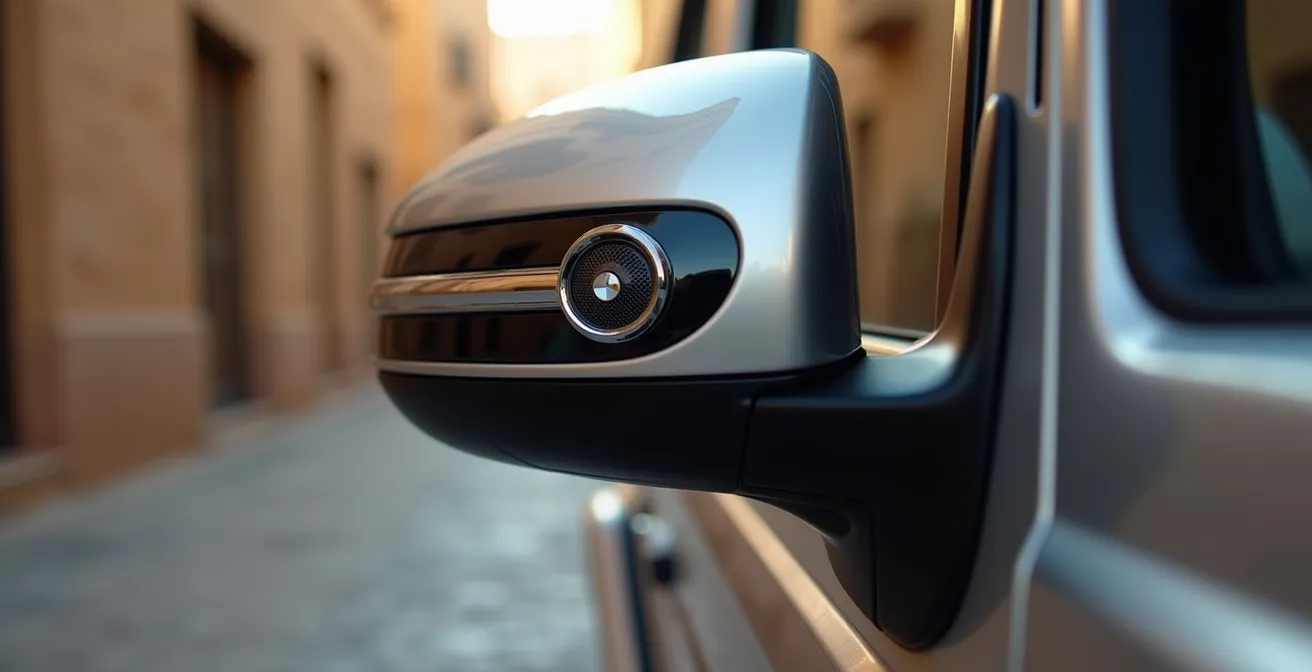
The smartest strategy, however, is often avoidance. Park the SUV at a large, modern facility like Deira City Centre, which features wider parking bays designed for such vehicles. From there, utilize RTA taxis or traditional Abra boats to cover the final, most constricted, leg of your journey. This hybrid approach allows you to enjoy the G-Wagon on appropriate roads while avoiding the stressful and financially risky task of forcing it through an environment it was not designed for. It’s a calculated decision to trade a few dirhams in taxi fare for the peace of mind of avoiding a several-thousand-dirham repair bill.
Valet vs Self-Park: Where to Leave Your Lamborghini Safely?
Parking a high-value vehicle like a Lamborghini or G-Wagon in Dubai is not a simple choice of convenience; it is a calculated risk assessment. The decision between using a valet service and self-parking involves a trade-off between perceived security, actual liability, and potential for damage. Not all valet services are created equal, and understanding the tiers of service is crucial to protecting your rental. A five-star hotel valet at the Burj Al Arab operates under a completely different liability and insurance framework than a pop-up valet service outside a busy restaurant.
The primary advantage of a top-tier valet is accountability. These services typically employ trained drivers, operate under extensive CCTV coverage, and have explicit policies covering damage incurred while the vehicle is in their care. Conversely, less formal services may have minimal insurance and poorly trained staff, making you liable for any mishaps. Self-parking, while seemingly giving you more control, introduces its own set of risks, primarily from other drivers, shopping carts, and a lack of direct oversight. The key is to make an informed choice based on the environment.
The following table, based on an analysis of Dubai’s parking landscape, breaks down the risk levels associated with different valet tiers.
| Service Tier | Location Type | Risk Level | Accountability Features |
|---|---|---|---|
| Tier 1 (Safest) | 5-star hotels (Burj Al Arab, Atlantis) | Minimal | Insured valets, CCTV coverage, damage liability policies |
| Tier 2 (Moderate) | Major malls (Dubai Mall, Mall of Emirates) | Low-Medium | Established operators, partial CCTV, standard procedures |
| Tier 3 (Higher Risk) | Pop-up valets, small restaurants | High | Limited accountability, minimal insurance, inconsistent training |
If you opt for self-parking, you must become your own security manager. This involves choosing a corner spot to eliminate risk from one side, verifying the presence of a CCTV camera directly above your space, and selecting a well-lit area near an entrance. Furthermore, activating the vehicle’s “Valet Mode,” if available, is a wise precaution. This function typically limits the vehicle’s top speed and locks access to the glove box and infotainment system, providing a layer of security even when you hand over the keys.
How Much Does it Cost to Refuel a V8 Patrol for a Weekend?
The daily rental rate of a powerful V8 SUV like a Nissan Patrol or a G-Wagon is only the first line item in a much larger budget. A savvy renter focuses on the Total Cost of Operation (TCO) for the rental period, and fuel is the most significant variable. A V8 engine’s thirst for premium fuel, especially with a mix of city and highway driving, can add a substantial amount to your weekend expenses. Expecting to spend between AED 350 and AED 450 for a full tank of Super 98 octane fuel is a realistic starting point. For a weekend involving a trip from Dubai to, for example, the mountains of Ras Al Khaimah, you might budget for one and a half tanks.
Beyond fuel, other operational costs must be factored into your financial planning. Salik, Dubai’s electronic toll system, will automatically charge your rental account each time you pass under a gate. Depending on your itinerary, this can add another AED 20-40 over a weekend. Parking is another key expense. While many places offer free parking, prime locations like Dubai Mall begin charging after a set number of free hours, potentially adding another AED 20-80 to your bill if you plan an extended visit.
Finally, a crucial logistical point often overlooked by novice renters is the final refueling. Most rental agreements require you to return the car with a full tank of fuel. To avoid exorbitant refueling charges from the rental company, you must do this yourself. A key piece of evidence is to keep the receipt from a petrol station located within a few kilometers of the rental return location. Using an app like Waze to find the nearest ENOC or Emarat station with Super 98 in stock just before you return the car is a professional-level move that prevents any disputes over the fuel level.
Chauffeur vs Uber Chopper: Which Is More Cost-Effective for Day Trips?
Once you are operating at the highest echelon of luxury transport, the decision is no longer simply about getting from A to B. It becomes a complex calculation of time, flexibility, cost, and status. For a day trip, say from your Palm Jumeirah hotel to an event at the Emirates Palace in Abu Dhabi, you face a choice between a full-day chauffeur service in your G-Wagon or a point-to-point transfer via Uber Chopper. While the helicopter offers undeniable speed and spectacle, a chauffeured vehicle provides a different, often more practical, set of advantages.
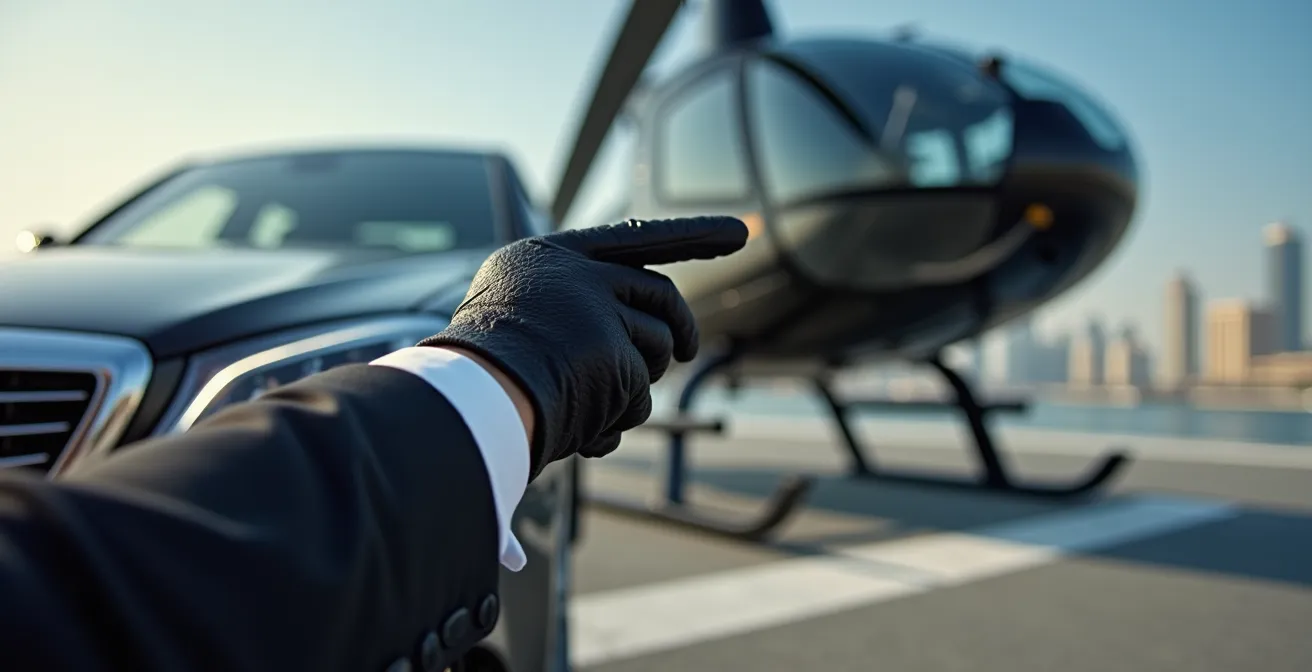
The primary advantage of a chauffeur is absolute flexibility. Your itinerary can change on a whim, you can make unplanned stops, and you have ample storage for luggage or shopping. A helicopter is rigid; it operates on a fixed schedule between pre-determined helipads and has severe luggage restrictions. Furthermore, a chauffeur service is an all-weather solution, whereas a sandstorm or high winds can ground a helicopter, potentially derailing your entire day. Cost is also a major differentiator. A full-day chauffeur might cost between AED 800-1500, while a one-way helicopter trip can easily range from AED 2000-3500.
The choice ultimately depends on the mission. For a direct, high-impact arrival where time is the absolute priority, the helicopter is unbeatable. For a day that requires adaptability, multiple stops, or carrying anything more than a small briefcase, the ground-based luxury of a chauffeur is far more cost-effective and operationally sound. This comparative data from a leading Dubai luxury provider clarifies the trade-offs.
| Factor | Chauffeur Service | Uber Chopper |
|---|---|---|
| Flexibility | High – change plans anytime | Low – fixed helipad locations |
| Storage | Full trunk capacity | Minimal luggage allowance |
| Speed | Subject to traffic | 15 mins Dubai to Ras Al Khaimah |
| Weather Dependency | All-weather operation | Grounded in sandstorms |
| Cost Range | AED 800-1500/day | AED 2000-3500/trip |
Why Luxury Suites Require a $1000 Credit Card Hold?
The financial logic behind a $1,000 hold on a luxury hotel suite is identical to that of a $5,000 hold on a G-Wagon: it is a simple, albeit inefficient, form of collateral to cover potential incidental costs like minibar consumption, room service, or damages. Understanding this parallel is the key to unlocking the strategy for bypassing the car rental deposit. The hotel industry provides a clear model for how to replace financial collateral with what we can term “trust signals.” These are indicators that position you as a low-risk, high-value guest, giving the establishment the confidence to waive or reduce standard security requirements.
The most powerful trust signal is elite status in a major hotel loyalty program. A guest checking in as a Marriott Bonvoy Titanium Elite or Hilton Honors Diamond member is immediately flagged as a known quantity. The hotel’s system recognizes them as a frequent, high-spending traveler with a long-standing and positive history with the brand. This proven track record of reliability is, in effect, a form of non-financial collateral. As one industry report notes:
High-tier status in hotel loyalty programs acts as a signal of a trustworthy guest, often empowering the front desk staff to waive or significantly reduce the standard deposit requirement
– Industry Analysis, Dubai Hospitality Standards Report
You can apply this same logic to your car rental. Instead of just being an anonymous renter, you can build a case. Have your five-star hotel’s concierge make the booking on your behalf. Provide proof of your senior executive position or professional credentials. Present a comprehensive travel insurance policy that covers rental car incidentals. Each of these actions serves to de-risk you in the eyes of the rental manager, transforming the negotiation from a rigid policy into a flexible, person-to-person assessment. You are no longer asking for an exception; you are demonstrating why the standard rule is not applicable to you.
Underground Parking Fees: How to Get Your Ticket Validated?
In Dubai’s sprawling mega-malls, parking is a high-tech, often automated, affair that can lead to unexpected costs if you don’t understand the system. The era of simple paper tickets is being replaced by barrier-free, Automatic Number Plate Recognition (ANPR) systems integrated with Salik accounts. At Dubai Mall, for example, the system grants 4 hours of free parking on weekdays and 6 hours on weekends, after which fees are automatically calculated and, in some cases, deducted from a linked Salik account upon exit.
Getting your “ticket” validated in this digital ecosystem is no longer about getting a stamp at a customer service desk. It’s about leveraging the system’s own rules. For instance, purchasing a cinema ticket at the mall’s VOX Cinemas can automatically extend your free parking period. Many high-end retailers or restaurants also offer validation, but it’s often handled digitally by registering your vehicle’s plate number at the point of sale. The key is to be proactive and inquire about the validation process when you make a significant purchase. Forgetting to do so can result in charges accumulating, and with systems like Mall of the Emirates, failure to pay within a set period can lead to fines.
Mastering this process is essential for cost control. The most effective approach is to fully embrace the digital tools provided. Registering your rental vehicle’s plate in the specific mall’s app (like The Dubai Mall app) or the general ‘Parkin’ app before you even arrive is the first step. This gives you a clear overview of your entry time, the applicable free hours, and the validation options available, transforming a potentially confusing experience into a manageable process.
Action Plan: Mastering Dubai’s Digital Parking Validation
- Register your rental’s vehicle plate number in the relevant mall or Parkin apps before your visit for seamless tracking.
- Proactively inquire about digital validation at cinemas, restaurants, or retail stores at the time of purchase.
- Use the mall app’s “find my car” feature by screenshotting your parking location to avoid wasting time upon departure.
- Ensure your Salik account (if linked to the rental) has a sufficient balance to cover any post-free-period charges for a smooth, barrier-free exit.
- If validation fails, use contactless payment options at digital kiosks to settle fees before exiting to avoid later complications or fines.
Key takeaways
- Liability is Your Biggest Cost: The most significant financial risk is not the rental fee, but the unlimited liability from violating contract clauses like the “off-road” exclusion.
- Calculate Total Cost of Operation: A smart rental involves budgeting for fuel, tolls (Salik), and strategic parking, not just the daily rate.
- Leverage Trust Signals: Your reputation, loyalty status, and professional credentials can be used as non-financial collateral to negotiate or waive hefty credit card holds.
Uber Black vs Tesla Taxi: Which Offers Better Status for Business Arrival?
In a city like Dubai, your choice of ground transportation for a business meeting is a non-verbal statement that speaks volumes before you even enter the room. The decision between hailing an RTA Tesla taxi or booking a BMW 7 Series via Uber Black is not about price; it’s about aligning your vehicle with the message you wish to project. As one expert from the Dubai Business Etiquette Guide states, “The vehicle choice sends a non-verbal message about your business values and priorities before you even shake hands.” Each service and vehicle type carries a distinct set of connotations that can either reinforce or undermine your position.
Arriving at a tech conference like GITEX in a silent, state-owned Tesla Model S projects an image of innovation, sustainability, and forward-thinking. It aligns you with the government’s own vision for the future. In contrast, arriving at a meeting in the Dubai International Financial Centre (DIFC) in a classic black BMW 7 Series or Lexus ES from a service like Uber Black signals traditional corporate power, stability, and a respect for established protocol. It’s a conservative, reliable choice that speaks the language of finance.
The context of the meeting dictates the optimal choice. For a creative agency in the Dubai Design District, a premium Careem, known for its local market understanding, might be more appropriate. For a sensitive meeting with a government entity, the understated and respectful presence of a Lexus is often the wisest decision. The following matrix provides a clear framework for this strategic selection.
| Business Context | Recommended Vehicle | Message Projected | Service Features |
|---|---|---|---|
| GITEX Tech Conference | RTA Tesla Model S | Innovation, sustainability, tech-forward | Silent arrival, smartphone integration, eco-credentials |
| DIFC Finance Meeting | Uber Black (BMW 7 Series) | Traditional corporate power, reliability | Professional drivers, water bottles, phone chargers |
| Dubai Design District | Premium Careem | Local market understanding, creative | Arabic-speaking drivers, local payment options |
| Government Relations | Lexus ES (Uber Black) | Respectful, established, conservative | Experienced drivers, pristine vehicles, formal service |
Ultimately, renting and operating a luxury vehicle in Dubai is an exercise in financial acumen. By moving beyond the sticker price and embracing a mindset focused on total cost, liability management, and strategic signaling, you transform a simple transaction into a demonstration of savvy and control. The next logical step is to apply this framework to your specific situation, identifying your strongest trust signals and preparing your negotiation strategy long before you arrive at the rental desk.