Tired of seeing ‘fully booked’ on Dubai’s best restaurant sites? The key isn’t waiting, it’s outsmarting the reservation ecosystem by knowing its hidden rules and access points.
- Strategic timing and leveraging non-public channels (like hotel concierges or bar seating) are more effective than online portals.
- Understanding the nuances, from dress code to menu choices, marks you as a savvy diner and can improve your experience.
Recommendation: Shift your focus from blindly booking to strategically targeting operational windows and alternative dining experiences to access top-tier cuisine without the long wait.
You see the name—Dinner by Heston, Trèsind Studio, Orfali Bros—and your foodie heart skips a beat. You click “Reserve,” ready for a culinary highlight on your short trip to Dubai, only to be met with a soul-crushing calendar of greyed-out dates. “Fully booked for the next three months.” It’s a common frustration in a city whose exceptional culinary prominence is reflected in its global ranking. For the time-crunched visitor, it feels like the best of Dubai’s dining scene is perpetually out of reach.
The standard advice is predictable: book months ahead, be flexible, or hope for a lucky cancellation. But what if the game isn’t about waiting? What if it’s about knowing how to play? The truth is, a sophisticated reservation ecosystem operates just beneath the surface of the public-facing booking portals. It runs on unwritten rules, personal connections, and operational rhythms that, once understood, can unlock doors that appear firmly shut. This isn’t about finding a glitch in a system; it’s about speaking the language of the industry.
This guide is your insider playbook. We’re moving beyond the obvious and into the tactical. You’ll learn why your outfit can be your first reservation hurdle, how to decode a menu for maximum value, and the precise strategies to employ when a top-tier table seems impossible to get. We’ll dissect the difference between a celebrity chef’s name on the door and the reality in the kitchen, and explore the very soul of what constitutes ‘Dubai Cuisine’. Forget the waiting list; it’s time to learn the concierge-level secrets to dining at Dubai’s pinnacle.
This article provides a complete roadmap for the discerning foodie. We will break down every aspect of the high-end Dubai dining experience, giving you the strategic advantage you need to turn ‘fully booked’ into ‘table for two’.
Summary: Your Playbook for Conquering Dubai’s Michelin Scene
- Why Your ‘Smart Casual’ Outfit Might Get You Rejected at the Door?
- Tasting Menu or A La Carte: Which is the Smarter Choice for Small Eaters?
- The Imported Truffle Trap: How to Spot Freshness in Desert Fine Dining?
- Why Is Water Costing You $30 at a Fine Dining Dinner?
- Celebrity Name vs Kitchen Reality: Is the Chef Actually Cooking Tonight?
- How to Get a Table at Heston’s Dinner Without Booking a Month Ahead?
- The ‘Pretty Food’ Trap: Is the Pistachio Croissant Actually Good?
- Is There Such a Thing as ‘Dubai Cuisine’ or Is It Just Fusion?
Why Your ‘Smart Casual’ Outfit Might Get You Rejected at the Door?
In Dubai’s elite dining circles, “smart casual” is less a suggestion and more a coded language. It’s the first filter, a non-verbal cue to the maître d’ that you understand the environment and respect the establishment. Showing up in casual shorts or a basic t-shirt isn’t just a fashion faux pas; it can be grounds for refusal at the door, regardless of your reservation. The city’s top venues cultivate a specific ambiance, and your attire is considered part of that curated experience. It signals that you’re not just a tourist looking for a meal, but a participant in the evening’s theatre.
The key is to aim for understated elegance. For men, this means bypassing the generic blazer and focusing on high-quality separates. A well-fitting polo shirt from a premium brand paired with chinos or dress trousers speaks louder than an ill-fitting suit jacket. For women, the focus is on sophisticated modesty—elegant silhouettes that are chic without being overly revealing, respecting local cultural sensibilities while remaining fashionable. The goal is to look polished and intentional, not like you just came from the beach.
Beyond the clothes themselves, accessories are crucial social signifiers. A quality watch, a designer handbag, or polished leather shoes can immediately elevate your entire look and communicate a level of sophistication that front-of-house staff are trained to recognize. Even your fragrance plays a role. While Dubai’s culture embraces perfume, fine dining requires subtlety. An overpowering scent can clash with the delicate aromas of the food and wine, marking you as a novice. It’s a delicate balance of looking the part without trying too hard.
Tasting Menu or A La Carte: Which is the Smarter Choice for Small Eaters?
The choice between a tasting menu and ordering à la carte is a classic fine-dining dilemma, especially for those with a smaller appetite. The tasting menu offers a narrative, a curated journey through the chef’s vision, but can feel like an overwhelming food marathon. À la carte provides control but risks missing the restaurant’s signature story. For the small eater, the “smarter” choice isn’t about volume, but about the kind of experience you’re seeking. The tasting menu is an immersive event; à la carte is a personalized meal.
The primary advantage of the tasting menu is its completeness. It’s designed as a coherent story, where each course builds on the last. This is especially true at concept-driven restaurants. The experience at a place like Trèsind Studio illustrates this perfectly.
Case Study: The Narrative Power of Trèsind Studio’s Tasting Menu
With just six tables facing an open kitchen, the restaurant creates an immediate sense of intimacy. Its “Rising India” tasting menu is a journey through India’s diverse culinary regions, from the Thar Desert to the Coastal Plains. Each course tells a story, making the experience about much more than just the food on the plate. Opting for à la carte here would mean missing the entire narrative and the immersive, educational aspect that justifies its two-Michelin-star status.
However, control and flexibility are the domain of à la carte. If your goal is to try one or two specific, legendary dishes you’ve heard about, or if you have dietary restrictions, this is the safer path. The decision ultimately hinges on your priorities, as the following comparison shows.
| Factor | Tasting Menu | A La Carte |
|---|---|---|
| Duration | 3-4 hour experience | 90-120 minutes typically |
| Control | Chef’s narrative | Guest’s selection |
| Price | Fixed cost (typically 250+ AED) | Variable based on choices |
| Portion flexibility | Limited, though some restaurants accommodate sharing | Full control over quantity |
| Experience completeness | Full culinary journey | Selected highlights |
The Imported Truffle Trap: How to Spot Freshness in Desert Fine Dining?
In the luxurious landscape of Dubai’s fine dining, the truffle is a king, often commanding a hefty supplement on the bill. But in a desert climate where everything is imported, how can you be sure you’re paying for genuine, aromatic excellence and not a flavorless imposter? The “truffle trap” is real, and it preys on diners’ unfamiliarity with the signs of true quality. It’s not enough for the menu to say “truffle”; an informed diner must know how to verify its authenticity before committing to the premium price.
The first line of defense is knowledge of seasonality. True gourmands know that White Alba Truffles have a short window from October to December, while Black Périgord Truffles are at their peak from December to March. A restaurant offering “fresh” white truffles in May is a major red flag. Your next tool is sensory inspection. Don’t be shy; ask to see the truffle before it’s shaved. A fresh truffle should be firm to the touch with a powerful, deep, earthy aroma. A soft texture or faint smell indicates it’s past its prime.
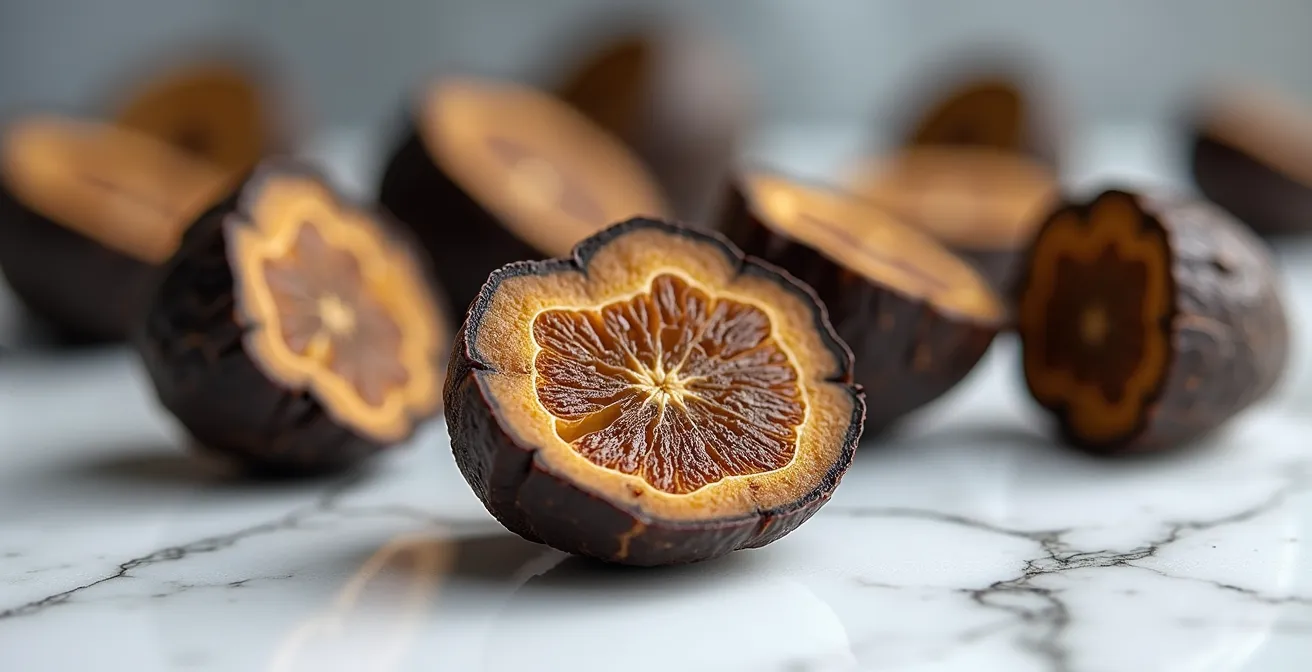
This macro view of a fresh truffle reveals the intricate, marbled veining that is a hallmark of its quality and complex flavor profile.
Finally, decode the menu’s language. The phrase “freshly shaved truffle” is the gold standard. Be wary of anything labeled “truffle essence” or, most critically, “truffle oil.” The vast majority of truffle oil is a synthetic chemical compound (2,4-dithiapentane) designed to mimic the aroma, and its presence on a fine dining menu is often a sign that the establishment cuts corners. A realistic price is also a good indicator; research the current market price per gram to see if the supplement is justified or wildly inflated.
Why Is Water Costing You $30 at a Fine Dining Dinner?
The moment the bill arrives can sometimes be as dramatic as the meal itself, especially when you spot a charge of $20 or $30 for a bottle of water. For many visitors, this seems like exorbitant price gouging. However, in the context of Dubai’s fine dining scene, the price of water is a microcosm of the larger operational economics at play. It’s not just about the water itself; it’s about what that bottle represents: import costs, luxury branding, high service standards, and the immense overheads of running a world-class restaurant in one of the planet’s most competitive markets.
First, almost every high-end product in a Dubai restaurant is imported, from the beef to the olive oil, and premium bottled waters are no exception. Brands like Acqua Panna or Evian are shipped from Europe, incurring significant logistics and import duty costs. Second, the price is part of the overall “experience” package. You’re paying for the sommelier who presents the water options, the perfectly chilled glasses, the attentive service that ensures your glass is never empty, and the prime real estate the restaurant occupies. These are all built into the pricing structure.
As the noted food and travel publication Travelling Foodie points out, this is a city that has firmly established its place on the global stage. This is a crucial piece of the puzzle.
Dubai has cemented its position as a culinary hub and gastronomic destination, being named one of the world’s top 10 cities for foodies.
– Travelling Foodie, Dubai Michelin Guide Restaurants Review
This status is maintained by meeting extraordinarily high international standards, which requires attracting top talent from a global pool. In fact, over 200 nationalities shape Dubai’s culinary scene. Paying these world-class chefs, sommeliers, and managers competitive international salaries is a massive operational cost. In this context, the high price of water is less an isolated charge and more a small contribution to the enormous cost of maintaining this global center of gastronomic excellence.
Celebrity Name vs Kitchen Reality: Is the Chef Actually Cooking Tonight?
When you book a table at a restaurant bearing the name of a world-famous chef—Gordon Ramsay, Björn Frantzén, Heston Blumenthal—there’s an implicit expectation that you are paying for that specific genius’s touch. The reality, however, is more complex. In most cases, the celebrity chef acts as a “consultant” or “patron.” They design the concept, develop the menu, and set the impossibly high standards, but they are not physically in the kitchen on a nightly basis. The day-to-day execution is left to a highly skilled, hand-picked Chef de Cuisine and their brigade.
This isn’t a bait-and-switch; it’s a standard and effective operational model in global fine dining. The celebrity chef’s brand guarantees a certain philosophy and level of quality, while the resident team ensures consistency. A recent addition to the Michelin guide is a perfect example.
Case Study: FZN by Björn Frantzén’s Three-Star Execution
When FZN by Björn Frantzén earned three Michelin Stars in Dubai, the guide acclaimed it as a “true destination restaurant with a stellar team.” It is celebrated chef Frantzén’s debut in the Middle East, but the success is credited to the “stellar team” on the ground who flawlessly execute his vision every single day. This highlights the model: the celebrity provides the blueprint, and a world-class local team builds the masterpiece nightly.
The real question for a diner isn’t “Is the celebrity here?” but rather “How strong is the resident team?” The true mark of a great celebrity-branded restaurant is a Chef de Cuisine who is a star in their own right, perfectly channeling the patron’s vision. Discerning diners can track the real kitchen leadership by following the Executive Chef (not just the celebrity) on social media, looking for posts about daily specials or team activities, which give a much better sense of the kitchen’s real-time energy and creativity.
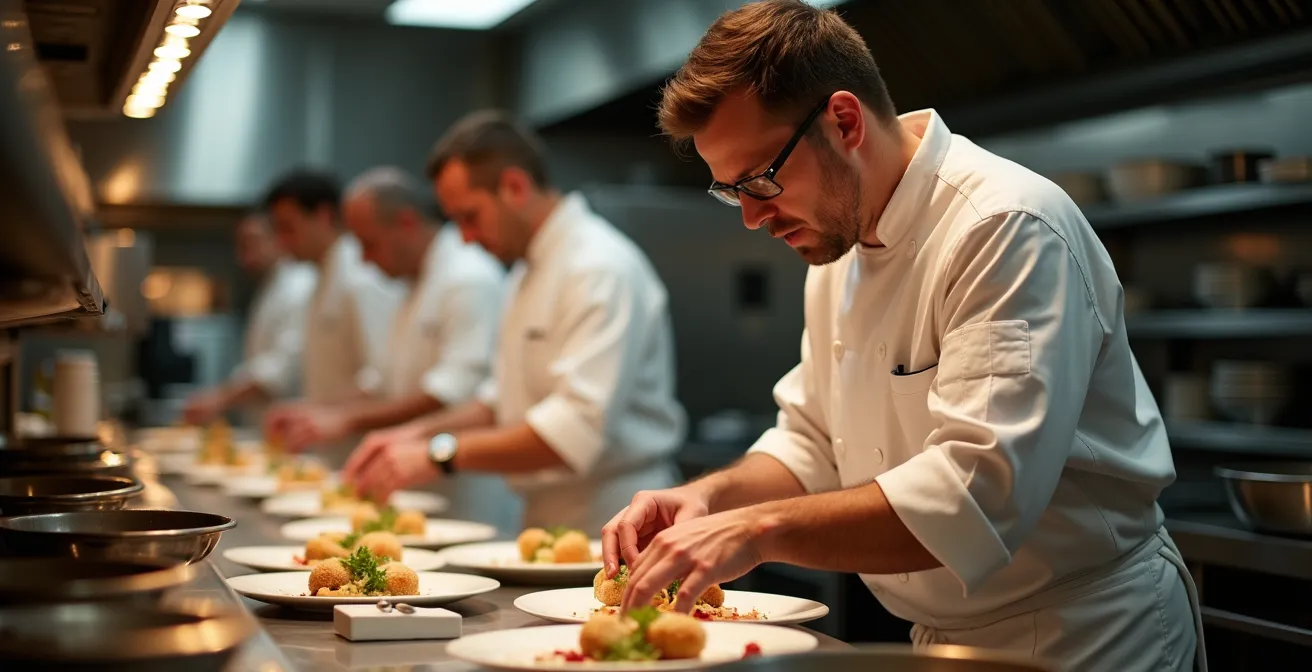
Ultimately, you are paying for the brand’s intellectual property—the recipes, the techniques, the service standards—which are executed by a dedicated brigade. The magic is in the system, not just the single star name on the sign.
How to Get a Table at Heston’s Dinner Without Booking a Month Ahead?
Dinner by Heston Blumenthal at Atlantis The Royal is one of the toughest reservations to secure in Dubai. The online portal often shows no availability for weeks, if not months. However, for the savvy diner, the online portal is the front door, and there are always side entrances. Securing a table here is a game of strategy, timing, and leveraging the hotel’s own ecosystem. Direct assault via the website is the lowest percentage play; a multi-pronged approach is required.
The most effective tactic is the bar seating strategy. The bar at Dinner often operates on a walk-in basis and, crucially, serves the full à la carte menu. Arriving 15 minutes before the restaurant opens for service gives you a prime chance to secure one of these seats. Another powerful approach is leveraging the hotel itself. Guests of Atlantis The Royal or its partner properties are given priority booking privileges. A quick call to the hotel’s concierge can often materialize a table that simply doesn’t exist for the general public.
Timing your request is also critical. Many top restaurants, including Dinner, have a daily 4 PM cancellation window. This is when they release tables held for VIPs or confirm cancellations from the day’s books. A polite, well-timed call to the restaurant’s direct line at this exact moment can yield surprising results. And don’t underestimate the power of lunch; booking a table for the lunch service is significantly easier and often comes with the added benefit of more accessible business lunch pricing, while still offering the core experience.
Action Plan: Verifying Your Booking Strategy
- Points of Contact: List all access channels for the restaurant: direct phone line, hotel concierge email, the official booking portal, and even the bar manager’s name if you can find it.
- Collect Intel: Scan the restaurant’s and the Chef de Cuisine’s social media for recent posts about walk-in availability, bar seating policies, or special menu nights.
- Coherence Check: Align your request with known operational windows. Don’t just call randomly; target the 4 PM cancellation release or the half-hour before opening.
- Memorability Pitch: When you call, be prepared. Instead of just “any tables?”, mention you’re a huge fan of the “Meat Fruit” and are visiting for a limited time. Create a connection.
- Integration Plan: Set a calendar alert for your target call time. Have the concierge’s number pre-programmed. Be ready with your backup plan, such as accepting a lunch slot or bar seat.
The ‘Pretty Food’ Trap: Is the Pistachio Croissant Actually Good?
In the age of Instagram, Dubai’s culinary scene is rife with the “pretty food” trap—dishes that are visually stunning, endlessly shareable, but ultimately underwhelming in flavor. The viral pistachio croissant or the gold-flaked burger might rack up the likes, but do they represent genuine culinary excellence? For a discerning foodie, the challenge is to see beyond the photogenic facade and identify true substance. A pretty dish is enjoyable, but a truly great dish delivers on taste, texture, and technique long after the photo is posted.
The first step is to look for depth beyond a single, gimmicky item. A cafe that is famous for only one viral creation may be a one-trick pony. A truly great establishment demonstrates consistency across its entire menu. The key is to look at the broader context of the city’s dining scene. The sheer quality available means you don’t have to settle for just looks. The existence of 119 MICHELIN-recommended establishments in Dubai as of 2025 demonstrates a profound depth of quality that goes far beyond Instagram trends. These are places recognized for their consistent excellence, not just one photogenic dish.
The language of a menu can also offer clues. Look for descriptions that emphasize technique, ingredient origin, or flavor pairings rather than just visual appeal. Words like “slow-braised,” “house-fermented,” or “line-caught” suggest a focus on craft over aesthetics. As the Michelin Guide itself notes, the city’s culinary strength lies in its diverse and authentic flavors.
Dubai embraces a rich tapestry of flavors that reflect the world’s gastronomic passions.
– Michelin Guide Dubai, The MICHELIN Guide Ceremony Dubai 2025
This “rich tapestry” is where the real value lies. Seek out reviews from trusted food critics and bloggers who discuss flavor profiles and execution, not just aesthetics. A viral dish can be a fun experience, but don’t let it distract you from the more profound and satisfying culinary adventures that Dubai has to offer. The best meals are often the ones that prioritize taste over trends.
Key Takeaways
- Securing a top table in Dubai is a strategic game of timing and leveraging non-public channels, not a waiting game.
- True quality is found in the details: the freshness of an ingredient like a truffle, the skill of the resident kitchen brigade, and a focus on flavor over visual gimmicks.
- Dubai’s culinary identity is not a single traditional cuisine but a dynamic, ever-evolving fusion reflecting its multicultural population.
Is There Such a Thing as ‘Dubai Cuisine’ or Is It Just Fusion?
This is the ultimate question for any foodie trying to understand the city’s soul. Unlike France with its centuries of codified gastronomy or Japan with its deep-rooted culinary traditions, Dubai doesn’t have a single, indigenous “cuisine” in the classic sense. For years, the prevailing view was that it was merely a hub for high-quality imports and international fusion. However, a new, more nuanced understanding is emerging: Dubai Cuisine *is* the fusion. It’s a unique gastronomic identity forged in the crucible of migration, trade, and modernity.
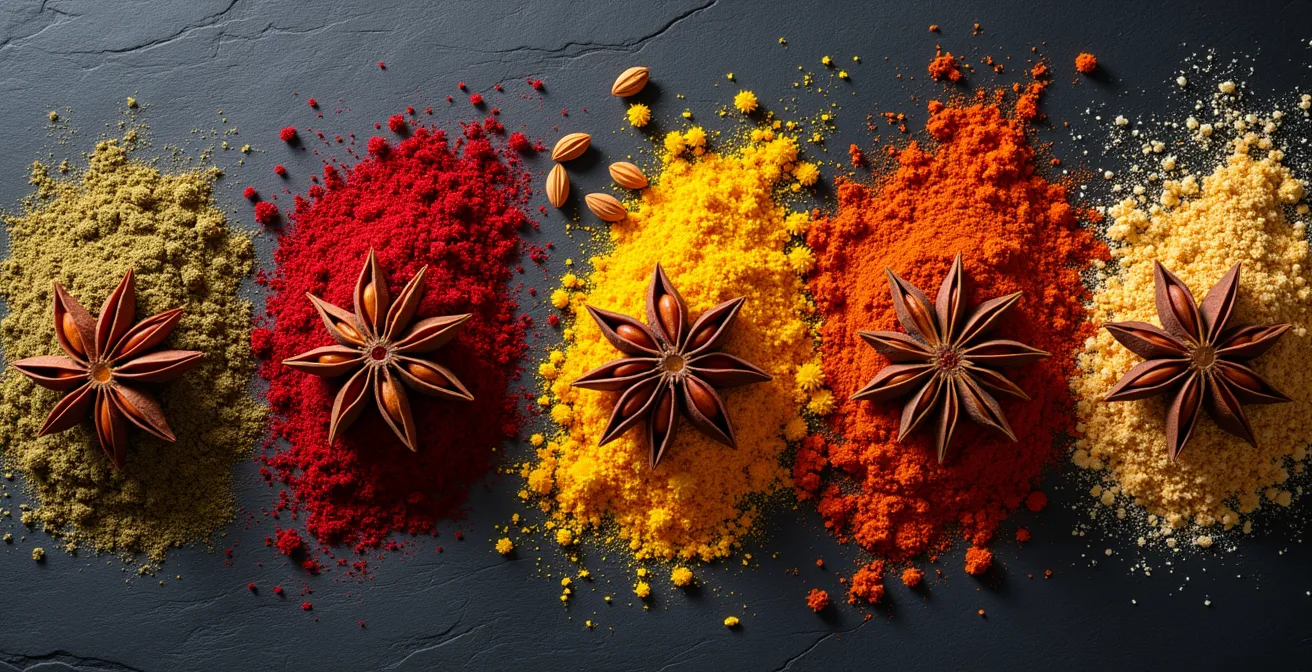
This identity isn’t based on ancient agricultural terroir but on a modern, multicultural “human terroir.” It’s defined by the lived experiences of the people who have called the city home. The inaugural Michelin Guide for Dubai highlighted this by recognizing an incredible 21 different cuisine types, showing the unprecedented diversity of traditions that coexist and influence one another. This blend of spices, techniques, and flavors from across the Middle East, India, Pakistan, and beyond creates something entirely new.
Restaurants like Moonrise, run by a young chef who grew up in the city, perfectly exemplify this new identity. They aren’t just combining disparate elements; they are telling the story of modern Dubai on a plate.
Case Study: Moonrise and the Birth of a Modern Culinary Identity
Chef Solemann Haddad’s cooking is explicitly about the “Dubai food culture,” which he defines as a mix of Indian, Sri Lankan, and Pakistani influences filtered through his own experience of growing up in the city. As one critic noted, “He’s grown up in Dubai, and has seen since he was a kid what the city started from and what it has become.” His menu is a reflection of that journey. This is not fusion for the sake of novelty; it is a deeply personal and authentic expression of a place, which is the very definition of a cuisine.
Your Dubai culinary adventure awaits. Don’t just be a tourist looking at a menu; be an insider who knows the story behind the table. Apply these strategies and insights to transform your next dining experience from a simple meal into a memorable conquest.