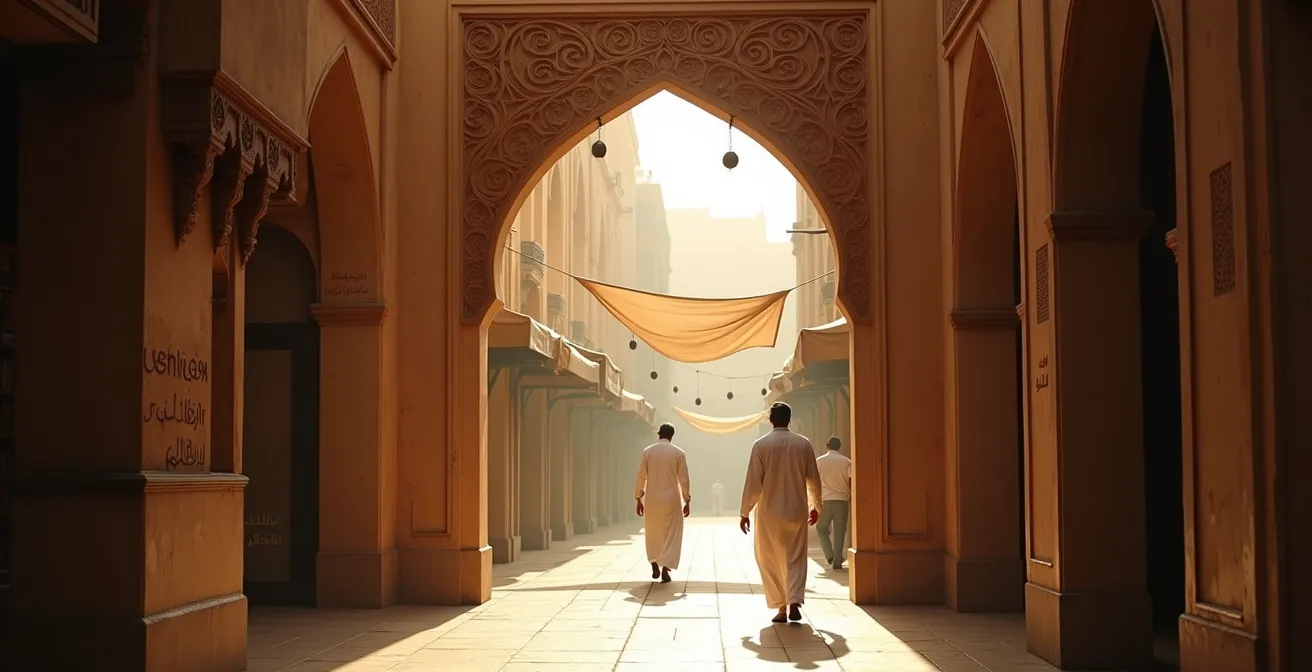
The secret to conquering the Gold Souk isn’t avoiding touts—it’s understanding the system they work in and using their own rules against them.
- Aggressive selling is driven by a commission-based system, not personal animosity.
- Your greatest defense is “psychological armor”: viewing the chaos as a game, not an attack.
Recommendation: Instead of just saying “no,” learn to disengage strategically and project the confidence of a local who knows the real value of things.
The moment you step into the dazzling arcades of the Dubai Gold Souk, it begins. A chorus of “My friend, looking is free!” or “Just for you, special price!” echoes from every direction. For most tourists, this is a stressful, intimidating gauntlet. The common advice you’ve heard is to just say “no” firmly or ignore them completely. But let’s be honest, that rarely works. You’re still marked as a tourist, a target. The touts are persistent because it’s their job, part of a complex economic engine you can’t see.
But what if the key wasn’t to build a wall, but to learn the secret handshakes? What if, instead of being a defensive player, you could become an offensive one, navigating the chaos with the cool confidence of a resident? This isn’t about being rude; it’s about being smart. It’s about understanding the unspoken rules of the game—the real value of a “making charge,” the tell-tale signs of a saffron scam, and the transport hacks that separate locals from visitors. The touts are playing a game of numbers and scripts, and they expect you to react in a predictable way.
This guide will hand you a different playbook. We’re going to dismantle the system, piece by piece. Forget the generic advice. You’re about to learn how to flip the script, turning their tactics into your advantage. You’ll learn to negotiate with precision, sidestep tourist traps with a single sentence, and move through the crowds with purpose. By the end, you won’t just survive the Gold Souk; you’ll master it.
This article breaks down the essential insider strategies you need. Below is a summary of the key areas we will cover, providing you with a complete playbook for a confident and enjoyable visit.
Summary: Your Gold Souk Insider Playbook
- The 30% Rule: How to Negotiate Prices Like a Local?
- Taking Photos of Locals: What Is Legally and Culturally Allowed?
- 1 Dirham Abra Ride: Why Cash Is King on the Creek?
- Saffron Scams: How to Tell Real Saffron from Dyed Corn Silk?
- Visiting Heritage Sites During Ramadan: What Changes for Tourists?
- The ‘Carpet Shop’ Stop: How to Avoid Wasting 45 Minutes?
- Water Bus vs Water Taxi: Which Is the Real Commuter Hack?
- How to Navigate the Al Fahidi Maze Without Google Maps?
The 30% Rule: How to Negotiate Prices Like a Local?
First rule of the souk: negotiation isn’t just accepted, it’s expected. But tourists make a critical mistake by trying to haggle the price of gold itself. The price of the gold weight is fixed and tied to the international market rate, displayed on screens in every shop. A local would never try to negotiate this, and doing so immediately marks you as a novice. The real negotiation happens on the “making charge”—the fee for the labor and artistry involved in crafting the piece.
This is where you focus your energy. When a seller quotes you a price, politely ask them to break it down: “How much for the gold, and how much is the making charge?” Once you have that number, your opening offer should be 30-40% below their asking price for the making charge *only*. For example, if the making charge is 200 AED, you can start your offer around 120-140 AED. The negotiation is a friendly, respectful dance, not a confrontation. A smile and a bit of humor will get you much further than aggression.
A common scenario proves this point. One visitor looking at a 4-gram gold piece was quoted a 125 AED making fee. By focusing solely on this fee, they got it down to 100 AED and felt they could have reached 75 AED. According to a real buyer’s experience in the souk, the key is understanding that your leverage is limited on small purchases, but a 20-25% discount on the making charge is very achievable. The ultimate power move? Be genuinely prepared to walk away. If your offer is reasonable, they will often call you back with their best price. That’s when you know you’ve hit the sweet spot.
Taking Photos of Locals: What Is Legally and Culturally Allowed?
The Gold Souk is a photographer’s dream, but it’s also a place of work and daily life. Pointing your camera without consideration is the fastest way to cause offense. In the UAE, it is illegal to take someone’s picture without their explicit permission. This is especially true for local women. The “hack” here isn’t about finding sneaky ways to take photos, but about shifting your focus to capture the spirit of the place with respect.
Instead of trying to capture “exotic” faces, focus on the details that tell a story. General wide shots of the bustling market and its incredible architecture are perfectly acceptable and capture the energy without invading anyone’s privacy. A powerful and respectful technique is to focus on the craftsmanship. A close-up of a jeweler’s hands at work, the scattered tools on a bench, or the intricate details of a necklace tells a more profound story than a stolen portrait ever could.
This paragraph introduces the concept of respectful photography. To better understand this, it is helpful to visualize its components. The illustration below shows how focusing on hands and craft tells a powerful story.

As this image demonstrates, the narrative is in the texture and action. If you do wish to take a portrait, always build rapport first. Buy a small item, have a friendly chat, and then politely ask. A simple “Is it okay if I take your picture?” with a smile works wonders. Pay close attention to non-verbal cues. If someone turns away, covers their face, or shakes their head, the answer is a definitive no. Respect it immediately and move on.
1 Dirham Abra Ride: Why Cash Is King on the Creek?
Once you’re done with the Gold Souk, you’ll want to cross the Dubai Creek to explore the Spice Souk and Al Fahidi. Tourists are often herded towards the more expensive Water Taxis or the modern Water Bus. But the real local hack, and the most authentic experience, is the traditional Abra ride for 1 AED. These small wooden boats are the lifeblood of the Creek, a constantly moving shuttle service for workers and residents.
Here’s the crucial part: Abras are cash only, and you need exact change. Don’t be the tourist holding up the line trying to pay with a 100 AED bill; the drivers don’t carry change for large notes. Always have a handful of 1 Dirham coins ready. This simple act of preparation instantly signals that you know how things work. You pay the driver directly as you board, find a spot on the wooden bench, and enjoy the five-minute journey. It’s not just transport; it’s a living piece of Dubai’s history, and a system that remains untouched by credit cards and Nol cards.
The sheer scale of this traditional system is staggering; over 15 million passengers use the Abra service annually, making it the city’s most authentic form of mass transit. To understand your options, a quick comparison is useful.
| Transport Type | Accepted Payment | Cost | Key Tip |
|---|---|---|---|
| Traditional Abra | Cash Only (exact change) | 1 AED | Have coins ready – no change given for large bills |
| Water Bus | Nol Card | 2-4 AED | Modern AC option with multiple stops |
| Water Taxi | Nol Card/Credit | 25-50 AED | Private, air-conditioned, tourist-oriented |
| Dubai Ferry | Nol Card/Credit | 15-25 AED | Scenic route with longer journey time |
Choosing the Abra isn’t just about saving money; it’s about participating in the daily rhythm of the city. It’s a small choice that earns you a huge amount of local credibility and a far richer experience.
Saffron Scams: How to Tell Real Saffron from Dyed Corn Silk?
Adjacent to the Gold Souk is the Spice Souk, a sensory overload of colors and aromas. Here, another high-stakes game is played, this time with saffron. Touts will lure you in with promises of “best quality” saffron at unbelievably low prices. This is a massive red flag. Real, high-quality saffron is one of the world’s most expensive spices, and fakes are rampant. The most common counterfeit is corn silk, safflower, or other plant matter dyed red.
Knowing the difference is your best defense. Don’t rely on the seller’s word; use your senses and a bit of science. A key data point to remember is the price. Based on current spice market rates in Dubai, genuine saffron typically costs between $10 and $30 per gram. If you’re offered a large bag for a fraction of that, you’re not getting a bargain; you’re getting scammed. Authentic saffron threads are also distinctive: they are trumpet-shaped (wider at one end) and not uniform in color, often with a lighter orange tendril at the base. Perfectly uniform, bright red threads are a sign of dye.
The smell should be a complex mix of sweet, hay-like, and almost metallic. If it smells like nothing or has a chemical scent, walk away. But the ultimate test is with water. Ask the vendor for a small cup of cold water. Real saffron will release its golden-yellow color slowly, tinting the water over 10-15 minutes. The threads themselves will remain red. Fake saffron, on the other hand, will bleed a reddish-orange color almost immediately as the dye dissolves, and the threads will lose their color.
Your Action Plan: Verifying Saffron Authenticity
- The Water Test: Drop a thread in cold water. Real saffron releases a golden-yellow color slowly (10-15 mins). Fakes release red dye immediately.
- The Smell Test: Sniff the product. Authentic saffron has a sweet, hay-like, metallic aroma. Fakes have no scent or a chemical odor.
- The Price Check: Ask for the price per gram. If it’s significantly under $5-10, it’s almost certainly fake. Compare with known market rates.
- The Appearance Test: Examine the threads. Real ones are trumpet-shaped with a lighter orange tendril. Uniformly red, straight threads indicate dye.
- The Feel Test: Rub a thread between your fingers with a bit of moisture. Real saffron will leave a yellow-orange stain. Fake saffron will leave a red stain or disintegrate.
Visiting Heritage Sites During Ramadan: What Changes for Tourists?
Visiting Dubai during the holy month of Ramadan is a unique and spiritual experience, but it completely changes the rhythm of the city, especially in heritage areas like the Gold Souk. What is usually a chaotic, 24/7 marketplace becomes a place of quiet reflection during the day, bursting into life after sunset. Navigating this requires a different strategy.
During Ramadan, it is forbidden to eat, drink, or smoke in public from sunrise to sunset. This is a law, and tourists are expected to respect it. This means you must plan your hydration and meals around designated tourist dining areas, which are usually screened off in malls or hotels. In the souk, you won’t find the usual street food vendors or cafes open during the day. The primary change, however, is the operating hours. Many shops in the souk will be closed from around 2 PM to 4 PM for afternoon prayers. The daytime hours (10 AM to 1 PM) are surprisingly quiet, making it a perfect time for photography and browsing without the usual crowds.
The real magic of the souk during Ramadan happens after sunset, following the call to prayer for Iftar (the breaking of the fast). The atmosphere transforms from quiet reverence to a vibrant, festive celebration. Shops reopen with extended hours, often staying open late into the night. Families come out to shop, and a palpable sense of community and joy fills the air. The strategic play is to time your visit in two parts: a quiet morning session for browsing and a festive evening session to soak in the incredible post-Iftar atmosphere. Always remember to dress modestly, covering your shoulders and knees, as a sign of respect during this important time.
The ‘Carpet Shop’ Stop: How to Avoid Wasting 45 Minutes?
One of the most common and frustrating traps isn’t in the souk itself, but on the way there. This is the “commission-driven detour.” The script is always the same: you get in a taxi, and the driver, who seems friendly, suggests a “quick stop” at his “cousin’s” or “brother’s” carpet shop, spice co-op, or art gallery. He’ll promise “no pressure, just looking” and might even offer a lower fare.
Don’t fall for it. The driver receives a commission just for bringing tourists into the shop. Once inside, the doors seem to close behind you. You’re offered complimentary mint tea, and before you know it, carpets are being unrolled at your feet in a dazzling, high-pressure display. Escaping can be incredibly awkward and time-consuming. You’ve been drawn into a well-oiled machine designed to separate you from your money.
Case Study: The ‘Dubai Museum’ Escape
This classic tourist trap is well-documented. A typical scenario involves a taxi driver diverting a trip to the Gold Souk with a promise of a quick look at a “government-regulated” art gallery. According to one traveler’s account, they were successfully able to escape this high-pressure situation. After 15 minutes of being shown item after item, they firmly stood up and stated, “I’m sorry, we have a reservation at the Dubai Museum in 10 minutes that we cannot miss.” By creating a specific, time-sensitive, and non-negotiable external appointment, they were able to walk out despite the seller’s protests. This highlights the effectiveness of using a concrete excuse rather than a vague refusal.
The best defense is a pre-emptive strike. The moment you get in the taxi, state your destination clearly and add, “No stops, please, straight to the Gold Souk.” If the driver insists, your best exit strategies involve creating an undeniable sense of urgency. Don’t just say you’re in a hurry; be specific. “My friend is waiting for me at the Abra station right now” or “I have a restaurant reservation I can’t be late for” are much more effective. Understanding the driver’s motivation—the commission—is key. It’s not personal; it’s business. Your job is to politely but firmly opt out of the transaction.
Water Bus vs Water Taxi: Which Is the Real Commuter Hack?
While the 1 Dirham Abra is the undisputed champion for a quick, authentic creek crossing, there’s another layer to Dubai’s water transport system that many tourists miss. When you want a more scenic, comfortable journey along the Creek without paying a fortune, the choice between the Water Bus and the Water Taxi is crucial. The Water Taxi is heavily marketed to tourists: it’s private, air-conditioned, and expensive, essentially a private tour boat.
The real commuter hack for a scenic ride is the Dubai Water Bus. It’s a modern, air-conditioned ferry that runs on set routes with multiple stops along the Creek, all for a fare of just 2-4 AED paid with your Nol card. It offers the same stunning views of the skyline and the bustling waterway as the Water Taxi, but at a tiny fraction of the cost. It’s the perfect middle ground between the rustic charm of the Abra and the expensive isolation of a Water Taxi.
The value proposition is stark when you break it down. As a street-smart traveler, you should think in terms of cost per minute of experience. The Water Taxi might cost 50 AED for a 20-minute ride, while the Water Bus offers a similar or longer journey with fantastic views for just 2 AED. In fact, transport comparison data shows the Water Bus is up to 25 times more cost-effective per minute of sightseeing than the Water Taxi. One is a tourist luxury; the other is a smart travel choice. The Water Bus is the “scenic commute hack,” giving you a premium experience for a local’s price.
Key Takeaways
- Negotiate the “making charge,” not the fixed gold price. Your opening offer should be 30-40% below the asking fee.
- Use cash and exact change (1 AED coin) for the Abra. It’s the most authentic and cheapest way to cross the Creek.
- Identify fake saffron with the water test: real saffron releases a slow, golden-yellow color; fakes bleed red dye immediately.
How to Navigate the Al Fahidi Maze Without Google Maps?
After the commercial intensity of the souks, the Al Fahidi Historical Neighbourhood offers a peaceful escape into Old Dubai. But its winding, narrow alleyways can be a disorienting maze, and relying on Google Maps here is a rookie mistake. The GPS signal is unreliable, and staring at your phone means you miss the entire point of the place. The ultimate local hack is to put the phone away and learn to read the environment itself.
Your primary navigation tools are the Barjeel, or wind towers. These traditional architectural features are the tallest structures in the area. Note their positions when you enter; they serve as your “north stars,” visible above the walls of the alleyways. Your second tool is the flow of art and culture. Navigate by landmarks like the XVA Art Hotel, the Majlis Gallery, and the Arabian Tea House. Instead of asking for a street name, ask a local shopkeeper for a specific landmark (“Where is the Coffee Museum?”). This sparks a more helpful, directional conversation.
There’s also an “intentional lost experience” that can be incredibly rewarding. One blogger described deliberately wandering Al Fahidi without a map. By following the morning shadows for east-west orientation and the flow of local foot traffic (purposefully towards the Creek in the morning, away in the evening), they discovered hidden courtyards and art galleries not on any tourist map. The key insight is to trust the subtle cues: the sound of water always leads to the Creek, the aroma of coffee leads to a cafe, and the call to prayer indicates the direction of the nearest mosque. This is how you truly discover the soul of a place—not by following a blue dot, but by engaging your senses.
Now that you have the playbook, it’s time to use it. Approach the souks not with fear, but with the confidence of someone who knows the rules of the game. Explore with curiosity, negotiate with a smile, and see the system for what it is. This is how you unlock an authentic, rewarding, and hassle-free Dubai experience.