In summary:
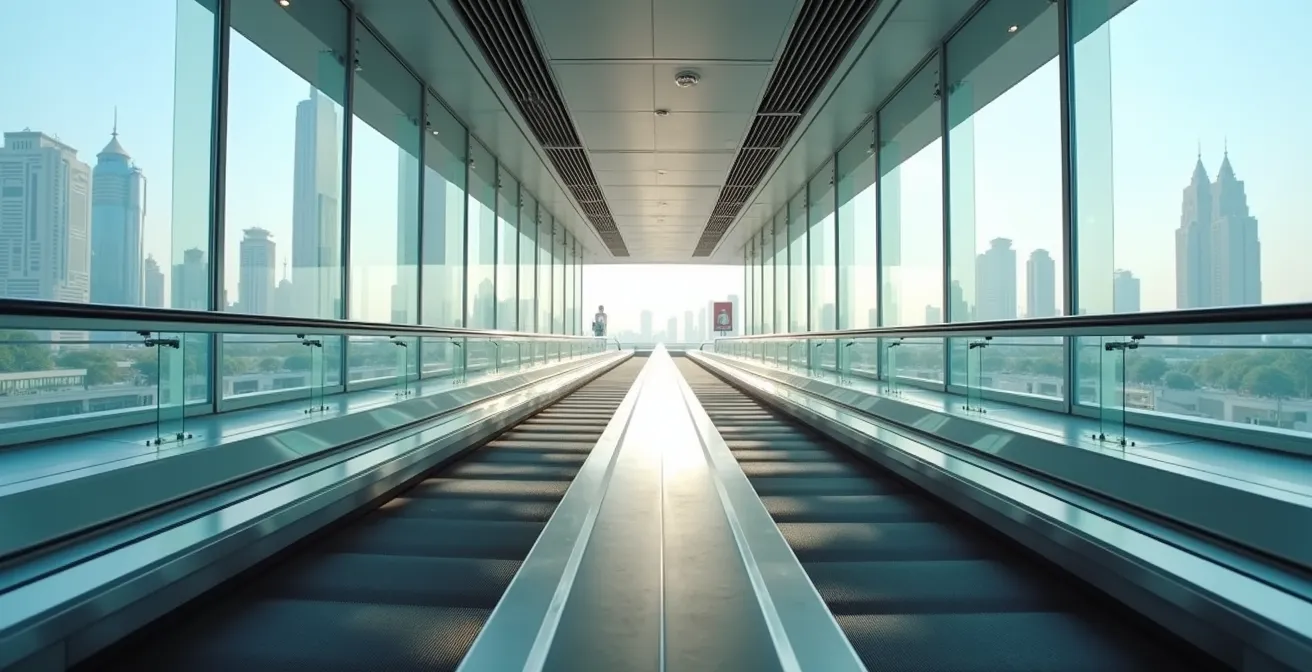
- The 820-meter Dubai Mall Metro Link bridge provides a fully air-conditioned walk from the metro to the mall.
- This “pedestrian superhighway” is part of a larger climate-controlled network connecting other key downtown locations.
- Mastering this network is the key to urban survival during Dubai’s extreme summer heat.
- Beyond the walk, strategic hacks for dining, navigating crowds, and even photography can transform your Downtown experience.
The first blast of Dubai’s summer air can feel like opening an oven. For a tourist standing at the Burj Khalifa/Dubai Mall Metro station in July, the gleaming facade of The Dubai Mall seems a world away, separated by a shimmering haze of 45°C heat. The immediate question isn’t one of desire, but of survival: how do you cross that distance without melting? Many will tell you to simply “follow the signs to the Metro Link bridge,” but this advice barely scratches the surface. It treats a marvel of urban design as a mere convenience.
The reality is far more compelling. That bridge is not just a walkway; it is the main artery of a hidden, climate-controlled ‘second city’—a network of passages, tunnels, and air-conditioned connections designed for urban survival. To truly conquer Downtown Dubai in the summer, you must stop thinking like a tourist following a path and start thinking like an urban explorer mapping a system. This isn’t just about getting from point A to B; it’s about mastering an architectural hack that makes the city’s most formidable challenge—its climate—irrelevant.
This guide provides the complete operational manual. We will dissect the primary route to The Dubai Mall, then expand the map to include other critical nodes in the Downtown network. From tactical dining and crowd evasion to stealth photography, you will learn the strategies to navigate this concrete jungle not as a visitor, but as a seasoned operative.
To navigate this urban landscape effectively, we’ve broken down the essential survival strategies into distinct missions. This guide details everything from your primary objective—the climate-controlled transit—to secondary operations that will define your experience in Downtown Dubai.
Summary: How to Walk From Metro to Dubai Mall Without Stepping Outside in Summer?
- Old Town vs High Rise: Which Downtown Zone Offers Better Sleep Quality?
- Where to Find Affordable Lunch in Downtown Dubai Under $20?
- How to Escape the Downtown Loop During New Year’s Eve Preparations?
- Is the Dubai Opera Garden Open to Public Without a Ticket?
- Tripod Rules in Downtown: How to Avoid Security Hassles?
- Metro Link Bridges: Which Malls Are Connected by AC Walkways?
- Why Are There So Many Empty Shops on Bluewaters?
- How to Process Your VAT Refund at DXB Airport in Under 10 Minutes?
Old Town vs High Rise: Which Downtown Zone Offers Better Sleep Quality?
Your first survival mission begins after sunset: securing a strategic base with optimal rest conditions. In Downtown Dubai, the choice between a modern high-rise and the traditional Old Town district is a choice between two entirely different nocturnal environments. This isn’t just about aesthetics; it’s a tactical decision affecting your sleep quality and, therefore, your energy for the next day’s exploration. High-rise apartments offer stunning views but expose you to a unique set of environmental stressors.
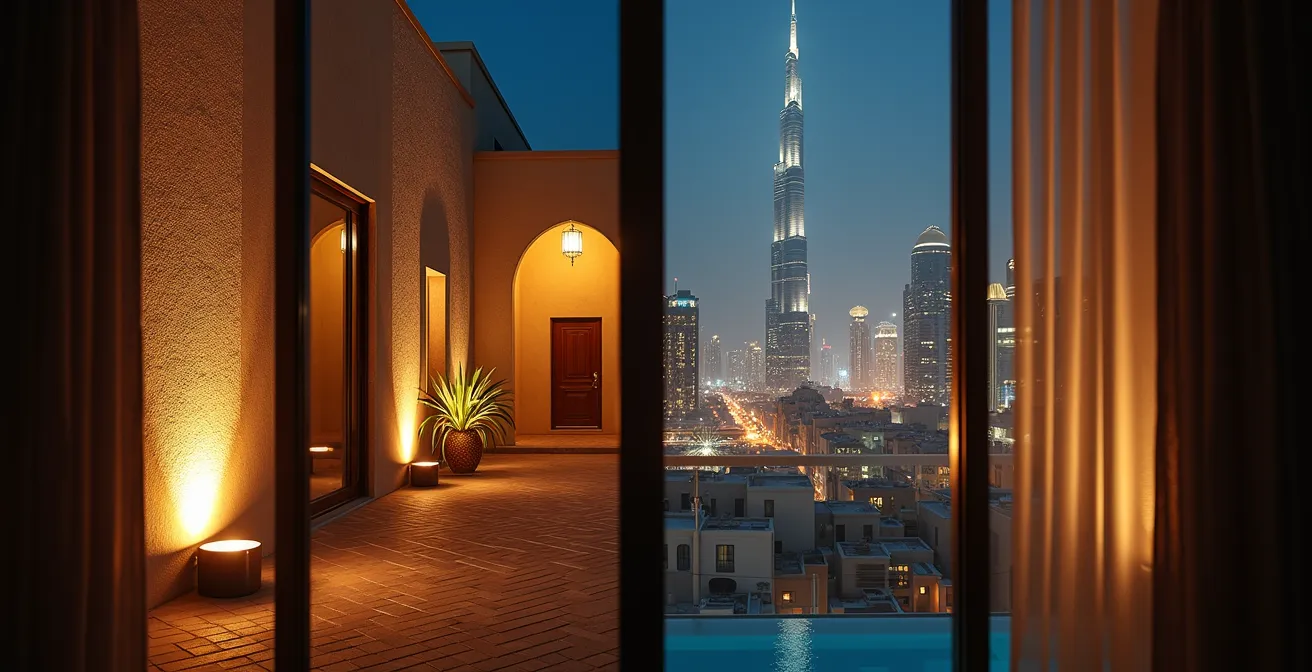
As the illustration starkly contrasts, the two zones present opposing challenges. High-rises contend with an acoustic signature of 65-75 dB from high-altitude wind and perpetual traffic hum, along with significant light pollution from the Burj Khalifa’s LED displays. Conversely, Old Town’s low-rise, courtyard-focused architecture provides a natural sound buffer, with ambient noise levels dropping to a more manageable 50-60 dB from pedestrian activity. The key is to assess your own sensitivity to these factors before committing to a location.
Microclimate is another critical factor. Balconies on the 30th floor can experience wind speeds of 20-30 km/h, creating persistent noise, while Old Town’s sheltered courtyards remain still. When scouting potential accommodations, a visit after 10 PM is non-negotiable to experience the true light and sound conditions of the area, ensuring your chosen sanctuary will actually provide rest.
Where to Find Affordable Lunch in Downtown Dubai Under $20?
In a district defined by luxury, the mission of securing an affordable meal can feel like a challenge. Yet, for the resourceful urban explorer, Downtown Dubai is riddled with budget-friendly “refueling stations” hiding in plain sight. The key is to look beyond the glittering facades of the main mall restaurants and tap into the ecosystem that serves the area’s vast workforce. While premium dining is the default, options for a satisfying lunch under $20 (approx. AED 74) are abundant.
The most obvious starting point is the food courts, where a wide array of choices is available. For instance, food court meals at Dubai Mall typically cost between AED 25-30 ($7-8), offering exceptional value. Beyond this, a deeper strategy involves exploring nodal points frequented by office workers, such as the Emaar Square food court, or leveraging the hot food counters at supermarkets like Waitrose, which offer daily specials that are both delicious and economical.
For a clear tactical overview, this table breaks down your best options for a budget-conscious lunch mission. Each location offers a different strategic advantage, from speed and convenience to variety.
| Location | Restaurant Type | Average Price | Best Deal |
|---|---|---|---|
| Dubai Mall Food Court | Fast Food/Asian | $7-10 | Shawarma combos with drink |
| Waitrose Supermarket Deli | Hot Food Counter | $8-12 | Daily hot meal specials |
| Emaar Square Food Court | Office Worker Cafes | $10-15 | Business lunch sets (weekdays) |
| Al Baik (Dubai Mall) | Fast Casual | $6-9 | Fried chicken meal deals |
| Tim Hortons (Mall Level 2) | Cafe/Bakery | $8-12 | Sandwich combo with coffee |
A prime example of this strategy in action is India Palace Express on the mall’s lower ground floor. It successfully serves both tourists and office workers with meals averaging around $16, proving that authentic, affordable cuisine can thrive even in the most premium locations. Understanding these patterns is key to eating well without depleting your operational budget.
How to Escape the Downtown Loop During New Year’s Eve Preparations?
Major events like New Year’s Eve transform Downtown Dubai from a bustling hub into a logistical trap. For the unprepared, road closures, crowd control barriers, and metro station overflows create a near-impenetrable loop. An effective extraction strategy is not a luxury; it is a necessity. The primary challenge is the sheer volume of people: on such nights, the station can experience over 110,000+ passengers, leading to complete gridlock.
Conventional exit plans fail under this pressure. Attempting to use the main Burj Khalifa/Dubai Mall station after the fireworks is a rookie mistake. A successful escape requires thinking laterally and using alternative egress points that are outside the main containment zone. This involves using lesser-known pedestrian routes, alternative transport methods, and, most importantly, precise timing. Your mission is to exit the area before the main exodus begins or use routes the majority of the crowd will overlook.
Consider these strategic withdrawal routes your operational plan. For example, using the Business Bay Metro Station requires a 15-minute walk, but it completely bypasses the chaos at the main station. Similarly, understanding the mall’s parking structure can provide a direct line to service roads that remain open. The Dubai Water Canal ferry is another excellent, often-ignored option that offers a clear path out of the chaos. Scheduling your departure before 6 PM or after the peak post-event rush (around 1 AM) is the most critical element of all.
Is the Dubai Opera Garden Open to Public Without a Ticket?
In the dense, vertical landscape of Downtown, finding a tranquil, ground-level ‘safe zone’ is a tactical advantage. The Dubai Opera Garden presents itself as one such location—an oasis of green space and water features at the foot of architectural giants. The critical question for the urban explorer is one of access: is this sanctuary truly public, or is it an exclusive perk for ticket holders? The answer is, fortunately, affirmative.
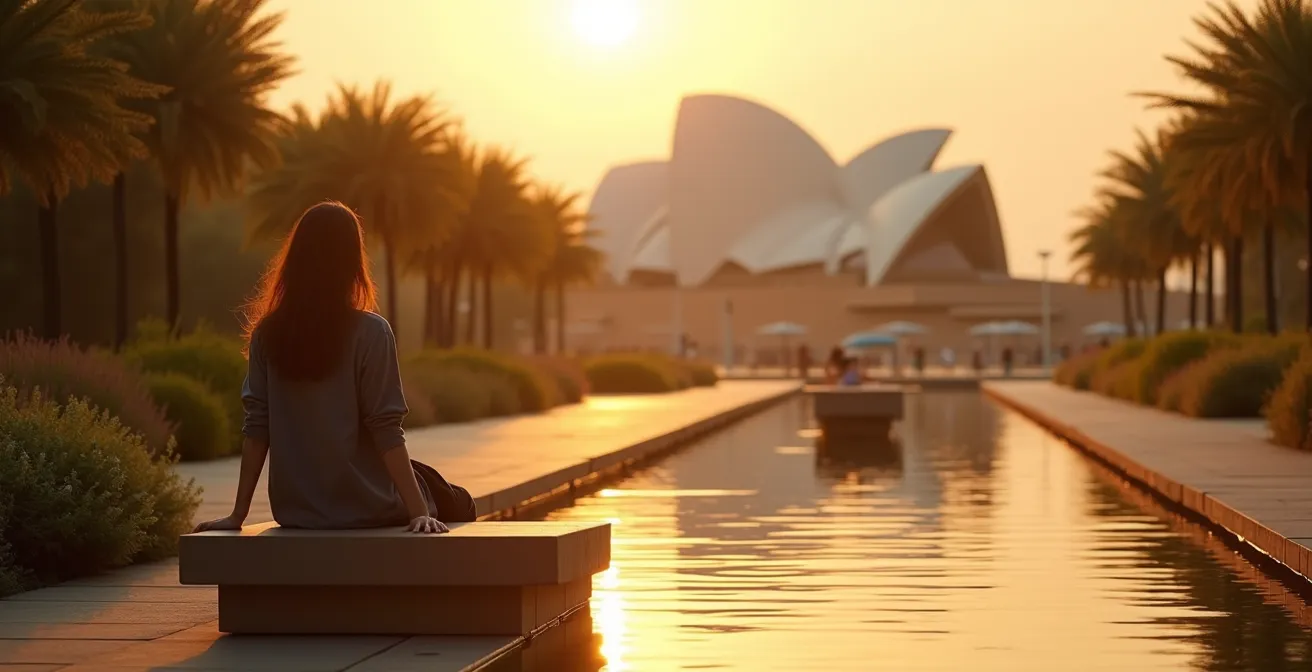
The garden areas surrounding the Dubai Opera are generally open to the public during daytime hours, typically from 8 AM to 10 PM. This makes it an invaluable spot for decompression, a quiet place to sit and plan your next move away from the relentless commercial energy of the mall. While certain terraces may be occasionally cordoned off for private events, the main pathways, benches, and waterfront promenades remain accessible to everyone, free of charge.
However, it’s important to note the garden’s limitations. It is designed for passive recreation, offering seating and shade but lacking amenities like public restrooms or cafes. For photographers, the golden hours—especially weekday mornings between 8 AM and 10 AM—offer the best conditions. During this window, the crowds are minimal, and the soft light creates stunning reflections of the Burj Khalifa in the garden’s water features, allowing you to capture the iconic skyline from a unique, serene vantage point.
Tripod Rules in Downtown: How to Avoid Security Hassles?
For the urban explorer who is also a photographer, capturing Downtown’s iconic architecture is a primary mission. However, this mission comes with a significant operational risk: security intervention. Displaying a full-sized, professional tripod in high-traffic areas like the Dubai Mall promenade is the fastest way to get shut down. The key to a successful photo operation is not to seek permission, but to employ stealth and use equipment that doesn’t register as “professional.”
The unofficial rule is simple: the larger and more professional your gear looks, the more attention you will attract. Security teams are trained to differentiate between a tourist taking a snapshot and a potential commercial shoot. As one photographer noted, this distinction is everything:
Security at Dubai Mall fountain area stopped me with my professional tripod within 2 minutes. However, when I switched to a small tabletop tripod and used my phone mount, I shot for 2 hours without any issues. The key is looking like a tourist, not a commercial photographer.
– A travel photographer, TripAdvisor Forum
This experience highlights the core strategy: blend in. Using compact, versatile gear allows you to operate under the radar. GorillaPods that can wrap around railings, or small travel tripods that are quick to deploy and pack away, are your best assets. The goal is to set up your shot, capture it in 30-60 second windows, and move on before you become a fixed point of interest.
Action Plan: Stealth Photography in Downtown Dubai
- Downsize Your Gear: Use compact travel tripods under 1 meter in height or flexible GorillaPods that security typically ignores.
- Work Fast: Set up your shot, capture it within a 30-60 second window, and then immediately pack up and move to a new spot.
- Choose Your Location Wisely: Opt for locations along the less-crowded Mohammed Bin Rashid Boulevard over the hyper-vigilant Dubai Mall entrance and fountain areas.
- Use Natural Supports: Utilize ledges, low walls, and other pieces of urban furniture as impromptu camera supports instead of a formal tripod.
- Look Like a Tourist: Avoid large camera bags and extensive gear. The more casual you appear, the less likely you are to be approached by security.
Metro Link Bridges: Which Malls Are Connected by AC Walkways?
The Dubai Mall Metro Link is the most famous part of the city’s climate-controlled pedestrian network, but it’s not the only one. Understanding the full extent of this system of “pedestrian superhighways” is the ultimate urban survival hack. Your primary mission—walking from the metro to The Dubai Mall—is accomplished via the 820-meter glass-enclosed bridge. Opened in 2012, this architectural marvel was designed to handle a capacity of 13,500 people per hour, featuring ten 0.5m/second travelators to ease the 10-15 minute journey. At peak times, the Metro Link Bridge carries almost 15,000 people per hour, making it a vital piece of city infrastructure.
This is not just a convenience; it’s a strategic asset. The bridge single-handedly eliminated the need for feeder buses, significantly reducing traffic in the Downtown core. But the system extends beyond this single connection. Other major malls are directly integrated into the metro system with similar, albeit shorter, climate-controlled walkways, creating a network that allows you to traverse large swathes of the city without ever exposing yourself to the elements.
This comparative data reveals the extent of the network. While the Dubai Mall connection is the longest and most sophisticated, other malls like Mall of the Emirates and Ibn Battuta offer highly efficient, direct links. Even destinations without a direct bridge, like Dubai Festival City, are integrated via a combined transport solution involving a short, air-conditioned water taxi ride. Mastering this map is essential.
| Mall | Metro Station | Walkway Length | Travelator Coverage | Walking Time | Key Features |
|---|---|---|---|---|---|
| Dubai Mall | Burj Khalifa/Dubai Mall | 820m | 60% (10 travelators) | 10-15 min | Views of Downtown, 13,500 people/hour capacity |
| Mall of Emirates | Mall of Emirates | 200m | 40% | 3-5 min | Direct to first floor, ski slope views |
| Ibn Battuta Mall | Ibn Battuta | 150m | 30% | 3-4 min | Themed zones access |
| Dubai Festival City | Creek Station + Abra | N/A | N/A | 15-20 min total | Requires AC water taxi connection |
Why Are There So Many Empty Shops on Bluewaters?
To the untrained eye, the vacant retail units on Bluewaters Island might seem like a sign of failure. But for the urban analyst, it’s a readable signal of Dubai’s specific model of urban development and the immense economic pressures at play. The high vacancy rate isn’t an accident; it’s the result of a confluence of strategic factors, primarily the island’s dependency on a single, massive footfall driver: the Ain Dubai observation wheel.
The island’s entire retail and commercial ecosystem was predicated on the 9 million annual visitors the wheel was projected to attract. With Ain Dubai’s closure since March 2022, footfall projections collapsed, with visitor numbers dropping by an estimated 60%. This created an unsustainable situation for retailers facing premium rents of AED 1,500-2,000 per sq ft. To be profitable, a store needs to achieve sales of over AED 3,000 per sq ft—a figure that is nearly impossible without the constant stream of tourists the wheel was meant to provide.
This is compounded by several other factors:
- Phased Development: Dubai’s typical strategy is to launch developments with 30-40% occupancy, planning to fill the rest over 3-5 years. The wheel’s closure stalled this process.
- Limited Resident Base: With a population of only around 4,000 residents, the local community is not large enough to support a retail capacity designed for 25,000 daily visitors.
- Fierce Competition: Bluewaters must compete with established, high-traffic destinations like JBR Beach and Dubai Marina Mall, both just minutes away.
- Seasonal Fluctuations: Tourist-dependent locations in Dubai can see occupancy swings of up to 70% between the peak winter season and the quiet summer months.
Understanding these dynamics allows you to read the urban landscape with greater insight. The empty shops are not a sign of decay, but a visible marker of a development strategy paused mid-execution, waiting for its primary economic engine to be reactivated.
Key takeaways
- Master the Network: See Downtown’s air-conditioned walkways not as individual paths but as an interconnected system for climate-controlled movement.
- Know Your Exits: In high-density situations like major events, your primary survival tool is knowledge of alternative, less-obvious egress routes.
- Exploit the System: From affordable lunch spots used by office workers to unwritten rules for photography, understanding the city’s hidden logic is your greatest advantage.
How to Process Your VAT Refund at DXB Airport in Under 10 Minutes?
Your final mission as an urban explorer in Dubai is a time-sensitive financial operation: processing your VAT refund at the airport. For many tourists, this becomes a frantic, stressful final hurdle. But with the right strategy, it can be executed with military precision in under 10 minutes. The secret lies in preparation and location. The standard process can take up to 20 minutes, but a simple pre-validation hack changes the game entirely.

The most powerful tool in your arsenal is the network of Planet Payment kiosks located in major malls. By using the kiosk at The Dubai Mall to pre-validate your purchases *before* you head to the airport, you complete the most time-consuming step. According to one analysis, pre-validated VAT refunds process in just 2 minutes at the airport, compared to the 15-20 minute standard. This is the single most effective tactic for a swift exit.
Once at the airport, choosing the right kiosk is your next tactical decision. The kiosks at Terminal 3’s Concourse A, specifically near Gate A1, are consistently reported to have the shortest queues. Further streamlining involves requesting digital receipts from major retail groups and keeping individual receipts under AED 7,000 to avoid a mandatory, time-consuming inspection of the goods. Finally, timing is everything. The quietest window for processing refunds is typically between 10 PM and 2 AM, when tourist flight departures are at a minimum. Combining these strategies transforms a potential bottleneck into a smooth, final victory.
By adopting this survivalist mindset, you can transform your visit. Begin viewing the city not as a series of attractions, but as a complex, fascinating system ready to be explored and mastered.
Frequently Asked Questions About How to Walk From Metro to Dubai Mall Without Stepping Outside in Summer?
Can I access Dubai Opera Garden without an event ticket?
Yes, the garden areas are generally open to the public during daytime hours (8 AM – 10 PM), though specific terraces may be reserved for private events.
What amenities are available in the public areas?
Public areas include benches, shaded seating areas, and water features. However, there are no public restrooms, playgrounds, or permanent cafe facilities in the garden itself.
When is the best time to visit for photography?
Weekday mornings between 8-10 AM offer the best conditions with minimal crowds and soft morning light, ideal for capturing Burj Khalifa reflections in the water features.