The infamous thigh chafing from a camel ride isn’t inevitable; it’s a solvable ergonomic problem where your physical comfort is directly tied to the animal’s welfare.
- Rider discomfort often stems from overworked animals, poorly maintained equipment, and a lack of regulation in the industry.
- Specific physical techniques (leaning back during the stand-up) and proper attire (jeans, not shorts) are non-negotiable for eliminating the primary biomechanical stresses of friction and impact.
Recommendation: Assess the animal’s health and the operator’s quality *before* you pay for the ride. Your physical well-being and the animal’s are two sides of the same coin.
You see the queue: tourists waiting for their turn on a camel, a quintessential part of the desert safari experience. It’s only a ten-minute ride, a quick photo opportunity. Yet, you hesitate. You’ve heard the stories—the awkward swaying, the jarring movements, and the notorious inner-thigh chafing that can make the next day’s walk uncomfortable. The common advice is to just “grin and bear it” for the experience, but from a physical and ergonomic standpoint, that’s a poor strategy. The discomfort you’re worried about isn’t just a minor inconvenience; it’s a direct signal of biomechanical stress, often linked to the animal’s own condition and the quality of the equipment.
Most travel guides focus on the picturesque sunset or the thrill of the ride. They might vaguely suggest wearing “comfortable clothes.” But what if the key wasn’t simply enduring the discomfort, but understanding and neutralizing its source? The truth is that a camel ride is a physical activity, governed by forces of friction, balance, and impact. Approaching it as an ergonomist—someone who studies how bodies interact with their environment—changes everything. It shifts the focus from passive endurance to active control, allowing you to not only protect your own body but also to develop a more critical and ethical eye toward the animal you are about to ride.
This guide will not tell you to simply “hold on tight.” Instead, we will break down the specific physical challenges of a short camel ride. We will analyze the mechanics of the mount, the reality of friction on your skin, and the crucial connection between your comfort and the animal’s health. By the end, you won’t just know if the ride is “worth it”; you will have the tools to make it a controlled, conscious, and physically sound experience.
This article provides a complete ergonomic and ethical breakdown for any tourist considering a camel ride. Discover how to assess an animal’s health, master the riding technique to avoid falling, and understand why your choice of clothing is the most critical factor for comfort.
Summary: Your Ergonomic Guide to Camel Riding
- How to Spot a Healthy Camel vs an Overworked Animal?
- The ‘Lean Back’ Technique: How Not to Fall When the Camel Stands?
- How to Take a Good Selfie While the Camel Is Walking?
- Why You Should Ride Before Sunset, Not After?
- Why Jeans Are Essential for Camel Riding Prevention?
- How Atlantis Certifies Animal Welfare for Its Dolphins?
- Starboard Tack Rule: How to Avoid Collisions in Crowded Waters?
- Shared Bus vs Private Land Cruiser: Is the Saving Worth the Discomfort?
How to Spot a Healthy Camel vs an Overworked Animal?
Before you even think about your own comfort, your first assessment should be of the animal itself. A healthy, well-cared-for camel will provide a smoother, safer ride and ensures your tourist dollar isn’t supporting animal cruelty. Unfortunately, the industry often lacks oversight; the Model Code of Practice for camel welfare is now over 18 years old and largely outdated, according to RSPCA’s 2024 assessment. This leaves the responsibility on you, the tourist, to spot the warning signs of an overworked or unwell animal.
The consequences of poor welfare are severe. Investigations have revealed systemic issues at major tourist sites. In Egypt, for example, a PETA-supported veterinary clinic reports that camels are often forced to work while injured, suffering from everything from malnutrition and painful saddle sores to untreated abscesses and lameness. These are not isolated incidents but symptoms of an industry where profit can often overshadow animal health. An animal in pain is more likely to be agitated, unpredictable, and provide a jarring, uncomfortable experience for the rider. Your comfort and the camel’s welfare are inextricably linked.
Your Pre-Ride Animal Welfare Checklist
- Observe Behavior: A healthy camel will often be chewing its cud, a key sign of relaxation. Look for a calm, settled demeanor rather than agitation, restlessness, or aggression.
- Check the Eyes and Nose: Eyes should be clear, bright, and free of any discharge or cloudiness. A runny nose can be a sign of illness.
- Inspect the Skin and Body: Look for obvious sores, wounds, or swelling, especially under the harness, saddle, and halter areas. The camel’s body should look well-fed, not underweight with visible ribs or hip bones.
- Assess Movement: As the camel walks, watch for any signs of lameness, limping, or difficulty moving. It should walk with a steady, even gait.
- Look for Saddle Sores: Pay close attention to the area where the saddle sits. Check for raw skin, scabs, or “wear spots” which indicate a poorly fitting or overused saddle causing constant friction.
If you see any of these red flags, refuse the ride. It’s the most powerful message you can send. Choosing a healthy animal is the first and most critical step in ensuring a positive and ethical experience.
The ‘Lean Back’ Technique: How Not to Fall When the Camel Stands?
The single most intimidating moment of a camel ride is the “launch sequence.” When a camel stands up, it does so in two distinct, powerful movements that can easily unseat a novice rider. It first straightens its hind legs, which pitches you sharply forward. Then, it straightens its front legs, which throws you just as sharply backward. Resisting this movement is a mistake; the key is to work with it using a specific, counter-intuitive technique.
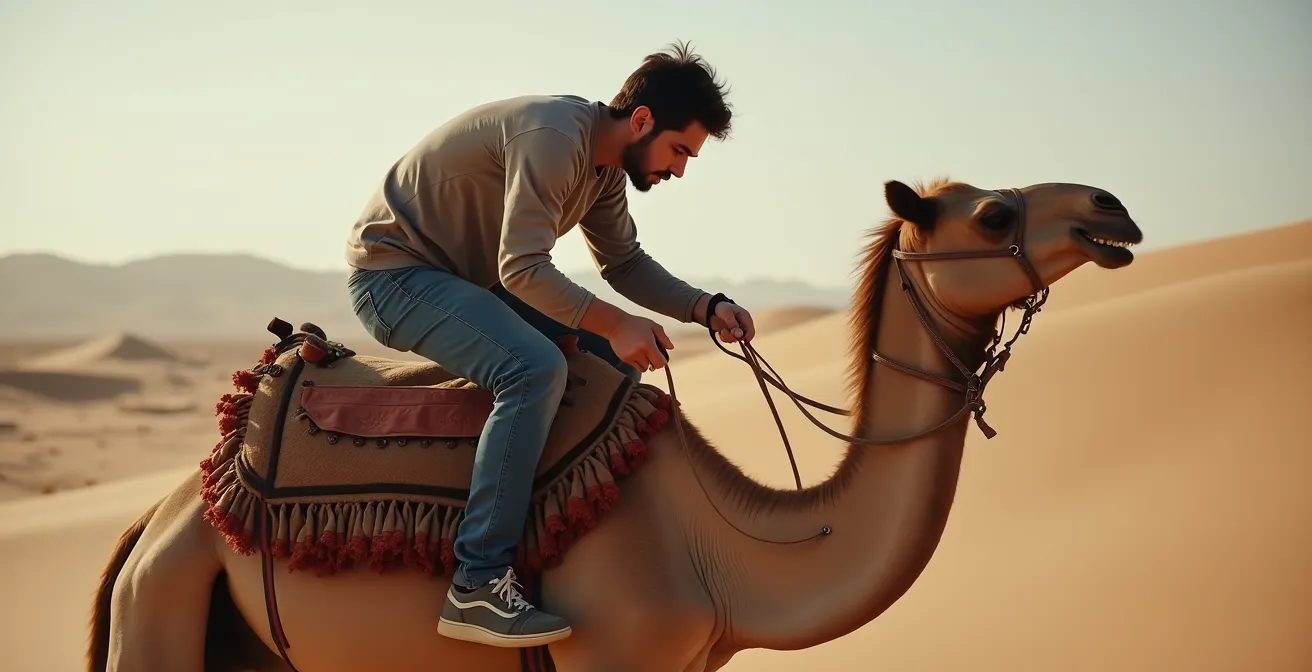
As the camel begins to rise, your only job is to grip the saddle pommel firmly with both hands and lean back as far as you can. This counter-balances the initial forward pitch. As it straightens its front legs, you must then immediately shift your weight and lean forward to absorb the backward momentum. This active balancing is the core of mastering the mount. Once the camel is walking, the motion becomes a gentle, rolling sway. The goal is to relax your joints and allow your hips to move with the animal, rather than staying rigid and fighting the movement.
A relaxed rider makes a relaxed animal: they really can sense the stress. Remember, this is a new and exciting experience for you, which instinctively triggers some stiffness in the body, so you have to actively relax your joints without sagging or falling off the camel’s back.
– Experience Jordan Adventures, How to Ride a Camel Guide
The same principles apply in reverse for dismounting. As the camel kneels on its front legs first, you must lean back hard to avoid being thrown forward. Wait until the animal is completely seated before you even think about swinging your leg over. Mastering this simple kinetic chain of movement is the difference between feeling in control and feeling like you’re about to fall off.
How to Take a Good Selfie While the Camel Is Walking?
The short answer: you don’t. From an ergonomic and safety perspective, attempting to take a selfie while the camel is in motion is a high-risk, low-reward activity. The animal’s swaying gait requires you to maintain balance, often with at least one hand on the saddle. Dividing your attention between your phone, your posture, and the animal’s movement significantly increases your risk of losing balance and dropping your device—or worse, yourself.
The rocking motion is deceptive. While it may feel gentle, it’s an unfamiliar multi-directional movement that your body isn’t accustomed to stabilizing. Trying to frame a shot, especially with one hand, compromises your core stability and grip. A sudden stop or a slight shift from the camel can be enough to cause a problem. As one travel blogger noted, the reality of riding makes photography nearly impossible:
I was riding with a DSLR camera on my back but quickly realized that I wasn’t going to be able to use it much since I always had to keep one hand on The Little Man in front of me, who did not stop talking the whole time.
– Parenting To Go
For a truly good photo, you need stability. The best strategy is to be present during the ride itself and plan your photo opportunities for when the camel is at rest. Here are the practical guidelines for getting your shot without compromising safety:
- Request a Photo Stop: Ask your guide to take photos of you from the ground either before the ride begins or after it ends. They know the best angles and can capture both you and the animal.
- Use Secure Mounts for Action Shots: If you must film during the ride, a hands-free device like a chest-mounted GoPro or a 360-degree camera is the only safe option.
- Strap Your Phone: If you must have your phone accessible, use a secure neck or wrist strap to prevent it from falling into the sand if you lose your grip.
- Protect from Sand: Sand gets everywhere. Keep your phone or camera in a protective case and clean it with a soft brush afterward to remove grit from ports and crevices.
The best picture is one that doesn’t cost you a broken phone or a fall. Enjoy the view with your own eyes during the ride and save the photography for when you’re safely on solid ground.
Why You Should Ride Before Sunset, Not After?
Many tourist-focused operators will push the “sunset ride” as the premium experience, citing the “great lighting for pictures” as the main selling point. While aesthetically pleasing, a ride that takes place during or immediately after sunset may raise an ergonomic red flag for the animal. From a purely physical standpoint, the timing of your ride can be a direct indicator of the animal’s workload and overall welfare. Camels are not machines; they are biological creatures that require adequate rest.
A recent dromedary welfare assessment protocol establishes that, like any working animal, camels require appropriate rest periods and should not be overworked beyond their capacity. In high-traffic tourist areas, camels can be forced to work from early morning until late at night, with minimal breaks. A ride scheduled late in the day, especially after the sun has set, is often the last of a long series of trips for that animal. An exhausted camel is more likely to be less coordinated, more agitated, and provide a jarring, uncomfortable ride. The physical fatigue of the animal translates directly into a lower-quality experience for you.
Choosing a ride earlier in the day—or with an operator who can verify their animals have structured rest periods—is a better ergonomic choice for both you and the camel. An animal that is fresh and not at the end of a long, grueling workday will move more smoothly and predictably. The “golden hour” lighting might be tempting, but a more comfortable and ethical experience is often found when the animal is not being pushed to its physical limit for one last ride of the day. The best light for a photo is not worth a ride on an exhausted animal.
Why Jeans Are Essential for Camel Riding Prevention?
The single most common complaint after a camel ride is raw, painful chafing on the inner thighs. This isn’t a random ache; it’s a predictable outcome of friction, and your choice of clothing is the primary variable you can control. The problem arises from the unique combination of the camel’s hair, the saddle’s texture, and the rider’s motion. Camel fur is coarse and scratchy, and traditional saddles are often made of rough, abrasive materials like leather or woven fabric.
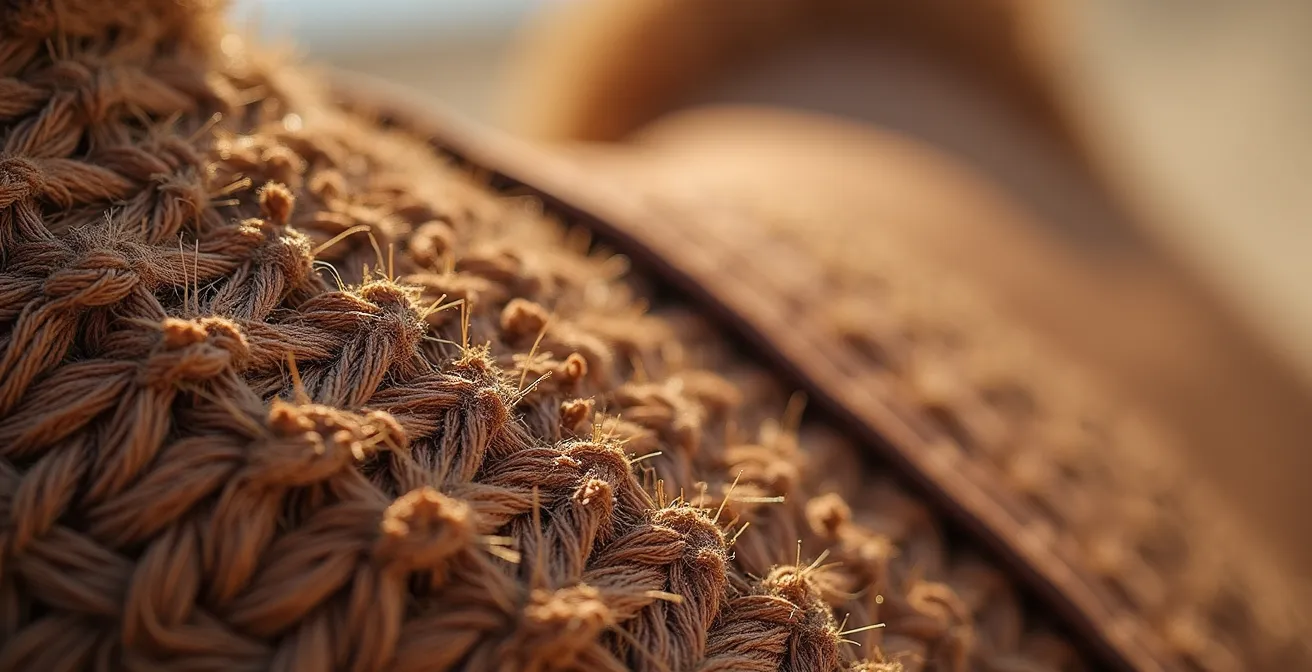
When you ride, your legs are in constant contact with this surface. The side-to-side swaying motion creates a continuous rubbing action. Wearing shorts or thin leggings is the worst possible choice. The direct skin-on-saddle contact generates intense friction, and even thin fabric will quickly wear down, leading to irritation. As one rider painfully discovered, it’s even worse when there are two people:
Even worse, if someone is on the camel with you, such as your three-year old son who is also wearing shorts, the skin-to-skin friction will drive the both of you crazy. The little man sporadically yelled ‘Stop. Touching. ME!’ over the last ten minutes of the ride.
– Parenting To Go
Jeans are the ergonomic solution. The durable, thick denim acts as a protective barrier, a crucial “friction interface” between your skin and the saddle. It’s sturdy enough to withstand the rubbing without wearing through. For maximum protection, follow a specific clothing strategy: choose loose or stretchy long pants, ideally with minimal or flat-felled inner-thigh seams to reduce pressure points. For rides longer than 30 minutes, consider wearing seamless biker shorts underneath your pants for an extra layer of defense and applying an anti-chafe cream to your inner thighs beforehand. This isn’t about fashion; it’s about creating a physical barrier to prevent what is essentially a friction burn.
How Atlantis Certifies Animal Welfare for Its Dolphins?
At first glance, the welfare standards for dolphins in a highly controlled environment like Atlantis may seem unrelated to a camel ride in the desert. However, examining this regulated industry provides a stark and useful contrast that highlights the systemic gaps in camel tourism. The key difference is the existence of formal, third-party certification and strict regulatory frameworks, which are largely absent for working camels.
Dolphin programs in many parts of the world can seek certifications like the one from American Humane, which audits for specific welfare standards. While the ethics of captivity itself remain a subject of intense debate, these programs operate within a system of oversight, with requirements for regular veterinary checks, habitat standards, and health monitoring. This framework, however flawed, creates a baseline of accountability. For camel tourism, no such universal certification or robust enforcement mechanism exists.
| Welfare Aspect | Dolphin Programs (e.g., Atlantis) | Camel Tourism Industry |
|---|---|---|
| Certification Standards | American Humane certification available | No universal certification exists |
| Regulatory Framework | Strict captivity regulations in many countries | Limited or unenforced regulations |
| Health Monitoring | Regular veterinary checks required | Many camels never see a veterinarian |
| Welfare Debate Focus | Ethics of captivity | Ethics of animal labor and working conditions |
| Industry Oversight | Regular inspections common | Difficult to monitor individual animals |
This lack of oversight is a critical problem. As responsible travel assessments point out, many countries popular for camel tourism have either no strict animal welfare laws or they are not properly enforced. This puts the onus entirely on individual operators, whose practices can vary dramatically, and on tourists to spot abuse. The comparison is clear: while one industry operates under a microscope (for better or worse), the other often operates in the shadows, making the tourist’s pre-ride assessment not just a good idea, but an essential ethical and safety check.
Starboard Tack Rule: How to Avoid Collisions in Crowded Waters?
In sailing, the “Starboard Tack Rule” is a fundamental principle for avoiding collisions. It dictates which boat has the right of way. In the seemingly chaotic environment of a tourist camel caravan, a similar, unwritten set of rules governs safety and prevents accidents. Your job as a rider is not to steer, but to be a predictable and aware passenger, understanding the “rules of the road” as dictated by the lead camel and your guide.
The most important rule is that the lead camel sets the pace. A caravan is a kinetic chain; never attempt to overtake the animal in front of you. Maintain at least one camel’s length of distance to avoid being kicked or bitten if the animal ahead stops suddenly. You must also be hyper-aware of your new dimensions. You are taller and wider, making you vulnerable to low-hanging branches or market stall overhangs that your guide on foot might not notice.
Unfortunately, this is not the case for camels – in fact, if you reach out to stroke one, you might end up bitten or kicked. Fun fact: whilst horses only kick forward and backward, camels can kick in all four directions.
– Bein Harim Tours, The Complete Guide for Camel-Riding
This ability to kick in all four directions makes personal space critical. Never approach a camel from directly in front, as it may bite or spit. Let the experienced Bedouin handlers manage any aggressive behavior between the animals. Your role is spatial awareness: keep your hands and feet inside the “ride,” maintain a safe following distance, and trust your guide to navigate the caravan. Just like in crowded waters, predictable behavior and respecting established hierarchies are what prevent chaos and ensure everyone’s safety.
Key Takeaways
- Your physical comfort on a camel is directly linked to the animal’s health; an overworked, unhealthy animal provides a jarring, unsafe ride.
- Specific techniques are required: lean back hard when the camel stands to counter the forward pitch, and relax your hips to absorb the swaying motion.
- Jeans or other thick, durable pants are non-negotiable. They create a crucial friction barrier between your skin and the rough saddle, preventing chafing.
Shared Bus vs Private Land Cruiser: Is the Saving Worth the Discomfort?
The choice between a shared bus and a private land cruiser for a desert safari is a metaphor for the decision you face with a camel ride: the cheap, mass-market option versus a more considered, ethical, and ultimately more comfortable experience. The bargain-priced 10-minute ride offered by a hawker outside a major tourist site is the “shared bus”—it gets you there, but often at the cost of comfort and ethical standards. The animals are often overworked, the equipment is basic, and the experience is rushed.
In contrast, ethical operators, often found through reputable tour companies or in locations with a strong community focus on sustainability, represent the “private land cruiser.” The price is higher, but that cost supports a different model of operation. This is especially true in regions that prioritize sustainable tourism. The Wadi Rum in Jordan is a prime example of this.
Case Study: The Wadi Rum Sustainable Tourism Model
In Wadi Rum, the local Bedouin communities have a deep-rooted connection to their camels. The animals are a part of their heritage, not just a tool for tourism. Here, camels are often cared for in large enclosures with proper nutrition and significant “off-time.” As a visitor, you can see them grazing freely in the desert. Local operators pride themselves on the good treatment of their animals. Rides are offered in moderation and during hours that are suitable for the animal’s welfare, creating a more sustainable and ethical ecosystem for both the animals and the community.
Ultimately, the “discomfort” is more than just physical chafing. It’s the ethical discomfort of participating in a system that may exploit animals. By choosing an operator with a transparent animal welfare policy—even if it costs more and is part of a longer, less-touristy safari—you are investing in a better experience for yourself and a better life for the animal. The saving from a cheap ride is rarely worth the physical and ethical cost.
The choice is yours. By applying this ergonomic and ethical framework, you can actively seek out operators who prioritize both animal welfare and rider comfort, transforming a potentially painful tourist trap into a genuinely rewarding experience.