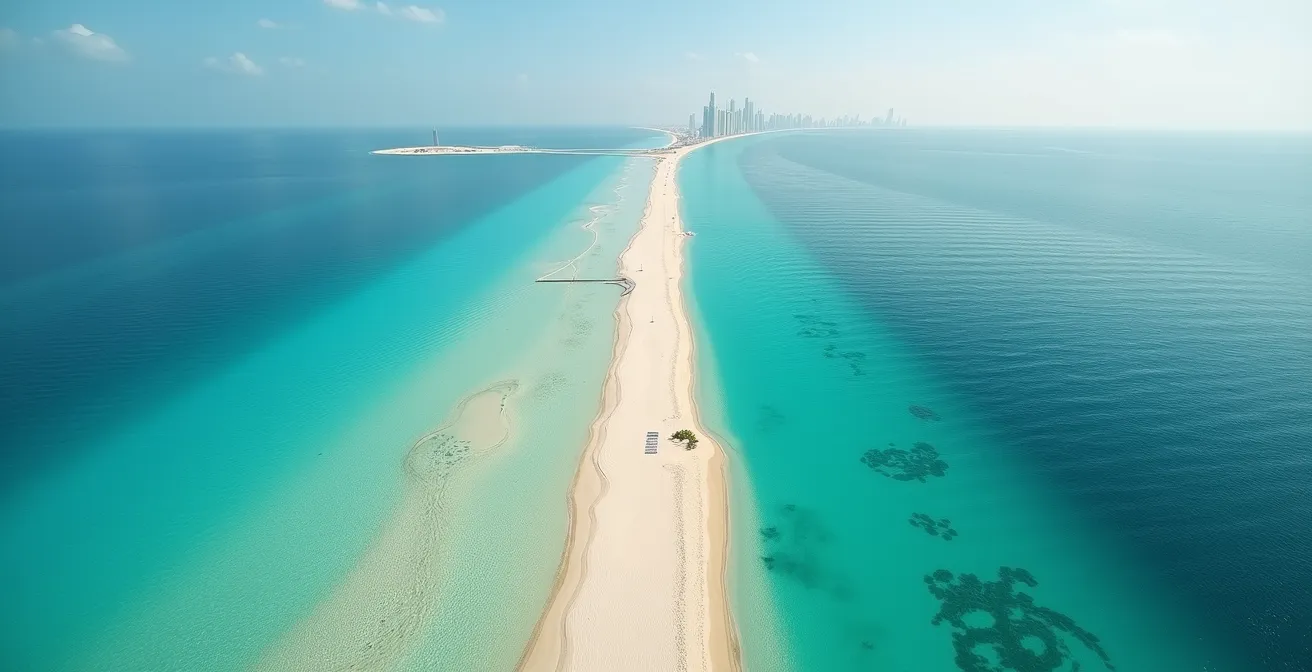
The visual cleanliness of a Dubai beach is not the best indicator of its water quality for swimming; the key factor is its position relative to man-made coastal structures.
- Beaches sheltered by artificial islands or breakwaters often experience reduced water circulation, creating “hydrodynamic shadows” that can lead to stagnation and altered marine ecosystems.
- Natural, open coastlines like Jumeirah Open Beach generally benefit from better flushing by currents, while semi-enclosed areas like Black Palace (Sufouh) Beach can have different characteristics due to nearby construction.
Recommendation: For the most invigorating swim, prioritize beaches with direct exposure to the open sea and be mindful of the ecological impact of nearby megastructures on water movement.
For the discerning swimmer, Dubai’s coastline presents a paradox. On the surface, the water appears uniformly pristine, an inviting turquoise set against immaculate sand. This image is carefully maintained by round-the-clock municipal efforts and celebrated with numerous Blue Flag awards. Yet, swimmers often report subtle but significant differences: one beach feels crisp and alive, while another, just a few kilometers away, can feel strangely still or heavy. The common advice—to simply pick the beach with the best amenities or views—completely misses the point.
The truth lies not in what you can see on the surface, but in the invisible forces shaping the water beneath. The massive and ongoing coastal engineering projects, from the Palm Islands to Dubai Harbour, have fundamentally altered the region’s hydrodynamics. But what if the key to finding the best water wasn’t about looking for cleanliness reports, but about understanding the science of water movement? The real distinction between an average swim and an exceptional one is rooted in coastal geomorphology and the unintended consequences of human ambition.
This guide moves beyond the tourist brochures to offer a marine ecologist’s perspective. We will analyze how artificial structures create zones of calm—and potential stagnation—and how natural environmental cycles dictate everything from water clarity to the presence of jellyfish. By understanding these principles, you can learn to “read” the water and make an informed choice for a healthier, more enjoyable swim.
To navigate these complex environmental factors, this article breaks down the key questions a health-conscious swimmer should ask. We’ll explore everything from the physics of wave patterns to the biology of the local marine life, providing a complete framework for your next beach visit.
Summary: A Swimmer’s Ecological Guide to Dubai’s Coastline
- Kite Beach or Sufouh: Where Does the Sun Actually Set Behind the Burj?
- When is Jellyfish Season and Which Beaches Are Net-Protected?
- Can You Walk the Entire Coastline from Jumeirah 1 to 3?
- How Artificial Islands Alter Wave Patterns for Swimmers?
- Which Beaches Allow Swimming After Sunset with Smart Lights?
- Why Humidity Levels Feel 15% Higher on The Crescent in August?
- Morning vs Sunset Charter: When Is the Water Color Most Vibrant?
- How to Find Free Parking at JBR Beach Walk on a Weekend?
Kite Beach or Sufouh: Where Does the Sun Actually Set Behind the Burj?
The iconic image of the sun setting behind the Burj Al Arab is a matter of precise seasonal and geographical alignment. It’s not a static view but a moving target that requires swimmers and photographers to adjust their position along the coast throughout the year. The sun’s setting point, or azimuth, shifts significantly from the southwest in winter to the northwest in summer. This celestial movement dictates the optimal viewing location.
From an ecological standpoint, the time of sunset also corresponds with a change in water conditions. As the sun’s angle lowers, water temperature begins to drop, and nocturnal marine life becomes more active. Understanding these patterns is key to planning both your photography and your swim. For those seeking the perfect shot, the choice of beach is critical and changes with the seasons.
Here are the key considerations for positioning yourself correctly:
- October-March: During these cooler months, position yourself at Kite Beach. The sun sets at an ideal azimuth angle between 240-260°, placing it perfectly behind the sail-shaped hotel.
- April-September: As the sun shifts northward, move to Sufouh Beach (also known as Black Palace Beach). The sunset azimuth of 280-295° aligns the sun with the Burj Al Arab from this vantage point.
- Atmospheric Conditions: For the clearest, most crisp photographs, aim for days following a ‘Shamal’ wind event, which often clears the atmosphere of dust and haze.
- Obstructions: Be aware that ongoing construction, particularly around Dubai Harbour, can increasingly block western horizon views, making beach selection even more crucial.
Ultimately, chasing the perfect sunset is a practical lesson in coastal geography, reminding us that even a visual experience is governed by predictable, natural cycles.
When is Jellyfish Season and Which Beaches Are Net-Protected?
Jellyfish blooms in the Arabian Gulf are a natural phenomenon, primarily driven by water temperature. As a swimmer, encountering them can be unsettling, but understanding their lifecycle provides the best defense. The “season” isn’t a fixed calendar date but rather an environmental threshold. Marine biology research indicates that water temperatures above 30°C trigger jellyfish blooms, making the peak summer months of May through September the most likely time for their appearance.
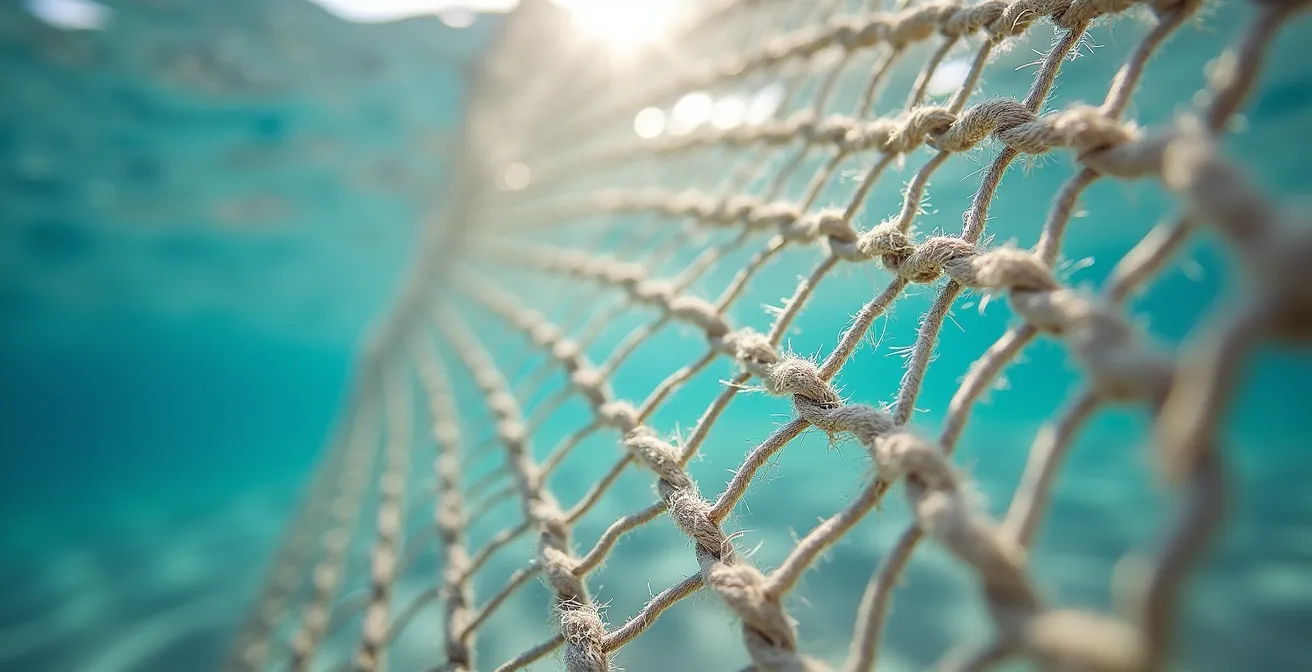
In response, Dubai’s authorities have implemented safety measures, including the installation of protective nets at several popular public beaches. These nets create safe swimming enclosures, though they can also slightly alter local water flow. While Dubai’s public beaches along Jumeirah and Umm Suqeim have been granted Blue Flag status for water quality and safety, the presence of nets is a direct acknowledgement of this seasonal biological challenge. A Blue Flag indicates high standards, but it doesn’t eliminate the natural cycles of the marine ecosystem.
For swimmers, the strategy is twofold: be aware of the season and know which beaches offer physical protection. The most common species in Dubai, the Blue Blubber Jellyfish (Catostylus mosaicus), has a sting that is typically mild, but caution is always advised, especially for those with allergies. Lifeguards are trained to treat stings, and vinegar is often available at first aid stations as a standard remedy.
Therefore, while the nets provide a physical barrier, the most empowered swimmer is one who understands the ecological calendar and can anticipate when these beautiful but hazardous creatures are most likely to be present.
Can You Walk the Entire Coastline from Jumeirah 1 to 3?
The dream of a continuous, uninterrupted walk along the Jumeirah coastline is a compelling one, but the reality is a patchwork of public access and private barriers. While the Dubai Municipality reports 24-hour daily beach cleaning across all public beaches, ensuring a pleasant environment, physical access is a different matter. The coastline is fragmented by private palace grounds, luxury hotels, and exclusive residential properties that force pedestrians to detour inland.
This fragmentation is a direct result of coastal development. The natural, open shoreline has been systematically divided, creating a start-and-stop experience for anyone attempting to traverse it on foot. While a continuous running and cycling track exists alongside Jumeirah Road, it is set back from the actual beachfront. The true coastal walk requires navigating a series of public access points and dead ends. The continuity of your walk depends entirely on which section of Jumeirah you are in.
To navigate this complex route, it is essential to understand the access points and obstacles along the way. The following breakdown clarifies what to expect in each section:
| Beach Section | Public Access | Walking Continuity | Key Obstacles |
|---|---|---|---|
| Jumeirah 1 | Yes – Open 24/7 | Continuous path | None |
| Jumeirah 2 | Partial | Detours required | Private palace zones |
| Jumeirah 3 | Yes – Multiple entry points | Full coastal path | Hotel properties require inland routing |
As the table shows, a full, uninterrupted walk is not feasible. The journey becomes a series of scenic stretches punctuated by mandatory diversions away from the water. This physical reality mirrors the ecological fragmentation of the coastline, where natural processes are frequently interrupted by man-made structures.
This walk, therefore, is less a serene stroll and more an exercise in urban navigation, highlighting the constant tension between public space and private development along Dubai’s sought-after waterfront.
How Artificial Islands Alter Wave Patterns for Swimmers?
The creation of megastructures like the Palm Jumeirah has had the single most significant impact on the swimming experience in Dubai. These artificial islands act as massive breakwaters, fundamentally altering the natural flow of currents and wave energy. The most noticeable effect for a swimmer is the creation of vast “hydrodynamic shadows”—areas of unnaturally calm water on the leeward side of the structures. While this calmness may seem appealing, it is a sign of reduced water circulation and can lead to increased stagnation.
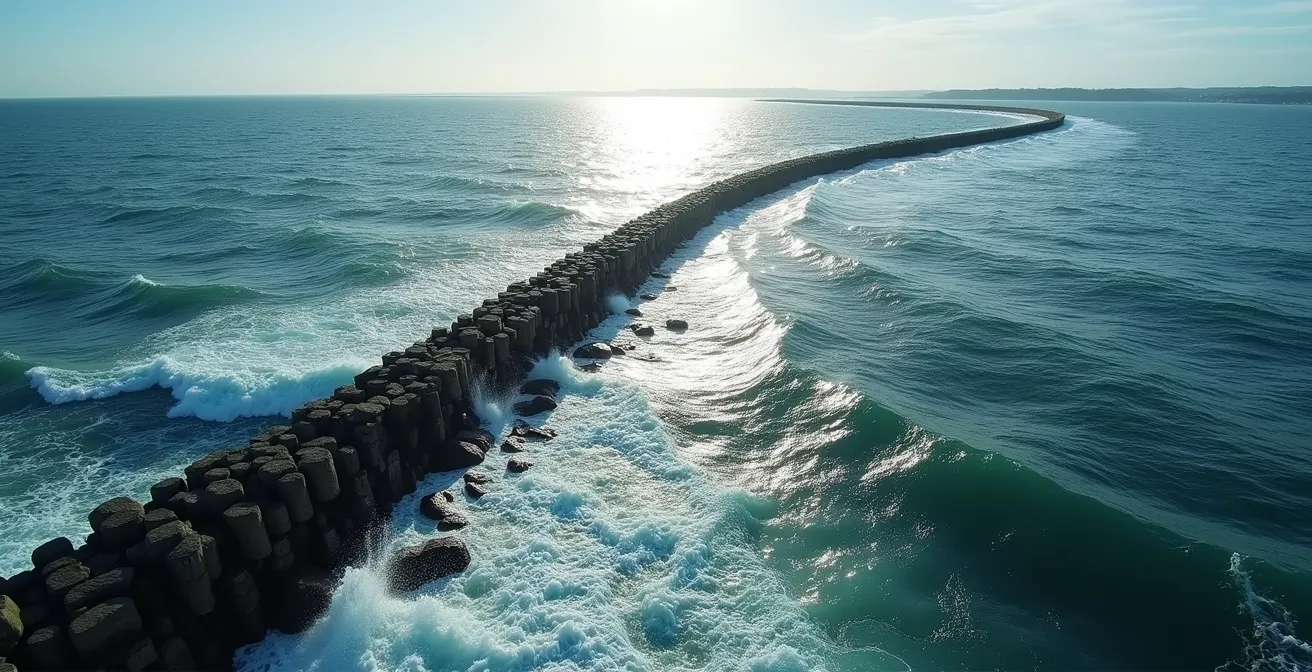
This disruption has measurable consequences. The blockage of longshore drift—the natural movement of sand along the coast—causes sediment to accumulate in some areas while starving others. Indeed, engineering studies have documented up to 10 meters of shoreline erosion per year in downstream areas deprived of their natural sand supply. For a swimmer, this translates to changes in the seabed profile and water clarity. The water within the semi-enclosed lagoons of these structures has a longer residence time, meaning it takes longer to be flushed out and replaced by fresh seawater. This can lead to higher water temperatures and different concentrations of phytoplankton and other microorganisms compared to the open coast.
This directly addresses the question of Jumeirah Open Beach versus Black Palace Beach (located near the Palm’s trunk). Jumeirah Open Beach faces the open sea, benefiting from robust wave action and current-driven flushing. In contrast, beaches in the shadow of the Palm experience a vastly different, more controlled environment. While engineering solutions aim to ensure water quality, the fundamental character of the water is changed from a dynamic, open system to a more managed, lacustrine one.
Therefore, choosing a beach is not just about sand quality or amenities; it’s an ecological choice between a natural, high-energy environment and an artificial, low-energy one.
Which Beaches Allow Swimming After Sunset with Smart Lights?
Swimming after sunset has long been prohibited on most Dubai beaches for safety reasons. However, the recent introduction of “smart” lighting systems has designated specific beaches for night swimming. This initiative is not random; the selection of these beaches is directly linked to their environmental conditions. As the Dubai Municipality Beach Safety Guidelines state:
Night swimming is only permitted on beaches with predictable and calm conditions
– Dubai Municipality Beach Safety Guidelines, Official Dubai Tourism Guidelines
This explicitly connects safety to the hydrodynamic environment. The chosen beaches—primarily in Jumeirah and Umm Suqeim—are often those located in the “hydrodynamic shadows” created by nearby artificial structures. These areas offer the predictable, wave-calmed conditions required for safe monitoring by lifeguards after dark. The 800-meter-long night swimming zones are illuminated by powerful LED lights, which not only light up the water for swimmers but also allow lifeguards to maintain constant visibility.
For a swimmer, this means night swimming is a trade-off. You gain the unique experience of a swim under the stars, but you are often doing so in the very waters that have reduced circulation. While safe from a wave and current perspective, it’s a different ecological environment than the open sea during the day. The smart light system is a technological solution that leverages a man-made environmental condition.
Action Plan: Your Checklist for Safe Night Swimming
- Verify 24/7 lifeguard presence at the designated beaches before entering the water.
- Check the official status of the smart LED light installation to ensure it is operational.
- Confirm the water temperature remains comfortable for you, typically staying above 25°C even at night.
- Prioritize beaches located near wave-calming artificial structures, as these are the designated zones.
- Always follow the colored flag system, even at night; only enter the water if the green flag is displayed.
This innovation is a perfect example of how Dubai adapts to its engineered coastline, turning a potential sign of stagnation (calm water) into a recreational asset.
Why Humidity Levels Feel 15% Higher on The Crescent in August?
Residents and visitors on the Palm Jumeirah’s outer Crescent often report a palpable increase in humidity, especially during the peak of summer in August. This is not just a feeling; it’s a measurable microclimate phenomenon driven by the island’s unique geomorphology. The vast, semi-enclosed lagoons of the Palm trap a large body of water that heats up significantly. This, combined with reduced wind flow caused by the dense construction, creates a localized pocket of higher humidity.
The science behind this involves evaporation rates and water properties. The Arabian Gulf is already one of the saltiest bodies of water in the world. Oceanographic measurements show that salinity in Dubai waters is around 39.30‰, notably higher than the global ocean average of 35‰. While higher salinity can slightly slow evaporation, the sheer surface area and elevated water temperatures inside the Palm’s fronds and Crescent lagoon create a massive evaporative surface. This water vapor gets trapped by the surrounding buildings, causing the “feels-like” temperature to soar.
Engineers were aware of potential stagnation issues during the design phase. To combat this, the design includes two large, 100-meter-wide openings on the breakwater to allow for circulation. Studies on water renewal time confirm these measures are in place to prevent the water from becoming completely stagnant. However, even with this engineered flushing, the sheer scale of the enclosed water body means its thermal properties and evaporative effect are significantly different from the open coast. The water acts as a massive heat sink during the day and a source of atmospheric moisture 24/7.
For a resident or visitor, this means that living on the Crescent is a trade-off: iconic views in exchange for a noticeably more intense and humid micro-environment, especially during the hottest parts of the year.
Morning vs Sunset Charter: When Is the Water Color Most Vibrant?
The perceived color of the water is not an intrinsic property but a result of the interplay between light, water depth, and suspended particles. For anyone chartering a boat in Dubai, timing is everything to experience the most vibrant hues. Climate data reveals Dubai receives over 3,500 hours of sunshine annually, making the angle of that intense sunlight the primary variable in water coloration.
In the early morning, the low-angle sun penetrates deep into the water column, scattering off fewer particles and resulting in a deep, clear blue. This is often when visibility is at its peak, as the calmer overnight conditions allow sediment to settle. Conversely, at midday, the sun is directly overhead. Light penetrates the shallow water over sandbanks and reflects directly off the light-colored seabed, creating the iconic, bright turquoise color seen in travel brochures. The sunset period offers a third, entirely different aesthetic, where the water acts as a canvas for the golden and orange light of the setting sun.
The choice of charter time, therefore, depends entirely on the desired visual experience. Each period offers a different but equally stunning display, driven by the physics of light refraction and reflection.
This table summarizes the conditions to help you choose the best time for your charter based on the water color you wish to see:
| Time Period | Water Color | Light Angle | Best For |
|---|---|---|---|
| Early Morning (6-8am) | Deep blue | Low angle | Clear visibility, calm water |
| Midday (11am-2pm) | Turquoise | High/overhead | Sandbank visibility |
| Sunset (5-7pm) | Golden-orange | Low angle | Dramatic reflections |
As the data shows, there is no single “best” time; the ideal moment is subjective and depends on the photographer’s or sightseer’s goal. Understanding the science of light allows you to plan your excursion to capture the exact marine palette you’re looking for.
This daily chromatic shift serves as a beautiful reminder that the marine environment is in a constant state of flux, shaped by forces as grand as the sun’s journey across the sky.
Key takeaways
- Artificial coastal structures create “hydrodynamic shadows,” significantly reducing water circulation and altering the swimming environment.
- Biological events like jellyfish blooms are directly linked to physical parameters, with water temperatures exceeding 30°C being the primary trigger.
- The perceived quality of a beach depends on a balance of natural flushing from open sea currents and the interruptions caused by man-made barriers.
How to Find Free Parking at JBR Beach Walk on a Weekend?
After exploring the complex ecological and hydrodynamic factors of Dubai’s coastline, the final challenge is often the most mundane: parking. Jumeirah Beach Residence (JBR) on a weekend is notoriously difficult for drivers. Finding a free spot requires a strategic approach and a willingness to arrive early or walk a bit further. The convenience of this bustling beachfront comes at the price of intense competition for parking.
While the focus of this guide is on the natural environment, ignoring this practical hurdle would be a disservice to the beachgoer. The frustration of circling for a parking spot can easily overshadow the pleasure of the swim itself. The area is designed to be pedestrian-friendly, but this design often pushes cars to the periphery or into paid lots. However, with the right knowledge, it is possible to avoid the high costs of valet or paid public parking.
A successful weekend parking strategy at JBR combines timing, local knowledge, and leveraging nearby amenities. Consider these proven tactics:
- Arrive before 8 am: This is the most effective strategy. Early arrival allows you to secure one of the limited street parking spots along the periphery of The Walk before the crowds descend.
- Use mall validation: Park at Carrefour in Marina Mall. A minimum purchase can validate your parking for 2-3 hours, which is often enough for a swim and a coffee.
- Park and walk: Dubai Marina Mall offers ample parking. From there, it’s a scenic 15-minute walk across the pedestrian bridges to JBR, offering great views of the marina.
- Utilize the Metro/Tram: Park at the Sobha Realty metro station, which often has more availability, and take the Dubai Tram directly to the JBR 1 or JBR 2 stops.
- Explore side streets: Check the smaller side streets behind the Amwaj Rotana hotel and other buildings in the second row, as some of these may have unrestricted spots, especially early in the day.
By applying this ecological knowledge and combining it with a practical parking plan, you can ensure your entire beach experience, from arrival to departure, is as seamless and rewarding as the swim itself.