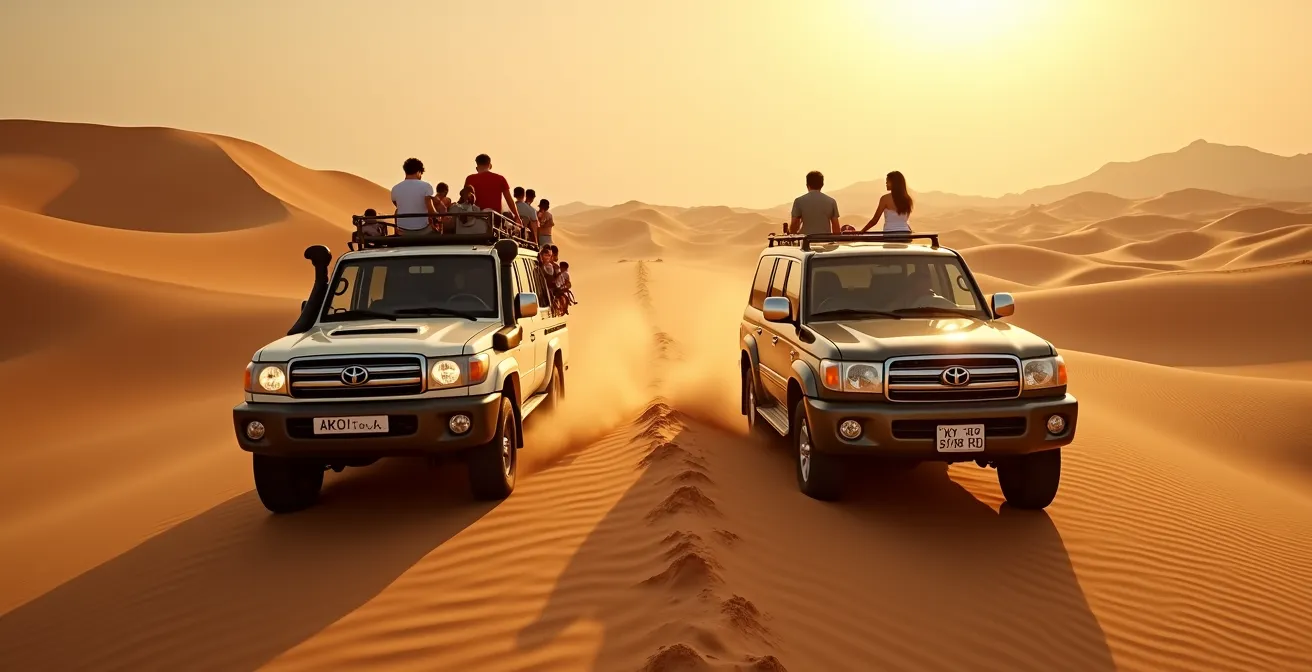
The price difference between a shared and private safari isn’t the real cost; the true price is paid in unpredictable delays, diluted experiences, and physical discomfort.
- Shared tours often include mandatory, time-wasting shopping stops and have longer, unpredictable return journeys.
- Private tours offer full control over the “intensity dial” for activities like dune bashing and guarantee the safety measures you need.
Recommendation: Frame your choice not as a cost-saving measure, but as an investment in quality control for your limited vacation time.
The decision seems simple on the surface. You see a desert safari advertised for AED 150 per person in a shared 4×4, and then you see a private Land Cruiser option for AED 700 for the entire vehicle. The immediate impulse is to question if the extra comfort is worth nearly five times the price. Most travel advice will tell you that private tours offer more “flexibility,” while shared tours are “good for budget travelers.” This is true, but it misses the fundamental point. The real currency you’re spending on a desert safari isn’t just money; it’s your limited and precious vacation time.
The debate isn’t about luxury versus budget. It’s about quality control versus unpredictability. A shared safari often comes with a “hidden time tax” and “experience friction”—small, cumulative frustrations that are never mentioned in the brochure. These can range from unscheduled commercial stops to one-size-fits-all activities that don’t match your comfort level. A private safari, by contrast, is a strategic investment in ensuring the experience you paid for is the one you actually get. It hands you the remote control to your own adventure, transforming the outing from a passive ride into a curated experience.
This guide moves beyond the obvious price discussion. As your comfort consultant, we will deconstruct the specific, real-world scenarios where the choice between shared and private has a tangible impact on your enjoyment, safety, and time. We will explore the nuances of navigating everything from unwanted souvenir detours and gear protection to tipping etiquette and motion sickness, giving you the framework to decide which option truly delivers the best value for *you*.
To help you navigate this decision, we have broken down the key differences into practical, experience-based sections. This structure will allow you to weigh the pros and cons based on what matters most for your trip, ensuring you make a fully informed choice.
Summary: Deciding Between a Shared Bus and a Private Land Cruiser
- The ‘Carpet Shop’ Stop: How to Avoid Wasting 45 Minutes?
- How to Protect Your Camera Gear from Fine Sand Damage?
- How Much to Tip Your Safari Driver vs the Camp Dancers?
- Why the Return Trip Often Takes 2x Longer Than the Departure?
- Where to Sit in the 4×4 to Minimize Dune Bashing Nausea?
- Does Gold Class Guarantee a Seat or Just Less Crowding?
- The 30% Rule: How to Negotiate Prices Like a Local?
- Is Dune Bashing Safe for Children Under 6 Years Old?
The ‘Carpet Shop’ Stop: How to Avoid Wasting 45 Minutes?
One of the most common yet unadvertised aspects of budget shared safaris is the “commercial stop.” Before you even see a sand dune, your vehicle pulls into a large souvenir shop, often disguised as a “rest stop.” This is a prime example of the hidden time tax you pay for a cheaper ticket. These stops are built into the business model of many low-cost operators who earn a commission on any sales made. For the traveler, it means a mandatory 30- to 45-minute delay in a high-pressure sales environment, significantly cutting into your actual desert time.
This experience friction is almost entirely absent in private tours. Premium operators build their reputation on the quality of the safari itself, not on kickbacks from rug merchants. With a private booking, you have absolute control over the itinerary. You can explicitly state “no shopping stops” and the driver, who works for you, will oblige. This is your first and most important act of quality control. You are not just a passenger; you are the director of the tour. To ensure this, it’s crucial to verify the operator’s policy *before* you book, as promises made over the phone can be conveniently forgotten on the day of the tour.
Action Plan: 3-Step Script to Verify Zero Shopping Stops Before Booking
- Email the operator before payment with this exact phrase: ‘Can you please confirm in writing that this tour has zero commercial, souvenir, or shopping stops included?’
- Screenshot or save their written response as proof. Legitimate operators will confirm immediately, while commission-based ones will be vague.
- Book directly with premium operators (not third-party aggregators), as their business model relies on reputation rather than commission kickbacks.
Ultimately, paying a premium for a private tour is paying to reclaim this lost time. You are buying an uninterrupted experience that respects your schedule and priorities from the moment you leave your hotel.
How to Protect Your Camera Gear from Fine Sand Damage?
The Dubai desert is a photographer’s dream, but its fine, powder-like sand is a nightmare for expensive camera equipment. The microscopic particles can work their way into lens mechanisms, sensor chambers, and control dials, causing costly and sometimes irreparable damage. In a shared vehicle, you have little control over the environment. Windows may be opened unexpectedly by other passengers, and the rush to keep up with a group schedule means less time to properly pack and protect your gear between stops. This lack of control poses a significant risk to your valuable electronics.
A private safari transforms this dynamic. You control the environment, deciding when windows are open or closed. More importantly, the relaxed pace allows you to take the necessary precautions without feeling rushed. This is where professional-grade techniques become practical.
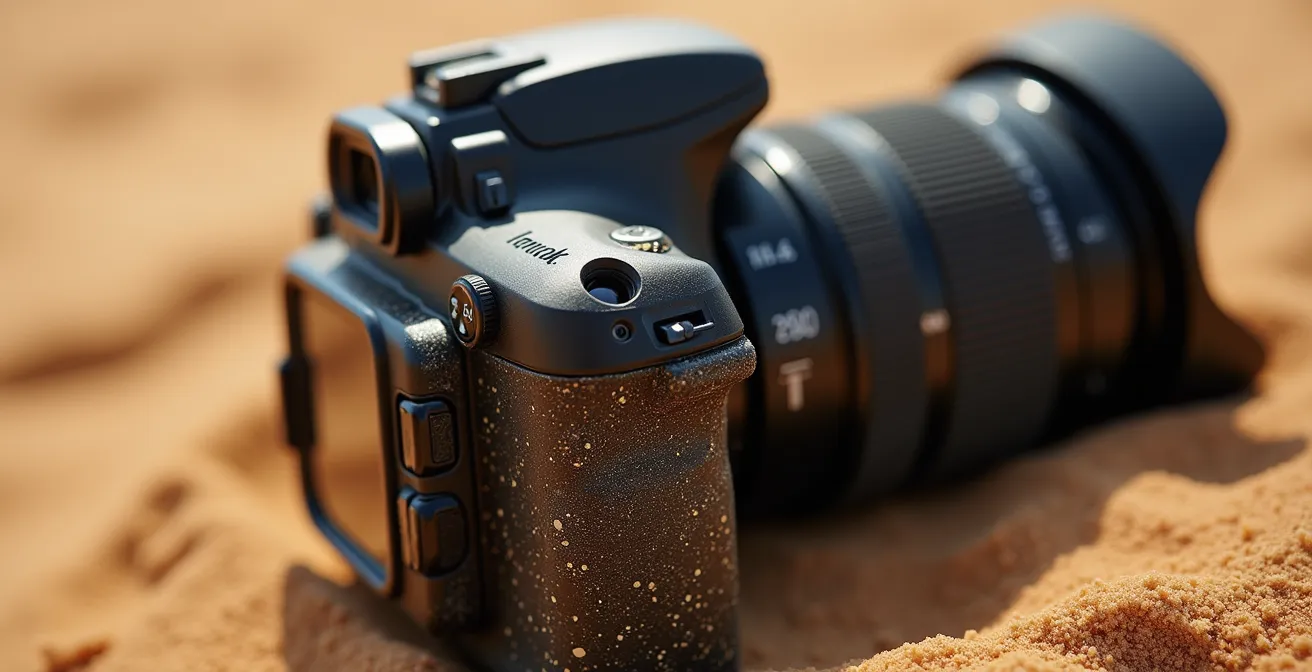
As the image above demonstrates, a simple but effective technique is to use gaffer tape to seal the seams of your camera body, lens mount, battery compartment, and card slots. This creates a physical barrier against the finest dust. In a private tour, you have the time and space to apply and remove this protection as needed. This level of meticulous care is often impractical in the hustle of a shared tour.
Case Study: Professional Photographer’s Desert Safari Gear Protection Protocol
A professional travel photographer’s experience during Dubai desert safaris revealed a highly effective protocol. By using a single, versatile 24-105mm lens for the entire trip to avoid lens changes in the dusty environment, combined with pre-sealing all camera openings with gaffer tape, the photographer reported zero sensor dust issues across over 50 desert shoots. The post-safari cleaning process was also key: using a rocket blower to clean the gear inside a steamy bathroom, where the moisture in the air helps weigh down and settle any airborne dust particles, preventing them from re-contaminating the sensor.
Choosing a private safari is, in this context, a form of insurance. It provides the controlled environment needed to safeguard your investment, ensuring your memories are captured without a costly repair bill waiting for you back home.
How Much to Tip Your Safari Driver vs the Camp Dancers?
Tipping etiquette can be a source of anxiety for many travelers, and the structure of a desert safari adds layers of complexity. In a shared safari, you interact with multiple service providers: the driver, the camp staff serving food, and the performers like fire dancers and Tanoura dancers. It can be confusing to know who to tip, how much, and how to ensure the money is distributed fairly. This ambiguity can lead to “service dilution,” where the collective efforts of the camp staff go unrewarded because guests are unsure of the protocol.
A private safari simplifies this process immensely. Your driver is not just a chauffeur; they are your personal guide and host for the entire experience. They are your single point of contact. This creates a clearer, more personal relationship, making tipping more straightforward. The industry standard is to give a consolidated tip to your private driver at the end of the tour with the request that they share it with the camp staff who assisted them. This culturally appropriate method ensures everyone is recognized without the awkwardness of handing out small bills to multiple people.
The following guidelines offer a clear breakdown of expectations, highlighting the difference in responsibility and service level between shared and private tour staff.
| Service Provider | Shared Safari Tip | Private Safari Tip | Payment Method |
|---|---|---|---|
| Basic Driver (transport only) | AED 20-30 per group | AED 50-70 per vehicle | Cash in local currency |
| Driver-Guide (with commentary) | AED 30-50 per group | AED 80-100 per vehicle | Cash preferred |
| Camp Entertainment Staff | AED 10-20 total | Included in driver tip | Via driver for distribution |
| Exceptional Service Bonus | +AED 20 | +AED 50 | Direct to individual |
By opting for a private tour, you are not just buying a more comfortable ride; you are also buying clarity and peace of mind. You can reward excellent service generously and confidently, knowing your gesture will be received and distributed appropriately.
Why the Return Trip Often Takes 2x Longer Than the Departure?
One of the most common complaints from travelers on shared safaris is the surprisingly long and exhausting return journey. While the trip from your hotel to the desert camp might take an hour, the ride back can easily stretch to two hours or more. This isn’t due to traffic alone; it’s a direct consequence of the shared tour model and another significant hidden time tax. After a long evening, the last thing anyone wants is an extended, meandering drive back to the city.
The reason is simple logistics. A shared 4×4 or bus typically carries multiple groups staying at different hotels across Dubai. The driver must navigate a complex, multi-stop route to drop everyone off. You might be the first person picked up and the last person dropped off, adding a substantial amount of time to your day. This is confirmed by industry data, as Emirates Desert Tours confirms that the average 50-65 minute journey can extend to 90+ minutes during evening returns. This “experience friction” is especially draining at the end of the night when you and your family are tired and ready for bed.
A private safari completely eliminates this problem. Your vehicle serves only you. The moment you decide to leave the camp, your driver takes the most direct route back to your specific hotel. There are no detours, no waiting for other passengers, and no unpredictable delays. That extra 45-60 minutes saved is not a small luxury; it’s the difference between ending your day on a high note and ending it with weary frustration. This is a clear instance where the higher upfront cost translates directly into a more efficient, respectful, and comfortable use of your time.
When you book a private tour, you are booking a direct, dedicated service. You are paying for the guarantee that your journey home will be as smooth and efficient as your journey out, providing a seamless end to an incredible day.
Where to Sit in the 4×4 to Minimize Dune Bashing Nausea?
Dune bashing is the headline act of most desert safaris, but for many, it can also be a source of intense motion sickness. The thrilling, roller-coaster-like maneuvers can quickly turn enjoyment into misery if you’re prone to nausea. In a shared vehicle, you have no say in where you sit. You might be relegated to the rear-most seats, which experience the most extreme whipping motions, or a side seat with a limited view of the horizon, both of which can significantly worsen nausea.
The key to a comfortable ride lies in physics. The most stable part of the vehicle is its center of gravity, located directly over the axles in the middle row. Sitting here dramatically reduces the rotational G-forces that trigger motion sickness. A private safari guarantees you can claim this optimal seating position. Furthermore, it gives you an “intensity dial.” You can communicate directly with your driver, asking them to take it easy or even opt for a more scenic “dune drive” instead of aggressive bashing. This level of personalized control is impossible in a shared tour where the driver must deliver a standardized thrill level for a full car of strangers.
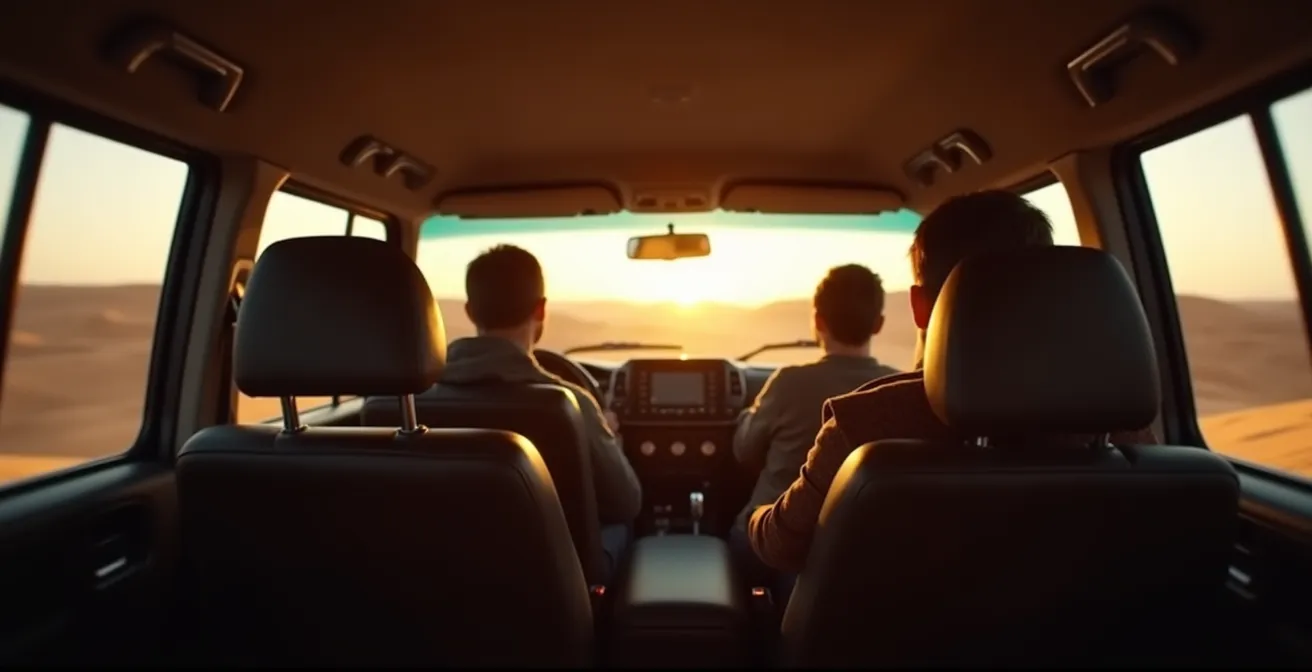
As the image above illustrates, securing a spot in the middle row with a clear, forward-facing view of the horizon is the single most effective way to prevent nausea. This allows your brain to match the motion it feels with the movement it sees. To ensure the best possible experience, follow this simple protocol:
- Choose the middle row seat directly over the vehicle’s center of gravity to minimize rotational G-forces.
- Focus your gaze on the farthest point of the horizon in the direction of travel—never look at nearby dunes or your phone.
- Before dune bashing begins, tell your driver: ‘Hello, I sometimes get motion sickness. Could we please do a medium-intensity ride?’
With a private tour, you are not just purchasing a seat; you are securing the best seat and the ability to dictate the ride’s intensity. This is the ultimate form of comfort and quality control, ensuring the adventure is thrilling for all the right reasons.
Does Gold Class Guarantee a Seat or Just Less Crowding?
In the world of shared safaris, many operators have introduced tiered ticketing like “Gold Class” or “VIP” packages. These are marketed as an upgrade, promising a more exclusive experience with benefits like better seating for the entertainment and dedicated service. However, these terms are unregulated, and the reality often falls far short of the promise. This is a classic case of marketing over-delivery causing significant “experience friction.”
Often, a “VIP” upgrade simply means a private table located in a roped-off section of the same massive, noisy, and crowded camp. You may still have to queue in the same long buffet line and use the same overwhelmed bathroom facilities as standard ticket holders. The “dedicated service” might be a single, overworked waiter for a large “Gold” section. This is a prime example of service dilution, where the perceived value is much higher than the actual benefit.
Case Study: The Reality of ‘Gold Class’ Marketing in Dubai Desert Safaris
An investigation of various Dubai desert safari operators revealed that “Gold Class” and “VIP” are often hollow marketing terms. In practice, many of these packages simply provide a separate table within the main camp, offering minimal tangible benefit over a standard ticket. True premium operators, such as Platinum Heritage, avoid such gimmicky terminology altogether. Instead, they advertise specific, verifiable features that constitute a genuinely premium experience: tour groups strictly limited to 20 guests, access to a completely private camp location, à la carte dining instead of a buffet, and truly dedicated service staff.
To avoid disappointment, you must become a savvy consumer and ask pointed questions before booking any so-called “VIP” package. Use this checklist to cut through the marketing fluff:
- Is the Gold Class area a completely separate camp, or just a roped-off section within the main camp?
- Will we have dedicated waiter service for food and drinks, or do we use the same buffet line as standard guests?
- Are the bathroom facilities exclusive to Gold Class guests, or are they shared with everyone?
- What is the maximum number of people allowed in the Gold Class section?
- Is there a separate entertainment viewing area, or do we just watch the same shows from slightly different seats?
Ultimately, a true private safari is the only way to guarantee an authentically exclusive experience. It sidesteps the misleading tiers and provides what you’re actually looking for: privacy, dedicated attention, and a crowd-free environment.
The 30% Rule: How to Negotiate Prices Like a Local?
The vast range of prices for desert safaris, from dirt-cheap to premium, can be confusing. It naturally leads to the question: are these prices negotiable? The answer is yes, but it depends heavily on the type of operator you are dealing with. For the numerous budget operators competing fiercely for volume, there is often significant room for negotiation. In fact, Desert Journey Tourism’s 2025 pricing data shows a wide AED 35-350 price range, with an average discount of up to 30% available, especially during the low season (May-September) or for large group bookings.
However, successful negotiation is not about aggressive haggling. A more effective approach is to frame it as a value exchange. Instead of just asking for a lower price, ask for an added inclusion. This allows the operator to maintain their price point while giving you more for your money. This strategy works best with mid-range providers.
Here are some effective value-based negotiation strategies:
- Frame it as a value exchange: Say, “The price is a little high for me. Can you include a 15-minute quad bike ride to make it work?”
- Bundle tours: Booking multiple tours (like a city tour and a desert safari) with one operator can give you leverage for a 15-20% discount.
- Book during the low season: From May to September, operators are more willing to negotiate to fill empty seats.
- Recognize fixed costs: Understand that licensed, premium private tour operators have high fixed costs (professional guides, top-tier insurance, vehicle maintenance). Their room for negotiation is minimal, typically only 5-10%, as their price reflects a guaranteed level of quality and safety.
While negotiating a deal on a shared safari can feel like a win, the most discerning travelers understand that with premium private tours, you are paying for certainty. The fixed price reflects a consistent, high-quality product where the value is already built-in, eliminating the need for haggling.
Key Takeaways
- The advertised price of a shared safari often hides a “time tax” from mandatory stops and inefficient drop-offs.
- A private safari gives you an “intensity dial” for activities and absolute control over safety, especially crucial for children and gear.
- “VIP” or “Gold Class” are often empty marketing terms; verify specific inclusions like private camps and dedicated service to avoid “service dilution.”
Is Dune Bashing Safe for Children Under 6 Years Old?
When traveling with young children, safety becomes the single most important factor, overriding all other considerations like price or entertainment. The aggressive nature of traditional “dune bashing” is generally not recommended for children under 6, pregnant women, or individuals with back problems. The intense, unpredictable movements can be distressing and physically unsafe for small children. In a shared safari, you have no control over the ride’s intensity; the driver must cater to the thrill-seeking majority in the car.
This is where a private safari proves its immeasurable worth. It provides an essential layer of quality control over safety. You can specifically request a gentle, scenic “dune drive” instead of “dune bashing,” allowing your family to experience the beauty of the desert without the associated risks. The ability to stop the vehicle immediately if a child feels unwell or scared provides peace of mind that is simply priceless. Furthermore, a private tour guarantees the provision and proper installation of an age-appropriate child seat, a safety feature that can be inconsistent or unavailable on cheaper shared tours.
Case Study: Family Safety Protocols for a Private Safari
Families with children under 6 consistently report safer and more enjoyable experiences when they book a private tour and request “dune driving.” This scenic, slow-paced navigation offers the visual splendor of the desert without the jarring movements. One family’s testimonial noted their private safari driver was able to completely adjust the route and pace when their 4-year-old became uncomfortable, a level of personalized care that is impossible in a fixed-itinerary shared tour. The private vehicle also ensured a correctly installed child seat and the flexibility to return to the city early when the child became tired.
For any parent, verifying safety protocols before booking is non-negotiable. Follow this checklist to ensure your operator meets the required standards:
- Email the operator and request photo proof of the specific, age-appropriate car seat they will provide before making any payment.
- Explicitly request “gentle dune driving,” not “dune bashing,” in your booking confirmation. Use these exact terms.
- Choose a private safari for emergency flexibility, including the ability to return to the hotel immediately if a child becomes distressed.
- Confirm the vehicle has fully functional air conditioning and request that extra bottled water is available for the children.
Ultimately, the decision to book a private safari for a family with young children is not a question of comfort, but a responsible choice for their safety and well-being. The premium paid is a direct investment in a controlled, secure, and stress-free family adventure.