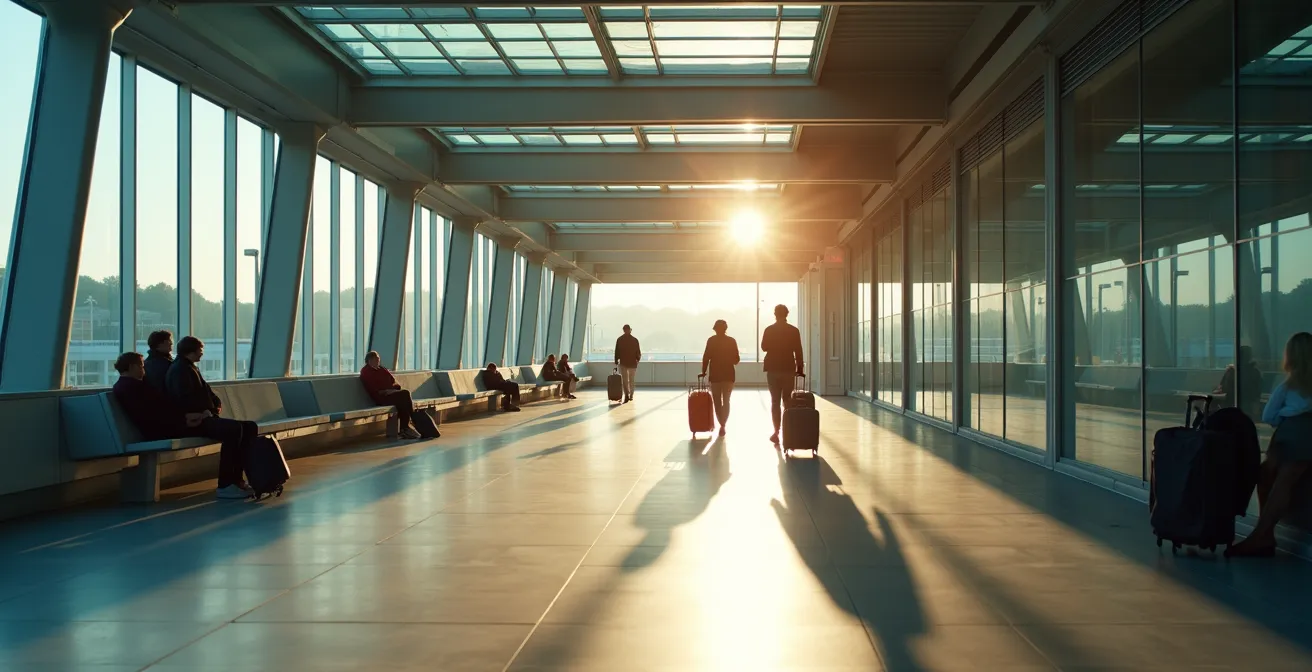
The real danger of Dubai’s summer isn’t the heat itself, but the unprepared transition from 100% AC to the outdoors—the ‘thermal gap’.
- Victory lies in pre-trip “digital reconnaissance” to map out climate-controlled paths and cooling oases.
- Creating a “personal cooling zone” with specific, lightweight gear is non-negotiable for any unsheltered wait.
Recommendation: Stop thinking like a tourist and start thinking like a thermal comfort strategist: treat your energy as a finite resource to be conserved at all costs.
text
You step out of the pristine, 20°C environment of a Dubai Metro carriage, feeling a sense of modern marvel. The transit system is an air-conditioned triumph, a network of cool, clean arteries running through the city. Your hotel is only 500 meters away. You assume the journey will be a seamless extension of this comfort. This assumption is your first mistake, and it can be a dangerous one. The moment the station doors slide open, you’re not just stepping outside; you’re entering a thermal combat zone. That short walk, the so-called “last mile,” is where the illusion of door-to-door AC shatters.
Most travel advice focuses on the obvious: drink water, wear a hat. But this fails to address the critical point of failure: the physiological shock of moving from a perfectly chilled environment into 45°C heat. This is the thermal gap, and it can drain your energy, ruin your mood, and even pose a health risk before you’ve even checked in. The standard advice is inadequate because it treats you like a tourist. To survive, you must think like a thermal comfort strategist.
This guide is not about general heat tips. It’s a tactical manual for weaponizing urban infrastructure, deploying personal cooling gear, and conserving every joule of energy to conquer the last mile. We will dissect the journey from platform to hotel lobby, identifying the threats and opportunities for survival. We will explore how to use technology for digital reconnaissance, transform a bus stop into a personal cooling zone, and understand why the system’s own rules are a clue to your survival. Forget what you think you know about walking in the heat; it’s time to learn how to master the transition.
To help you navigate this thermal landscape, this article is structured as a strategic briefing. The following summary breaks down the key intelligence you’ll need to master your journey from the station to your final destination, ensuring you arrive cool, calm, and in control.
Summary: Your Tactical Guide to the ‘Last Mile’
- Metro Link Bridges: Which Malls Are Connected by AC Walkways?
- Waiting for the Feeder Bus: Are Bus Stops Air Conditioned?
- Is Station Wifi Strong Enough for a Zoom Call While Waiting?
- Why You Never See Dust in Dubai Metro Stations?
- Elevator vs Escalator: Which Is Faster for Strollers in Heat?
- The Hydration Mistake That Ruins 40% of Sunset Safaris
- Old Town vs High Rise: Which Downtown Zone Offers Better Sleep Quality?
- Why You Can Get Fined $30 for Chewing Gum on the Metro?
Metro Link Bridges: Which Malls Are Connected by AC Walkways?
The most powerful tool in your thermal survival kit is avoiding the heat entirely. This is where infrastructure weaponization comes into play. Before your trip, your primary mission is to conduct digital reconnaissance to identify climate-controlled pathways. Many of Dubai’s major malls and commercial buildings are directly connected to metro stations via enclosed, air-conditioned walkways. These are not mere conveniences; they are strategic assets.
Your goal is to map a route that maximizes time spent inside these cooled arteries. This requires a proactive approach, not a hopeful wander out of the station exit. Use online maps with street-level views to scout your route from the station to your hotel, specifically looking for the tell-tale glass structures of elevated pedestrian bridges. Search for official information from transit authorities or the websites of your destination mall, which often detail these direct connections.
Case Study: Dubai’s Mall of the Emirates Direct Metro Connection
The station’s most significant advantage is its seamless access: a fully enclosed, air-conditioned pedestrian bridge connects the metro concourse straight into the mall. This eliminates road crossings, keeps the route shaded in summer, and ensures a comfortable, step-free connection. This exemplifies how modern transit systems integrate climate-controlled connections, allowing travelers to walk from train to destination without exposure to outdoor heat.
To execute this strategy, follow this three-step reconnaissance plan:
- Step 1: Use Google Maps Street View to virtually walk your route from the station to the hotel, identifying buildings with visible glass bridges or covered connections at second-floor level.
- Step 2: Search for “[destination] metro station pedestrian bridge” or “air-conditioned walkway” to find official transit authority information about enclosed connections.
- Step 3: Check mall websites for “Getting Here” or “Transportation” sections which often detail direct metro connections and covered walkways from specific stations.
Choosing a hotel, or even a lunch spot, based on its proximity to a direct metro link is the single most effective decision you can make to defeat the last mile problem.
Waiting for the Feeder Bus: Are Bus Stops Air Conditioned?
Sometimes, your journey requires a feeder bus, forcing you into an exposed waiting position. While many of the city’s bus stops are equipped with air-conditioned shelters, a feature highlighted in Dubai’s RTA accessibility features, you must be prepared for the possibility that yours is not. In this scenario, you are your own last line of defense. You must be able to create a Personal Cooling Zone (PCZ)—a survivable micro-climate around your body.
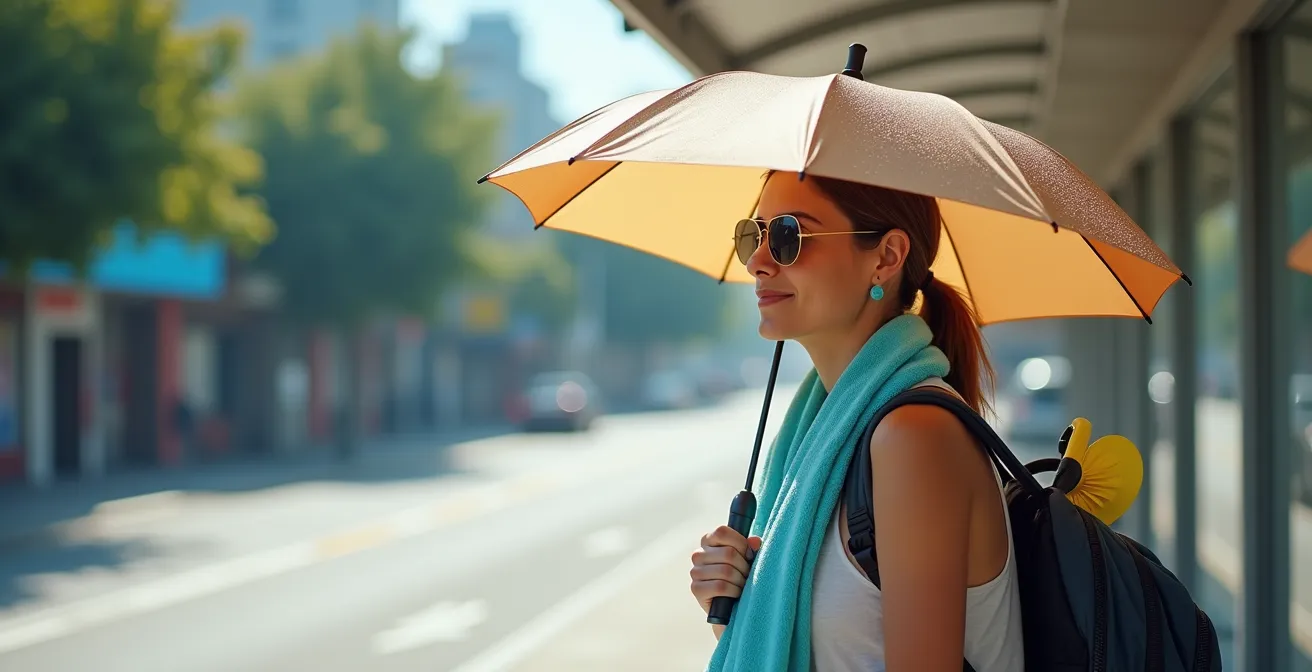
As the image demonstrates, this isn’t about looking stylish; it’s about tactical survival. A high-quality, UV-blocking umbrella is your first layer of defense, creating a pocket of shade that can significantly reduce the perceived temperature. Augment this with a small, battery-powered fan clipped to your bag or held in your hand to create airflow and aid evaporative cooling. A cooling towel, soaked in water, draped around your neck targets major blood vessels and provides immediate relief. These items are lightweight, portable, and dramatically effective when used in combination.
The effectiveness of this personal equipment cannot be overstated. It’s the difference between a miserable, energy-sapping wait and a manageable pause. Analyze this data to build your personal kit:
| Cooling Method | Temperature Reduction | Duration | Portability |
|---|---|---|---|
| UV-Blocking Umbrella | 5-7°C shade effect | Unlimited | Lightweight |
| Battery Fan | 3-5°C perceived | 2-4 hours | Clip-on |
| Cooling Towel | 2-3°C on skin | 1-2 hours | Ultra-light |
| Combined Use | Up to 10°C perceived | Varies | Full kit < 500g |
Never assume a shelter will be available or functional. Carry your PCZ kit with you at all times. It is your personal, portable oasis in the urban desert.
Is Station Wifi Strong Enough for a Zoom Call While Waiting?
This question misses the point. From a survivalist perspective, the free Wi-Fi in the station is not for entertainment or work—it’s a tactical tool to be used in the final, precious moments of air-conditioned safety. While the entire system, including both the Red and Green lines, features trains equipped with Free Wi-Fi, attempting a high-bandwidth task like a video call is a strategic error. It drains your phone’s battery, a critical resource, and uses up valuable time that should be dedicated to final preparations before facing the heat.
Instead of a Zoom call, you should execute the “Golden 15 Minutes” protocol. This is a pre-planned sequence of low-bandwidth actions designed to make your journey through the thermal gap safer and more efficient. It’s about using the final moments of connectivity and coolness to your maximum advantage.
The protocol is as follows:
- Minutes 1-3: Download offline maps for your walking route and save screenshots of directions. Do not rely on a live data connection once you are outside.
- Minutes 4-6: Check and confirm your hotel check-in via their mobile app. This can help you avoid a long, stressful wait in the lobby.
- Minutes 7-10: Research and bookmark nearby air-conditioned cafes, convenience stores, or shop entrances along your route. These are your potential cooling oases or emergency shelters.
- Minutes 11-13: Send arrival updates or any necessary messages to contacts while your signal is guaranteed to be strong.
- Minutes 14-15: Switch your phone to battery-saving mode, close all unnecessary apps, and prepare yourself mentally for the transition.
Your phone is a lifeline, not a conference room. Conserve its battery, pre-load your data, and use the station’s Wi-Fi to arm yourself with information for the walk ahead.
Why You Never See Dust in Dubai Metro Stations?
The immaculate, dust-free environment of the metro is not a coincidence; it is a deliberate and crucial component of the system’s function. This level of cleanliness is a direct indicator of a high-performance, meticulously maintained air filtration and cooling system. For the thermal strategist, this isn’t just a pleasant detail—it is the source of the “breathing space” that you must strategically use before stepping into the heat.
The absence of dust and grime signifies that the air you’re breathing is being powerfully chilled and filtered. Systems designed for this level of performance are immense; for instance, a large-scale urban transit system can have an advanced cooling infrastructure with dozens of chillers dedicated to maintaining a precise, comfortable temperature. This controlled environment has a profound psychological effect. As one analysis of transit design notes:
The hyper-cleanliness is an intentional design choice to lower passenger anxiety and create a sense of calm and order.
– Transit Design Principle, Urban Planning Analysis – Metro Station Psychology
This manufactured calm is the perfect state in which to conduct your final preparations. Use these last moments in the clean, cool air to regulate your body temperature, check your gear, and run through your “Golden 15 Minutes” protocol. Do not rush out of the station. Think of it as a diver taking a final, deep breath from a tank before plunging into the deep.
The pristine environment is your final sanctuary. Respect it, and more importantly, use the calm and cool it provides to prepare for the thermal shock that lies just beyond the doors.
Elevator vs Escalator: Which Is Faster for Strollers in Heat?
The question of speed is a trap. In the battle against the thermal gap, the primary goal is not speed, but energy conservation. Every drop of sweat, every flexed muscle, every beat of a raised heart rate is a victory for the heat. From this perspective, the choice between an elevator and an escalator is not a choice at all. The elevator is always the correct strategic decision, especially when managing luggage or a stroller.
An escalator requires constant balance, physical adjustment, and, if it unexpectedly stops, a significant physical effort to climb with baggage. This expends precious energy that you will desperately need for the walk ahead. An elevator, by contrast, demands almost nothing from you. The wait time is a moment of static rest in a climate-controlled space. This is reinforced by the system’s comprehensive design, where Wheelchair accessible restrooms are located beyond the fare gates in every station, proving a commitment to step-free, low-effort routes.
The difference in energy expenditure is critical. Consider the following tactical breakdown:
| Factor | Elevator | Escalator | Heat Impact |
|---|---|---|---|
| Wait Time | 30-60 seconds | 0 seconds | AC while waiting |
| Physical Effort | Minimal | High if stops | Critical in heat |
| Predictability | Very High | Variable | Reduces stress |
| Energy Conservation | Maximum | Moderate-Low | Preserves for walk |
| Accessibility | 100% | Limited | Step-free priority |
Choosing the elevator is a conscious decision to prioritize your energy reserves for the most critical phase of the journey: the walk itself. Don’t trade precious coolness and stamina for the illusion of saving 30 seconds.
The Hydration Mistake That Ruins 40% of Sunset Safaris
The most common hydration mistake is waiting until you’re thirsty. By then, you’re already in a state of dehydration, and your body is playing catch-up. For a short but intense journey like the last mile walk, this reactive approach is a recipe for failure. Effective hydration is proactive and strategic. It’s not just about water; it’s about electrolytes.
When you sweat in extreme heat, you don’t just lose water; you lose critical salts and minerals (electrolytes) that govern muscle function and cognitive clarity. Under tough conditions, research shows hikers can lose 1-2 liters of fluid per hour. Drinking plain water can further dilute your body’s remaining electrolyte stores, a dangerous condition known as hyponatremia. The solution is to pre-hydrate with an electrolyte-enhanced beverage *before* you step into the heat.
Field Technique: Flash Evaporative Cooling
In addition to internal hydration, manage the initial shock externally. Professional therapists who conduct walk-and-talk sessions in hot climates recommend using an atomizer spray bottle with cool water on your pulse points (wrists, neck, back of knees) the moment you exit an air-conditioned space. This simple action tricks the body’s thermoreceptors, dramatically reducing the initial impact of heat exposure and making the transition far more manageable.
Adopt this pre-hydration protocol before any walk in the heat:
- 30 minutes before: Start sipping room-temperature water with an electrolyte tablet or powder. Avoid ice-cold water, which can shock your system.
- Check urine color: Before you start your walk, it should be light yellow, almost clear. Dark yellow is a red flag.
- Pack electrolyte options: Carry tablets or powder packets. They are far lighter and more practical than pre-mixed sports drinks.
- Set hydration reminders: During your walk, sip every 15-20 minutes. Do not wait for the sensation of thirst.
- Avoid diuretics: Coffee and caffeinated tea can increase fluid loss. Skip them before venturing into the heat.
Treat your body like a high-performance machine entering a hostile environment. Proper fuel and fluid balance is not optional; it is the foundation of your survival strategy.
Old Town vs High Rise: Which Downtown Zone Offers Better Sleep Quality?
The battle for thermal comfort doesn’t end when you reach your hotel. It begins with where you choose to stay. The walkability of your chosen ‘downtown zone’ has a direct impact on your energy levels and overall experience. A seemingly small increase in outdoor temperature dramatically alters how your brain perceives distance and effort. In fact, MIT research found pedestrians perceive walks as 81 meters longer for every 1°C increase in temperature. A 500-meter walk in 45°C heat can feel like a grueling kilometer.
This is why a “micro-route audit” of your hotel’s immediate vicinity is a critical part of your pre-trip planning. You need to analyze the final few hundred meters of your daily journeys with the ruthlessness of a surveyor. High-rise districts often offer wider, more modern sidewalks and a higher density of air-conditioned shops at ground level that can serve as “cooling oases.” Conversely, older, more historic “Old Town” areas might offer more character but feature narrower sidewalks, less shade from modern awnings, and heat-retaining asphalt surfaces.
Before you book, you must perform this audit using digital tools. This is the most practical way to ensure your ‘last mile’ is survivable every time you step out.
Action Plan: Your Micro-Route Audit Checklist
- Shade Assessment: Use Street View to count trees, awnings, and building shadows along your likely walking paths at the time of day you expect to be out.
- Cooling Oases: Identify and inventory air-conditioned shops, convenience stores, or mall entrances within 200-meter intervals of your hotel. These are your emergency relief points.
- Sidewalk Integrity: Check for adequate pedestrian space away from the radiant heat of traffic. Note the width and condition of the pavement.
- Surface Materials: Scrutinize the ground. Are the sidewalks light-colored concrete (reflects heat) or dark asphalt (absorbs and radiates heat)?
- Alternative Routes: Map out two or three backup paths to and from the nearest station or point of interest, prioritizing routes with better shade coverage or more potential cooling stops.
Your choice of accommodation zone is a strategic decision that dictates the thermal challenge you will face every single day. Choose wisely, based on data, not just on pictures of the hotel room.
Key Takeaways
- The ‘Last Mile’ is the most dangerous part of your journey; plan for it specifically using digital reconnaissance and infrastructure weaponization.
- Prioritize energy conservation over speed: always choose the elevator, the shaded path, and the climate-controlled bridge.
- Effective hydration is proactive, not reactive. Pre-load with electrolytes before you even feel thirsty to prevent a performance decline.
Why You Can Get Fined $30 for Chewing Gum on the Metro?
The strict prohibition of eating, drinking, and even chewing gum on the metro is not an arbitrary rule designed to inconvenience travelers. It is a cornerstone of the entire system’s integrity. For the thermal strategist, this rule is a crucial piece of the puzzle. The fine is not just about cleanliness; it’s about preserving the pristine, hyper-functional environment that serves as your essential pre-cooling and post-cooling sanctuary.
This strictness guarantees that the station and carriages remain the clean, calm, and reliable oases you depend on. It prevents the kind of degradation that would compromise the high-performance air filtration and cooling systems. By enforcing these rules, the transit authority is, in effect, protecting your survival infrastructure. However, this creates a tactical challenge: how do you stay hydrated if you cannot drink on the final leg of your air-conditioned journey?
The answer is to turn the restriction into a strategy. The prohibition forces you to plan your hydration around the system’s boundaries.
Strategic Hydration Stop Planning
Because transit systems like Dubai’s prohibit food and drink, a hydration challenge is created. The elegant solution is to make your very first stop after exiting the station a pre-scouted convenience store or cafe right at the station exit. This turns the restriction into a distinct advantage. You acquire a perfectly chilled, electrolyte-rich drink at the exact moment you need it most: right before you begin your walk through the thermal gap. It ensures your hydration is immediate and effective.
Now, equip yourself with this mindset. Before your next trip, audit your ‘last mile’ and plan your thermal strategy. Your comfort, energy, and safety depend on it. Stop being a victim of the heat and become the master of your environment.