
Contrary to what travel brochures suggest, a ‘safe tan’ in Dubai is a medical impossibility for pale skin; the only rational goal is clinical sun damage mitigation.
- Under a UV Index of 11, unprotected pale skin can suffer significant cellular damage in under 10 minutes due to the sun’s intensity and high reflectivity off sand and water.
- Luxury amenities like AC cabanas and responsive service are not mere comforts but critical tools for health, providing essential refuge from extreme heat and dehydration.
Recommendation: Treat every moment of sun exposure as a calculated clinical risk. Re-evaluate your choice of beach club based on its proven ability to provide environmental protection, not just its social prestige.
As a dermatologist, I must address a dangerous misconception many European tourists hold when visiting Dubai: the pursuit of a “safe” tan. You envision returning home with a golden glow, a testament to luxurious days spent by the pool. This is a fantasy that collides harshly with the medical reality of a desert climate where the UV Index frequently hits 11 or higher. For fair skin, this is not a tanning environment; it is a high-risk zone for acute cellular damage.
The standard advice—wear sunscreen, stay hydrated—is dangerously insufficient here. It fails to account for the sheer speed and intensity of the radiation. Within minutes, your skin is under assault. A burn is not just a temporary discomfort; it’s a visible sign of widespread DNA damage to your skin cells, accelerating aging and significantly increasing your risk of melanoma. The very notion of “tanning” is your skin’s trauma response, a desperate attempt to produce melanin to shield itself from further injury.
This guide reframes the approach. We will not discuss how to tan. We will discuss how to survive. The crucial shift in mindset is this: your time at a Dubai beach club is not a casual sunbathing session but an exercise in clinical risk management. The luxury amenities you pay a premium for—the private cabanas, the attentive service, the oversized towels—must be viewed not as indulgences, but as essential medical and safety equipment in your arsenal against a hostile solar environment.
This article provides a clinical breakdown of how to navigate Dubai’s high-end sunbathing spots, using their own features as your primary line of defense. We will analyze everything from service speed to cooling technology, empowering you to make choices that protect your health above all else.
Summary: Surviving the Sun at Dubai’s Premier Beach Clubs
- Which Beach Clubs Have Anti-Drone Tech for Privacy?
- Button to Waiter Time: Which Cabanas Have the Fastest Service?
- Mist Fans vs AC Cabanas: What Actually Works in August?
- Why Oversized Towels Matter on Luxury Sunbeds?
- How to Find a Sunbed Away from the DJ Speakers?
- The Hydration Mistake That Ruins 40% of Sunset Safaris
- Why Drones Are Strictly Prohibited in the Reserve?
- Nikki Beach or Drift: Which Club Justifies the $100 Entry Fee?
Which Beach Clubs Have Anti-Drone Tech for Privacy?
An often-overlooked source of stress during relaxation is the violation of privacy from unauthorized drones. While you might expect high-end clubs to deploy sophisticated anti-drone jamming technology, the primary protection in Dubai is regulatory, not technical. The city enforces a strict, zero-tolerance policy against unauthorized drone flights over public and private beaches. According to an analysis of local regulations, flying drones over beaches like Jumeirah is prohibited without explicit permission from the Dubai Civil Aviation Authority (DCAA). This legal framework is the most powerful deterrent.
This means your privacy is upheld by law enforcement and regulatory oversight rather than individual club security systems. Even the official Dubai Police surveillance drones are specifically designed to respect privacy, focusing on the horizon rather than individuals. However, your choice of club and location within it can add crucial layers of physical and operational security. You must be proactive in ensuring these layers are in place.
Privacy Assessment Checklist for Your Beach Club
- Ask the concierge about the club’s specific policy on drone enforcement and if security actively monitors for unauthorized devices.
- Request cabanas positioned in ‘acoustic dead zones’ or areas with natural privacy barriers, away from the main pool where most photos are taken.
- Look for clubs with natural privacy shields like dense palm groves or architectural elements that inherently block aerial views.
- Verify if the club is within Dubai Police’s “Drone Box” coverage area, which signifies enhanced regulatory enforcement.
- Prioritize clubs on private islands or secluded peninsulas where public access for drone operation is naturally restricted.
Ultimately, your best defense is a combination of robust regulation and smart, physical positioning away from easily observable areas.
Button to Waiter Time: Which Cabanas Have the Fastest Service?
In Dubai’s extreme heat, the speed of service is not a luxury—it is a critical health and safety function. The time it takes to get a bottle of water can be the difference between comfort and the onset of heat exhaustion. The “button to waiter” time is a key performance indicator of a club’s commitment to guest welfare. While many clubs operate with zone-based teams, leading to variable wait times, the most elite venues have eliminated this variable entirely.
This paragraph introduces the concept of service as a health metric. The close-up below illustrates the very tool that can summon immediate hydration and assistance.
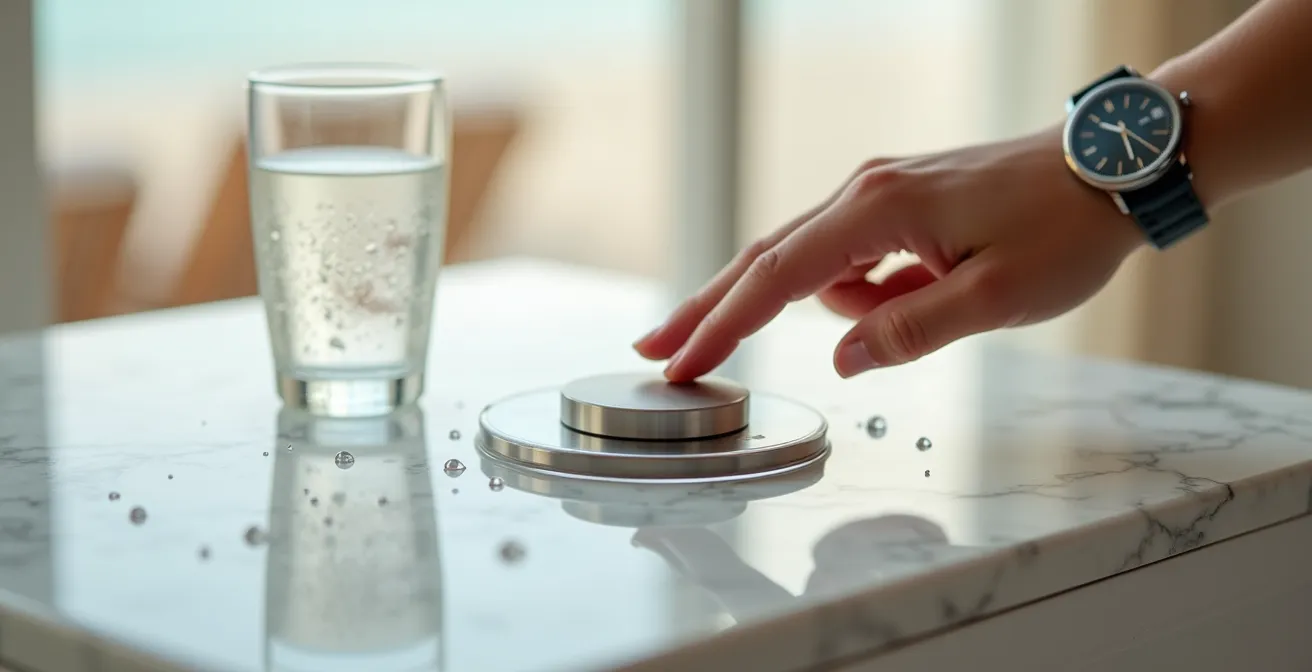
Venues like DRIFT, for instance, provide an ultra-exclusive experience by assigning a dedicated host to their private beach cabanas. This proactive service model means your needs—especially for hydration—are often anticipated before you even think to press the button. This removes the risk of waiting 5-10 minutes during peak hours, a delay that is medically significant under a UV Index of 11. When evaluating a club, the service model is as important as the price.
| Beach Club | Service Model | Response Indicator | Peak Time Strategy |
|---|---|---|---|
| DRIFT | Dedicated host per cabana | Proactive (no wait) | Maintains ratio regardless |
| Nikki Beach | Zone-based teams | 5-10 min average | Extra staff 3-7 PM |
| Twiggy | Roaming service | Variable by location | Premium toiletries as compensation |
| Nammos | High-touch luxury | Near-instant | Overstaffed by design |
For a pale-skinned tourist, guaranteed, instant access to water and assistance is a non-negotiable factor that justifies a higher premium.
Mist Fans vs AC Cabanas: What Actually Works in August?
In the peak of a Dubai summer, with extreme humidity accompanying the heat, understanding cooling technology is vital. Many tourists are drawn to the idea of open-air cabanas with misting fans, but from a medical standpoint, this can be a dangerous choice in August. Mist fans work by evaporative cooling. However, when ambient humidity is already high (often exceeding 70-80%), the water from the misters cannot evaporate effectively. Instead of cooling you, they simply make you wet and increase the “wet-bulb” temperature, a critical measure for heat stress. This can accelerate the risk of heatstroke.
The only truly effective method for creating a safe recovery zone is an air-conditioned cabana. An AC unit does not just lower the temperature; crucially, it dehumidifies the air. By reducing humidity to a comfortable 40-50%, it allows your body’s natural cooling mechanism—sweat—to function properly. An AC cabana is not a luxury; it is a personal micro-climate that provides a genuine refuge, allowing your core body temperature to decrease and your system to recover from solar and thermal stress. The difference in effectiveness is not marginal; it is absolute.
| Cooling Method | Temperature Reduction | Humidity Impact | Comfort Duration | Cost Premium |
|---|---|---|---|---|
| Mist Fans | 3-5°C perceived | Increases to 80%+ | 1-2 hours max | Included in base rate |
| AC Cabanas | 15-20°C actual | Reduces to 40% | 6+ hours | +150-200% surcharge |
| Hybrid (AC + Mist) | Graduated zones | Controlled transition | All day | Premium pricing |
While the surcharge for an AC cabana may seem steep, it should be factored into your budget as a non-negotiable health and safety expense if you plan to visit a beach club during the summer months.
Why Oversized Towels Matter on Luxury Sunbeds?
A towel at a luxury Dubai beach club serves a function far beyond drying off. It is a critical piece of personal protective equipment. Sunbeds, especially those with dark-colored cushions, can reach surface temperatures exceeding 60-70°C (140-158°F) under direct sun. Brief contact with such a surface can cause first or even second-degree contact burns, a painful and serious injury. The standard-issue towel provided by many clubs is often insufficient to create an effective thermal barrier.
This is why the concept of an oversized, high-GSM (grams per square meter) towel is so important. A thick, plush towel of at least 800 GSM acts as an insulator, protecting your skin from the dangerously hot surface beneath. Furthermore, a multi-towel strategy is the hallmark of a prepared visitor. This involves using the club’s towel as a base layer, your own personal oversized towel for comfort and insulation, a smaller antimicrobial towel for your face, and even a fourth lightweight towel (like a Turkish peshtemal) for instant privacy or added shade.
This may seem excessive, but it is a clinical approach to preventing burns and maintaining hygiene. High-end clubs like Twiggy, which provide premium toiletries and Dyson hairdryers, signal an attention to detail that often extends to their amenities. However, carrying your own high-quality, oversized towel (minimum 100x200cm) is the only way to guarantee consistent protection regardless of the venue’s specific standards. It is an investment in your safety and comfort.
In this environment, your towel is less an accessory and more a piece of essential safety gear, as vital as your sunscreen.
How to Find a Sunbed Away from the DJ Speakers?
The auditory environment of a beach club has a direct impact on your physiological and psychological state. Constant, high-decibel music from DJ speakers elevates cortisol levels, the body’s primary stress hormone. This chronic stress can impair judgment, making you less likely to notice the early signs of sunburn or dehydration. Finding a sunbed in an “acoustic sanctuary” is not about personal preference; it’s about creating an environment where you can remain vigilant about your health.
This aerial view shows how a well-designed club offers distinct zones, allowing you to position yourself for acoustic comfort.
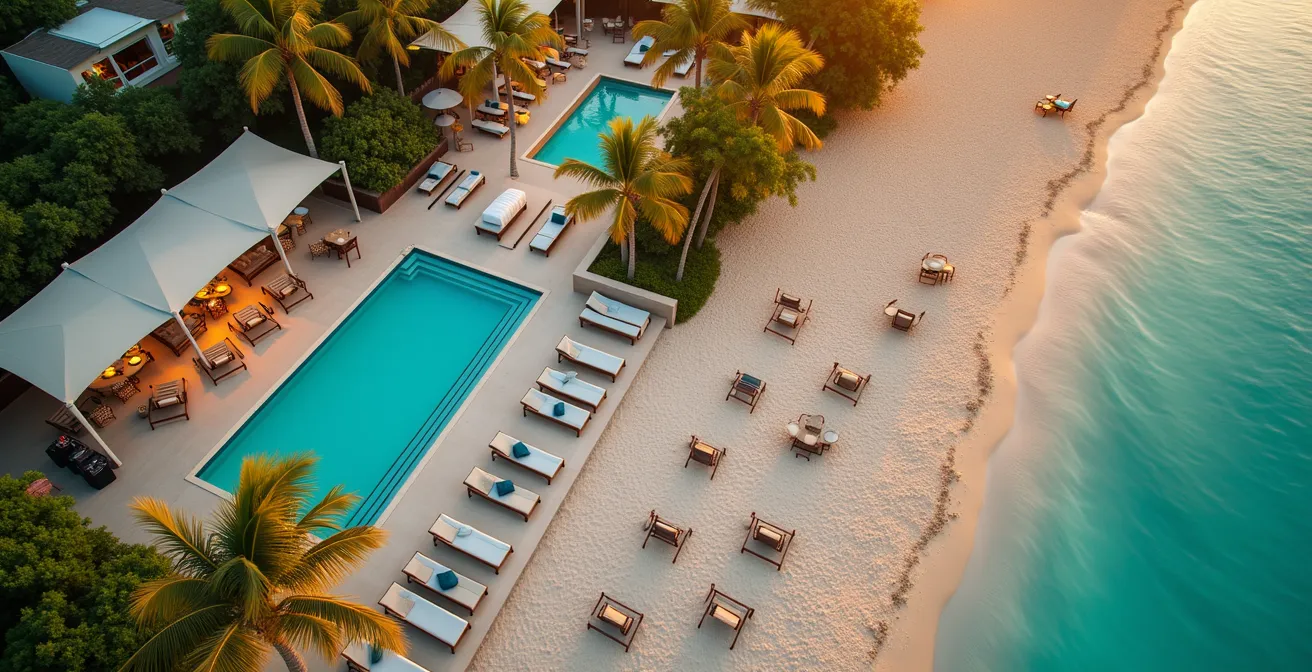
Clubs like DRIFT, with a “no kids allowed” rule and a design philosophy centered on a serene atmosphere, are naturally better choices for those prioritizing quiet. Their minimalist design and muted colors contribute to a feeling of calm. However, even in high-energy clubs, you can secure a quieter spot with strategic planning. This involves more than just showing up and hoping for the best. A proactive booking strategy is essential. When you call to reserve, you must be explicit about your needs. Use specific language like, “I’m booking for relaxation and require your quietest area, furthest from the speakers and main pool.”
Follow a clear script when making your reservation:
- Call Timing: Contact the club between 10-11 AM, when managers are often available but not yet in the lunch rush.
- Opening Phrase: “I’m looking to book for relaxation and would prefer your quietest available area.”
- Time Preference: “We prefer to arrive early. Which areas tend to stay quietest for the longest?”
- Confirmation: “Could you please add a note to our reservation for the host team regarding our preference for a quiet location?”
This small effort can significantly enhance your ability to monitor your sun exposure and overall well-being throughout the day.
The Hydration Mistake That Ruins 40% of Sunset Safaris
The desert environment, particularly during a sunset safari, presents a unique and often underestimated hydration challenge. With temperatures ranging from 30°C to 50°C in non-winter months, your body loses water at an accelerated rate through sweat and respiration. The critical mistake many tourists make is waiting until they feel thirsty to drink. Thirst is a delayed signal; by the time you feel it, you are already in a state of dehydration, which impairs cognitive function and physical performance, ruining the experience and posing a health risk.
The most common error is “reactive hydration”—drinking water only after activities like dune-bashing or upon arrival at the camp. The correct, clinical approach is proactive pre-hydration and disciplined consumption. You must begin hydrating well before the safari even starts and follow a strict protocol throughout the event. This ensures your body has the reserves to cope with the extreme conditions. Waiting to drink until you are sitting down for dinner is far too late; the deficit has already been established.
A medically sound rehydration protocol for a desert safari should be followed without deviation:
- Pre-Safari Loading: Drink at least 1 liter of water in the 60 minutes before your safari vehicle pickup.
- Immediate Replenishment: Upon arrival at the desert camp, immediately request and consume 500ml of water before any other beverage or food.
- Activity-Based Sipping: Keep a water bottle in your hand during all activities, including the sunset photo session, and sip continuously.
- Post-Dinner Diligence: For every alcoholic or caffeinated beverage consumed, match it with an equal volume of water to counteract their diuretic effects.
Ignoring this structured approach to hydration is one of the fastest ways to turn a magical desert experience into a medical emergency.
Why Drones Are Strictly Prohibited in the Reserve?
The strict prohibition of drones within Dubai’s desert conservation reserves is rooted in a dual mandate: protecting sensitive wildlife and safeguarding human privacy. From an ecological perspective, the noise and erratic movement of drones induce a significant stress response in wildlife. For protected species like the Arabian Oryx, this stress can disrupt feeding and breeding patterns, posing a direct threat to their survival. The “zero-tolerance” policy is a crucial conservation tool designed to maintain the natural tranquility these animals require.
Simultaneously, the ban addresses legitimate privacy concerns from visitors. Following incidents of misuse, the UAE implemented a highly structured regulatory framework for drone use. An official review of these rules highlights that the phased return of drones addresses concerns raised by community members about privacy, especially in recreational areas like desert camps. In a reserve, where guests expect a degree of seclusion and peace, the drone ban ensures this expectation is met. It prevents intrusive filming and photography, allowing visitors to immerse themselves in the experience without the feeling of being watched.
Therefore, the ban is not an arbitrary rule but a deliberate policy with two clear beneficiaries. It creates a sanctuary for both animals and humans, protecting the delicate ecological balance of the reserve while upholding the right to privacy for those who visit. Respecting this rule is a fundamental part of responsible tourism in the region.
By leaving your drone behind, you are actively participating in the conservation of this unique ecosystem and respecting the privacy of fellow travelers.
Key Takeaways
- In Dubai’s climate, ‘tanning’ is cellular damage. Your goal must shift from achieving a tan to mitigating sun-induced injury.
- Luxury is a tool for safety. Use AC cabanas, responsive service, and oversized towels as medical equipment, not just as perks.
- Proactive planning is non-negotiable. This includes pre-hydrating for excursions, strategically booking quiet zones, and assessing privacy measures before you arrive.
Nikki Beach or Drift: Which Club Justifies the $100 Entry Fee?
When choosing between two premier beach clubs like Nikki Beach and DRIFT, the decision for a health-conscious, pale-skinned tourist should transcend mere “vibe.” You must analyze their value proposition through a clinical lens: which venue offers a better return on investment for your health and safety? While both command a significant entry fee, their environments offer vastly different levels of protection.
Nikki Beach is known for its high-energy, social, party atmosphere. This translates to a crowded environment, particularly on weekends. For someone managing sun exposure, a dense crowd means less personal space, more reflective surfaces from surrounding people, and potentially stretched service during peak times. Its value lies in social networking, not serene protection. DRIFT, in contrast, cultivates an atmosphere of serene, adults-only refinement. Its commitment to a controlled capacity and consistently excellent service provides a more predictable and manageable environment. From a risk-management perspective, the calmer, more exclusive setting of DRIFT offers a superior “health ROI.”
| Factor | Nikki Beach | DRIFT | Winner for Value |
|---|---|---|---|
| Entry Fee (Weekend) | AED 300 non-redeemable | AED 250 non-redeemable | DRIFT |
| Atmosphere | High-energy, social, party vibe | Serene, refined, adults-only | Depends on preference |
| Crowd Density | Packed on weekends | Controlled capacity | DRIFT |
| Service Level | Good but stretched at peak | Consistently excellent | DRIFT |
| Social ROI | Maximum networking potential | Privacy and exclusivity | Nikki Beach |
Even the exit experience is a factor. According to a review, while Nikki Beach’s location at Pearl Jumeira may offer better taxi access during the 5-7 PM rush, the controlled, less-chaotic environment at DRIFT provides a less stressful conclusion to a day focused on recovery and relaxation.
To ensure your trip to Dubai is memorable for its luxury and not for a medical emergency, you must now re-evaluate your itinerary through the clinical lens of sun safety. Prioritize clubs and activities that offer verifiable protection, not just perceived prestige.