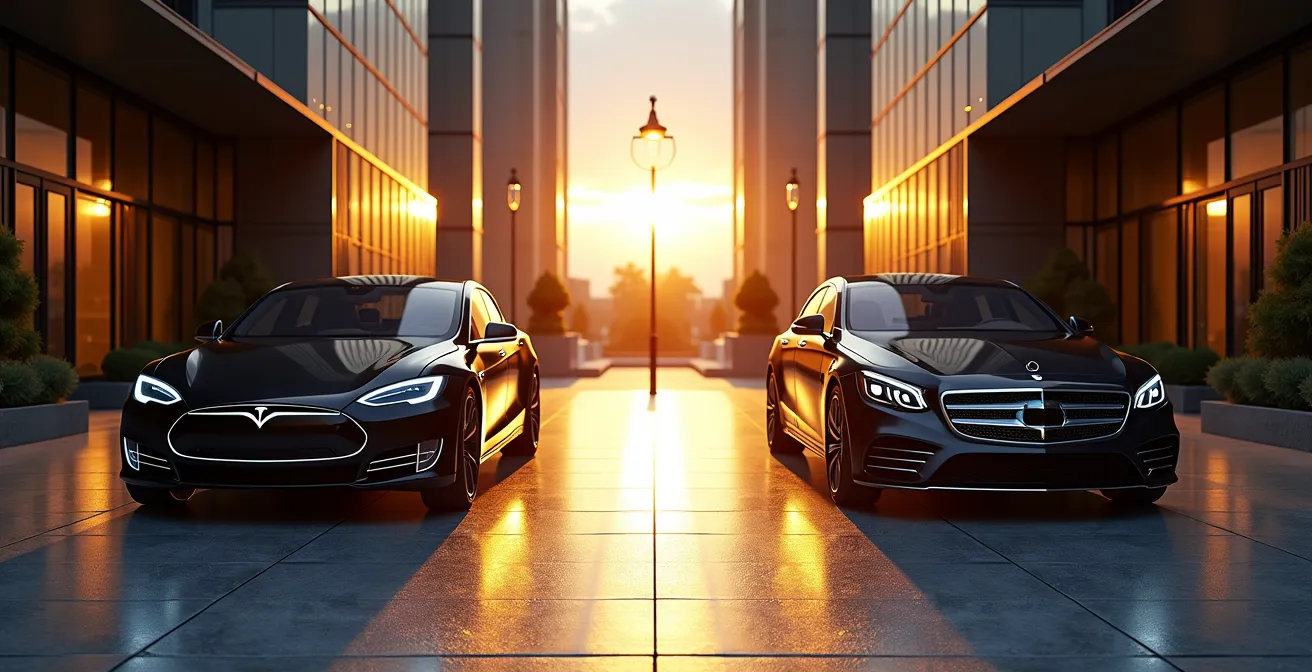
Your arrival vehicle is a strategic communication tool, not just transport. The choice between a traditional Uber Black and a Tesla actively shapes your professional brand before you even speak.
- Uber Black signals established, discreet, and reliable luxury, projecting an image of gravitas and control.
- A Tesla signals disruptive innovation, tech-forward thinking, and sustainability, but can be polarizing in conservative business contexts.
Recommendation: Align your vehicle choice with the specific brand narrative you want to project for each meeting. Assess whether your audience values tradition or disruption.
For the modern business executive, the moments leading up to a crucial meeting are a calculated sequence. Every detail matters, yet one of the most significant is often treated as a logistical afterthought: the arrival. You might think the choice between a pre-booked Uber Black and a readily available Tesla is merely about convenience or cost. This is the first mistake. The common wisdom is to simply pick the “nicer” or “faster” option, focusing on basic comfort and punctuality. But this view misses the bigger picture.
The vehicle you step out of is the first line of your business pitch. It’s a powerful act of non-verbal communication, a piece of brand semiotics that frames the entire interaction to follow. In a world where perception is reality, are you signaling the quiet confidence of established power or the bold statement of a disruptive innovator? The debate isn’t about leather seats versus electric motors; it’s about the narrative you want to control. A significant portion of business travelers already lean into this, as over 50% of active Uber for Business riders opt for premium trips, understanding that the small premium pays dividends in perception.
But what if the true key to a high-status arrival isn’t just about choosing a premium service, but about understanding the precise message each type of premium vehicle sends? This guide moves beyond the surface-level comparison. We will dissect the brand signals of Uber Black’s traditional luxury fleet versus the forward-thinking (and sometimes polarizing) statement of a Tesla. We will explore how to manage expectations, project unwavering reliability, and ultimately, weaponize your arrival to make the exact impression you intend.
This article provides a complete framework for making a strategic transportation choice. By exploring the nuances of service, brand perception, and reliability, you will learn to master your arrival narrative and ensure your first impression is as powerful and deliberate as your business strategy itself.
Summary: The Strategic Executive’s Guide to Arrival Status
- Pre-booked Limo vs Airport Queue: Is the Time Saving Real?
- Uber Chopper: Is It a Gimmick or a Viable Commute to Yas Island?
- Renting a Ferrari with Driver: Can You Actually Drive It?
- English Proficiency: What to Expect from VIP Chauffeurs?
- Pink Taxi vs Standard Taxi: Is It Safer or Just a Color?
- Land Cruiser vs G-Wagon: Which Vehicle Suits Your Back Pain Best?
- What Happens if Fog Rolls in After You’ve Driven to the Site?
- How to Rent a Luxury Yacht in Dubai Without Hidden Cleaning Fees?
Pre-booked Limo vs Airport Queue: Is the Time Saving Real?
The first signal of status is not extravagance, but control. An executive who appears flustered after a frantic search for a ride at the airport has already lost the first battle of perception. The debate between a pre-booked premium service like Uber Black Reserve and hailing a car from the airport queue transcends mere time savings. It’s about eliminating variables and projecting an aura of seamless efficiency. While the airport queue might occasionally be faster, it introduces uncertainty: surge pricing, vehicle quality variance, and the cognitive load of navigating a crowded pickup zone. This is a gamble a high-stakes professional cannot afford.
A pre-booked vehicle establishes a narrative of foresight. It communicates that your time is too valuable to be left to chance. With features like locked-in advance pricing and a generous grace period for delays, the service is engineered to absorb travel friction. This contrasts sharply with the standard ride-share experience, where a five-minute delay can result in a cancellation fee and a renewed scramble for a ride. The real value isn’t measured in minutes saved, but in the mental bandwidth preserved for the meeting ahead.
The difference in service levels further reinforces this status signal. A premium booking often grants access to priority pickup locations, such as curbside access at LAX, bypassing the chaotic shuttles required for standard services. This isn’t just a convenience; it’s a visible demonstration of a higher tier of service, a subtle but clear signal to any observing party. The following comparison highlights how the pre-booked experience is fundamentally about risk mitigation and control, the true currencies of the executive world.
| Feature | Pre-booked Limo/Uber Black Reserve | Airport Queue (UberX/Taxi) |
|---|---|---|
| Wait Time | 15 minutes grace period | 5 minutes before cancellation fee |
| Pickup Location | Curbside at LAX (premium privilege) | LAX-it shuttle required |
| Driver Rating Requirement | 4.85+ minimum | No minimum requirement |
| Customer Support | 24/7 phone support priority access | In-app support only |
| Price Predictability | Locked-in advance pricing | Subject to surge pricing |
Ultimately, opting for a pre-booked service is a statement. It says you anticipate challenges and proactively manage them, a trait you want associated with your professional brand long before you step into the boardroom.
Uber Chopper: Is It a Gimmick or a Viable Commute to Yas Island?
Status signaling exists on a spectrum. At one end lies quiet luxury; at the other, overt spectacle. Services like Uber Chopper, offering helicopter transit to destinations like Yas Island, represent the pinnacle of spectacle. It’s an arrival that is impossible to ignore, a grand gesture designed to generate buzz and make an unforgettable statement. For certain industries—entertainment, high-fashion, or a product launch aimed at creating viral momentum—this level of ostentation can be a powerful tool. It screams “no expense spared” and positions the passenger as a major player.
However, for the majority of corporate contexts, this approach carries significant risk. It can be perceived as a gimmick, a display of new money that lacks the subtlety and gravitas of established success. A helicopter arrival, while impressive, can alienate a conservative client or partner, suggesting a focus on flash over substance. The central mission of Uber’s premium ground services, by contrast, is to refine the existing model. As the company itself states, “Uber Business Black reimagines the traditional black car experience, combining the luxury of premium car services with the flexibility, familiarity, and ease of Uber.” This is about elevating a familiar process, not replacing it with a theatrical performance.
The strategic executive must therefore weigh the arrival narrative they wish to create. Is the goal to be the center of attention, or to command respect through discretion? The image below captures this dichotomy: the loud, public statement of a helipad versus the silent, private confidence of a sleek sedan. The choice between them defines your understanding of what true status means.

As the visual suggests, the more powerful statement is often the quieter one. While a helicopter delivers you to a location, a premium sedan delivers you with an aura of composed authority. It’s the difference between arriving with a bang and arriving with purpose.
Unless your business is show business, the most potent status signal is often one of understated excellence. A viable commute is one that enhances your professional standing, and more often than not, that means keeping your feet—and your reputation—firmly on the ground.
Renting a Ferrari with Driver: Can You Actually Drive It?
The question isn’t just whether you *can* drive the rented Ferrari—in most chauffeur services, the answer is a clear “no”—but what arriving in one *says* about you. A high-performance sports car like a Ferrari or a Lamborghini communicates ambition, aggression, and a taste for the finer things. It’s an unapologetic display of success. In a similar vein, the rise of Tesla within premium fleets like Uber Black introduces a new kind of performance-oriented status. It’s less about traditional horsepower and more about forward-thinking “wow factor.”
A Tesla, particularly a Model S, is often perceived as a car of the future, a signal of innovation and tech-savviness. One driver’s experience using a Tesla for Uber Black, detailed in an analysis of the vehicle’s “wow factor,” revealed passengers frequently call it their “dream car.” It projects an image of being ahead of the curve, associating the passenger with progress and environmental consciousness. This is a departure from the traditional luxury narrative of a Mercedes S-Class, which speaks more to established wealth and heritage.
Case Study: The Tesla “Wow Factor” in Premium Service
A rideshare driver using a Tesla Model S for Uber Black found that passengers consistently perceived it as a high-end luxury vehicle that created a memorable experience. The vehicle’s inclusion in the Uber Black category, combined with its silent operation and futuristic interior, allowed it to signal innovation rather than just wealth. Economically, the driver noted significant gas savings over traditional luxury sedans, but the key takeaway was the passenger reaction: the Tesla was seen as aspirational and forward-thinking, demonstrating how a brand can build a unique form of status not tied to old-world luxury.
Choosing a Tesla is a calculated impression. It positions you not as someone who has simply “made it,” but as someone who is shaping what comes next. However, this choice is not without its own nuances. While it can impress a tech startup or a venture capital firm, it might be seen as too casual or trendy for a meeting with a centuries-old financial institution. The status conveyed by performance—whether the roaring engine of a Ferrari or the silent torque of a Tesla—must be calibrated to the audience.
The ultimate power move is not just arriving in an impressive car, but arriving in the *right* impressive car for the context, demonstrating a deep understanding of brand semiotics.
English Proficiency: What to Expect from VIP Chauffeurs?
The vehicle is only half of the equation. A truly premium arrival experience is defined by the human element. The professionalism, discretion, and service quality of the chauffeur are a direct reflection of the passenger’s own standards. In a VIP service like Uber Black, the focus extends far beyond mere transportation; it’s about curating a controlled, stress-free environment from door to door. This is where expectations for a VIP chauffeur become critically important, with clear communication being paramount.
While English proficiency is a baseline expectation, the true measure of a VIP chauffeur lies in their ability to understand and execute on nuance. This is enforced through rigorous standards. For instance, drivers in premium services must maintain an exceptionally high rating and adhere to commercial regulations, ensuring a consistent level of professionalism. The service is designed to be an extension of your own executive function, anticipating needs before they arise. Riders can pre-set preferences for temperature and even conversation level, transforming the vehicle into a mobile sanctuary tailored to their needs.
This level of service is not a luxury; it’s a strategic tool. A chauffeur who seamlessly handles luggage, navigates traffic with calm precision, and communicates clearly and concisely reinforces the passenger’s own image of competence and control. It removes potential points of friction, allowing the executive to remain focused on the business at hand. The following checklist outlines the baseline standards that differentiate a mere driver from a true VIP chauffeur.
Your Action Plan: Vetting the VIP Chauffeur Experience
- Performance Metrics: Verify that the service requires drivers to maintain a high minimum rating (e.g., 4.85-stars or above) based on a significant number of recent trips.
- Regulatory Compliance: Confirm that all drivers operate with full commercial insurance and meet all local and state livery regulations, ensuring legitimacy and safety.
- Service Guarantees: Look for services that include courtesies like luggage assistance and a guaranteed wait time (e.g., 15 minutes), which signal a client-first approach.
- Personalization Options: Check for in-app features that allow you to set preferences for the in-car environment, such as temperature and a ‘quiet mode’ for conversation.
- Punctuality Protection: Prioritize services that offer on-time pickup protection, providing compensation or credit if a driver is even marginally late, demonstrating a commitment to your schedule.
Ultimately, the chauffeur is your ambassador. Their professionalism doesn’t just make for a pleasant ride; it reinforces the high standards you set for yourself and your business.
Pink Taxi vs Standard Taxi: Is It Safer or Just a Color?
While a “Pink Taxi” service is often marketed toward safety for women, the underlying principle is universal for the business executive: the appearance of your vehicle sends an immediate, powerful message. Color, brand, and model are not neutral details; they are loaded with cultural and social connotations. Choosing the wrong vehicle can create a “perception delta”—a gap between the image you intend to project and the one your audience receives. This is where the choice between a traditional luxury brand and a disruptor like Tesla becomes a high-stakes decision.
A traditional black car—a Mercedes, BMW, or Cadillac—is a globally understood symbol of established success, discretion, and seriousness. It’s a conservative, safe choice that is unlikely to be misinterpreted. A Tesla, on the other hand, signals something entirely different: innovation, tech-forward thinking, and a modern approach to business. While this can be a powerful positive signal, it can also be polarizing.
Case Study: The “Red Tesla” Incident and Brand Polarization
A viral incident highlighted this very issue when a podcast host, expecting a classic black luxury car for her Uber Black ride, complained about receiving a red Tesla. The backlash was swift, with some riders demanding a “no Tesla” option and associating the brand with specific political or cultural leanings. This case vividly demonstrates how a vehicle choice can backfire. The Tesla, intended as a premium, modern option, was perceived by some as unprofessional or misaligned with the “black car” promise. It underscores a crucial lesson: your brand signal is only as effective as your audience’s interpretation of it.
This is the core of brand semiotics. Every design element of a car, from its silhouette to its door handle, tells a story. Is it a story of timeless chrome and leather, or one of flush-mounted sensors and carbon fiber? The executive’s task is to ensure the story of their arrival aligns with the story of their business.
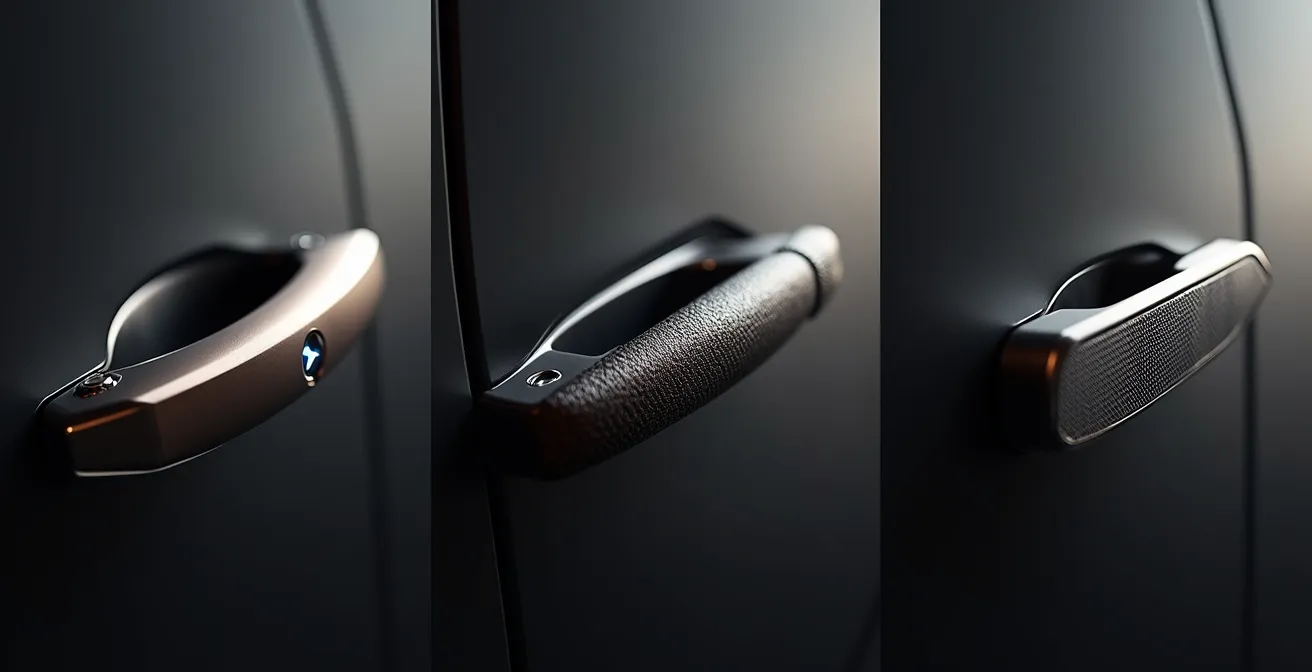
Just as a pink taxi is more than just a color, your choice of an Uber Black is more than just a car. It’s a conscious branding decision that can either reinforce or undermine your first impression. You cannot request a specific car model on most platforms, but you are choosing a category, and with it, a set of potential brand signals.
The safest bet is not just about physical security, but about reputational security. Choose the brand narrative that leaves the least room for negative interpretation in the eyes of the person you aim to impress.
Land Cruiser vs G-Wagon: Which Vehicle Suits Your Back Pain Best?
The choice between different vehicle types within the premium category—specifically a large, imposing SUV versus a sleek electric sedan—is a masterclass in status signaling. While comfort and features like suspension are practical considerations, the strategic choice is about the message. A vehicle like a G-Wagon or a Cadillac Escalade projects dominance, security, and traditional power. It’s a fortress on wheels, communicating that the passenger is important, protected, and commands a significant presence. This is the automotive equivalent of a corner office with a view.
An electric sedan, primarily represented by Tesla in the current market, offers a contrasting narrative. As industry analysis confirms, the Tesla Model Y and Model S qualify for Uber Black, placing them directly in competition with traditional luxury vehicles. However, their status signal is entirely different. A Tesla projects innovation, sustainability, and a tech-forward mindset. It suggests the passenger is not just successful in the old-world sense, but is also shaping the future. It’s less about commanding a room and more about inventing a new one.
The decision between these two archetypes should be a deliberate one, tailored to the business context. Meeting with a conservative banking institution might call for the gravitas of a large SUV, while a pitch to a Silicon Valley incubator would be better served by the innovative image of an electric sedan. The table below breaks down these contrasting signals.
| Aspect | Large SUV (G-Wagon/Escalade) | Electric Sedan (Tesla Model S) |
|---|---|---|
| Passenger Capacity | Up to 6-7 passengers | Up to 5 passengers |
| Luggage Space | Extended cargo area | Ample front + rear trunk space |
| Ride Quality | Commanding road presence, insulated cabin | Silent operation, instant acceleration |
| Status Signal | Dominance, security, traditional power | Innovation, sustainability, tech-forward |
| Typical Service | Uber Black SUV | Uber Black / Comfort Electric |
The most sophisticated executive doesn’t have a single “go-to” vehicle type; they have a portfolio of arrival narratives and deploy the one that best serves their strategic objective for that specific encounter.
What Happens if Fog Rolls in After You’ve Driven to the Site?
The ultimate signal of high status is not wealth, but unwavering reliability. Anyone can rent a fancy car. True power lies in the ability to command a service that is dependable even when circumstances are not. Unexpected events—a sudden downpour, a traffic jam, or even thick fog rolling in—are the true tests of a transportation service. An executive whose plans are derailed by a minor inconvenience projects an image of fragility. One who proceeds unfazed projects an image of absolute control.
This is where the stringent requirements of premium services become a critical asset. A key reason for their reliability is the quality of the chauffeurs. For example, Uber Black drivers must maintain a near-perfect 4.85+ rating based on their last 500 trips. This isn’t just a number; it’s a proxy for experience, professionalism, and the ability to handle unexpected situations with calm competence. A seasoned professional chauffeur has navigated these challenges before and can adapt, ensuring you arrive at your destination safely and on time.
Furthermore, the service itself is built with flexibility in mind. The extended wait times and understanding of fluctuating business schedules are part of this. As one industry analysis notes, this flexibility is a core feature.
Whether your business meetings run long or your time at baggage claim takes longer than expected, Uber Black can help you avoid cancellation fees
– Ridester Analysis, What Is Uber Black? Car List, Pricing, & More
This built-in buffer against the unexpected is invaluable. It means your transportation is a reliable partner, not another variable you have to manage. When the fog rolls in, a standard taxi driver might cancel or get lost. A VIP chauffeur, backed by a premium service, is your guarantee of continuity. They know the alternate routes and have the professional composure to see the job through.
In the end, arriving on time despite the fog is a more powerful statement than arriving in a sports car on a sunny day. It demonstrates that your operations, and by extension your business, are resilient and impervious to chaos.
Key Takeaways
- Your arrival vehicle is a critical part of your professional branding, sending clear signals about your status and intent.
- Traditional luxury vehicles (Uber Black) project established power and discretion, while modern electric cars (Tesla) signal innovation and a forward-thinking mindset.
- The most important status signal is control and reliability; a premium, pre-booked service eliminates variables and projects an image of seamless efficiency.
How to Rent a Luxury Yacht in Dubai Without Hidden Cleaning Fees?
The logic of selecting an executive vehicle mirrors that of chartering a high-end asset like a luxury yacht: the primary goal is to eliminate “hidden fees,” both financial and reputational. When chartering a yacht, the sticker price is only part of the story; ancillary costs, crew professionalism, and the condition of the vessel all contribute to the true value. Similarly, with executive transport, the fare is secondary to the overall impression. A cheaper ride that results in a tarnished first impression is an unforgivably expensive mistake.
The launch of dedicated services like Uber Business Black in 2024 was a direct response to this need for corporate-level transparency and reliability. As highlighted in a report on its introduction, the service was designed to offer transparent, all-inclusive pricing and on-time pickup protection. This structure is intended to prevent the “reputational hidden fees” that come from an inappropriate vehicle choice or a service failure before a critical meeting. Choosing a G-Class or a Rivian from a trusted platform is not about the car itself, but about buying certainty—the certainty of quality, punctuality, and a specific brand message.
This is the ultimate evolution of status. It moves beyond simple luxury to strategic assurance. You are not just paying for a ride; you are investing in a predictable outcome. You are ensuring there will be no surprise “cleaning fees” on your reputation due to a late arrival, a flustered driver, or a vehicle that sends the wrong signal. Whether it’s a Tesla or a traditional sedan, the choice must be made through the lens of a risk manager. Which option provides the greatest certainty of achieving the desired perceptual outcome?
Therefore, approach your next booking not as a simple transport request, but as a strategic investment in your personal brand. Analyze the context, define your desired narrative, and select the service that guarantees your arrival is as flawless and impactful as your business pitch.