
An Emirati BBQ dinner is less a random buffet and more a structured culinary narrative. The true experience goes far beyond generic grills to embrace a story of hospitality told through specific rituals. Real value lies in understanding these acts—like pre-meal Gahwa for trust and the luqma hand-eating technique for respect—and learning to identify the sensory markers of authenticity, from the aroma of real saffron to the texture of perfectly-fried Luqaimat.
The image of a desert BBQ dinner is often reduced to a simple, satisfying cliché: sizzling chicken tikka, generic kebabs, and a vast buffet under the stars. For many visitors, it’s a pleasant but predictable part of the desert safari package. This perception, however, misses the point entirely. It views the meal as a mere collection of dishes when it is, in fact, a carefully orchestrated performance of culture, hospitality, and history. The standard international fare often serves as a comforting backdrop, but the soul of the experience lies in the details that are uniquely Emirati.
To truly appreciate this meal, one must look beyond the main course. It begins with the seemingly simple cup of coffee offered upon arrival and extends to the subtle etiquette of sharing food. The real questions for a discerning foodie are not about what is on the grill, but why things are done in a specific order. Why is the coffee bitter and served in a tiny cup? What distinguishes the two main desserts that look so different? And how, in the desert’s warmth, do the salads retain their crispness?
This guide peels back the layers of the typical desert buffet. We will deconstruct the culinary narrative of an Emirati BBQ, transforming you from a passive diner into an active participant who understands the meaning behind each taste and gesture. We will explore the vegetarian-friendly foundations of the mezze, the profound symbolism of eating with the right hand, and the logistical artistry required to serve fresh food in the middle of the dunes. Forget what you think you know about desert dining; we’re here to discover its authentic heart.
This article breaks down the essential components of the Emirati dining experience, from understanding cultural rituals to identifying authentic local flavors. Explore the detailed sections below to become an expert on what truly constitutes a Dubai desert dinner.
Summary: Decoding the Emirati Desert Dinner Experience
- Surviving a Desert BBQ as a Vegetarian: What Can You Actually Eat?
- Eating with Hands: The Right Hand Rule You Must Follow
- Why Arabic Coffee (Gahwa) Is Served Before the Meal?
- Luqaimat vs Umm Ali: Which Desert Dessert Should You Save Room For?
- How Camps Keep Salads Fresh in 35-Degree Evenings?
- Shawarma vs Manakish: Which is the Ultimate Late-Night Dubai Snack?
- Saffron Scams: How to Tell Real Saffron from Dyed Corn Silk?
- Is There Such a Thing as ‘Dubai Cuisine’ or Is It Just Fusion?
Surviving a Desert BBQ as a Vegetarian: What Can You Actually Eat?
The term “BBQ” can strike fear into the heart of any vegetarian, conjuring images of a carnivore’s feast with few alternatives. However, an Emirati BBQ is structurally designed around a rich foundation of vegetarian dishes. The heart of the meal isn’t the grill, but the expansive cold and hot mezze spreads. These are not side dishes; they are a course in their own right, deeply rooted in Levantine and Middle Eastern culinary traditions. Staples like Homs (hummus), Mutabbal, and Baba Ghanoush are naturally plant-based, offering creamy, smoky flavors from chickpeas and aubergines. Fresh, vibrant salads like Tabbouleh (parsley and bulgur) and Fatoush (mixed greens with fried bread) provide texture and acidity.
This emphasis on plant-based starters reflects a growing trend. In the wider UAE foodservice landscape, the demand for vegetarian options is not just an afterthought. Market research confirms that plant-based dining options have increased by 19% CAGR through 2024, pushing tour operators to offer more than just grilled meat. While the buffet will always feature staples, true variety can often be found by simply asking. Many camps can prepare grilled halloumi cheese or dedicated vegetable skewers upon request, even if they are not on public display. The key is proactive communication.
Navigating the buffet requires a strategic eye. First, load up on the guaranteed-vegetarian mezze. When approaching the hot section, it is wise to ask staff if the rice has been cooked in chicken or vegetable stock, a common pitfall. The real secret weapon for a vegetarian is to call the tour operator 24 hours in advance. A simple request can often unlock off-menu dishes like Shorbat Adas (lentil soup) or Foul Medames (fava bean stew), transforming a potentially limited meal into a fulfilling feast. The options are almost always there; you just need to know how to find them.
Eating with Hands: The Right Hand Rule You Must Follow
The directive to “eat with your right hand” is common advice for travelers in the Middle East, but it’s often presented without its crucial context, reducing a profound cultural practice to a simple rule of hygiene. The tradition is not merely about avoiding the “unclean” left hand; it’s an act of respect for the food, a display of fellowship with your dining companions, and a technique refined over centuries for sensory engagement. The left hand is reserved for passing large platters or holding a drink, but the right hand is the sole instrument for bringing food to your mouth.
True mastery of this custom involves learning the traditional Bedouin three-finger technique, known as luqma. This is not a messy grab, but an elegant and efficient method of eating. The process involves using the thumb, index, and middle finger to gather a small portion of rice and meat from the communal platter in front of you. You then gently use your fingers to form a compact, cohesive ball (the luqma), which is then delicately popped into your mouth using your thumb. This technique prevents your palm from getting dirty and ensures each bite is a perfect, self-contained morsel. Reaching across the platter is considered poor form; the principle is to eat from the portion directly in front of you.
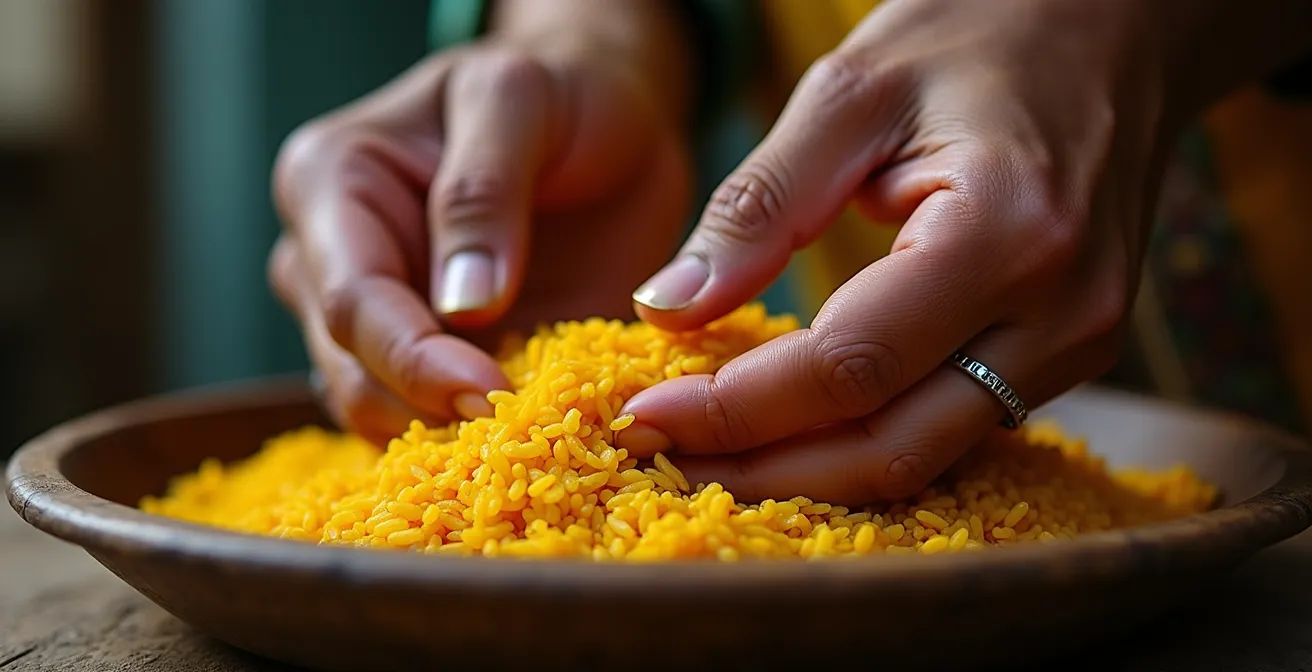
As detailed in cultural experiences at camps like Al Khayma, this practice has deep roots. It is both a practical way to eat from shared dishes and a sign of religious piety. Engaging in this practice, even imperfectly, is a powerful non-verbal signal of respect. It shows you are not just a tourist consuming a meal, but a guest participating in a shared tradition. As their guides often explain, the traditional method shows respect for both the food and fellow diners, elevating the act of eating from simple sustenance to a communal ritual.
Why Arabic Coffee (Gahwa) Is Served Before the Meal?
Before any food appears, your Emirati host will offer you Gahwa, or Arabic coffee. To the uninitiated, this can seem puzzling. The coffee is light-colored, has a distinctively spiced and slightly bitter taste from cardamom and saffron, and is served in a tiny, handleless cup called a finjan that is only ever filled halfway. This is not a pre-dinner caffeine boost; it is the opening act of the hospitality ritual. Serving Gahwa is an ancient Bedouin tradition symbolizing welcome, trust, and generosity. By accepting the coffee, you are accepting the host’s hospitality.
The server, or muqahwi, will continue to pour refills until you signal you are finished. The signal is not verbal; you must gently shake the empty finjan from side to side. Simply placing the cup down will only result in another serving. The half-full pour is also intentional. A full cup would imply the host wants you to drink quickly and leave, whereas a small pour encourages a longer, more relaxed interaction and ensures the coffee doesn’t get cold. It’s a gesture that says, “stay a while.”
The contrast with Western coffee culture is stark, where coffee is typically a finale to a meal or a functional beverage. Gahwa is ceremonial. A comparison of desert hospitality norms clearly shows that its purpose is entirely different from that of regular coffee. It is always served with dates, whose natural sweetness perfectly balances the coffee’s bitterness, creating a harmonious and symbolic pairing that has welcomed travelers in the desert for centuries.
| Aspect | Gahwa (Arabic Coffee) | Regular Coffee |
|---|---|---|
| Serving Size | Small finjan cup, half-filled | Full cup or mug |
| Purpose | Hospitality ritual & trust building | Caffeine boost & enjoyment |
| Roast Level | Light roast with cardamom | Medium to dark roast |
| When Served | Before any meal or business | With or after meals |
| Refill Protocol | Continuous until cup is shaken | Upon request |
Luqaimat vs Umm Ali: Which Desert Dessert Should You Save Room For?
As the savory courses wind down, the dessert station presents a critical choice, often between two iconic but wildly different Emirati sweets: Luqaimat and Umm Ali. This is not just a matter of taste but of texture, history, and timing. Choosing correctly requires understanding the essence of each dessert. Luqaimat are the sprinters of the dessert world: small, golden-fried dumplings, brilliantly crispy on the outside and astonishingly light and airy within. They are best eaten immediately after being lifted from the hot oil, drenched in sticky date syrup (dibs), and sprinkled with sesame seeds. A good luqaimat should offer a satisfying crunch followed by an almost-hollow interior.
Umm Ali, on the other hand, is a marathon runner. Its name translates to “Ali’s Mother,” and it is a rich, comforting bread pudding. It’s made from torn pastry or bread soaked in a sweet milk mixture, studded with pistachios, almonds, and sometimes raisins or coconut flakes, then baked until the top is golden brown and bubbling. Unlike the instant gratification of Luqaimat, Umm Ali is a dish to be savored slowly. It should be creamy but not soggy, with the pastry layers still offering some textural integrity beneath the rich, fragrant cream. It holds its heat and quality well, making it a more forgiving choice if there’s a wait before dessert is served.
So, which should you choose? A connoisseur’s approach depends on the situation. If you can get to the Luqaimat station the moment a fresh batch is ready, prioritize it. The fleeting perfection of its crispy-airy texture is an experience not to be missed. Look for authentic date syrup rather than a simple sugar glaze. If the dessert has been sitting for a while or you prefer a richer, more substantial sweet, Umm Ali is the superior choice. Verify that it contains visible nuts and real cream for an authentic taste. Ultimately, the choice between the immediate, crispy joy of Luqaimat and the deep, creamy comfort of Umm Ali is a delightful dilemma.
How Camps Keep Salads Fresh in 35-Degree Evenings?
The presence of a crisp, vibrant salad bar in the middle of a desert where evening temperatures can linger at 35°C (95°F) seems like a minor miracle. It is, however, not magic but a feat of sophisticated logistics and culinary science. The secret to fresh salads in the desert is a meticulously managed “cold chain” operation that begins long before the guests arrive. Camps do not prepare these salads from scratch on-site in the heat. Instead, the process is centralized in city-based kitchens.
The journey of a desert salad begins with pre-chilling and pre-cutting ingredients in a temperature-controlled environment. These components are then transported to the desert in refrigerated vehicles, a trip that typically takes 45 to 60 minutes. Once at the camp, they are moved into dedicated “finishing kitchens,” which are often cooler, shaded tents. Here, the final assembly of the salads happens only moments before the buffet is scheduled to open, minimizing their exposure to the ambient heat. This just-in-time approach is critical for maintaining freshness and a crisp texture.
Case Study: Desert Camp Cold Chain Logistics System
As detailed by insiders at Dubai desert camps, the system relies on both technology and smart ingredient selection. The journey from refrigerated vehicles to finishing tents is the final, crucial step. But equally important is the choice of vegetables. Camps strategically favor robust ingredients like cucumbers, tomatoes, and bell peppers, which hold their structure and moisture far better in the heat than delicate lettuces. Furthermore, the dressings are often high-acidity, using lemon juice and sumac or za’atar, which not only provide a refreshing taste but also act as natural preservatives, helping to keep the vegetables crisp, as explained in reports on BBQ operations in the Dubai desert.
This combination of a carefully controlled cold chain, just-in-time assembly, and intelligent ingredient selection is the unseen artistry behind that surprisingly refreshing bite of salad. It’s a testament to the modern ingenuity that underpins the seemingly traditional desert safari experience, ensuring quality and food safety even in the most challenging of environments.
Shawarma vs Manakish: Which is the Ultimate Late-Night Dubai Snack?
While the desert BBQ is a curated event, Dubai’s true culinary pulse can be felt in its late-night street food scene. After a safari, the conversation often turns to grabbing a “real” local snack, and the debate inevitably narrows down to two titans: Shawarma and Manakish. Choosing between them depends entirely on the experience you seek. Shawarma is the ultimate walking food, designed for speed and convenience. It’s a flavor-packed wrap of thinly sliced meat (chicken or lamb) shaved from a vertical rotisserie, packed into a soft flatbread with pickles, fries, and a generous slather of garlic sauce (toum). The quality of a shawarma joint is judged by its visible rotisserie and, most importantly, the freshness and potency of its toum.
Manakish, by contrast, is a social, sit-down affair. It is a Levantine flatbread, often described as an “Arabic pizza,” traditionally topped with a mix of thyme, sesame seeds, and olive oil (za’atar) or salty akkawi cheese. It is baked in a brick or dome oven and served hot, usually cut into slices for sharing. Manakish is not a grab-and-go item; it’s a centerpiece for a relaxed, post-evening debrief with friends. Its quality is determined by the presence of a proper oven and the fragrance of fresh za’atar. As research on Dubai’s dining habits reveals, for nearly half the population, the choice is driven by the specific culinary experience they desire, with 49% of people in Dubai considering the type of cuisine the most important factor in their decision.
The following table breaks down the key differences for any foodie trying to make that critical late-night choice. It’s a showdown between the swift convenience of Shawarma and the shared, relaxed experience of Manakish.
| Factor | Shawarma | Manakish |
|---|---|---|
| Best Neighborhoods | Satwa, Al Karama | Jumeirah, Downtown |
| Eating Style | Walking food, handheld | Sit-down, shared plates |
| Price Range (AED) | 5-15 | 10-25 |
| Authenticity Test | Vertical rotisserie visible | Brick/dome oven present |
| Key Quality Indicator | Fresh garlic sauce (toum) | Fresh za’atar, akkawi cheese |
| Post-Safari Convenience | Quick grab-and-go | Relaxed social experience |
Saffron Scams: How to Tell Real Saffron from Dyed Corn Silk?
Saffron, the “red gold,” is a defining flavor in Emirati cuisine, lending its unique aroma, vibrant color, and subtle metallic notes to everything from rice to Gahwa. However, its high price makes it a prime target for counterfeiters. In the bustling Dubai souks, tourists are often duped into buying fake saffron, which is typically nothing more than dyed corn silk, safflower threads, or even shredded paper. For a foodie, telling the difference is an essential skill. Fortunately, you don’t need a lab; you just need your senses and a cup of water.
The most reliable method is the cold water test. Real saffron threads release their color slowly, infusing the water with a beautiful, consistent golden-yellow hue over 10-15 minutes. The threads themselves will retain their red color. Fakes, on the other hand, bleed color instantly, turning the water a harsh red or orange, and the threads often lose their color entirely. This immediate color bleed is a dead giveaway that you’re dealing with a simple dye.
Beyond color, scent and touch provide further clues. Crush a single thread between your fingers; authentic saffron has a complex, unmistakable aroma often described as a mix of honey, hay, and a slight metallic tang. Fakes will smell of chemicals or nothing at all. If you rub a wet thread between your fingers, real saffron will remain intact while coloring your skin yellow-orange. Fake threads often feel slimy and can disintegrate under pressure. Finally, trust the price. Authentic, high-quality saffron is expensive for a reason. Any “bargain” offering saffron for significantly less than 20-50 AED per gram is almost certainly a scam, especially if it’s pre-ground, which is the easiest form to adulterate.
Your Action Plan: 4 Quick Tests to Verify Real Saffron in Dubai Souks
- The Cold Water Test: Place 2-3 threads in cold water and wait 10-15 minutes. Real saffron releases a golden-yellow color slowly, while fakes bleed a harsh red or orange instantly.
- The Touch Test: Rub a wet thread between your fingers. Genuine saffron stays intact and dyes your skin yellow/orange; fakes often disintegrate or feel slimy.
- The Scent Test: Crush one thread. Authentic saffron emits a complex honey-hay aroma with metallic notes, whereas fakes smell chemical or are odorless.
- The Price Check: Be wary of bargains. Real saffron costs a minimum of 20-50 AED per gram. Anything cheaper, especially if pre-ground, is highly suspect.
Key takeaways
- The Emirati BBQ is a ‘culinary narrative’ with distinct acts: welcome, mezze, main, and dessert, not just a random buffet.
- Authenticity lies in the details: the light roast of Gahwa, the three-finger luqma technique, and the distinct textures of fresh Luqaimat versus creamy Umm Ali.
- ‘Dubai Cuisine’ is a real concept, defined by the sophisticated fusion that reflects the city’s global identity, rather than just traditional Bedouin food.
Is There Such a Thing as ‘Dubai Cuisine’ or Is It Just Fusion?
A common critique leveled against Dubai’s food scene is that it lacks a singular identity, that there is no “Dubai Cuisine” but rather a vast, imported collection of global foods. While the city boasts over 200 nationalities and a staggering variety of restaurants, this view mistakes breadth for a lack of depth. “Dubai Cuisine” does exist, but it is not a static set of ancient recipes. Instead, it is a dynamic, hyper-modern, and sophisticated form of fusion. This identity is born directly from the city’s status as a global crossroads, a place where culinary traditions meet, mingle, and are reinvented.
While traditional Emirati restaurants diligently preserve heritage dishes like Machboos (spiced rice and meat) and Harees (wheat and meat porridge), the true modern culinary character of the city is found in this innovative fusion. According to a 2024 gastronomy report, a key marker of Dubai’s identity is the high satisfaction with its innovative offerings, demonstrating how 61% of diners express satisfaction in fusion and innovation. The desert safari BBQ is a perfect microcosm of this. The experience seamlessly blends distinctly Emirati rituals of hospitality, like serving Gahwa, with a menu that is itself a fusion: Levantine mezze starters, South Asian-inspired grills like chicken tikka, and classic Emirati desserts.
This is not a confused identity; it is the identity. Dubai Cuisine is the story of a port city, a place where the best ingredients and ideas from across the Persian Gulf, the Indian subcontinent, and the Levant have converged for decades. While Middle Eastern cuisine holds a dominant 42.58% market share, its expression is uniquely cosmopolitan. The cuisine is defined by its ability to absorb, adapt, and elevate, creating a globalized dining experience that is authentic to modern Dubai, even if it isn’t strictly “traditional” in a historical sense.
By understanding the narrative, rituals, and ingredients behind the Emirati BBQ, you can transform a simple meal into a rich cultural exploration. The next step is to apply this knowledge on your next visit, approaching the buffet not as a consumer, but as a culinary historian ready to read the story on your plate.