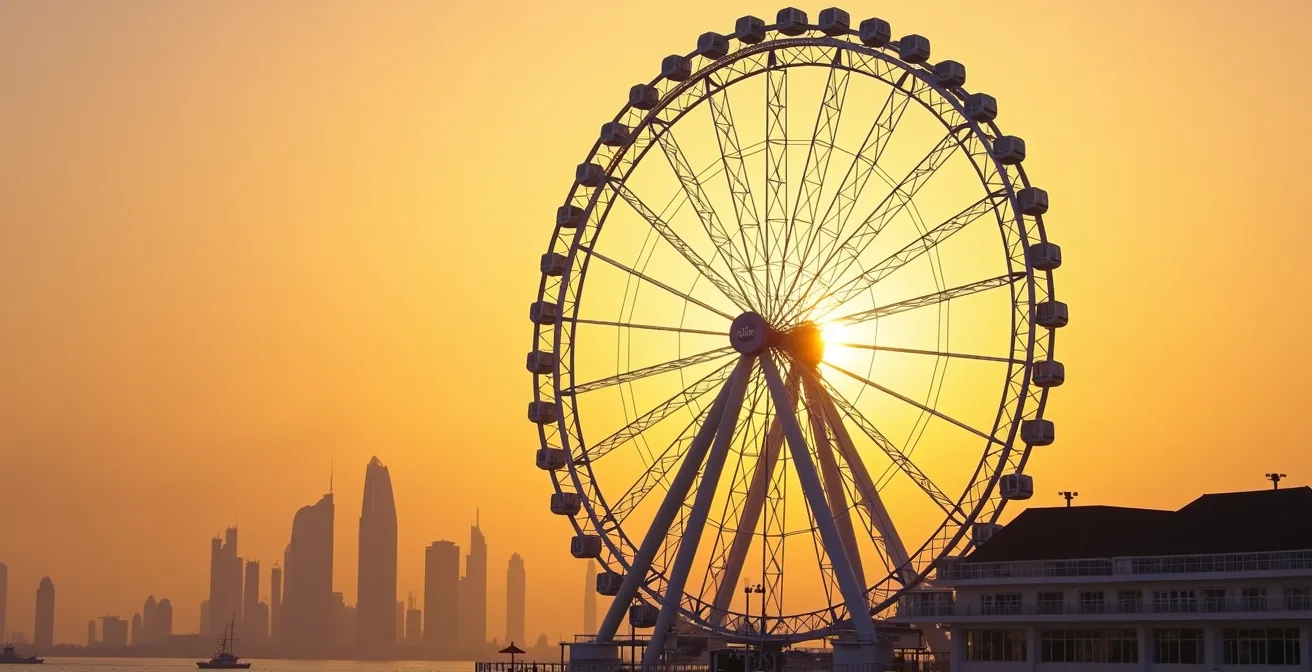
The sudden stop of the Ain Dubai is not a malfunction; it is a deliberate and controlled part of the wheel’s operational protocol.
- These planned pauses, or “dwell times,” are necessary for safe passenger boarding and maintaining the wheel’s precise load balance.
- The drive system is designed for an exceptionally slow and smooth rotation, making any sensation of motion barely perceptible and eliminating the risk of motion sickness.
Recommendation: Instead of feeling anxious during a pause, view it as a stable, secure moment engineered specifically for you to capture the perfect, unobstructed photo of the Dubai skyline.
You’re ascending, the curve of the Palm Jumeirah unfolding below, when suddenly, the gentle motion ceases. The cabin hangs motionless, 250 meters above the sea. The immediate thought for many is, “Has it broken down?” This flicker of anxiety is understandable, especially on the world’s largest observation wheel. The common reassurance is that it’s simply for boarding, but this explanation often feels incomplete, leaving a gap for worry to fill. While Ain Dubai’s longer-term operational status has been a topic of discussion, the in-ride experience itself is a masterclass in precision engineering that is often misunderstood.
The key to transforming this anxiety into awe lies in understanding the ‘why’ behind the pause. This isn’t an unexpected event; it’s a fundamental feature of the system’s design. The stop is not a symptom of a problem but a sign that the system is operating exactly as intended. It is a carefully orchestrated procedure, governed by complex algorithms that prioritize safety and efficiency above all else. This guide will take you inside the operator’s mindset, explaining the engineering principles that govern every movement, from the cabin you sit in to the speed of rotation, proving that every pause is part of a perfectly executed plan.
To fully appreciate this feat of engineering, let’s break down each component of your experience. The following sections explore the choices you make, the sensations you feel, and the technical realities that ensure your journey is both spectacular and completely secure.
Summary: Understanding the Engineered Experience of Ain Dubai
- Social Cabin vs Private Cabin: Is the Privacy Worth Double the Price?
- The 38-Minute Rotation: When Exactly to Board for Sunset at the Apex?
- Will You Get Seasick on a Wheel of This Size?
- Glass Floor vs Solid Floor: Choosing the Right Cabin for Fearful Flyers
- Bag Restrictions: Can You Bring a Tripod onto the Wheel?
- Jumeirah Sceirah: How Does the Drop Capsule Actually Work?
- How Fast Is the Elevator and Will It Pop Your Ears?
- Walking from JBR to Bluewaters: Is the Bridge Walk Doable in Summer?
Social Cabin vs Private Cabin: Is the Privacy Worth Double the Price?
Your experience is shaped long before the wheel begins to turn. The first decision—choosing your cabin—sets the tone for the entire 38-minute journey. From an operational standpoint, all cabins are identical in weight and engineering, ensuring the wheel’s balance is maintained regardless of which option you select. The difference lies entirely in the passenger experience. While standard tickets start at a competitive price point, the premium and private options cater to those seeking exclusivity. A private cabin isn’t just about being alone; it’s a different class of service.
The standard “observation cabins” offer a shared, social experience with ample space and clear 360-degree views. This is the classic way to see Dubai’s skyline. For a significant price increase, private cabins transform the ride into a VIP event. As noted by journalists who experienced the launch, these exclusive spaces feature plush, outward-facing seats and a central bar with dedicated staff. This turns a sightseeing trip into a private celebration, ideal for special occasions where the ambiance is as important as the view. The “Views Plus” option strikes a middle ground, enhancing the standard experience with fast-track access and included refreshments without the full cost of a private booking.
Ultimately, the choice depends on your objective. For pure sightseeing, the social cabin is more than sufficient. If the ride is the main event and a central part of a celebration, the added luxury and privacy of a premium or private cabin can justify the expense by creating a more memorable and personalized experience. It’s a calculated trade-off between budget and bespoke service.
Your 5-Point Audit for the Perfect Ain Dubai Ride
- Identify Your Goal: Clearly define the purpose of your visit. Is it casual sightseeing, a romantic date, a family outing, or a milestone celebration?
- Inventory Your Options: List the key features of each cabin type—Social (shared view), Views Plus (snacks/fast track), Premium (lounge/drinks), and Private (exclusivity/bar).
- Check for Coherence: Match the cabin choice to your goal and budget. Does the added cost of a private cabin align with the importance of the occasion?
- Assess the Experience Factor: Consider the value of unique elements. Is a glass floor essential for your sense of thrill? Is priority boarding necessary to reduce wait times?
- Build Your Itinerary: Finalize your choice and book the ideal time slot (e.g., sunset). Plan your arrival on Bluewaters Island based on this decision.
The 38-Minute Rotation: When Exactly to Board for Sunset at the Apex?
Timing is everything, not just for the wheel’s operation but for your own experience. Capturing that perfect sunset shot from the highest point is a common goal, but it requires precision planning. The wheel completes a full rotation in approximately 38 minutes, meaning you will reach the apex—the very top—at the 19-minute mark of your journey. To witness the sunset from this peak vantage point, you must work backward.
First, check the exact sunset time for your planned date of visit, as it varies significantly throughout the year in Dubai. Once you have that time, subtract 19 minutes. This is your target moment for being at the apex. Therefore, your boarding time should be 19 minutes before that. For example, if sunset is at 6:30 PM, you need to be at the apex at 6:30 PM, which means you should have boarded your cabin at approximately 6:11 PM. It’s crucial to arrive at the facility 30 to 60 minutes prior to your intended boarding time to account for ticketing, security, and walking to the entrance. For photographers, an alternative strategy is to board about 30 minutes before sunset to capture the beautiful “golden ascent” as the light changes on the way up.
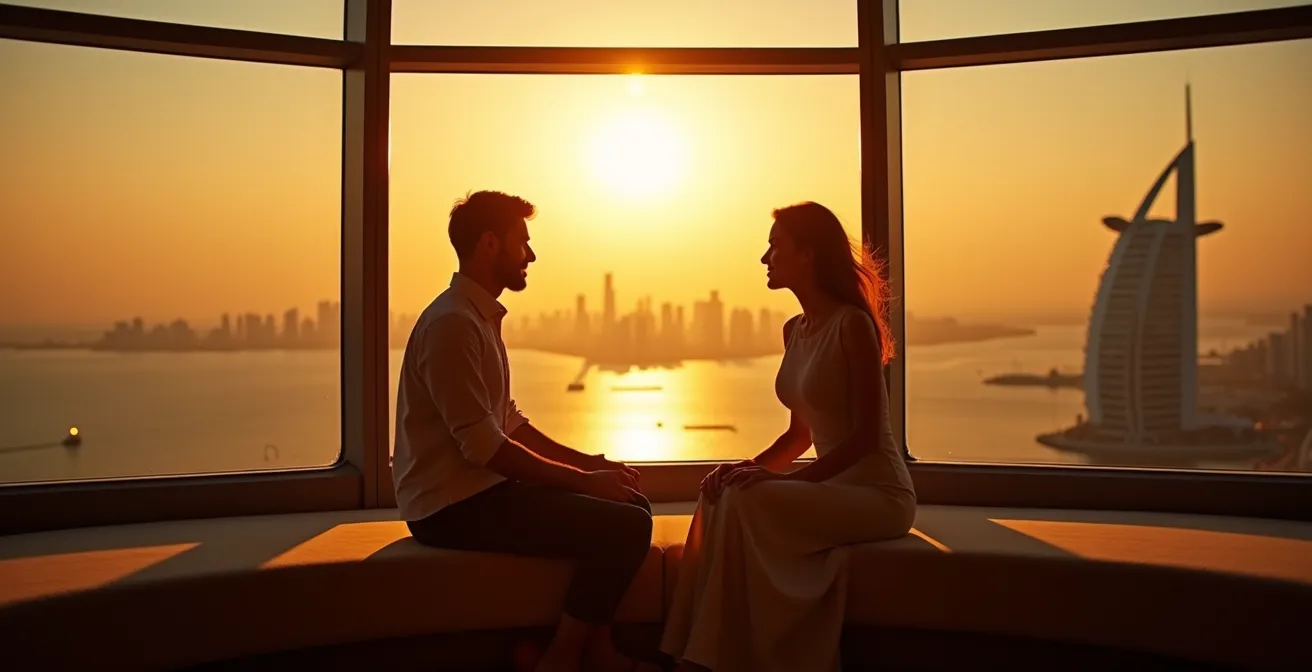
As you can see, timing your ride is a simple calculation, but one that makes a world of difference. These sunset slots are the most popular and sell out quickly, so advance booking is highly recommended. Just as our systems are calibrated for a perfect rotation, you can calibrate your schedule for a perfect view.
Will You Get Seasick on a Wheel of This Size?
The feeling of unease when the cabin stops high in the air can sometimes be mistaken for the beginning of motion sickness. However, from a mechanical standpoint, this is virtually impossible on Ain Dubai. Motion sickness is triggered by a disconnect between what your eyes see and what your inner ear’s vestibular system senses. This typically requires noticeable acceleration, deceleration, or swaying. The Ain Dubai is engineered specifically to eliminate these sensations.
The entire structure moves at an incredibly slow and constant pace. The official data reveals the wheel’s extremely slow rotation speed of approximately 0.007 rpm. This is so gradual that your body does not register it as movement. The starts and stops are not sudden jolts; they are controlled by a sophisticated drive system that smoothly ramps the speed up and down over several seconds. There is no sway, as the cabins are mounted on a stabilized system, and the immense weight and structural integrity of the wheel prevent any influence from wind. Your brain perceives a stable, unmoving room with a changing view.
Case Study: Inaugural Passenger Comfort
Reports from the very first passengers on opening day highlighted the exceptional comfort level engineered into the ride. A Gulf News feature quoted a rider saying, “The cabins of Ain Dubai are very spacious… The wheel moves slowly and smoothly, offering uninterrupted views.” The report also confirmed that the powerful, climate-controlled environment is maintained throughout, ensuring physical comfort that complements the smooth mechanical motion. This feedback confirms the design goal: to create an experience so seamless that the mechanics become invisible, leaving only the stunning panorama.
Therefore, any queasiness is likely psychological, stemming from anxiety about the height, rather than a physical reaction to motion. Understanding that the system is designed for imperceptible movement can help calm this feeling, allowing you to relax and enjoy the ride.
Glass Floor vs Solid Floor: Choosing the Right Cabin for Fearful Flyers
Part of feeling secure is controlling your environment, and for some, that control extends to what is directly underfoot. While all cabins are structurally identical and equally safe, the choice between a solid floor and a glass floor can have a significant psychological impact, especially for those with a fear of heights. For anxious riders, the decision is straightforward: opt for a solid floor cabin. This removes the vertigo-inducing vertical view and allows you to focus solely on the horizontal panorama, which is the primary attraction.
The glass floor cabins are an engineering feat, using multi-layered, laminated safety glass designed to far exceed any possible load. They offer a unique, thrilling perspective looking straight down at Bluewaters Island and the sea below. However, this feature is for thrill-seekers, not for the faint of heart. For photographers, the glass floor presents both opportunities and challenges—it allows for unique downward-angle shots but can also create unwanted reflections, especially at night. A solid floor provides a more stable and predictable environment for capturing clear shots through the main windows without worrying about floor glare.
The following table, based on information from ticketing partners, breaks down the key features. It shows that apart from the floor itself, the core amenities and safety standards are consistent across all standard observation cabins, as detailed by an analysis of available cabin types.
| Feature | Glass Floor Cabin | Solid Floor Cabin |
|---|---|---|
| View Angle | 360° plus vertical down | 360° horizontal only |
| Capacity | 40 passengers | 40 passengers |
| Climate Control | Full AC with UV protection | Full AC with UV protection |
| Safety Features | Multi-layered laminated glass | Standard reinforced floor |
| Photography | Unique angles, reflection challenges | Clear shots, no floor reflections |
Choosing a solid floor is a simple and effective way to manage anxiety. It allows you to ground yourself, both literally and psychologically, so you can fully immerse yourself in the breathtaking views without unnecessary stress.
Bag Restrictions: Can You Bring a Tripod onto the Wheel?
With such a magnificent view, it’s natural to want to capture the best possible photos. This brings up practical questions about what you can and cannot bring into the cabin. From an operator’s perspective, policies on bags and equipment are about two things: safety and passenger flow. The cabins are spacious, but they are a shared space. Policies are in place to ensure everyone can move around freely and safely during the 38-minute rotation.
Standard backpacks, handbags, and camera bags are generally permitted. You are encouraged to bring your professional DSLR or mirrorless camera to capture the stunning scenery. However, larger items that could obstruct pathways or pose a tripping hazard are restricted. This is why large, traditional tripods are typically not allowed inside the cabins. They take up significant floor space and can impede the movement of other guests who are also trying to get the best view from different angles.
This doesn’t mean you have to settle for shaky, handheld shots. Photographers have several approved alternatives for stabilization. A flexible GorillaPod that can be wrapped around interior railings (without damaging them), a compact monopod, or even a window-mounted suction cup are excellent, non-intrusive options. These tools provide the stability you need without compromising the safety and comfort of others, ensuring that everyone’s experience is both memorable and secure.
Jumeirah Sceirah: How Does the Drop Capsule Actually Work?
You’re worried about the gentle pause on Ain Dubai, but to put it in perspective, let’s consider another marvel of Dubai engineering designed for a very different sensation: the Jumeirah Sceirah water slide. Here, the engineering goal is not calm observation, but pure, heart-pounding adrenaline. The experience begins inside a vertical capsule, where a transparent door closes in front of you. The most intense part is the anticipation, waiting for the floor beneath you to disappear.
The “drop” is controlled by a sophisticated latch mechanism. Once the operator receives the all-clear signal, an electromagnetic lock releases the hinged floor, which swings down like a trapdoor. From that moment, gravity takes over entirely. This isn’t a slow, controlled descent; it’s a free-fall. During this initial drop from a height of 32 metres, riders reach speeds of up to 80 km/h as they plummet down the slide. The entire system is built around creating a moment of maximum, controlled thrill.
Comparing this to Ain Dubai highlights the difference in engineering intent. The Jumeirah Sceirah uses a sudden release mechanism to maximize acceleration and surprise. Ain Dubai uses a massive, geared drive system to minimize acceleration and provide a perfectly smooth, predictable ride. Both are safe and highly engineered, but they exist at opposite ends of the thrill spectrum. The pause you feel here is the engineering equivalent of a gentle breath, not a heart-stopping drop.
How Fast Is the Elevator and Will It Pop Your Ears?
Another common point of physical sensation in tall structures is the elevator ride up. Many of Dubai’s skyscrapers have some of the fastest elevators in the world, and the rapid change in altitude can cause your ears to “pop.” This is due to the pressure difference between your middle ear and the air outside. The sensation on Ain Dubai is fundamentally different and far gentler, by design.
An elevator travels vertically and quickly, causing a rapid change in atmospheric pressure. The Ain Dubai ascends along a vast curve, and its rotation is exceptionally slow. The change in altitude is so gradual over the 19 minutes it takes to reach the top that your body has ample time to acclimatize naturally. Most passengers do not experience any ear popping at all. For the few who are particularly sensitive to pressure changes, the feeling is very mild and can be easily managed.
If you do feel a slight pressure, simple techniques can equalize it instantly. Yawning is often the most effective method, as it naturally opens the Eustachian tubes that connect your throat to your middle ear. Other methods include chewing gum, sucking on a candy, or performing the Toynbee maneuver (pinching your nose while swallowing). These are simple, preventative measures for an effect that is already minimized by the wheel’s slow, deliberate design. Unlike a high-speed elevator, comfort is prioritized over speed.
Key takeaways
- The pauses of Ain Dubai are planned “dwell times” for passenger boarding and load balancing, not malfunctions.
- The wheel’s rotation speed is extremely slow (approx. 0.007 rpm), making motion sickness virtually impossible and ensuring a smooth, stable ride.
- For anxious riders, choosing a solid-floor cabin is an effective way to eliminate vertigo and enhance psychological comfort.
Walking from JBR to Bluewaters: Is the Bridge Walk Doable in Summer?
Your controlled, comfortable experience inside the Ain Dubai cabin stands in stark contrast to the journey one might take to get there. Bluewaters Island is connected to the Jumeirah Beach Residence (JBR) mainland by a pedestrian bridge. During the cooler months, this is a pleasant five-minute stroll with great views. However, in the sweltering heat of a Dubai summer, this walk can be a significant physical challenge.
The bridge is fully exposed to the sun, and with summer temperatures often exceeding 45°C (113°F), even a short walk can be draining and uncomfortable. For this reason, many visitors wisely opt for a water taxi from Dubai Marina or a standard taxi that can drop them directly on the island. This highlights a core principle of comfort in Dubai: managing the transition between the extreme outdoor heat and the perfectly climate-controlled indoor environments.
The engineering that goes into the powerful air-conditioning systems of Ain Dubai’s cabins is just as critical as the drive system that turns the wheel. Each cabin is a sealed, climate-controlled oasis, protected from heat and UV rays by specialized glass. The moment you step inside, you leave the harsh outdoor elements behind. The challenging walk across the bridge in summer serves as a powerful reminder of the value of this controlled environment, making the cool, calm interior of the cabin feel even more like a sanctuary.
Now that you understand the engineering and design choices that prioritize your comfort and safety, the next pause can be seen not as an interruption, but as an integral part of the spectacle—a stable platform from which to truly absorb one of the world’s most impressive views.
Frequently Asked Questions about Why Ain Dubai Stops Moving: Is It a Breakdown or Boarding Protocol?
Are professional cameras allowed on Ain Dubai?
Yes, professional cameras are permitted in the cabins, allowing you to capture the spectacular views during your rotation.
Can I bring a tripod into the cabin?
Large tripods are typically restricted due to cabin space limitations and passenger flow considerations.
What alternatives exist for stable photography?
Consider using a GorillaPod, monopod, or window-mounted suction cup for stabilization without violating restrictions.