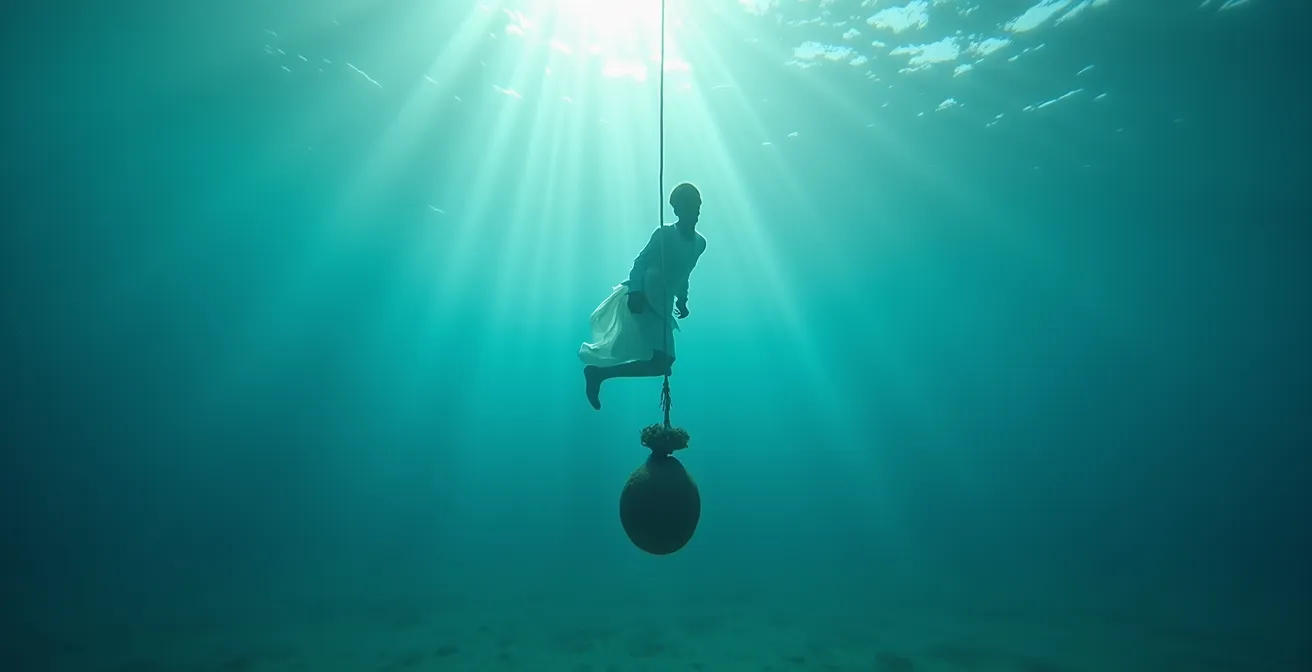
The romantic image of pearl diving masks a brutal medical reality: blindness and deafness were not accidents, but near-certain outcomes of the trade.
- Chronic barotrauma from repeated, rapid pressure changes systematically damaged the delicate structures of the divers’ eyes and ears.
- The economic system of debt bondage forced divers to ignore safety and push their bodies past their limits, exacerbating the physiological toll for minimal gain.
Recommendation: Understanding this history re-frames the pre-oil Gulf not as a simple past, but as a complex story of human endurance against overwhelming physical and economic pressure.
The legacy of Arabian pearl diving is often painted in romantic hues—of daring men on wooden dhows, plunging into azure waters to retrieve treasures for kings and queens. This image, while compelling, is a profound oversimplification. It neatly omits the grinding poverty, the systemic exploitation, and the devastating physical cost paid by the divers. While the immediate dangers of drowning or shark attacks were real, the true, insidious threat was a slow, cumulative, and almost inevitable destruction of the body. The most common and cruelest of these afflictions were blindness and deafness.
As a medical historian, my focus is on the “why.” This was not a matter of chance or bad luck. The blindness and deafness that plagued generations of divers were a direct, physiological consequence of their work, compounded by a socio-economic system that offered no escape. To understand this phenomenon is to move beyond the romance and confront the brutal physics of pressure, the pathology of chronic injury, and the unforgiving reality of a pre-oil economy. This article will deconstruct the mechanisms of this occupational tragedy, exploring how the relentless pursuit of pearls systematically dismantled the very senses that allow us to perceive the world.
To fully grasp the context of this demanding life, this article explores the economic pressures, the diving techniques, the social structure, and the lasting legacy of the pearling era. The following sections will guide you through this complex history.
Summary: The Brutal Reality of Historical Pearl Diving
- Natural vs Cultured Pearls: Why the Industry Collapsed in the 1930s?
- The Nose Clip and Stone: How Divers Stayed Underwater for 3 Minutes?
- The Nokhada vs The Diver: Debt Bondage in the Pearling Fleet
- Where to Watch a Live Pearl Diving Demonstration Today?
- The Role of the Naham: Why Singing Was Essential for Rowing Rhythm?
- Swimming Off the Yacht: What Are the Jellyfish Risks in October?
- Oryx vs Gazelle: How to Identify the Species You Will See?
- Etihad Museum or Dubai Museum: Which One Explains the Union Better?
Natural vs Cultured Pearls: Why the Industry Collapsed in the 1930s?
For centuries, the entire economy of the Arabian Gulf was built on the iridescent luster of natural pearls. By the late 19th century, the industry was a colossal enterprise, with an estimated 60,000 men involved in the pearling fleet. This single industry accounted for up to 95% of all local incomes, making it the undisputed foundation of society. Entire communities rose and fell with the fortunes of the annual pearl hunt, a four-month season known as ‘al-ghous al-kabir’ or the ‘Great Dive’. This economic dependency created immense pressure to maximize yields, often at the expense of the divers’ health and safety.
The collapse, when it came, was swift and devastating, caused by a confluence of two global events. The first blow was economic; as the Diving Heritage Archives note, “The great depression made it hard to get good prices for pearl shell,” crippling the market’s demand. The second blow was technological and existential. In Japan, Kokichi Mikimoto perfected the technique of creating cultured pearls, flooding the market with perfectly round, affordable alternatives. The mystique and rarity of the natural Gulf pearl evaporated almost overnight. Unable to compete, the centuries-old industry disintegrated in the 1930s, leaving widespread economic ruin and paving the way for the eventual rise of oil as the region’s new economic engine.
The economic collapse left behind a legacy of poverty and a population whose primary skill was suddenly obsolete, highlighting the fragility of an economy built on a single, high-risk resource.
The Nose Clip and Stone: How Divers Stayed Underwater for 3 Minutes?
The romantic notion of divers gracefully spending three minutes or more at the seabed is a myth. The reality was a brutal, rapid-fire exercise in human endurance. Historical records show a far grimmer picture: most divers remained underwater for 60 to 90 seconds, reaching depths of 6-20 metres, performing this feat up to fifty times a day. The tools used were not for comfort but for ruthless efficiency. The diver carried a woven bag (‘diyyin’) around his neck for the oysters, but the most crucial pieces of equipment were the nose clip and the weight.
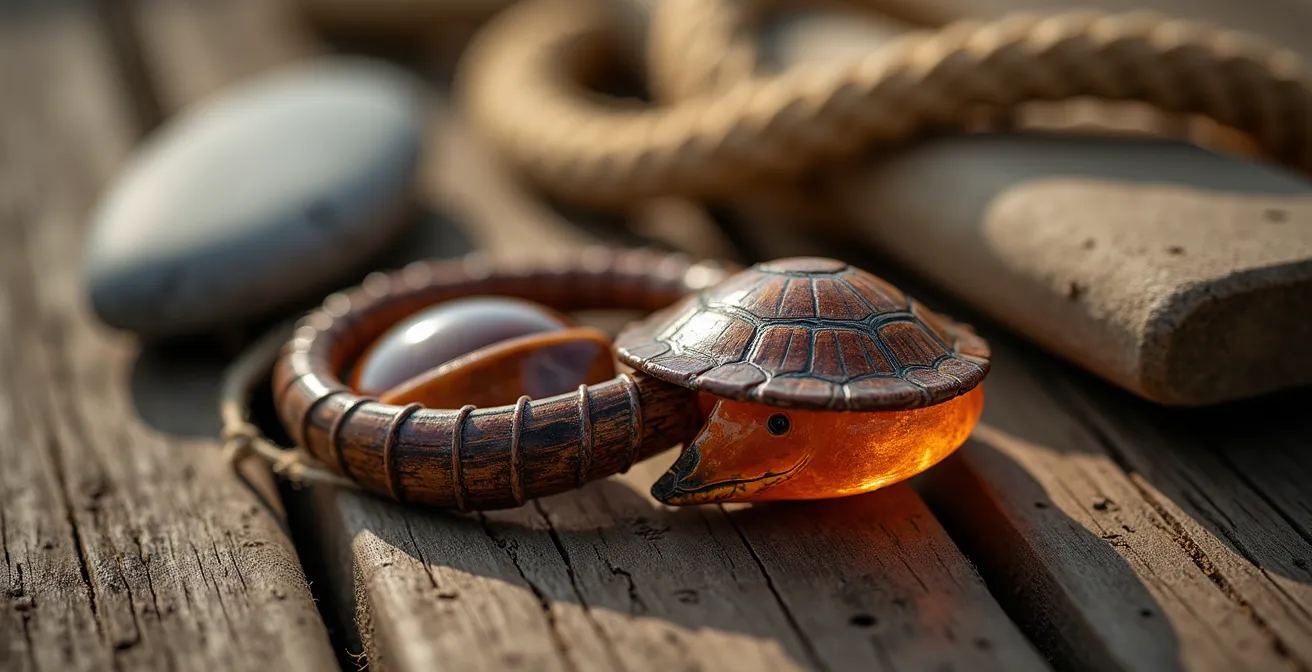
The ‘fitaam’, a nose clip typically crafted from turtle shell or bone, was used to clamp the nostrils shut. This simple device was often a source of chronic infections and could permanently disfigure the nose. To descend quickly and conserve precious oxygen, the diver would hold onto a rope attached to a stone or lead weight (‘hasat’), plunging rapidly to the seafloor. This rapid descent and ascent cycle was the primary cause of the divers’ chronic health issues. The repeated, drastic changes in pressure inflicted a severe physiological toll known as barotrauma.
This occupational pathology was the direct cause of the blindness and deafness that afflicted so many. Ocular barotrauma could cause hemorrhages in the small blood vessels of the eye, leading to blurred vision and eventual blindness. Aural barotrauma was even more common, with the pressure difference rupturing eardrums, damaging the inner ear, and causing chronic infections that led to permanent hearing loss. The very tools and techniques that defined their trade were the instruments of their slow, physical destruction.
The Nokhada vs The Diver: Debt Bondage in the Pearling Fleet
The physical suffering of the pearl divers cannot be separated from the economic system that trapped them. The pearling fleet operated on a rigid hierarchy, at the top of which was the ‘Nokhada’—the captain and financier of the dhow. At the bottom was the ‘ghawwas’, the diver, who undertook the most dangerous work for the smallest share of the profits. This relationship was rarely one of simple employment; it was a system of institutionalized debt bondage that ensured a lifetime of servitude for the divers.
Before the season even began, the Nokhada would advance loans to the divers for the upkeep of their families. These loans came with exorbitant interest rates. At the end of the season, the value of the pearls was tallied, expenses were deducted, and profits were distributed. However, after the Nokhada, the traders, and the crew’s food were paid, the diver’s share was often insufficient to cover his initial debt. As historical archives note, the system was designed to perpetuate poverty.
The unfortunate ghai ghawwas took the smallest cut, and the majority of them was still subjected to a vicious cycle of poverty
– Historical Archives, The Origins of Pearl Diving in the Persian Gulf
This debt was heritable, passing from father to son. A diver with failing eyesight or hearing—conditions caused directly by his work—could not simply retire. He was forced to continue diving, pushing his damaged body to its limits to chip away at an unpayable debt. This economic desperation ensured a constant supply of men willing to endure the known physiological toll of the job, as the alternative was starvation for their families. The system was a perfect, brutal trap.
Where to Watch a Live Pearl Diving Demonstration Today?
While the commercial pearl diving industry is a relic of the past, its profound cultural legacy is actively preserved and honored throughout the Gulf today. For those interested in witnessing this heritage, several places offer compelling reconstructions and exhibits that bring the divers’ stories to life. These demonstrations serve not only as tourist attractions but as vital educational tools, ensuring that the sacrifices of past generations are not forgotten. The UAE, in particular, hosts several key sites where one can connect with this history.
In Dubai, the Dubai Museum, housed in the Al Fahidi Fort, features life-size dioramas that vividly depict the pre-oil era, with a strong focus on the pearling community. For a more specialized view, the Pearl Museum at the Emirates NBD headquarters contains one of the world’s most significant collections of natural Arabian Gulf pearls. A more immersive experience can be found at the Suwaidi Pearls farm in Ras Al Khaimah, a floating facility that educates visitors on both the history of diving and the modern science of pearl cultivation. This renewed interest is not just for show; recent reports confirm a genuine revival in the practice, with over 1,000 divers now registered and diving regularly in Bahrain since a government initiative began in 2017.
These modern demonstrations and museums provide a powerful, tangible link to the past, allowing visitors to appreciate the skill and endurance of the divers while learning about the harsh realities they faced.
The Role of the Naham: Why Singing Was Essential for Rowing Rhythm?
Life aboard a pearling dhow was one of monotonous, back-breaking labor, punctuated by moments of extreme danger. In this environment, the ‘Naham’, the ship’s singer, played a role far more critical than mere entertainment. His songs, known as ‘fidjeri’, were the heartbeat of the vessel, providing the rhythm for communal tasks like rowing, hoisting the sails, and weighing anchor. The collective chanting helped synchronize the crew’s movements, turning a group of individuals into a single, efficient machine.
But the Naham’s role extended deep into the crew’s psychological well-being. As described in cultural heritage documents, “The Naham was the crew’s historian and poet.” His songs were a form of oral history, recounting tales of legendary divers, mythical sea creatures, and the sorrows and joys of life at sea. They provided an emotional outlet, a way to voice the shared anxieties, loneliness, and hopes of men separated from their families for months on end. The music blended diverse influences from Bedouin, East African, and Indian traditions, creating a unique musical heritage that reflected the multicultural nature of the pearling crews.
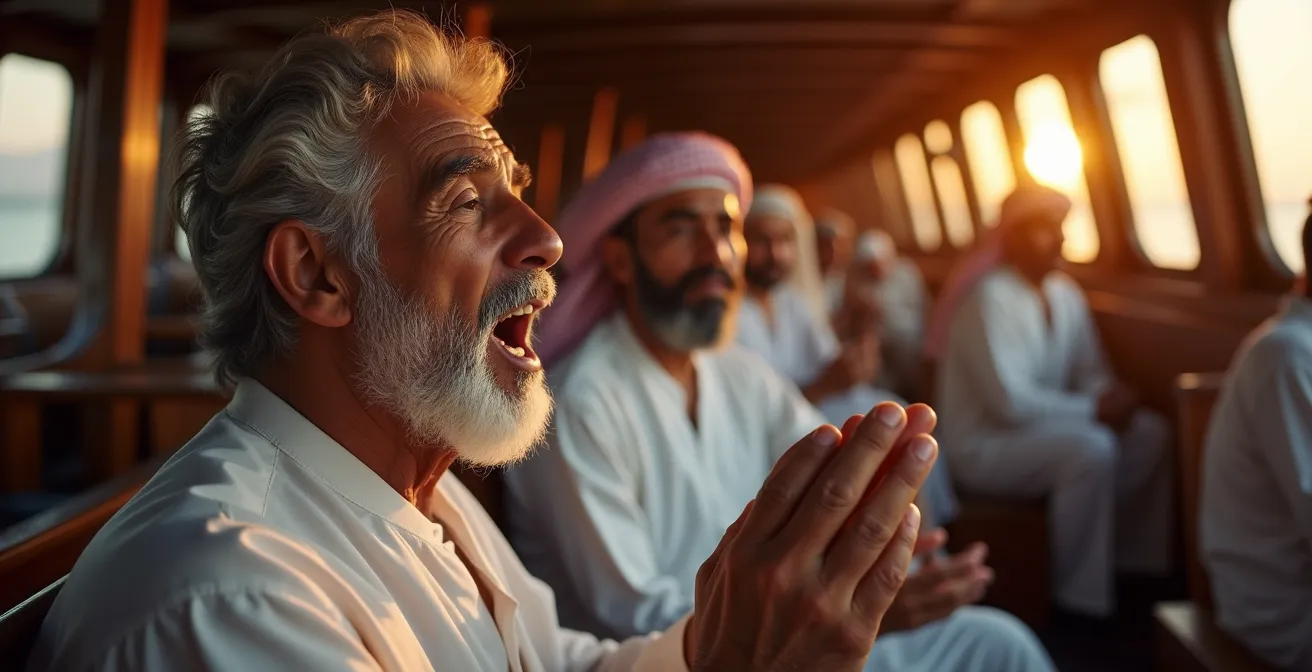
These songs of resilience and camaraderie were essential for maintaining morale during the long, arduous season. They transformed the dhow from a simple workplace into a cultural space, reinforcing social bonds and a shared identity. The Naham’s voice was the thread that wove the crew together, offering solace and strength in the face of constant hardship. In the silence of the deep, it was the memory of his songs that offered a connection to the world of the living.
Swimming Off the Yacht: What Are the Jellyfish Risks in October?
Today, a swimmer in the Arabian Gulf in October might have a fleeting concern about jellyfish. But for the historical pearl divers, this was no minor nuisance; it was a source of profound terror and a constant, debilitating threat. In the hierarchy of dangers, jellyfish were often more feared than sharks. While a shark attack was a possibility, encounters with vast swarms of jellyfish were a daily certainty during certain seasons. The stings were intensely painful, and a diver, naked and vulnerable, could receive hundreds in a single dive.
These encounters were not just painful; they were dangerous. Repeated stings could lead to shock or incapacitation underwater, increasing the risk of drowning. The venom caused severe skin irritation, open sores, and infections in the hot, unhygienic conditions of the dhow. To protect themselves, divers would often wear thin, full-body cotton suits (‘libis’), but these offered minimal protection against the most venomous species. Indeed, historical diving accounts reveal that divers feared jellyfish far more than the sharks they occasionally encountered. This constant, agonizing threat added another layer of physical and psychological stress to an already brutal existence.
For the modern swimmer, knowledge is the best protection—a luxury the old divers did not have. Following a clear protocol can neutralize the danger.
Your Action Plan: Arabian Gulf Jellyfish Safety Protocol
- Identification: Be aware of the common species in Gulf waters, primarily the Blue Blubber and the harmless Upside-down jellyfish.
- First Aid – Saltwater Rinse: In case of a sting, rinse the affected area with saltwater only. Never use freshwater, as it can cause remaining stinging cells to fire.
- Neutralization: Apply vinegar to the sting area. Vinegar’s acetic acid helps to neutralize the venom and prevent further envenomation.
- Pain Management: Apply a hot pack or immerse the area in hot water (as hot as can be tolerated) for 20-45 minutes. Heat helps to denature the protein-based venom.
- Seasonal Awareness: Be most cautious during the peak jellyfish season, which typically aligns with the warmest water months from June to September.
Oryx vs Gazelle: How to Identify the Species You Will See?
While the world of the pearl diver was the sea, the land they returned to was part of a wider, arid ecosystem teeming with its own unique forms of life. The Arabian Peninsula is home to several iconic antelope species, and for the historical traveler and the modern visitor alike, distinguishing between them is a key part of appreciating the region’s natural heritage. The two most prominent are the Arabian Oryx and the various species of gazelle, each adapted in its own way to the harsh desert environment.
The most striking difference is size and horn structure. The Arabian Oryx is a large, powerfully built animal, famous for its long, straight, spear-like horns found on both males and females. Its predominantly white coat is thought to help reflect the harsh desert sun. Gazelles, by contrast, are smaller, more delicate, and built for speed. The Sand Gazelle (or ‘Reem’), known for its pale, sand-colored coat, is a classic image of the deep desert, while the darker Mountain Gazelle prefers rockier terrain. Distinguishing them often comes down to observing their horns, coloration, and group behavior.
This brief comparative guide outlines the key features to look for when identifying these magnificent desert animals.
| Feature | Arabian Oryx | Sand Gazelle (Reem) | Mountain Gazelle |
|---|---|---|---|
| Size | Large (1m at shoulder) | Medium (60-70cm) | Small (50-60cm) |
| Color | White body, dark legs | Very pale sand color | Darker brown tones |
| Horns | Long, straight, both sexes | Lyre-shaped, males only | Short, straight, males |
| Habitat | Open plains | Deep desert dunes | Rocky slopes |
| Group Size | Large mixed herds | Small groups (3-5) | Pairs or small groups |
Key takeaways
- Blindness and deafness in pearl divers were primarily caused by chronic barotrauma from repeated, rapid dives.
- The economic system of debt bondage forced divers to endure these physically destructive conditions for minimal personal gain.
- The collapse of the pearling industry in the 1930s, due to cultured pearls and the Great Depression, paved the way for the socio-economic transformation of the Gulf.
Etihad Museum or Dubai Museum: Which One Explains the Union Better?
To truly connect with the history of the UAE, one must understand the foundational role of pearling. Two key museums in Dubai offer different but complementary perspectives on this journey from a fragmented past to a unified nation. The choice between them depends on what part of the story you wish to explore: the deep maritime roots or the modern political birth.
The Dubai Museum, located in the historic Al Fahidi Fort, is the custodian of the pre-oil narrative. Its exhibits are a deep dive into the maritime heritage that defined the coastal communities for centuries. The life-size dioramas of souks, dhows, and pearl divers provide an immersive, visceral understanding of the hardship and resilience that characterized this era. It masterfully demonstrates how the collapse of the pearling industry created the economic vacuum that made a new vision for the future not just possible, but necessary.
A Tale of Two Museums: The Pearl vs. The Union
The Dubai Museum at Al Fahidi Fort is where you go to understand the soul of the pre-union Emirates, focusing on the maritime and pearling heritage that was the bedrock of its economy and culture. In contrast, the Etihad Museum is a sleek, modern institution dedicated to telling the political story of the 1971 unification of the seven emirates. While the Etihad Museum explains the ‘how’ of the modern state’s formation, the Dubai Museum explains the ‘why’—the historical context and shared cultural identity, forged in the pearling era, that made such a union conceivable.
For a visitor seeking to understand the story of the union, the Etihad Museum is the literal answer. However, to understand the *people* who formed that union, the Dubai Museum is indispensable. It tells the story of what came before, a narrative of shared struggle and endurance best summarized by a poignant observation:
Oil may have reshaped the modern UAE, but pearls shaped its soul
– Abdulla Rashed Al Suwaidi, Gulf News Heritage Report
This history is not a footnote; it is the central pillar upon which the modern Emirati identity is built, a testament to a past that was endured and overcome.
To truly honor the memory of the pearl divers is to look beyond the romance and acknowledge the brutal reality of their existence. By visiting these sites and engaging with their stories, you participate in the vital work of remembering this foundational chapter of Gulf history.