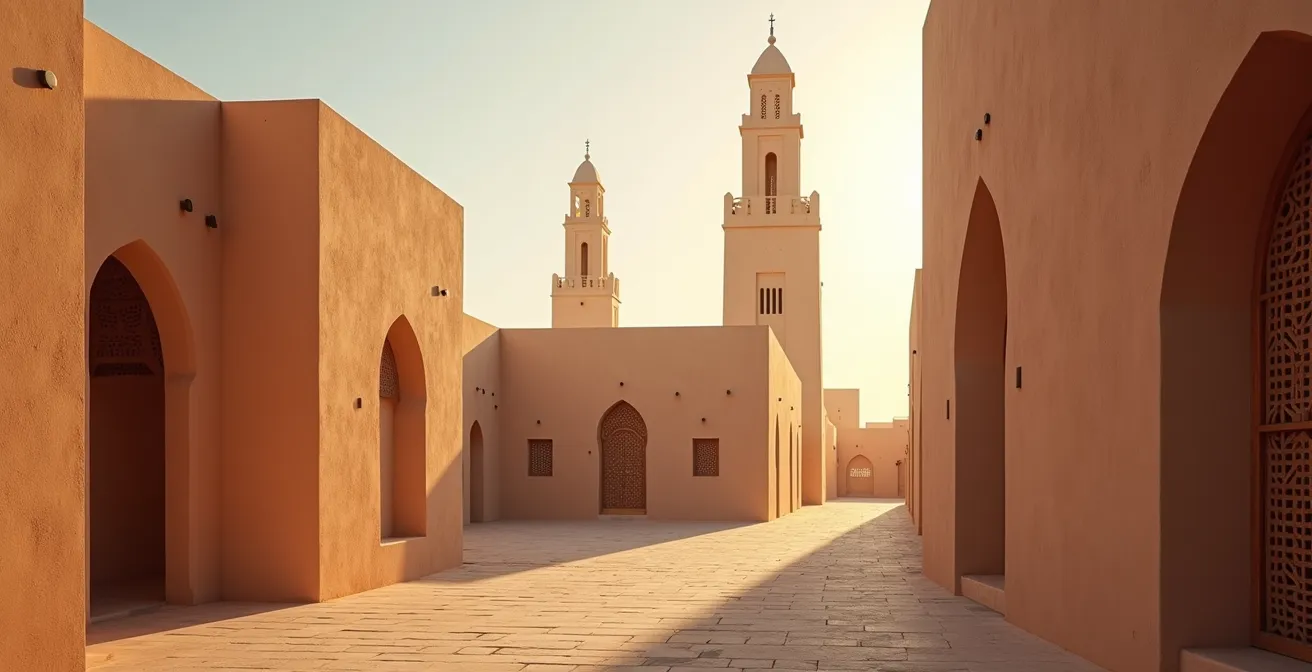
The passive cooling of old Dubai houses is not a collection of quaint features but a systemic engineering marvel where materials, layout, and ventilation elements work in concert as a sophisticated passive cooling machine.
- Architectural elements like the barjeel (wind tower), sikkat (narrow alleys), and mashrabiya (latticework) form an integrated system to manage airflow and heat.
- Indigenous materials like porous coral stone offer superior thermal insulation and moisture regulation compared to modern concrete.
Recommendation: Contemporary builders should analyze these time-tested principles to inform the design of modern, energy-efficient buildings in arid climates.
In the blistering heat of Dubai, the reliance on modern air conditioning seems absolute. Yet, long before the city’s glass towers pierced the skyline, a sophisticated architectural tradition allowed residents to live comfortably through the scorching summers. Many assume this was simply a matter of thicker walls or living with the heat, but this view misses the genius at play. The common solutions—wind towers, shaded courtyards, special materials—are often seen as individual, almost folkloric elements. This perspective overlooks the profound ingenuity of their design.
But what if the true secret wasn’t in any single feature, but in the way every component worked together as a single, integrated passive cooling engine? This is where the true lesson for modern sustainable design lies. Traditional Emirati courtyard houses were not merely shelters; they were finely tuned machines designed to manipulate shade, air pressure, and thermal mass. Understanding this systemic approach moves beyond historical appreciation and into the realm of applied building physics, offering powerful insights for today’s eco-conscious architects and builders.
This article deconstructs the science behind this traditional architecture. We will explore the specific function of each key element, from the physics of narrow alleyways to the material science of coral walls, revealing how these ancient homes mastered sustainable design long before it became a global imperative. By understanding the ‘why’ behind the design, we can uncover principles that remain strikingly relevant today.
To fully grasp this integrated design philosophy, this guide breaks down the core architectural components and scientific principles that enable these structures to regulate their microclimate effectively. The following sections explore each element in detail.
Summary: The Engineering of Traditional Dubai Homes
- The Sikkat: Why Narrow Alleyways Were Designed for Shade and Privacy?
- Coral Stone and Gypsum: Why Use Sea Materials for Desert Walls?
- Why the Majlis Always Has a Separate Entrance from the House?
- How Wooden Latticework Allows Air Flow While Blocking Sun?
- Salt Damage: Why Restoring Coral Walls Is a Nightmare?
- How Do Ancient Wind Towers Cool Houses by 5 Degrees?
- Why Humidity Levels Feel 15% Higher on The Crescent in August?
- How to Navigate the Al Fahidi Maze Without Google Maps?
The Sikkat: Why Narrow Alleyways Were Designed for Shade and Privacy?
The winding, narrow alleyways, or sikkat, of historic districts like Al Fahidi are a defining feature, but their purpose extends far beyond providing privacy or creating a maze-like defense. They are a critical component of the community-wide passive cooling system. Primarily, their narrowness ensures that the walls of adjacent buildings cast long shadows, minimizing the amount of direct solar radiation hitting the building facades and the ground. This drastically reduces the heat absorbed by the urban fabric during the day, keeping the pathways pleasantly cool.
Beyond shade, the sikkat function based on a principle of building physics known as the Venturi effect. As wind is forced through these constricted passages, its velocity increases, creating zones of lower pressure. This pressure differential helps to draw hot air out of the courtyards and rooms of the adjoining houses, promoting constant, natural air circulation. The effect is a natural ventilation system at the neighborhood scale.
Modern research into building design validates this ancient technique. Studies on optimized ventilation systems demonstrate that constricting airflow channels can result in a significant temperature drop. For instance, scientific modeling confirms that well-designed narrow passages can lead to a temperature reduction of 2.8 K to 3.0 K in adjacent indoor spaces compared to unventilated areas. The sikkat are therefore not just paths but engineered conduits for climate control.
Coral Stone and Gypsum: Why Use Sea Materials for Desert Walls?
The choice of building materials in traditional Emirati architecture was a masterclass in using local resources to solve environmental challenges. The walls were primarily constructed from coral stone harvested from the sea, bonded with a gypsum-based mortar. This was not a choice of convenience but of performance. Coral stone has a highly porous structure, containing countless tiny air pockets. These pockets disrupt the flow of heat, giving the material a naturally low thermal conductivity and making it an excellent insulator.
This porosity serves another vital function: moisture regulation. The walls can absorb humidity from the air during cooler, more humid nights and release it slowly during the hot, dry day, a process that has a slight evaporative cooling effect. This hygroscopic property acts as a natural buffer against the extreme diurnal temperature swings of the desert. The material’s high thermal mass also means it absorbs heat very slowly, delaying the transfer of daytime heat to the interior until the cooler evening hours, when it can be dissipated.
This performance is quantifiable. While coral stone itself is unique, studies on similar traditional materials in hot regions offer a clear comparison. For example, research shows that traditional 60 cm thick limestone walls can achieve a U-value as low as 2.96 W/m²K, demonstrating a high resistance to heat transfer far superior to uninsulated modern blockwork.
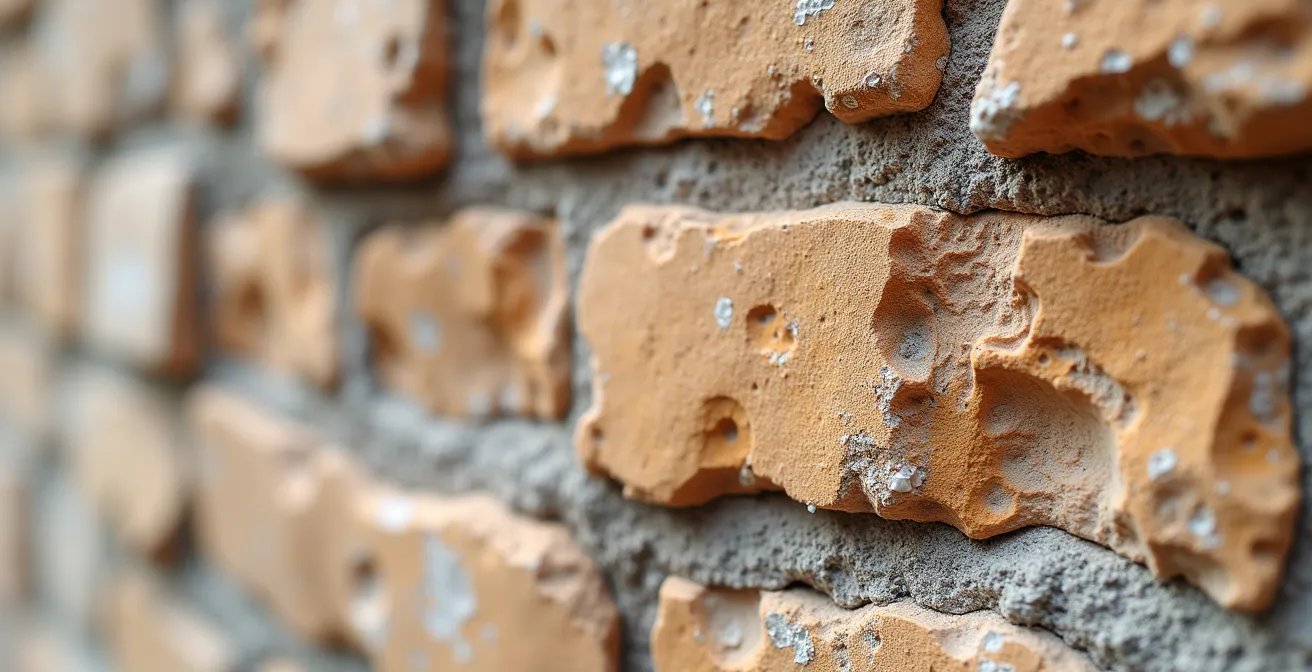
As this image shows, the fossilized structure of the coral stone is visibly porous. These trapped air pockets are the key to its insulating power, creating a wall that breathes and protects the interior from the desert’s thermal assault. This material science is a cornerstone of the entire passive cooling system.
Why the Majlis Always Has a Separate Entrance from the House?
The majlis, or the formal reception room for entertaining male guests, holds a distinct and strategic position in the layout of a traditional Emirati house. Its separation, often with its own external entrance, is commonly understood as a means to preserve the privacy of the family’s domestic spaces, particularly for the women of the household. While this cultural function is paramount, the architectural separation also serves a critical role in the home’s thermal management system.
By separating the majlis, architects created distinct ventilation circuits. The public-facing majlis could be ventilated independently without compromising the cooler, more sheltered air within the private family courtyard and living quarters. This zoning prevents the frequent opening of doors and the movement of guests from introducing hot daytime air into the core of the home. This creates a thermal buffer, isolating the most exposed part of the house from the private sanctuary.
This concept is further explained by experts in traditional architecture, who note the strategic placement of the majlis as a sacrificial thermal zone. As noted in documentation on heritage buildings:
The majlis was often located on the most sun-exposed side of the house or near the main entrance to absorb the heat and protect the cooler, private living quarters from thermal gain
– Traditional Architecture Studies, Heritage Village Documentation
In essence, the majlis acts as a heat shield. Its location and separate access are part of a deliberate strategy to stratify the house into thermal zones, sacrificing the temperature of a public space to maintain the comfort and coolness of the private domain. This is another example of integrated, systemic design where cultural needs and climate response are seamlessly interwoven.
How Wooden Latticework Allows Air Flow While Blocking Sun?
The beautiful and intricate wooden screens known as mashrabiya are one of the most recognizable elements of traditional Islamic architecture. Far from being purely decorative, they are a highly sophisticated technology for climate control. Their primary function is to provide shade and privacy while still allowing for ventilation. The screen breaks up direct sunlight into dappled patterns, significantly reducing solar gain and glare without plunging the room into darkness. This allows residents to keep windows open for airflow even during the brightest parts of the day.
The genius of the mashrabiya lies in its complex geometry. It does more than simply allow air to pass through. As air moves through the small, angled openings of the latticework, its flow pattern is altered. Analysis of this traditional element reveals that intricate geometric patterns that create micro-turbulences in the airflow are key to its function. This turbulence enhances the rate of heat exchange, helping to cool the air as it enters the room. Furthermore, this complex airflow helps filter out dust from the desert air more effectively than a simple screen.
The mashrabiya is therefore a multi-functional device: it is a light diffuser, a privacy screen, a dust filter, and an air-cooling convection enhancer. Its design allows for a high degree of control over the indoor environment, demonstrating a deep understanding of fluid dynamics and light physics. It is a perfect example of how a single architectural element can be engineered to perform several critical functions within the building’s overall passive cooling system.
Salt Damage: Why Restoring Coral Walls Is a Nightmare?
While coral stone walls are remarkably effective for thermal insulation, their seaside origin presents a significant, long-term challenge: salt damage. The same porosity that makes the stone an excellent insulator also makes it highly susceptible to absorbing salt from the humid, marine air. This process, known as salt crystallization, is the primary source of decay for these historic structures and makes their restoration an incredibly specialized and difficult task.
The mechanism of damage is relentless. Salt-laden moisture penetrates the porous stone. As the moisture evaporates, the salt crystallizes and expands within the stone’s pores. This expansion exerts immense internal pressure, causing the surface to spall, flake, and eventually crumble. Using modern, non-breathable materials like cement-based renders for repairs only exacerbates the problem. These materials trap moisture and salts inside the wall, accelerating the decay from within rather than allowing the wall to “breathe” as it was designed to.
Restoration requires a deep understanding of traditional materials. Conservators must use specialized, breathable lime- or gypsum-based renders that are compatible with the original coral stone. These renders allow moisture and salts to travel to the surface and evaporate, creating a “sacrificial layer” that may need to be replaced over time but protects the structural integrity of the stone beneath. Research into these historic materials confirms that traditional materials such as coral stones… have significant low thermal conductivity values, but this performance is contingent on preserving their original, breathable state. The nightmare of restoration lies in fighting a constant battle against the very environment that provided the building material.
How Do Ancient Wind Towers Cool Houses by 5 Degrees?
The most iconic feature of traditional Emirati architecture is the barjeel, or wind tower. These towers are not merely decorative chimneys; they are sophisticated passive air-conditioning systems that work on principles of convection. The basic design features a tower rising above the roofline with openings on one or more sides. These openings are designed to catch prevailing winds and funnel them down into the rooms below. This downward draft of cooler, higher-altitude air displaces the warmer, stale air inside the house, which then rises and exits through other openings, creating a continuous convective loop.
Even on still, windless days, the barjeel continues to function. The sun heats the air inside the tower, causing it to rise. This creates a negative pressure at the base of the tower, which draws the cooler, denser air from the shaded courtyard or lower rooms of the house upwards and out through the top. This “stack effect” ensures a constant, gentle air circulation that prevents the interior from becoming stagnant and hot. The effectiveness of this system is remarkable, with research indicating that barjeels can cool homes by more than 10 degrees Celsius compared to the outside temperature.
The widespread adoption of this technology is a testament to its efficacy. In Dubai’s Al Fahidi Historic Area, there are approximately 50 wind towers in less than a quarter of a square kilometer, with an average of one tower per house. This density shows that the barjeel was not an optional luxury but an essential component of the home’s climate control engine, working in concert with the shaded sikkat and insulating walls to create a livable indoor environment.
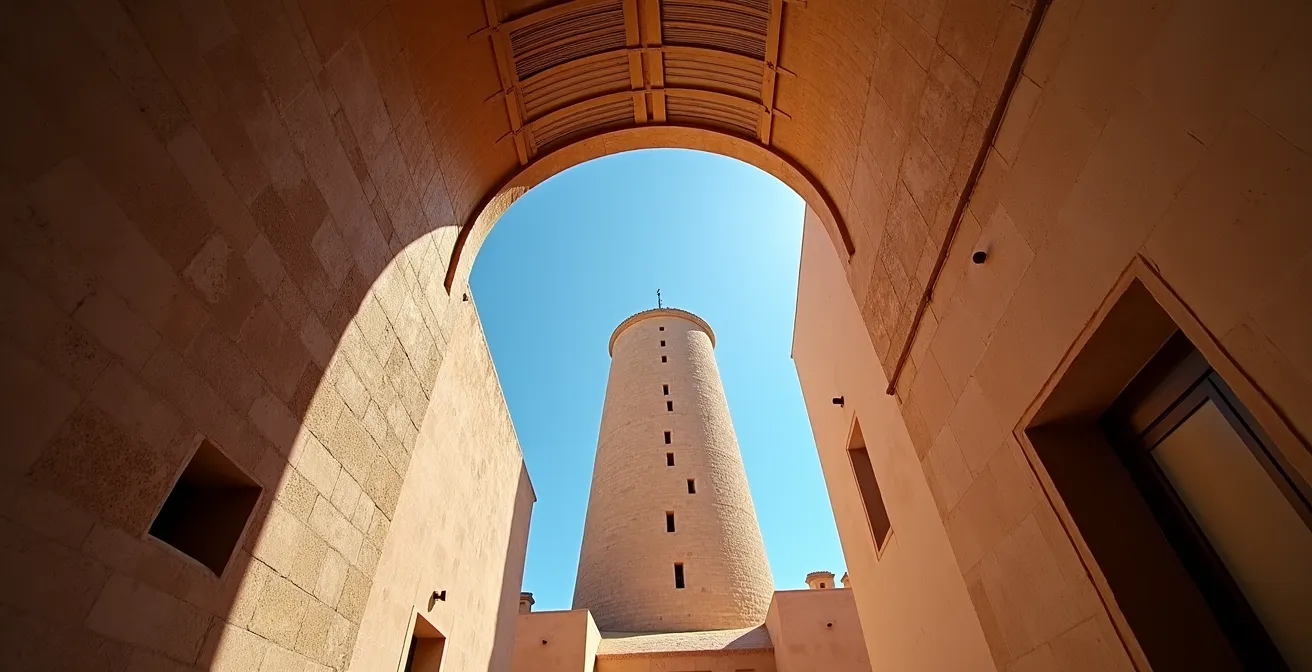
The sight of a barjeel rising above the rooftops, as shown here, is a symbol of this ancient engineering. It represents a system where architecture actively harnesses natural forces, turning the structure itself into a dynamic machine for cooling.
Why Humidity Levels Feel 15% Higher on The Crescent in August?
The perceived increase in humidity in modern developments like Palm Jumeirah’s Crescent, compared to the older parts of the city, can be explained by the stark contrast in architectural philosophy and material science. Modern urban areas are dominated by non-porous surfaces such as concrete, asphalt, and glass. These materials create a significant “Urban Heat Island” effect. They absorb and retain vast amounts of solar radiation during the day and release it slowly at night, keeping the ambient temperature elevated around the clock.
This retained heat directly impacts humidity. Warmer air can hold more moisture, so even if the absolute humidity is the same, the higher temperature in a modern development makes the “feels like” temperature and perceived humidity much greater. Furthermore, these impermeable surfaces prevent the natural absorption and evaporation of moisture that occurs in environments with soil and vegetation. Moisture from irrigation and sea spray tends to linger on the surface and in the air, trapped by the surrounding thermal mass.
In contrast, traditional towns were designed to mitigate these effects. As documented in studies of desert homes, they featured short streets, shaded alleys, and closely packed buildings made of porous materials. This layout minimized direct sunlight on the ground and walls, while the materials themselves helped regulate temperature and moisture. The lack of extensive, dark, heat-absorbing surfaces prevented the creation of a localized heat island. The traditional city’s design created a cooler, drier microclimate, making high summer humidity feel less oppressive than in a modern, concrete-heavy environment.
Key Takeaways
- Systemic Integration: No element works in isolation; the barjeel, sikkat, courtyard, and materials form a single, integrated passive cooling system.
- Material Science is Key: The porosity and thermal mass of traditional materials like coral stone are fundamental to insulating interiors and regulating humidity.
- Microclimate Management: Traditional design principles manage the climate not just inside the house, but across the entire neighborhood through shade and airflow manipulation.
How to Navigate the Al Fahidi Maze Without Google Maps?
Navigating the labyrinthine alleyways of the Al Fahidi Historic District without digital aid feels like a daunting task, but the district’s design contains its own inherent logic. Traditional wayfinding relied on observing subtle environmental and architectural cues. This approach turns navigation into an act of reading the building fabric itself, revealing a deeper layer of the area’s design intent. The key is to stop looking for street signs and start observing patterns of light, shadow, and air.
The architecture provides a map if you know how to read it. Wind towers, for instance, are not randomly oriented; they are typically aligned to catch the prevailing winds, providing a consistent directional clue. The flow of air itself can guide you, as the main thoroughfares were often designed to be the coolest and breeziest paths. The position and sharpness of shadows on the walls act as a natural sundial, indicating the time of day and cardinal directions. Even the grander doorways offer hints, as they usually face away from the harshest afternoon sun exposure.
Understanding the social hierarchy of the paths is also crucial. Wider paths were generally public thoroughfares, while the progressively narrower sikkat signified a transition into semi-private or private residential clusters. Learning to recognize these subtle shifts in scale and design helps to build a mental map of the neighborhood. This method of navigation is a direct engagement with the architectural system, using its climatic functions as your guide.
Action Plan: Navigating Al Fahidi Using Traditional Wayfinding
- Orient by Wind Towers: Observe the direction the barjeel openings face, as they are aligned with prevailing winds, offering a natural compass.
- Follow the Coolest Paths: The main thoroughfares were designed for maximum airflow and shade; if a path feels cooler, it is likely a primary route.
- Read the Shadows: Use the patterns and angles of shadows cast on the walls to determine the position of the sun and, by extension, the time of day and general direction.
- Observe Doorway Orientation: Note that the most elaborate or largest doorways typically face north or are shielded from the direct west/south sun, indicating the front of a major residence.
- Recognize Path Hierarchy: Understand the transition from wider public paths to the narrowest, semi-private sikkat to map out residential clusters.
By applying these observational techniques, navigating Al Fahidi becomes an immersive experience. The next logical step for any student of architecture is to analyze how these time-tested principles of orientation, thermal comfort, and material science can be reinterpreted and applied to inform the design of contemporary sustainable building projects in challenging climates.