
The true physical challenge of sandboarding isn’t the exhilarating ride down; it’s the brutal high-intensity interval training (HIIT) session of the climb back up, a reality that demands specific physical preparation.
- The unstable surface of sand creates significant “energy leaks,” spiking your metabolic cost and demanding more work from your stability muscles for every single step.
- Your choice of gear and technique directly impacts your energy expenditure and efficiency, determining whether you’re working smart or just working hard.
Recommendation: Treat your dune adventure like a targeted gym session. Prepare your body’s energy systems and muscular endurance for the climb, not just your board for the slide.
You see the photos: the epic glide down a golden wave of sand, a silhouette against a perfect sunset. It looks effortless, a desert-based cousin to snowboarding. So you, a reasonably fit individual, give it a try. The ride down is a 30-second thrill. And then it hits you. The long, slow, heart-pounding trudge back to the top. Suddenly, your legs feel like lead, your lungs are on fire, and you’re questioning your cardio choices. This experience is universal, and it highlights a fundamental misunderstanding of the sport. While snowboarding uses a lift to eliminate the “work” phase, sandboarding is raw, unfiltered effort. The real sport isn’t the descent; it’s the ascent.
As a fitness trainer, I see sandboarding not as a casual pastime, but as a perfect, if punishing, example of high-intensity interval training (HIIT). The short, fast ride down is your recovery interval. The grueling climb back up a dune that can be as high as 500 feet is your work interval. But unlike a stable gym floor, the sand actively works against you, draining energy with every step. Understanding the biomechanics and metabolic cost of this climb is the key to conquering the dune instead of letting it conquer you. It requires a shift in mindset: you are not just going to the desert to slide; you are going to perform a demanding athletic feat.
This guide will deconstruct the physical demands of sandboarding from a trainer’s perspective. We’ll analyze how equipment, technique, and timing are not just about performance, but about energy management. By understanding the forces at play, you can turn a day of exhausting struggle into a powerful and rewarding workout.
Summary: Why Sandboarding Is Exhausting: The Reality of Walking Back Up
- Waxing the Board: The Secret to Actually Sliding Down?
- Boots vs Socks vs Barefoot: What Works Best on Hot Sand?
- How to Fall Safely on Sand to Avoid Wrist Injuries?
- Big Red vs Fossil Rock: Which Dune Is Best for Beginners?
- Why Midday Sandboarding Is Impossible Due to Friction?
- Assessing Your Body’s ‘Feeding Time’: When Is It Safest to Tackle the Dunes?
- Harnessing Your ‘Inner Wind’: Respiratory Technique for Peak Endurance
- Insuring Your Body: Is Your Physical ‘Coverage’ Adequate for the Challenge?
Waxing the Board: The Secret to Actually Sliding Down?
From a fitness perspective, board wax isn’t just about going faster; it’s about managing your work-to-rest ratio. A poorly waxed board that sticks or slows down midway turns your “rest” interval (the slide) into another frustrating “work” interval. This drastically cuts your recovery time and accelerates muscle fatigue. The goal is to maximize the efficiency of the slide to properly recover for the next climb. This is where understanding the science of friction comes in. Effective sliding is a battle against the abrasive nature of sand. Unlike snow, sand grains create immense friction, and research from Physical Review Letters demonstrates that even small amounts of moisture can dramatically alter these frictional forces.
This is why specialized sandboard waxes are critical and function differently from snowboard waxes. They are formulated to create a slick, durable barrier between the board’s base and the sand grains. Choosing the right wax is an essential part of your energy conservation strategy. Different waxes are designed for specific temperature ranges and sand conditions. For instance, some of the most effective waxes have distinct properties:
- Race-specific waxes like Blitz are engineered for high-temperature performance. As the sand heats up, these waxes maintain their low-friction properties, ensuring a consistent and fast glide when other waxes might become sticky and increase resistance.
- All-condition waxes like Base Butter offer a harder, more versatile solution. They are effective across a broad range of temperatures and require minimal preparation, allowing for quicker starts and a reliable slide, which is crucial for preserving energy over a long session.
By selecting and applying the correct wax, you ensure your descent is a true recovery period, allowing your heart rate to lower and your muscles to clear some lactic acid before you begin the next metabolically expensive climb.
Boots vs Socks vs Barefoot: What Works Best on Hot Sand?
The choice of what to wear on your feet is a critical decision that balances protection, proprioception, and energy cost. Each option has direct biomechanical consequences for both the ride down and, more importantly, the exhausting walk back up. Your feet are your primary interface with an unstable, scorching surface, and your choice here directly influences your performance and endurance.
Barefoot: Going barefoot offers the highest level of proprioceptive feedback. Your feet can feel and react to the shifting sand, allowing for micro-adjustments in balance and board control. During the climb, your toes can dig in for better traction. However, this comes at a high cost. The sand can be incredibly abrasive, leading to blisters and cuts. More critically, sand temperatures can soar, posing a real risk of serious burns. From an endurance standpoint, the pain and tissue damage from hot, rough sand will quickly end your session.
Socks: While socks offer a thin layer of protection from the heat and abrasion, they represent the worst of both worlds. They provide almost no structural support, get filled with sand, and offer terrible traction for the climb back up. The lack of grip means you’ll experience more “energy leak”—where your effort to push off is lost as your foot slips backward—dramatically increasing the metabolic cost of the ascent.

Boots or Bindings: Using proper sandboarding boots or strap-in bindings (similar to snowboarding) provides the best protection and board control. They secure your feet, allowing for powerful energy transfer into the board for carving and stopping. For the climb, dedicated boots offer ankle support and traction. However, this comes with a weight penalty. Heavier footwear increases the energy required to lift your leg with every single step up the dune, adding to the overall cardiovascular load. The best choice is often a hybrid approach: using bindings for the ride down and carrying lightweight, breathable trail shoes for the climb up.
How to Fall Safely on Sand to Avoid Wrist Injuries?
In any high-intensity sport, preventing injury is paramount to consistent training and performance. A single bad fall can end your day and set back your fitness goals. On sand, falling is not like falling on snow or water. As sandboarding safety experts note, sand is unforgiving.
Sand behaves as a non-Newtonian fluid on impact – it’s abrasive and doesn’t cushion uniformly.
– Sandboarding safety experts, TryCrawl Sandboarding Guide
This means it can feel soft one moment and rock-hard the next, and its abrasive texture can easily cause skin injuries. The most common mistake is reaching out with your hands to break a fall, which often leads to sprained or broken wrists. The key to falling safely is to dissipate the impact across the largest, most-muscled areas of your body. If you feel yourself losing balance, commit to the fall. Bend your knees, lower your center of gravity, and try to fall onto your back or side. The goal is to roll with the momentum rather than fighting it. Think of it as a controlled surrender to gravity. Attempting to dig in your heels to stop suddenly can also be dangerous, as it can cause the board to whip around and throw you off balance unpredictably.
Proper falling technique is a skill that protects your body, your primary athletic asset. Just as you train your muscles to perform, you must train your reflexes to react correctly in a fall. Safety gear, especially a helmet and knee pads, is not optional; it’s essential equipment for mitigating the inevitable. Before you even step on the board, your body must be prepared for the physical demands and potential impacts of the sport.
Your Pre-Dune Physical Readiness Checklist: Is Your Body Truly Prepared?
- Core Stability Screen: Can you hold a plank for at least 60 seconds? Your core is the foundation for balance on the board and for maintaining posture during the exhausting climb. A weak core leads to poor form and potential back injury.
- Lower Body Power Test: Perform 15-20 bodyweight squats with perfect form. This assesses the baseline strength in your glutes, quads, and hamstrings—the primary engines for both the ride and the grueling ascent.
- Cardiovascular Baseline Check: Can you sustain a moderate-intensity activity (like jogging) for 20 minutes without reaching exhaustion? The climb is a test of your anaerobic threshold; this baseline check ensures your cardio system is ready for the challenge.
- Flexibility & Mobility Screen: Sit on the floor with legs straight and try to touch your toes. This simple test indicates hamstring and lower back flexibility, crucial for absorbing shock and preventing muscle strains during falls.
- Hydration & Fueling Plan: Have you planned your pre-activity meal and water intake? Arriving at the dune under-fueled or dehydrated is like starting a workout with an empty tank—performance will plummet and the risk of heat-related illness skyrockets.
Big Red vs Fossil Rock: Which Dune Is Best for Beginners?
Choosing your training ground is a core principle of progressive overload in fitness. You wouldn’t send a novice weightlifter to attempt a personal record on their first day, and the same logic applies to sandboarding. Selecting the right dune is not about finding the most “Instagrammable” peak; it’s about matching the intensity of the challenge to your current physical capacity and skill level. Starting on a dune that is too steep or large is a recipe for rapid exhaustion and potential injury, providing a poor training stimulus.
The characteristics of a dune—its slope angle, height, and sand consistency—dictate the physical demands. For a beginner, the primary goal is to build confidence and technique while conditioning the body for the unique stress of climbing on sand. A gentle, smaller dune allows for more repetitions. More reps mean more practice with balance, turning, and stopping, and it allows your cardiovascular system to adapt to the climb without pushing you past your anaerobic threshold on the very first attempt. The table below illustrates how slope affects difficulty.
This comparative analysis shows why dune selection is a strategic part of your training plan.
| Dune Type | Slope Angle | Surface Quality | Difficulty |
|---|---|---|---|
| Steep Dunes | >30° | Requires high speed to maintain glide; similar to deep powder. | Advanced |
| Moderate Slopes | 20-30° | Balanced speed and control, ideal for skill progression. | Intermediate |
| Gentle Hills | <20° | Insufficient momentum for long glides; best for learning basics. | Beginner |
As experts from the Oregon Dunes suggest, the strategy is to “practice on small dunes. Then you can move to the larger dunes.” This graduated approach ensures your body and skills develop in tandem. For beginners, the best dune is not the tallest one, but the one that allows for the most productive practice and conditioning. It’s about building a solid foundation before tackling the monumental climbs.
Why Midday Sandboarding Is Impossible Due to Friction?
Attempting to sandboard in the middle of a hot day is not just uncomfortable; it’s often physically impossible due to the laws of physics. As the sun beats down, the sand temperature skyrockets. This has a direct and dramatic effect on the friction between your board and the sand. From a physics standpoint, friction is the force that resists motion, and as physics research confirms that, the energy lost to friction is converted into thermal energy. But the reverse is also true: increased thermal energy can dramatically affect frictional forces.
In the context of sandboarding, extreme heat makes the sand “stickier.” The microscopic interactions between the hot sand grains and your board’s base increase the coefficient of friction. No matter how hard you push off, the board simply won’t glide. This transforms the sport from a dynamic activity into a stationary, frustrating exercise. Your planned “rest” interval—the slide down—vanishes completely. Instead, you’re left standing on a scorching slope, expending energy just to stay upright.
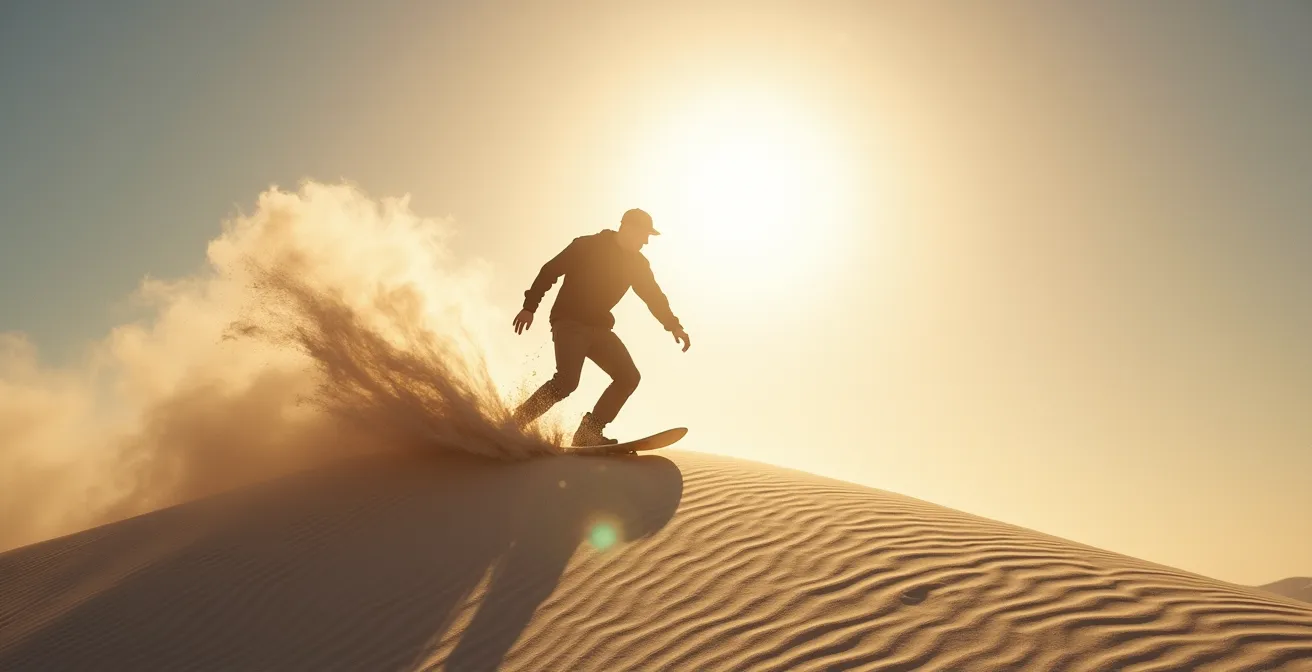
This is where specialized equipment and timing become paramount. Wax specialists confirm that “as the heat increases with the angle of the sun directly on the dune, graphite and petroleum based waxes are needed to overcome the increased friction.” Even with the best wax, there’s a point of diminishing returns. The sheer intensity of midday heat creates so much resistance that even advanced waxes struggle to perform. From a training perspective, this is a non-starter. You get no glide, no recovery, and expose yourself to dangerous levels of heat. The most intelligent training decision you can make is to avoid these conditions entirely. The optimal times for sandboarding are early in the morning or late in the afternoon when the sand is cooler, the friction is lower, and the environment is conducive to an effective workout.
Key Takeaways
- Sandboarding is a HIIT workout: The real challenge is the metabolically demanding climb, not the ride.
- Energy management is crucial: Your gear, technique, and timing directly impact your stamina by minimizing ‘energy leaks’.
- Progressive overload applies: Start on smaller dunes to condition your body before tackling larger, more exhausting climbs.
Assessing Your Body’s ‘Feeding Time’: When Is It Safest to Tackle the Dunes?
In the world of extreme sports, timing is everything. A diver knows not to enter the water during a shark’s peak feeding time because it needlessly increases risk. The same strategic thinking must be applied to your own body when preparing for a physically demanding activity like sandboarding. Tackling a massive dune is an all-out assault on your energy systems, and showing up unprepared is the equivalent of jumping into a feeding frenzy. Your body’s “feeding time” is the period before the activity, where you must strategically load it with the fuel and hydration it needs to perform safely and effectively.
The primary fuel for the intense, repeated climbs is glycogen, the form of carbohydrates stored in your muscles and liver. Starting your session with depleted glycogen stores is a guarantee for premature fatigue, often referred to as “bonking” or “hitting the wall.” Your muscles simply run out of readily available energy, your power output plummets, and every step becomes a monumental effort. Furthermore, dehydration dramatically impairs performance. Even a small loss of body fluid can lead to a reduced blood volume, a higher heart rate, and an impaired ability to regulate body temperature—a dangerous combination in a hot desert environment that significantly increases the risk of heat exhaustion or heatstroke.
Therefore, assessing your body’s readiness is a non-negotiable safety check. This means consuming a carbohydrate-rich meal a few hours before your session and sipping water consistently in the hours leading up to it. Ignoring your body’s need for fuel is not a sign of toughness; it’s a critical strategic error that compromises performance and, more importantly, your health. Just as a diver respects the ocean’s rhythms, an athlete must respect their own body’s metabolic needs.
Harnessing Your ‘Inner Wind’: Respiratory Technique for Peak Endurance
A kitesurfer becomes an expert at reading and harnessing an external force—the wind—to generate power and speed. For the sandboarding athlete facing a grueling climb, the most critical force to master is an internal one: your own breath. Inefficient breathing is a massive energy leak that can sabotage your endurance faster than any steep slope. When your body is under intense cardiovascular stress, learning to control your respiration is like a kiter catching the perfect gust; it provides the efficiency needed to sustain effort and delay fatigue.
Most people, when exerting themselves, revert to shallow, rapid chest breathing. This method is incredibly inefficient. It fails to fully engage the diaphragm, the large muscle at the base of the lungs, and therefore doesn’t maximize oxygen intake. The solution is to practice diaphragmatic breathing, or “belly breathing.” By consciously expanding your abdomen as you inhale, you draw air deeper into your lungs, increasing oxygen uptake and improving the efficiency of gas exchange. This delivers more oxygen to your working muscles—your quads, glutes, and calves—which are screaming for it during the climb.
Beyond the type of breath, the rhythm is also key. Syncing your breath to your steps creates a powerful cadence that promotes efficiency and a meditative focus. A common technique is to use a 2:2 ratio: inhale for two steps, then exhale for two steps. As the climb gets steeper and your heart rate soars, you might switch to a 1:1 ratio. This rhythmic approach prevents you from holding your breath or breathing erratically, which can spike your heart rate and accelerate the buildup of lactic acid. Mastering your “inner wind” transforms the climb from a panicked struggle for air into a controlled, powerful ascent.
Insuring Your Body: Is Your Physical ‘Coverage’ Adequate for the Challenge?
Before undertaking any risky activity, you check your insurance policy to ensure you’re covered. When it comes to an extreme physical challenge like sandboarding, your fitness level *is* your insurance policy. It’s the coverage you’ve built through consistent training that protects you from the “disaster” of injury, extreme muscle soreness, or a day cut short by sheer exhaustion. But is your policy comprehensive enough? Does it cover the specific demands of climbing unstable, steep dunes?
A standard “general fitness” policy—a bit of jogging, some light weights—may not be sufficient. The demands of sandboarding are highly specific. Your coverage needs to include:
- High-Intensity Interval Training (HIIT): Your policy must cover repeated, near-maximal efforts. Can your cardiovascular system handle spiking your heart rate to 85-95% of its max, recovering briefly, and doing it all over again?
- Muscular Endurance & Power: Your lower body—glutes, quads, hamstrings, and calves—is the engine. Your fitness policy needs to ensure these muscles can produce sustained power to push you up the sand without cramping or failing.
- Core and Stabilizer Strength: The unstable sand requires constant micro-adjustments. A strong core and stability muscles in your hips and ankles act as your “liability coverage,” preventing the energy leaks that lead to inefficient movement and potential injury.
Now is the time to audit your physical insurance. Are there gaps in your coverage? Perhaps your cardio is strong, but your leg power is lacking. Or maybe you have strength but lack the stability and balance needed for the shifting terrain. Recognizing these gaps before you hit the dune is the most critical step in preparation.
The next logical step is to integrate these principles into your training. Start by honestly assessing your current fitness against these specific demands and build a plan that treats the dune with the athletic respect it deserves. Your body will thank you for it.