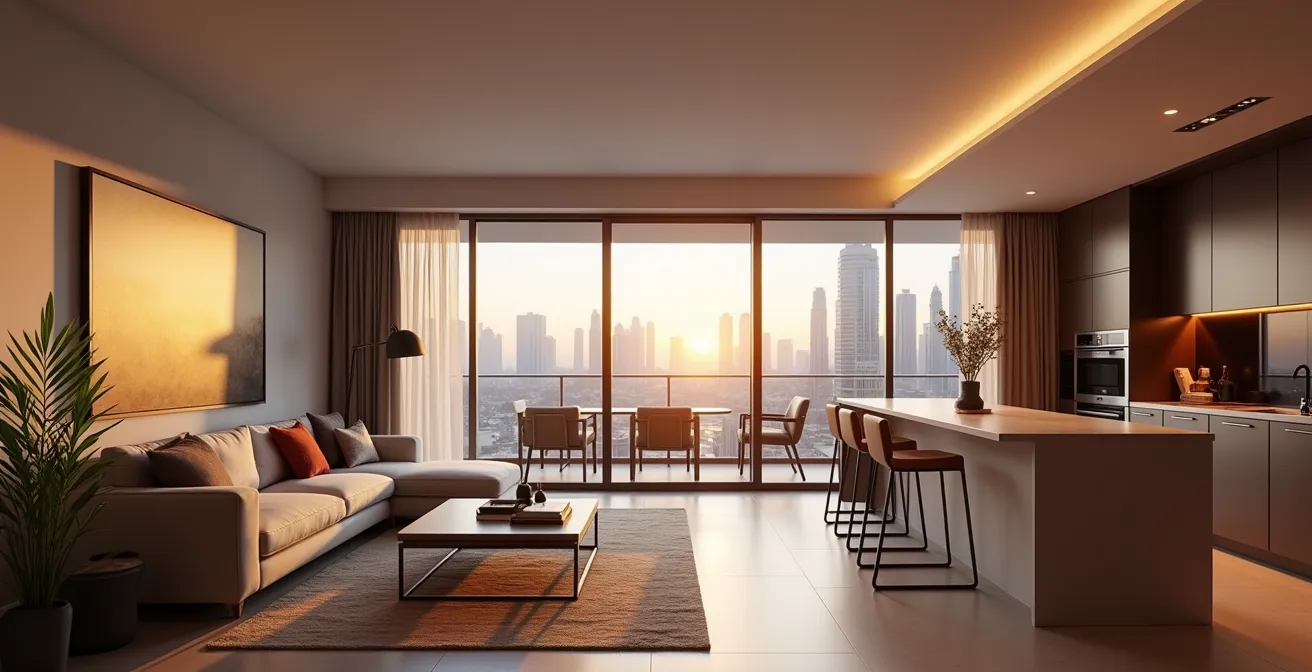
For a two-week family trip, a serviced apartment isn’t just an alternative to a hotel; it’s a superior financial system that actively contains your budget, saving upwards of $150 per day.
- Hotels maximize revenue through high-margin services (laundry, dining), creating daily budget “leakage.”
- Serviced apartments provide built-in cost controls (kitchen, laundry) that eliminate these unpredictable expenses.
Recommendation: Shift your evaluation from comparing nightly rates to auditing the total cost of living. An apartment’s higher initial price often yields a significantly lower total trip cost.
For a family planning an extended stay of two weeks or more, the choice between a hotel and a serviced apartment seems like a simple trade-off: luxury services versus more space. This is the standard travel advice, and it’s fundamentally wrong. It misses the critical financial dynamic at play. The real difference isn’t about comfort; it’s about control. A hotel is designed to extract maximum revenue per day through a dozen small, high-margin services. A serviced apartment, by contrast, operates as a cost-containment system, giving you the tools to manage and drastically reduce the “per-diem leakage” that quietly drains a family’s travel budget.
The common wisdom focuses on the obvious—you can cook your own meals. But the true value lies in a series of strategic advantages that compound daily. It’s about eliminating the forced expense of restaurant meals three times a day, sidestepping exorbitant hotel laundry fees, and gaining spatial privacy that has tangible value for a family’s sanity. It’s about understanding how a flat, one-time tourism fee for an apartment is more efficient than a nightly, per-room hotel tax that accumulates relentlessly. Instead of just looking at the nightly rate, a savvy traveler audits the entire ecosystem of expenses.
But if the core of the decision is financial, how do you quantify it? The promise of saving $150 a day isn’t based on vague feelings of being “more at home.” It’s the result of a line-item analysis of daily expenditures that a hotel structure imposes versus the lifestyle arbitrage a serviced apartment enables. This guide breaks down that analysis, moving beyond generic comparisons to provide a practical financial audit of your Dubai long-stay, proving how the right accommodation choice is your most powerful budget-management tool.
This article provides a detailed financial breakdown, exploring the specific cost centers where a serviced apartment outperforms a hotel on extended stays. The following sections offer a clear framework for making a financially sound decision for your family’s trip to Dubai.
Table of Contents: A Financial Audit of Your Dubai Stay
- Cooking in Dubai: Are Grocery Prices Higher in Hotel Zones?
- Can You Bring Visitors to Your Serviced Apartment After 10 PM?
- Tourism Dirham Fee: How to Calculate the Extra Tax Per Bedroom?
- Washer-Dryer in Room vs Hotel Laundry Service Pricing?
- Downtown Address vs Marina Address: Which Offers Better Walkability?
- Frond Living vs Apartment Living: Which Offers Better Privacy for Families?
- Old Town vs High Rise: Which Downtown Zone Offers Better Sleep Quality?
- How to Choose a Dubai Marina Tower That Isn’t Plagued by Traffic Jams?
Cooking in Dubai: Are Grocery Prices Higher in Hotel Zones?
The primary financial advantage of a serviced apartment is the kitchen, but its true value is only unlocked by understanding the geography of grocery pricing in Dubai. The convenience of a mini-mart attached to a hotel comes at a steep, often hidden, premium. These stores operate on a captive-audience model, knowing that tired travelers will pay for convenience. Opting for a serviced apartment in a residential area provides access to a competitive grocery market, which is a cornerstone of your cost-containment system.
The price difference isn’t trivial. Shopping at a hypermarket like Carrefour or Lulu in a residential neighborhood versus a small convenience store in a tourist-heavy zone like Jumeirah Beach Residence (JBR) can slash your food bill significantly. For a family, the ability to prepare breakfast, pack lunches for outings, and cook a few dinners translates into massive savings over a two-week period. This isn’t just about saving money; it’s about reallocating those funds from basic sustenance to memorable experiences. A family of four can easily spend over AED 600 ($165) on a single day of mediocre restaurant meals. A well-stocked apartment kitchen cuts that potential expense by over 80%, with a typical couple’s grocery bill ranging from AED 800 to AED 1,200 per month, showcasing the long-term affordability.
This comparative table breaks down the price markups you can expect based on store location, highlighting why neighborhood choice is paramount for budget control.
| Store Type | Location | Average Price Premium | Examples |
|---|---|---|---|
| Hotel Adjacent Mini-marts | Tourist zones | +40% markup | Near Burj Al Arab, JBR |
| Mall Supermarkets | Shopping centers | +15-20% markup | Spinneys, Waitrose |
| Residential Supermarkets | Local neighborhoods | Base prices | Carrefour, Lulu Hypermarket |
| Local Markets | Old Dubai areas | -20% below base | Deira markets |
Therefore, selecting an apartment based on its proximity to a major supermarket is a more critical financial decision than a 5% difference in the nightly rate.
Can You Bring Visitors to Your Serviced Apartment After 10 PM?
Yes, and this freedom has significant, though less obvious, financial and practical value. Hotels are inherently public spaces with strict policies on unregistered guests, often forcing you to entertain friends, family, or business colleagues in an expensive lobby bar or restaurant. This isn’t just an inconvenience; it’s a forced expense and a loss of privacy. It’s a prime example of a friction cost—an obstacle that adds stress and expense to what should be a simple social interaction.
A serviced apartment functions as your private residence. You have the autonomy to host guests in your own living room, on your own schedule, without the scrutiny of hotel staff or the need to pass through a bustling lobby. For a family staying long-term, this means you can have local friends over for a home-cooked dinner or let the kids have a playdate without it becoming a public spectacle. This autonomy is a luxury that hotels simply cannot offer. A case study on serviced apartment benefits highlights that residents enjoy complete privacy, allowing them to entertain in their own space without dealing with strict registration requirements.
However, this freedom comes with the responsibility of being a good temporary resident. Unlike a hotel, your apartment is part of a residential community. It’s crucial to respect building rules, especially regarding noise. Most residential buildings in Dubai have quiet hours, typically from 10 PM to 7 AM. Adhering to these norms ensures a pleasant stay for everyone. You should also inform the apartment provider if you expect guests for an extended period, keep common areas tidy, and generally act as a considerate neighbor, not a transient tourist. This blend of freedom and responsibility is the hallmark of apartment living.
Ultimately, the privacy of an apartment allows you to live more like a local, integrating social activities into your stay without adding to your budget.
Tourism Dirham Fee: How to Calculate the Extra Tax Per Bedroom?
The Tourism Dirham fee is a mandatory government tax on all hotel and holiday home stays in Dubai, but the way it’s calculated creates a significant financial advantage for serviced apartment renters on longer trips. Hotels charge this fee per room, per night. For a family needing two hotel rooms for 14 nights, this tax compounds quickly and becomes a substantial hidden cost. In contrast, for a serviced apartment (classified as a holiday home), the fee is charged per bedroom but is capped after 30 consecutive nights.
The hotel fee structure is variable, with the current Dubai tourism tax structure showing rates from 7 to 20 AED per room per night, depending on the hotel’s star rating. A family in two rooms at a ‘Deluxe’ hotel apartment would pay AED 40 per night (2 rooms x 20 AED). Over a 14-night stay, that’s an extra AED 560 ($152) in taxes alone. A two-bedroom serviced apartment, however, is charged the same rate but as a single unit, not two separate rooms. This small structural difference in billing demonstrates superior tax efficiency for families.
The core principle is that hotel pricing models are optimized for short stays, where nightly fees seem small. Serviced apartment pricing is built for extended stays, where the diminishing impact of one-time or capped fees provides greater value over time. This visual metaphor helps clarify the concept: the hotel’s tax is a tall, precarious stack of coins that grows daily, while the apartment’s is a lower, more stable base.

As you can see, the compounding nature of per-night, per-room fees makes a significant difference to the bottom line on an extended stay. This is a critical detail that is often overlooked when comparing headline nightly rates.
This fee structure is a perfect illustration of how the financial architecture of a serviced apartment is fundamentally more aligned with the needs of a long-stay traveler.
Washer-Dryer in Room vs Hotel Laundry Service Pricing?
The in-unit washer-dryer is one of the most underestimated financial assets of a serviced apartment. On the surface, it’s about convenience. In reality, it’s a powerful tool for eliminating one of a hotel’s most notoriously overpriced services and preventing another form of per-diem leakage. Hotel laundry services are a significant profit center, with charges that can feel punitive. A small bag of laundry can easily cost over AED 100 ($27), an expense that becomes unsustainable for a family over a two-week stay.
Even using external services is a costly alternative. A 2025 Dubai laundry market analysis reveals that a single load costs between AED 15 to AED 50. For a family of four generating multiple loads per week, this quickly adds up to hundreds of dirhams, not to mention the time and hassle of coordinating drop-offs and pickups. An in-unit machine erases this entire cost category from your budget. The freedom to do a quick load of clothes whenever needed isn’t just convenient; it’s a direct and recurring financial saving.
Moreover, the benefits extend beyond just laundry fees. As a case study on in-unit facilities highlights, the ability to wash clothes at will allows a family to pack significantly lighter. This can mean avoiding checked baggage fees, which can be $30-$60 per person, per flight segment. For a family of four on a round trip, that’s a potential saving of $240-$480 before the trip even begins. The ability to personally care for delicate items or quickly handle spills without waiting 24 hours for hotel service provides a level of control and peace of mind that has immense practical value.
This single amenity transforms your packing strategy and completely removes a recurring, high-margin travel expense from your budget, making it a critical component of the value proposition.
Downtown Address vs Marina Address: Which Offers Better Walkability?
Choosing between Dubai’s iconic neighborhoods like Downtown and the Marina isn’t just a lifestyle choice; it’s a strategic financial decision rooted in walkability. A highly walkable neighborhood directly reduces your reliance on taxis or ride-sharing services, plugging another significant source of daily budget leakage. While Downtown offers proximity to landmarks like the Burj Khalifa and Dubai Mall, the Dubai Marina generally offers superior “errand walkability” for families on extended stays. The Marina’s design, with its long, pedestrian-friendly promenade, puts grocery stores, pharmacies, cafes, and leisure activities within a pleasant, stroller-friendly walking distance of most towers.
A Downtown address might seem central, but its sprawling, highway-centric layout can often mean that a destination “next door” is actually a 15-minute taxi ride away. In the Marina, a 15-minute walk can get you to the beach, a supermarket, a dozen restaurants, and a tram station. This ability to handle daily needs on foot is a form of lifestyle arbitrage, allowing you to save the AED 30-50 per day that might otherwise be spent on short taxi trips. Over a two-week stay, these small savings accumulate into a significant sum that can be reallocated to other activities.

Assessing walkability requires a structured approach beyond simply looking at a map. For any potential apartment, you should apply a clear set of criteria to understand the true cost and convenience of its location.
Walkability Audit: Your 5-Point Checklist for Dubai Neighborhoods
- Assess ‘Errand Walkability’: Identify the proximity of grocery stores, pharmacies, and other daily necessities. Are they within a 10-minute walk?
- Evaluate ‘Leisure Walkability’: Map out access to parks, cafes, and waterfront promenades for easy, no-cost family activities.
- Check ‘Transit Walkability’: Measure the distance to the nearest metro station or tram stop. This determines your access to the city’s affordable public transport network.
- Calculate ‘Last Mile’ Costs: Factor in potential daily taxi or ride-share expenses for reaching essential services not within walking distance.
- Consider Noise vs. Convenience: Acknowledge that highly central and walkable locations often come with higher levels of ambient activity and noise.
Ultimately, a walkable address is not just a convenience; it is an active component of your budget management strategy, minimizing daily transport costs and enhancing your quality of life.
Frond Living vs Apartment Living: Which Offers Better Privacy for Families?
For families, privacy isn’t a luxury; it’s a necessity for sanity. While a villa on a Palm Jumeirah frond offers ultimate seclusion, a multi-bedroom serviced apartment provides a far more practical and cost-effective solution for achieving essential family privacy. The key difference lies in the concept of internal versus external privacy. A standard hotel room, or even a junior suite, forces the entire family into a single, shared space. Once the children are asleep, parents are often relegated to sitting in the dark, whispering. This is a major friction cost of family travel.
A two or three-bedroom apartment creates true separation of space. It provides parents with a private living room where they can talk, watch a movie, or plan the next day’s activities after the kids are in bed. This simple feature is transformative on a long trip. As travel accommodation experts from the Compass Furnished Apartments Guide note, this separation is a direct contributor to parental well-being.
A multi-bedroom apartment provides true separation of space, allowing parents to talk or watch TV after kids are asleep. Frame this as a key to parental sanity on a family trip.
– Travel accommodation experts, Compass Furnished Apartments Guide
This isn’t just about emotional comfort; it’s about maximizing the value of your accommodation. You’re not just paying for a place to sleep; you’re investing in a functional living environment. On average, industry analysis demonstrates that serviced apartments offer 30% more space than equivalent hotel rooms. This extra square footage isn’t empty space; it’s functional zones—a kitchen, a living area, separate bedrooms—that allow a family to operate without being on top of each other. This drastically reduces the stress and friction of cohabitation, making the entire trip more enjoyable.
Choosing an apartment over a hotel room is a strategic decision to invest in the quality of your family’s time together, ensuring everyone has the space they need to relax and recharge.
Old Town vs High Rise: Which Downtown Zone Offers Better Sleep Quality?
While a Downtown address offers unparalleled access to attractions, the specific zone you choose—charming Old Town versus a modern high-rise—has a direct impact on a crucial, often-overlooked aspect of your well-being: sleep quality. Poor sleep is a significant friction cost, impacting your energy levels, mood, and overall enjoyment of the trip. The romantic appeal of Old Town’s traditional architecture can be deceptive, as these buildings often come with liabilities that affect rest.
Modern high-rise apartments, while sometimes perceived as less characterful, are generally engineered for better living conditions. They typically feature superior soundproofing, double-glazed windows that mitigate both noise and heat, and centralized, filtered HVAC systems that provide better air quality and consistent temperature control. Research on accommodation choices shows that guests in quieter locations with modern amenities report better sleep. For families with children or individuals with allergies, these features are not just nice-to-haves; they are essential for a healthy and comfortable stay. A bustling street-level environment in Old Town, with its cafes and foot traffic, can be disruptive, whereas a high-floor apartment can offer a retreat from the city’s energy.
The choice involves a trade-off between ambient noise, light pollution, and environmental controls. This table outlines the key factors to consider when evaluating a property for its sleep-friendliness.
| Factor | Old Town Buildings | Modern High-Rise |
|---|---|---|
| Noise Level | Street-level noise from bars, pedestrians | Wind noise, elevator sounds, construction |
| Soundproofing | Often poor in older buildings | Better modern insulation |
| Light Pollution | Lower, darker environments | High from adjacent buildings and advertising |
| Air Quality | Window units, variable quality | Superior filtered central HVAC systems |
For an extended stay, investing in an environment conducive to restful sleep is a direct investment in the quality of your vacation, ensuring you have the energy to make the most of every day.
Key Takeaways
- Financial Control is Key: A serviced apartment is not just cheaper; it’s a financial system that gives you control over major expense categories like food and laundry.
- Location Dictates Costs: Your apartment’s location directly impacts your daily spending on groceries and transport. A walkable, residential area offers the best value.
- Value Beyond the Rate: True value comes from “hidden” benefits like in-unit laundry (saving baggage fees), privacy (improving sanity), and superior tax efficiency on long stays.
How to Choose a Dubai Marina Tower That Isn’t Plagued by Traffic Jams?
Choosing a tower in Dubai Marina offers fantastic walkability, but this advantage can be completely negated if you’re trapped in traffic every time you use a car. The Marina’s one-way systems and limited entry/exit points can create severe bottlenecks, especially during peak hours. Selecting the right building is a strategic exercise in logistical planning. A poorly chosen tower can add 30-45 minutes of frustrating travel time to every outing, a major friction cost that erodes your vacation time.
The key is to analyze a building’s “multi-modal access score”—its efficiency for cars, public transport, and pedestrians. A prime location is not necessarily at the center of the Marina but near a major interchange, allowing for quick access to Sheikh Zayed Road without navigating the entire internal loop. Furthermore, proximity to a Metro or Tram station provides a powerful alternative, enabling you to bypass traffic altogether for city-wide excursions. With Dubai’s public transport pricing data showing an unlimited monthly pass costs around 300 AED (approx. $80 USD), leveraging the transit system is a highly effective cost- and time-saving strategy.
Before committing to an apartment, perform a thorough logistical audit. Don’t just look at the view or amenities; analyze the flow of traffic and people in and out of the building. This checklist provides a framework for making a smart, data-driven decision.
Your Traffic Avoidance Checklist for Dubai Marina Towers
- Map the Car Park Exit: Analyze the building’s exit relative to one-way systems and freeway on-ramps. How many turns until you’re on a main road?
- Check Elevator-to-Unit Ratio: Avoid towers with a high number of units per elevator (e.g., more than 20), as this creates internal “traffic jams.”
- Calculate Multi-Modal Access: Measure the walking distance to the nearest Metro/Tram station and the availability of safe walking/cycling paths.
- Simulate Peak Hour Travel: Use Google Maps’ “Depart at” feature to check estimated travel times from the building at 8:30 AM and 6:00 PM.
- Prioritize Proximity to Interchanges: Favor buildings within 200m of a main road interchange to minimize time spent in local bottlenecks.
- Verify Ride-Share Access: Check if Uber/Careem vehicles have a dedicated, safe spot to stop without blocking traffic, which is a common issue.
This level of due diligence transforms your accommodation choice from a gamble into a calculated decision that protects your most valuable asset on vacation: your time.