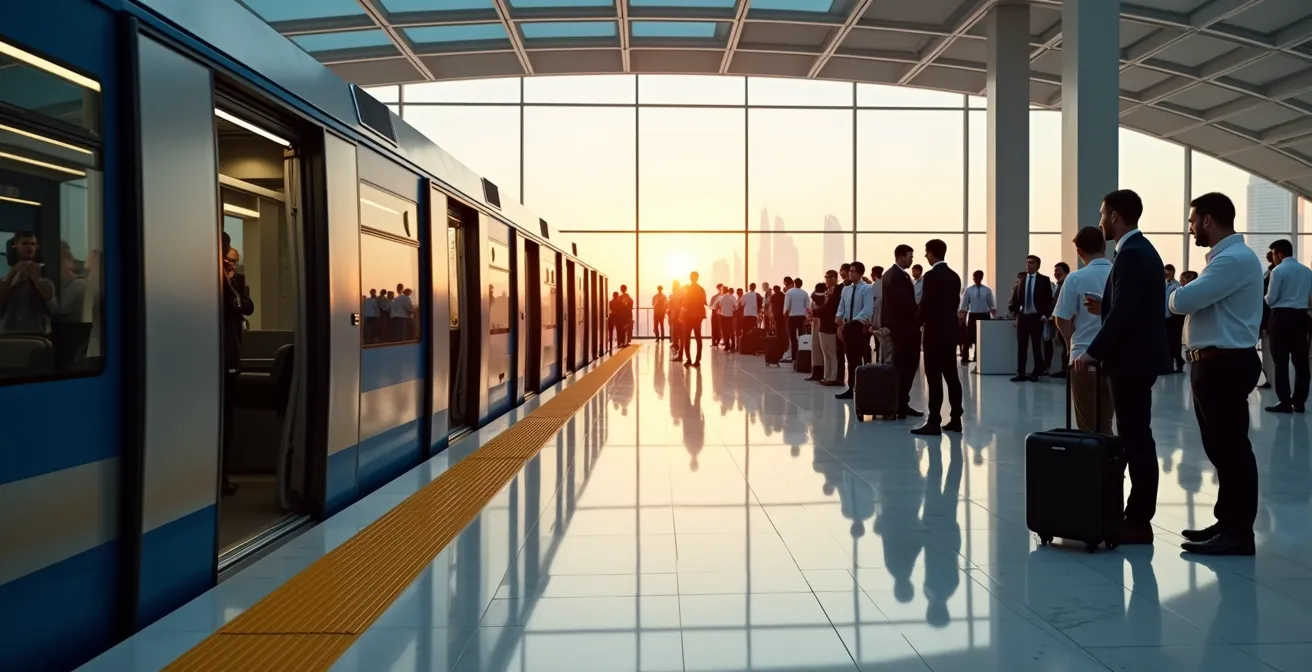
Navigating the Dubai Metro is not about memorizing a list of prohibitions; it is about understanding the system’s logic of efficiency and respect. For tourists, confusion over unspoken rules often leads to violations. This operational briefing provides the necessary intelligence on card selection, cabin integrity, and luggage protocols to ensure full compliance, thereby avoiding fines and integrating seamlessly into the network’s disciplined passenger flow.
You may consider yourself a considerate traveler. Yet, on the Dubai Metro, an action as simple as chewing gum is a breach of conduct. While the standard fine for eating or drinking is AED 100, the core principle is what matters: the system’s rules are absolute and enforced. Many tourists, accustomed to different transport cultures, inadvertently commit violations related to luggage, ticketing, or cabin selection, assuming leniency that does not exist here.
This is not another list of fines. This is an operational briefing. To navigate this network effectively, you must understand the underlying system logic. The regulations are designed to maximize passenger flow, ensure safety, and maintain a high standard of cleanliness and comfort. Compliance is not about fear of penalty; it is a matter of passenger discipline and a prerequisite for the system’s remarkable efficiency. Mastering these protocols is essential for a smooth and compliant journey.
This briefing will cover critical operational parameters for tourists. We will dissect ticketing choices, cabin zone integrity, rush hour protocols for luggage, and contingency plans for off-hour travel. Your adherence to these directives will ensure an incident-free experience.
Contents: Dubai Metro Operational Protocols
- Silver vs Red Nol Card: Which Is Best for a 5-Day Trip?
- Sheikh Zayed Road View: Which Side of the Train to Stand On?
- The Pink Cabin: Can Men Enter if It Is Empty?
- Missing the Last Train: What Are Your Options at 12:How to Find Free Parking at JBR Beach Walk on a Weekend?
- Two Suitcases Limit: Will You Be Stopped During Rush Hour?
- Water Bus vs Water Taxi: Which Is the Real Commuter Hack?
- How to Escape the Downtown Loop During New Year’s Eve Preparations?
- Is the Double Price for Gold Class Justified During Rush Hour?
Silver vs Red Nol Card: Which Is Best for a 5-Day Trip?
The choice between a Red and Silver Nol card is a primary logistical decision. The Red Nol card is a paper ticket intended for single trips or infrequent use. For a tourist on a 5-day itinerary, it is operationally inefficient, requiring repeated top-ups and offering no multi-modal benefits. The Silver Nol Card is the standard operational choice for any multi-day visit. It is a durable plastic card valid for five years, integrated across all RTA transport modes, including buses, trams, and water buses.
The primary advantage of the Silver Card is its automated daily fare cap. Once your total fares for the day reach AED 20, all subsequent travel on that day is free. This provides cost certainty and encourages use of the network. The Red Card has no such feature. While the initial AED 25 cost of the Silver Card (including AED 19 of credit) is higher than the AED 2 for the Red Card, the long-term cost-effectiveness and convenience are superior. The following table breaks down the key operational differences.
This data is based on a standard tourist travel pattern, and an analysis of Nol card usage confirms the Silver card’s superior value proposition for stays longer than two days.
| Feature | Red Nol Card | Silver Nol Card |
|---|---|---|
| Initial Cost | AED 2 | AED 25 (includes AED 19 credit) |
| Validity | 90 days | 5 years |
| Daily Cap | No automatic cap | AED 20 daily fare cap |
| Multi-Modal Use | Metro only per trip | All RTA transport modes |
| 5-Day Total Cost (avg) | AED 50-70 | AED 40-60 |
| Queue Time | 5-10 min per top-up | One-time purchase |
| Resale/Future Value | None after 90 days | Retains balance for 5 years |
Action Plan: Maximizing Silver Card Value
- Purchase your Silver Card at the airport metro station upon arrival. Avoid Red Card counters.
- Load an initial credit of AED 40-50 for a 5-day trip. Top-ups can be performed at any station.
- Utilize the card across metro, tram, buses, and water buses to benefit from the 30-minute transfer rule between modes.
- Monitor daily spending via the card reader display. Once the AED 20 cap is reached, all further trips are at zero cost.
- Retain the card for future visits or transfer it to another traveler; the balance remains valid for five years.
Sheikh Zayed Road View: Which Side of the Train to Stand On?
For optimal visual data acquisition of the Dubai skyline along the Sheikh Zayed Road corridor, positioning is critical. The Red Line of the Dubai Metro runs parallel to this main artery, offering passengers an elevated view of the cityscape. However, the most iconic landmarks, including the Burj Khalifa and the Museum of the Future, are located on one specific side.
The correct procedure is as follows: When traveling from the south (e.g., from DXB Airport, Deira) towards the south-west (e.g., towards Dubai Marina, JBR), you must position yourself on the left-hand side of the train. When traveling in the opposite direction, from the south-west towards the north-east, you must be on the right-hand side of the train. This ensures an unobstructed view of Downtown Dubai and its primary architectural assets. The forward-most cabin, which is often the Gold Class cabin, provides the most panoramic, forward-facing perspective if you have the appropriate ticket.
This vantage point provides a clear, moving panorama of the city’s development. The large, clean windows of the train are designed for this purpose.
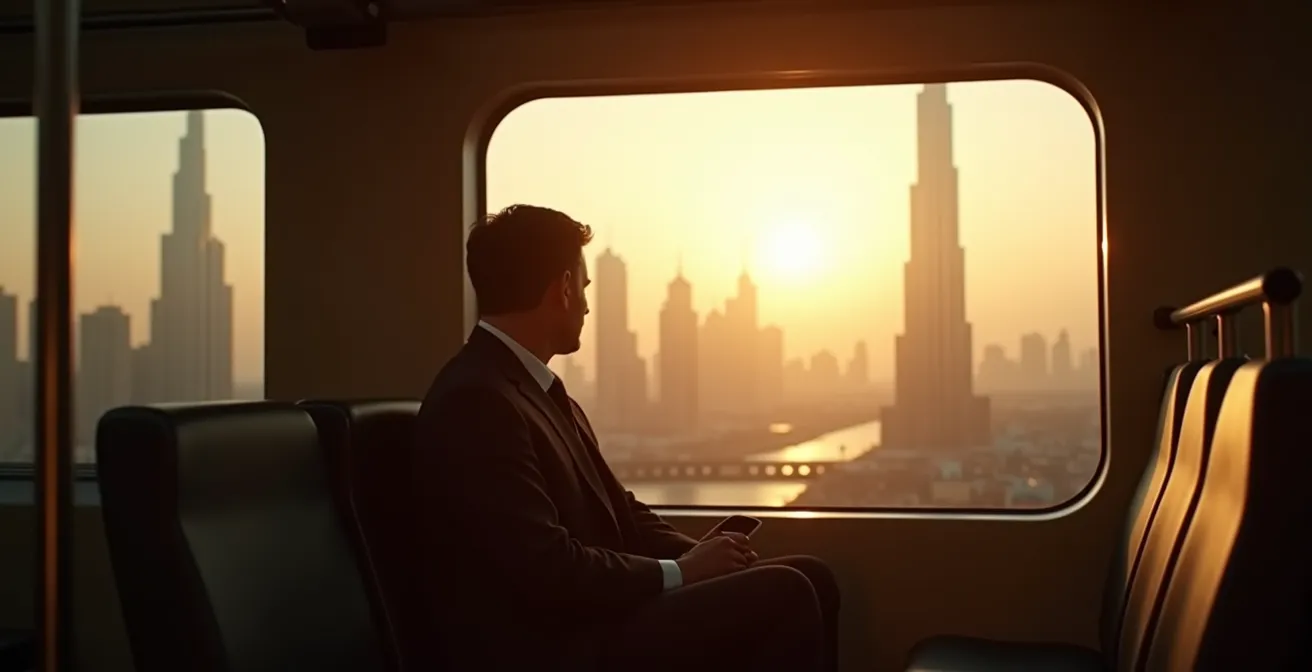
As the image demonstrates, the perspective from within the cabin frames the skyline effectively. Failure to position correctly will result in a view of the opposite side of the highway, which is of limited architectural or touristic interest. Plan your position before the train becomes crowded to secure a viewing spot. Passenger discipline includes allowing others to view and take photographs without obstruction.
The Pink Cabin: Can Men Enter if It Is Empty?
The answer is unequivocal: No. The designated Women & Children’s cabin, identifiable by the pink signage on the platform and inside the train, is a restricted zone. The rule is not conditional on the cabin’s occupancy. A man is prohibited from entering this section at any time, even if it is completely empty. The integrity of this zone is strictly maintained.
This regulation is not merely a suggestion; it is a matter of law and is actively enforced. Violators are subject to an immediate AED 100 fine. Enforcement is not sporadic. Patrols are regular, and station CCTV is monitored. Data confirms the high rate of enforcement, with approximately 2,400 male passengers fined monthly for this specific violation. Ignorance of the rule is not considered a valid defense. The pink markings are clear and universally understood within the system.
For male travelers accompanying female partners or family, the correct protocol is to travel together in the standard silver class cabins. Women are not required to use the pink cabin; it is an option provided for their comfort and privacy. Children (boys under 10 and all girls) may accompany a woman in this section. Adherence to this rule is a fundamental aspect of passenger discipline and shows respect for the system’s social contract.
- Before boarding: If traveling as a couple and choosing to separate, pre-arrange a meeting point in an adjacent standard cabin.
- On the platform: Women may wait at the pink markers, while men position themselves at the entrance to the next cabin.
– During rush hour: It is often more practical for groups and couples to remain together in the standard cabins.
Missing the Last Train: What Are Your Options at 12:How to Find Free Parking at JBR Beach Walk on a Weekend?
This section addresses two distinct logistical challenges: post-operational hour transport and vehicle integration at a key destination. Both require advance planning to avoid significant cost and time penalties.
Post-Midnight Contingencies: The Dubai Metro typically ceases operations around midnight. Missing the last train, especially in major hubs like Downtown, requires immediate activation of a contingency plan. While ride-hailing apps are available, they are subject to extreme surge pricing during closing times and special events. The RTA taxi is a more reliable and often cheaper option. However, the most cost-effective solution is the RTA Night Bus service, which shadows major metro lines. For instance, the N55 route provides service from the Dubai Mall area towards the Marina. As the table below indicates, the cost-to-time ratio varies significantly between options.
The data from the official public transport guide highlights the economic viability of RTA-operated alternatives over private services during peak demand.
| Option | Cost (to Marina from Downtown) | Availability | Journey Time |
|---|---|---|---|
| RTA Taxi (street hail) | AED 45-55 | High at main stations | 20-25 min |
| Careem/Uber | AED 60-120 (surge pricing) | 5-15 min wait | 20-25 min |
| Night Bus (N55) | AED 5 | Every 30 min until 2 AM | 45-60 min |
| Hotel Shuttle | Free (if guest) | Varies by hotel | 30-45 min |
Vehicle Parking and Tram Interface at JBR: Finding free parking at Jumeirah Beach Residence (JBR) on a weekend is not feasible. All prime parking is paid and limited. The correct operational procedure is not to seek parking at the destination but to use a park-and-ride strategy. The DMCC Metro Station offers a large, free multi-story car park that is underutilized on weekends. From there, you interface with the tram system for the final approach to JBR.
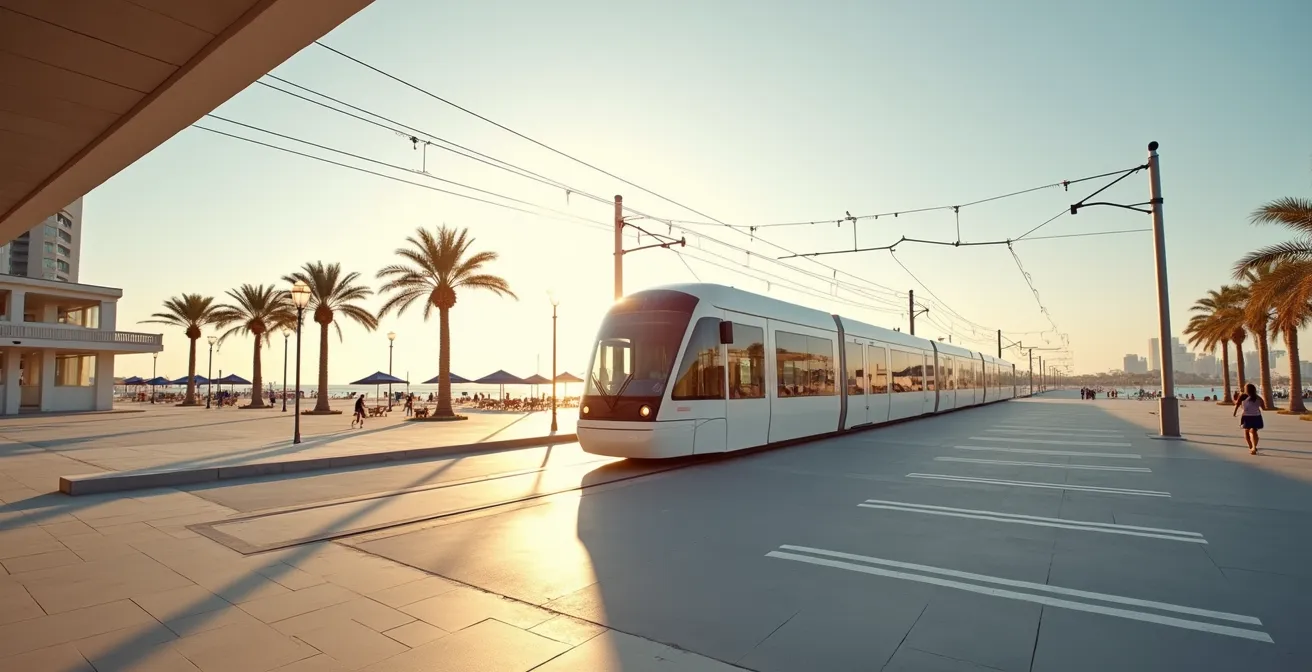
The Dubai Tram is fully integrated with the metro. By parking at DMCC, you take a short metro ride one stop to Sobha Realty, then transfer directly to the tram, which will take you to the JBR 1 or JBR 2 stations. This entire journey takes approximately 15 minutes and costs a fraction of the price of JBR parking, while avoiding all road traffic. This is the official and most efficient method.
Two Suitcases Limit: Will You Be Stopped During Rush Hour?
The official RTA regulation permits each passenger to carry two pieces of luggage: one large suitcase (dimensions not exceeding 81cm x 58cm x 30cm) and one small carry-on bag (dimensions not exceeding 55cm x 38cm x 20cm). The probability of being stopped and questioned is directly correlated with two factors: time of day and location.
Enforcement is not arbitrary; it is a function of maintaining passenger flow. During off-peak hours, you are unlikely to be challenged even if your luggage slightly exceeds the limit, provided it is not causing an obstruction. However, during peak hours (approximately 07:00-09:00 and 17:00-19:00), enforcement protocol is significantly heightened. This is especially true at major interchange stations like Union and Burjuman, where passenger density is highest. Analysis shows that 87% of luggage-related warnings are issued during these times and at these locations. A passenger with excessive luggage during rush hour impedes movement and can be a safety hazard, which will trigger an intervention from RTA staff.
For tourists traveling to or from the airport with luggage, the following strategy is advised:
- Travel during off-peak hours if possible (e.g., between 10:00 and 15:00).
- Use the designated wide-access gates, which are designed for passengers with luggage.
- Board the first or last cabin of the train, as these have larger dedicated luggage storage areas.
- Keep luggage stowed vertically in the designated zones, never blocking aisles or doorways.
- If you must travel during peak hours, be prepared to wait for a less crowded train to find adequate space.
If your luggage exceeds the permitted amount, the only compliant option is to use an airport taxi. Attempting to board the metro with excessive luggage during rush hour will result in being denied entry and will cause delays.
Water Bus vs Water Taxi: Which Is the Real Commuter Hack?
Both the Water Bus and Water Taxi are components of the RTA’s marine transport network, but they serve different operational purposes. Neither is a “hack” in the sense of a loophole; they are tactical options for specific scenarios. The correct choice depends on your primary objective: cost-efficiency or time-sensitivity.
The Water Bus operates on fixed routes and schedules, much like a terrestrial bus. It is integrated with the Nol card system, and fares are low (AED 2-4 per trip), counting towards your daily cap. It is the ideal choice for scenic, low-cost travel, particularly for crossing the Dubai Creek or for leisurely journeys around the Marina. It is not a time-saving tool; its pace is deliberate.
The Water Taxi, conversely, is an on-demand, high-speed service. It is significantly more expensive and is not integrated with the Nol card system. Its primary function is as a tactical traffic bypass. It excels in point-to-point journeys in heavily congested areas like the Dubai Marina, where a short trip by water can be three to four times faster than the equivalent journey by road during rush hour.
Case Study: The Marina Traffic Bypass
A resident commuting from Dubai Marina Mall to Bluewaters Island during evening rush hour faced a 35-45 minute journey by car due to heavy traffic, at a cost of AED 30-40. By using the Water Taxi, the journey time was reduced to just 12 minutes. The cost was AED 20, representing a significant time saving for a negligible cost increase. This demonstrates the Water Taxi’s value as a time-sensitive commuter tool, not a budget travel option.
The following table clarifies the operational trade-offs:
| Feature | Water Bus | Water Taxi (Shared) |
|---|---|---|
| Cost per person | AED 2-4 with Nol | AED 15-25 |
| Schedule | Fixed timetable (every 15-30 min) | On-demand |
| Journey Time (Marina to Bluewaters) | 35 minutes | 12 minutes |
| Nol Card Integration | Yes – counts toward daily cap | No – cash/card only |
| Group of 4 Cost | AED 8-16 | AED 60-75 (full boat) |
| Best For | Scenic Creek tours, regular commutes | Time-sensitive trips, groups |
How to Escape the Downtown Loop During New Year’s Eve Preparations?
New Year’s Eve in Downtown Dubai is a maximum-density event. Standard transport protocols are suspended, and special measures are enacted. Viewing the event is straightforward; exiting is a complex logistical challenge. Failure to have a pre-planned exfiltration strategy will result in hours of delay.
The primary error is attempting to exit from the event’s epicenter after the fireworks conclude. The Burj Khalifa/Dubai Mall Metro Station is the focal point of the crowd and is closed to entry for crowd control purposes hours before midnight. RTA protocols confirm that this closure can happen as early as 4 PM, affecting over 200,000 visitors seeking to use it. Attempting to use this station for exit is a critical tactical error.
The correct strategy involves a preemptive move to a perimeter station *before* the event concludes. Stations such as Business Bay and Financial Centre on the Red Line, or Al Jadaf on the Green Line, remain operational and are located outside the primary crush zone. The following timeline is a mandatory procedure for a successful exit:
- 23:45: Begin movement. Disengage from your viewing position and start walking towards your pre-selected perimeter station (e.g., Business Bay). Do not wait for the fireworks to end.
- 00:05: Immediately after the main display, you should already be on the platform. Board the *first available train* in any direction to simply move out of the immediate hot zone. You can change trains and re-route at a later, less congested station.
- 00:15: Exit at a station at least 2-3 kilometers away from Downtown, such as World Trade Centre. From this location, you can hail a taxi or book a ride-hailing service with a higher chance of success and without surge pricing.
- Alternative Route: The Al Jadaf station on the Green Line is often overlooked. It requires a 15-20 minute walk from the Downtown area but completely bypasses the Red Line crowds.
Waiting until 00:30 to begin your exit will trap you in a stationary crowd for up to two hours. Preemption is the only viable strategy.
Key Takeaways
- The Silver Nol card is the standard operational choice for any tourist stay exceeding one day due to its daily cap and multi-modal integration.
- The integrity of designated zones, specifically the Gold Class and Women & Children’s cabins, is strictly enforced with immediate fines for non-compliance.
- Operational protocols change drastically during peak hours and major events; luggage rules are stricter, and standard station access may be suspended. Advance planning is mandatory.
Is the Double Price for Gold Class Justified During Rush Hour?
The Gold Class cabin is not a luxury; it is a tactical tool. Its fare is exactly double that of a standard Silver Class journey. The justification for this cost is not based on comfort alone, but on a quantifiable return on investment in time, personal space, and productivity, particularly during peak operational hours.
During rush hour, standard cabins frequently reach maximum capacity, forcing passengers at busy stations like Union or Burjuman to wait for two or three trains to pass before being able to board. This can add 10-15 minutes to a single journey. The Gold Class cabin, due to its higher price point, consistently has available space, guaranteeing boarding on the first arriving train. The premium leather seats and panoramic views are secondary benefits; the primary benefit is time efficiency.

The value proposition becomes clear when analyzed over a period of time. A quieter, less crowded environment also allows for a productive commute, enabling passengers to make phone calls or work on a laptop—activities that are impossible in a crowded standard cabin.
Case Study: Gold Class Commuter Analysis
A daily commuter from Deira to Dubai Marina calculated that using Gold Class saved him an average of 50 minutes per week. The 10-minute wait saved at Union Station each evening amounted to a significant time recovery over a month. The additional monthly cost of AED 200 for Gold fares translated to an effective rate of AED 10 per hour of time saved. Furthermore, the ability to conduct work calls during his commute effectively extended his productive workday by approximately 40 minutes daily.
The decision to use Gold Class is therefore a strategic one. If your time is valuable and you need a guaranteed, efficient, and productive journey during peak hours, the double price is not only justified but is a sound investment. If your priority is purely cost minimization and you are traveling off-peak, the standard cabin is sufficient.
Assess your journey’s operational requirements. Select the transport class that aligns with your mission’s priority: absolute cost minimization or time-efficiency and productivity.