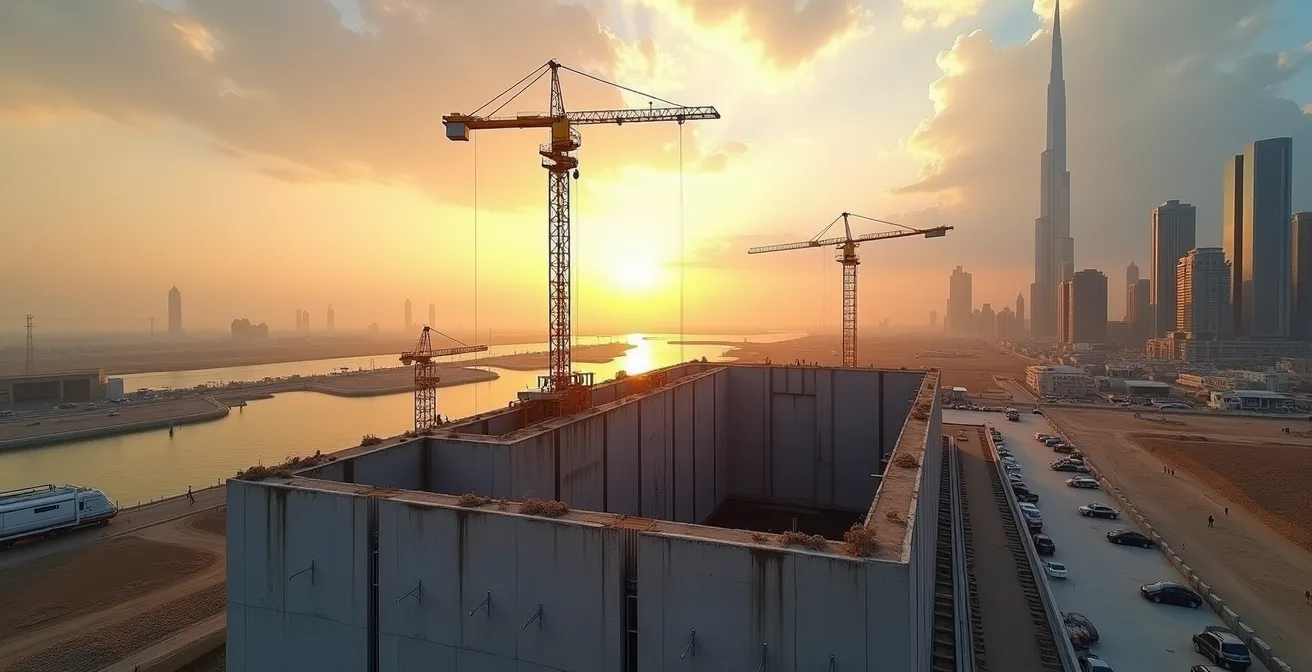
Contrary to common concerns, the investment value of Dubai Creek Harbour no longer depends on the Creek Tower breaking world height records.
- The project’s recent redesign signals a strategic pivot from a monumental icon to a commercially viable district anchor.
- The development’s core fundamentals, from its record-breaking foundation to its environmental planning, suggest underlying long-term resilience.
Recommendation: Investors should assess their property’s value based on the Creek Harbour’s evolution as a self-sustaining community, not solely on the uncertain ‘tower view’ premium.
For any real estate investor with a stake in Dubai Creek Harbour, the towering, silent foundation of the Dubai Creek Tower has become a source of significant apprehension. The initial vision was a structure that would pierce the clouds and redefine skylines, promising unparalleled prestige and a substantial ‘tower view’ premium for surrounding properties. However, years of perceived inaction and recent announcements of a major redesign have shifted the narrative from one of ambitious triumph to one of cautious uncertainty. This leaves investors grappling with a critical question: is the dream on hold, or is it fundamentally changing?
Many analyses focus on the simple facts of construction timelines and the competition for the “world’s tallest” title. But this perspective misses the larger strategic recalibration underway. The key to understanding the future value of your off-plan property isn’t found in speculating on a completion date. Instead, it lies in deciphering the shift in Emaar’s strategy—from building a record-breaking monument to cultivating a commercially sustainable and integrated community hub. This is no longer just about vertical height; it’s about horizontal value across the entire district.
This analysis will move beyond the headlines. We will dissect the technical and economic realities shaping the tower’s future, from its structural classification and foundational engineering to its environmental context. By examining these core components, we can build a more informed, speculative framework for what the tower’s evolution means for property values and the long-term viability of an investment in Dubai Creek Harbour.
For those who prefer a visual update, the following video offers a recent perspective on the project’s renewed activity, providing context for the speculative analysis in this guide.
To fully grasp the implications for your investment, this article breaks down the critical factors influencing the tower’s future and its impact on the surrounding real estate market. The following sections will guide you through the technical definitions, design philosophies, and economic scenarios that matter most.
Summary: Analyzing the Future of Dubai Creek Tower and Its Real Estate Impact
- Creek Tower vs Burj Khalifa: Why Cable-Tied Towers Don’t Count as Buildings?
- The Pinnacle Room: Will It Really Offer 360 Views?
- Buying in Creek Harbour: Is the ‘Tower View’ Premium Worth It Today?
- The Lily Flower Design: How Biomimicry Shaped the Structure?
- Understanding the Foundation: Why Did Piling Take So Long?
- What Time to Book Your Slot to Catch Both Day and Night Views?
- Artificial Reefs: How Floating Homes Affect Local Marine Life?
- At The Top Sky vs Level 124: Is the $100 Upgrade Really Worth the View?
Creek Tower vs Burj Khalifa: Why Cable-Tied Towers Don’t Count as Buildings?
A primary source of confusion for investors is the tower’s very definition. Unlike the Burj Khalifa, a self-supporting skyscraper, the Dubai Creek Tower is a cable-stayed observation tower. This distinction is not just semantic; it has profound implications for its function and value. The Council on Tall Buildings and Urban Habitat (CTBUH), the global arbiter for building height, has a “50% rule”: for a structure to be classified as a ‘building’, at least half of its height must be occupied by habitable floor space. The Creek Tower was never designed to meet this. In fact, analysis based on its original design shows that less than 30% of its height will have habitable floors. Its value was always intended to come from its status as an icon and a tourist destination, not from residential or office space within the structure itself.
This structural reality aligns perfectly with the recent strategic shift announced by Emaar. In early 2024, it was confirmed that the original 1,300-meter-plus ambition was being shelved. According to an announcement from Emaar’s Mohamed Alabbar, the tower would be redesigned with a reduced height, making it shorter than the 828-meter Burj Khalifa. This isn’t necessarily a sign of failure but rather a pragmatic investment recalibration. By letting go of the costly and complex race for the “world’s tallest” title, the developer can focus on creating a beautiful, functional, and, most importantly, commercially viable landmark that can be completed more efficiently and serve as a powerful anchor for the Creek Harbour community. For an investor, this signals a move from a high-risk, high-prestige gamble to a more predictable, value-oriented development strategy.
The Pinnacle Room: Will It Really Offer 360 Views?
Despite the redesign, understanding the original architectural vision is key to appreciating the quality and ambition that still underpin the project. The apex of the original design was to be a breathtaking series of observation decks, culminating in a feature known as the Pinnacle Room. This was not envisioned as a simple viewing platform but as the jewel in the tower’s crown, a destination in itself. According to the project’s engineering consultants, the design was ambitious and clear: as Aurecon Engineering noted in the technical specifications, “At the top will be an oval-shaped bud, housing ten observation decks, including The Pinnacle Room, which will offer 360-degree views of the city.” This promise of an unparalleled, panoramic experience was a core part of the tower’s initial allure.
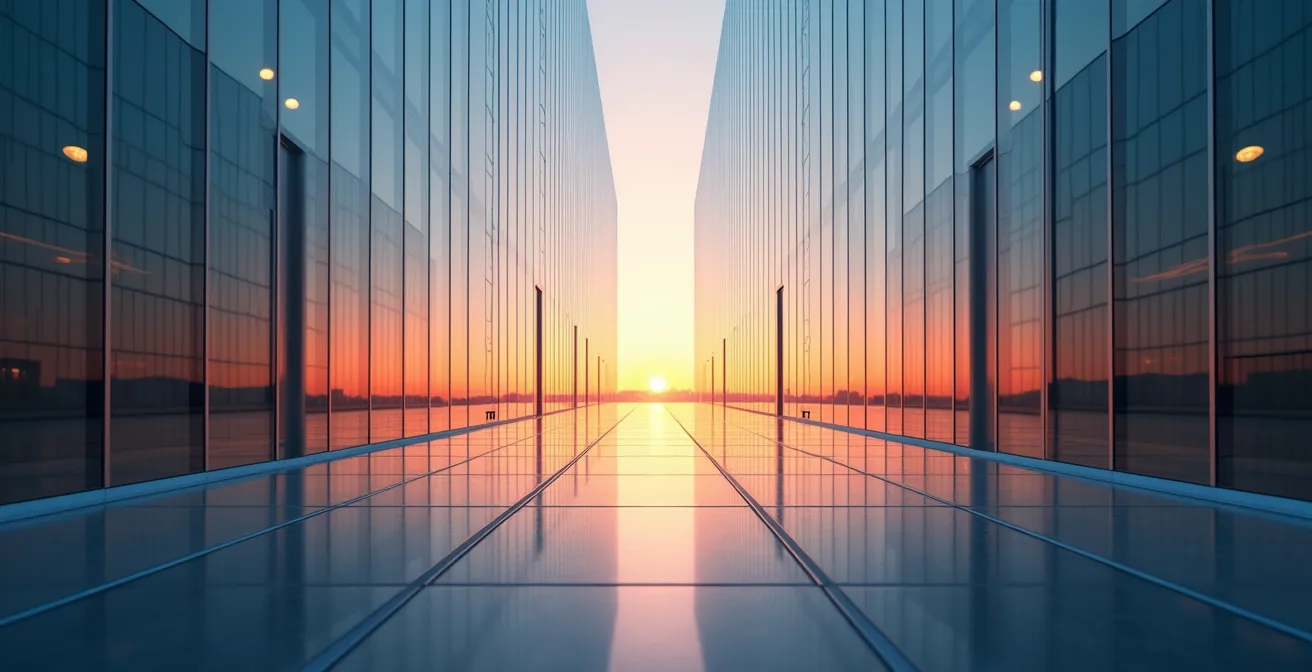
The concept was to create an experience that would surpass any other observation deck in the world, not just in height but in the quality of the vista. The visual below captures the essence of what this space was intended to feel like—an ethereal pod floating above the cityscape, offering uninterrupted sightlines from the urban core of Downtown Dubai to the natural landscapes beyond.
While the final form of the redesigned tower is yet to be revealed, it is highly probable that a world-class observation experience will remain a central feature. The developer understands that the tower’s primary function is as a tourist magnet. Therefore, even at a reduced height, a spectacular 360-degree viewing deck is a non-negotiable element for ensuring its commercial viability. The question for investors is not *if* there will be an observation deck, but how the new design will execute this vision to draw visitors and energize the surrounding area.
Buying in Creek Harbour: Is the ‘Tower View’ Premium Worth It Today?
For property owners, this is the most pressing question: with the tower’s final form uncertain, what is a “tower view” actually worth? The premium paid for such properties was based on the promise of a record-breaking, iconic structure. Now, that premium is subject to significant speculation. While recent development reports confirm that the foundations are complete and work is expected to continue, the final aesthetic and scale remain unknown. This uncertainty introduces risk, and investors must move beyond a simple reliance on the “view” and analyze the underlying value of their asset based on more resilient factors.
The investment logic now requires a scenario-based approach. The value of a property in Creek Harbour is no longer a single trajectory but a set of potential outcomes, each with different implications for property value and rental yields. The following table outlines three plausible scenarios, providing a framework for investors to assess their risk exposure. As the analysis shows, even in a delayed or scaled-down scenario, the intrinsic value of the location is expected to provide a stable foundation for rental yields.
| Scenario | Property Value Impact | Rental Yield Projection | Risk Level |
|---|---|---|---|
| Tower Completed (2025-2027) | +15-25% premium for tower views | 6-8% annual | Medium |
| Tower Delayed/Scaled Down | Stable, location-based value | 5-6% annual | Low-Medium |
| Tower Cancelled | -5-10% initial drop, recovery based on area development | 4-5% annual | High |
This data suggests that while the upside of the full-height tower is significant, the downside of a scaled-down version is manageable, supported by the area’s other amenities and strategic location. The ‘cancellation’ scenario, while carrying the highest risk, is also the least likely given the immense capital already invested in the foundation and the developer’s public commitment to a new design. Therefore, the ‘view premium’ should be seen as a potential bonus, not the core thesis of the investment.
Action Plan: Auditing Your ‘Tower View’ Investment
- Asset Location: Pinpoint your property’s exact line of sight. Is the view direct and unobstructed, or partial? A partial view carries a lower premium and less risk.
- Premium Paid: Quantify the percentage premium you paid specifically for the “tower view” at the time of purchase compared to similar non-view units. This is your specific risk exposure.
- Community Maturity: Assess the value derived from other local amenities. How close are you to the waterfront promenade, retail outlets, and parks? These provide a baseline value independent of the tower.
- Rental Yield Analysis: Compare current rental yields in Creek Harbour for view vs. non-view apartments. Is there still a significant gap? This indicates current market sentiment.
- Future-Proofing Strategy: Based on the scenarios above, define your holding strategy. Is your plan to sell on completion (higher risk, higher reward) or hold for long-term rental income (lower risk, stable returns)?
The Lily Flower Design: How Biomimicry Shaped the Structure?
The tower’s immense value, even in a redesigned state, is rooted in its extraordinary design by renowned architect Santiago Calatrava. His proposal was selected for its elegant and culturally resonant form, a concept grounded in biomimicry—the practice of drawing inspiration from nature to solve complex engineering challenges. As stated in the official project description by his firm, Calatrava’s design is “influenced by the natural forms of the lily and evokes the shape of a minaret, a distinctive architectural feature in Islamic culture.” This dual inspiration gives the tower a deeply symbolic and organic quality that distinguishes it from purely functional structures.
This “lily” concept is not merely decorative; it is fundamental to the tower’s structural integrity. The delicate appearance of a slender stem topped by a bud is made possible by an intricate, high-strength support system. The engineering specifications detail that the design includes a distinctive net of steel cable stays attached to a central reinforced concrete core. These cables function like the veins of a leaf or the petals of a flower, providing tensile strength and stability while maintaining a sense of lightness and elegance. This marriage of natural form and advanced engineering is what makes the structure an architectural landmark.

For an investor, this deep design narrative is a powerful asset. It ensures that regardless of its final height, the tower will be an architectural masterpiece and a significant point of interest. Its unique, nature-inspired form guarantees it will be a photogenic and memorable icon, continuing to draw visitors and support the value of the surrounding district. The tower’s worth is not just in its scale, but in its artistic and cultural significance.
Understanding the Foundation: Why Did Piling Take So Long?
The long period of apparent inactivity after the foundation work was a major cause of investor concern. However, from a structural engineering perspective, this phase was not a delay but a monumental achievement that underpins the entire project’s viability. The foundation of the Dubai Creek Tower is one of the most robust ever constructed, designed to support a structure of unprecedented slenderness and height. The process involved extensive testing to guarantee its stability. Official construction reports confirm that the tower’s 145 barrette piles were tested to a world record load of 36,000 tonnes and were driven 72 metres deep into the ground. This wasn’t a standard piling job; it was a record-setting feat of geotechnical engineering.
The sheer scale of this undertaking explains the time it took. The engineering team had to innovate to create a foundation capable of securing the slender tower against wind and seismic loads. The case study on the tower’s engineering provides staggering figures: the foundation required a colossal 211,000 tons of concrete and 15,000 tons of steel reinforcement. The pile cap alone, a massive concrete slab that distributes the tower’s weight onto the piles, contains 50,000 cubic meters of concrete and weighs approximately 120,000 tonnes. To put that in perspective, as noted by the engineering firm Zutari, that is roughly equivalent to the entire weight of the iconic CN Tower in Toronto. This foundational strength is the project’s ultimate insurance policy. It means that whatever final form the tower takes, it will be built on a base of unparalleled stability and quality, a fact that should provide significant reassurance to any long-term investor.
What Time to Book Your Slot to Catch Both Day and Night Views?
While the final height and opening date remain speculative, we can analyze the inherent strategic value of the tower’s location to understand the visitor experience it will offer. One of its most unique selling points, as detailed in project descriptions, is its position offering a unique bi-directional viewing experience. Unlike other observation decks that offer a singular urban panorama, the Creek Tower will provide a stunning 360-degree vista that captures two contrasting worlds: the futuristic skyline of Downtown Dubai on one side and the serene, protected ecosystem of the Ras Al Khor Wildlife Sanctuary on the other. This duality is a powerful differentiator.
For future visitors, this means the timing of a visit will be a crucial decision. To catch both the day and night views in a single trip, the prime booking slot will undoubtedly be the “golden hour”—the period just before, during, and after sunset. Booking a slot approximately 60-90 minutes before sunset would be the optimal strategy. This would allow a visitor to ascend in daylight, witnessing the sun glinting off the skyscrapers of Downtown and illuminating the green expanse of the wildlife sanctuary. They would then experience the dramatic sunset over the city, followed by the magical transition as millions of lights begin to twinkle across the urban landscape. This “day-to-night” experience, capturing both the man-made and natural wonders of Dubai from a single vantage point, will be a premium offering and a major driver of the tower’s appeal as a tourist destination.
Artificial Reefs: How Floating Homes Affect Local Marine Life?
While the H2 title is a misnomer, the underlying issue—the project’s environmental impact—is a critical consideration for any large-scale development’s long-term sustainability. For an investor, understanding environmental risks and mitigation strategies is essential, as they can affect a project’s reputation and regulatory standing. The Dubai Creek Harbour development is being built in a sensitive location, immediately adjacent to the Ras Al Khor National Wildlife Sanctuary. This area is not just a local park; it’s a globally important, protected wetland under the Ramsar Convention, serving as a vital stopover for migratory birds. The proximity demands an exceptionally high level of environmental stewardship, as noted in the project’s context, which highlights that the tower is being built on a waterfront area close to the sanctuary.
Awareness of this sensitivity is built into the development’s master plan. This isn’t a case of unchecked construction but a planned development with specific environmental protocols. The project, which spans an area three times the size of Downtown Dubai, has had to implement strict measures to protect the adjacent sanctuary. According to a review of the project’s mitigation strategies, these include using silt curtains during marine construction to prevent sediment from disturbing the water, conducting continuous water quality monitoring, and actively working to preserve the existing mangrove habitats. These measures are designed to maintain the delicate ecological balance of the sanctuary. For an investor, this demonstrates a commitment to responsible, sustainable development, reducing the risk of future environmental fines or project-halting issues and bolstering the area’s reputation as a premium, eco-conscious community.
Key Takeaways
- The Dubai Creek Tower’s redesign is a strategic shift towards commercial viability, not a project failure.
- The investment case for Creek Harbour is now supported by the community’s intrinsic value, not just a ‘tower view’ premium.
- The tower’s extraordinary foundation and nature-inspired design provide long-term value as an architectural landmark, regardless of its final height.
At The Top Sky vs Level 124: Is the $100 Upgrade Really Worth the View?
To speculate on the future commercial model of the Creek Tower’s observation decks, we can analyze the current market leader: the Burj Khalifa. The operator offers two distinct experiences, “At The Top” (Level 124/125) and “At The Top Sky” (Level 148). The significant price difference—often over $100—is not primarily for a better view. The altitude gain from 452 to 555 meters is proportionally small and offers a minimal visual difference to the naked eye. Instead, the premium is for a better experience. This is a crucial lesson for speculating on the Creek Tower’s business model. It will likely adopt a similar tiered strategy, focusing on experiential upgrades rather than just height.
The value of the premium ticket at the Burj Khalifa comes from exclusivity and comfort. The Level 148 lounge has a strict capacity limit, making it 75% less crowded than the lower decks. It includes complimentary refreshments and a more personalized service. This transforms the visit from a crowded tourist activity into a relaxed, premium lounge experience. The following table breaks down this value proposition, showing that the extra cost buys luxury and exclusivity, not just a few extra meters of altitude.
| Feature | Level 124 (At The Top) | Level 148 (At The Top Sky) | Height Difference Impact |
|---|---|---|---|
| Altitude | 452 meters | 555 meters | 23% higher, minimal visual difference |
| Crowd Density | High (200+ people) | Limited (50 people max) | 75% less crowded |
| Experience Inclusions | Basic entry only | Complimentary refreshments, dedicated host | Premium hospitality |
| Viewing Time | 30-45 minutes average | No time limit | Relaxed experience |
| Price Premium | Base price | +$100-150 | 2.5x-3x base price |
This model is highly relevant to the Creek Tower. As a real estate analysis from ARAB MLS notes, the original plan for the tower was to feature “the world’s highest observation deck, restaurant, and swimming pool.” Even with a redesign, creating a multi-tiered, experience-driven destination will be central to its financial success. Investors should anticipate a business model that monetizes not just the view, but the luxury, comfort, and exclusivity of accessing its highest points.
The prudent investor, therefore, should shift their focus from the fluctuating completion date to these durable fundamentals. The value of an investment in Creek Harbour is increasingly tied to the maturity of the community, the quality of its infrastructure, and the guaranteed architectural significance of its central landmark—whatever its final height may be.