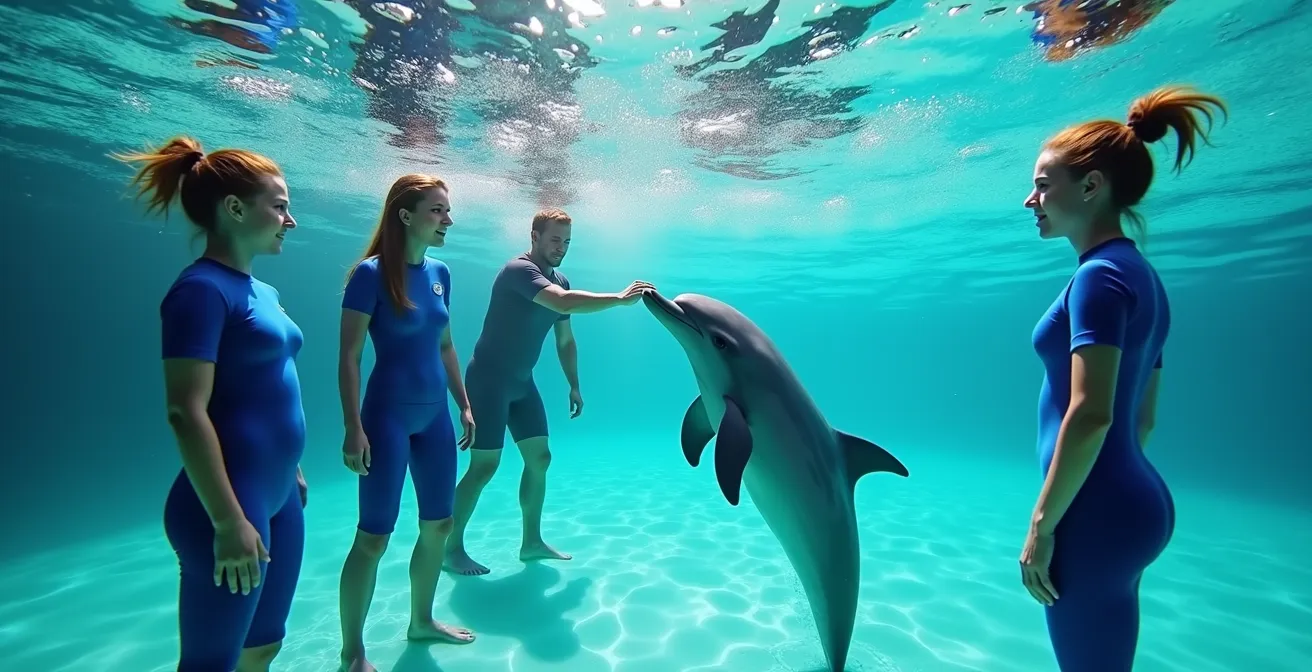
The safest and most rewarding dolphin encounter for a non-swimmer isn’t determined by water depth, but by understanding the operational systems that protect both you and the animals.
- Strict rules, like age limits or camera bans, are primarily for animal welfare and your safety, not just profit.
- A wetsuit offers significant advantages over regular swimwear, including buoyancy and protecting the dolphins from chemical contamination.
- Ethical animal tourism means choosing providers with certified welfare standards and learning to recognize signs of animal well-being.
Recommendation: Prioritize programs with transparent safety protocols and third-party animal welfare certifications to ensure a positive experience for everyone involved.
The thought of meeting a dolphin is exhilarating. For anyone who loves animals, it’s a dream come true. But if you’re not a confident swimmer, that dream can be tinged with anxiety. The primary question that surfaces is almost always: should I stick to the safety of shallow water, or is the deep water experience possible for me? You’ve likely heard the standard advice to “just stay in the shallow end” or “wear a life vest.” While well-intentioned, this guidance often misses the bigger picture.
As an aquatics safety instructor, I want to reframe the conversation. The most critical decision isn’t just about the depth of the water; it’s about the quality and integrity of the entire operation. A truly great experience is built on a foundation of mutual respect and safety—for you and for the dolphins. The rules and procedures in place, from age restrictions to what you’re allowed to wear, are not arbitrary obstacles. They are key components of an ethical framework designed to ensure the well-being of highly intelligent, sensitive marine mammals.
This guide will walk you through the real reasons behind these rules. We will explore why some programs have age limits, why a wetsuit is more than just swimwear, and how policies like a camera ban are directly linked to animal safety. By understanding the “why” behind the logistics, you can move past your fear of the water and make an informed, confident choice that aligns with your love for animals. We’ll also look beyond dolphins, examining how you can be a more responsible tourist when interacting with other animals, like camels or falcons.
Summary: A Non-Swimmer’s Guide to Safe and Ethical Animal Encounters
- Why Children Under 8 Cannot Join the Royal Swim?
- Do You Need a Wetsuit in Summer for Dolphin Bay?
- Why Personal Cameras Are Banned and Photos Cost Extra?
- How Atlantis Certifies Animal Welfare for Its Dolphins?
- How Far in Advance to Book a Dolphin Slot for Christmas Morning?
- How to Spot a Healthy Camel vs an Overworked Animal?
- Why Are Falcons Flown from Balloons and Is It Cruel?
- How to Minimize Queue Times at Aquaventure by 2 Hours During School Holidays?
Why Children Under 8 Cannot Join the Royal Swim?
It’s a common point of confusion for families: why can an 8-year-old participate in an activity that a 7-year-old, who might even be a better swimmer, cannot? The reason has less to do with physical ability and more to do with cognitive understanding and impulse control. Dolphins are large, powerful, and highly intelligent animals. A safe and positive interaction depends on all human participants’ ability to listen, understand multi-step instructions, and remain calm, even when excited. Younger children, by nature, are more unpredictable and have a harder time regulating their behavior.
This isn’t just a precautionary guess; it’s backed by observation and research. For instance, a 2012 study on children with autism spectrum disorders in dolphin-assisted therapy noted that cognitive benefits were complex and took time to manifest, highlighting the intricate nature of child-dolphin dynamics. The facility’s primary responsibility is the safety of both its guests and its animals. A child’s sudden movement or inability to follow a guide’s signal could startle a dolphin, creating a potentially risky situation. In contrast, most “swim with the wild dolphin” programs in the U.S. allow swimmers as young as 10 years for their programs, demonstrating a widespread industry understanding that maturity is key.
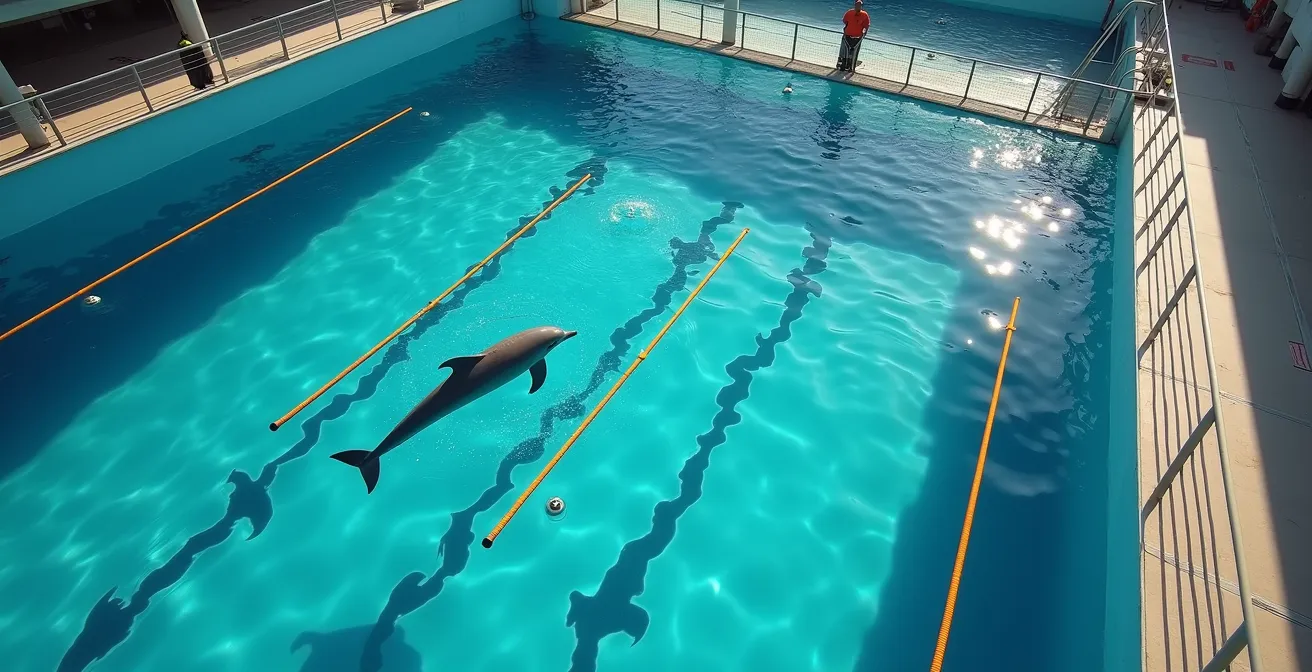
Ultimately, the age limit is a clear, enforceable line drawn to ensure a predictable and controlled environment. It protects the child, the other guests, the trainers, and the dolphins themselves by ensuring every participant has the developmental maturity to engage safely and respectfully.
Do You Need a Wetsuit in Summer for Dolphin Bay?
Even when the sun is blazing and the air is warm, you’ll likely be required to wear a facility-provided wetsuit for your dolphin interaction. This often surprises guests, but the rule serves several crucial purposes that go far beyond temperature control. For a non-swimmer, the most immediate benefit is added buoyancy. A wetsuit can provide significant lift, making it easier to float and reducing anxiety about being in the water. This allows you to relax and focus on the experience rather than on staying afloat.
However, the most important reasons are linked to animal welfare. Human skin is often covered in lotions, perfumes, and especially sunscreen. Many of these products contain chemicals that are harmful to marine life and can contaminate the dolphins’ aquatic environment. Scientists estimate that between 6,000-14,000 tons of sunscreen lotion are deposited in coral reef areas each year, highlighting the scale of the problem. Requiring a pre-rinsed wetsuit creates a clean barrier, ensuring these chemicals don’t leach into the water and affect the dolphins’ sensitive skin and eyes. The table below illustrates the clear advantages from a safety and environmental standpoint.
| Aspect | Wetsuit | Regular Swimwear |
|---|---|---|
| Buoyancy Support | Provides 5-7 pounds of lift | No buoyancy assistance |
| Skin Protection | Full coverage prevents sunscreen transfer | Requires sunscreen application |
| Foreign Object Risk | Standardized smooth neoprene | Zippers, buttons, jewelry hazards |
| Water Quality Impact | Pre-rinsed, chemical-free | Potential lotion/oil contamination |
| Emergency Identification | Uniform appearance aids quick ID | Variable, harder to spot in emergency |
Furthermore, regular swimwear can have zippers, buttons, or decorative elements that could scratch a dolphin’s delicate skin or even be ingested. A standardized, smooth wetsuit eliminates this risk entirely, making it an essential component of a safe and responsible interaction.
Why Personal Cameras Are Banned and Photos Cost Extra?
The “no personal cameras” rule is often the most frustrating for guests. It can feel like a simple money-making tactic. While official photo packages are indeed a revenue stream that helps support animal care, the primary reasons for the ban are rooted in safety and animal welfare. First and foremost, a guest trying to operate a camera or phone is a distracted guest. In a dynamic aquatic environment, your full attention must be on the trainer’s instructions and your surroundings. A missed cue because you were trying to get the perfect shot could lead to a misunderstanding with the animal.
Second, and more critically, is the risk of foreign objects. Anything you bring into the water—a phone, a GoPro, sunglasses, a hat—can be dropped. An object sinking to the bottom of the habitat becomes a potential ingestion hazard for a curious dolphin. Their skin is also incredibly sensitive and can be easily scratched by a hard-cased camera. The goal is to create the safest, most streamlined interaction possible. This is why you are also asked to remove all jewelry. Even a small earring poses an unnecessary risk.
Finally, it’s about managing animal behavior. Unfortunately, the desire for a “perfect” social media photo can lead people to behave recklessly. Allowing personal cameras could encourage guests to lean too close or attempt unsafe poses. As the organization World Animal Protection warns, these interactions are not without risk: “Pushing people into deeper water, head-jerking, and biting causing broken bones” have all been reported in unregulated encounters. By having a professional photographer who knows the safe angles and distances, the facility maintains control and ensures the dolphins are not put in a stressful position.
How Atlantis Certifies Animal Welfare for Its Dolphins?
For any traveler who cares about animals, the question of ethics is paramount. How can you be sure that the dolphins are well-cared for and not just exploited for entertainment? The answer lies in looking for credible, third-party certification. It’s one thing for a facility to say they have high standards; it’s another for them to prove it by undergoing rigorous, independent audits. One of the most respected accreditations in the world is from the Association of Zoos & Aquariums (AZA).
AZA accreditation is the gold standard for animal welfare and is notoriously difficult to obtain. It involves a thorough investigation of every aspect of the facility, including animal health, enrichment programs, habitat quality, veterinary care, and staff expertise. The standards go far beyond basic survival needs, focusing on ensuring the animals are thriving. They mandate comprehensive enrichment plans to keep the animals physically and mentally stimulated, as well as participation in conservation and research efforts.
For a facility like Atlantis, Dubai, achieving this status is a significant mark of distinction. In fact, in 2020, Atlantis Dubai became the first facility in the Middle East to be granted AZA accreditation. This certification is not permanent; it must be renewed every five years, ensuring that high standards are consistently maintained. When you choose a facility with AZA accreditation, you are choosing an organization that has voluntarily opened itself up to the highest level of scrutiny in animal care, providing a powerful assurance of its commitment to welfare.
How Far in Advance to Book a Dolphin Slot for Christmas Morning?
Booking any popular activity during a peak holiday period like Christmas requires strategic planning, and dolphin interactions are no exception. Christmas morning, in particular, is one of the most sought-after times. The simple answer is: book as early as humanly possible. You are competing with thousands of other families who have the exact same idea. Waiting until you arrive in your destination means you will almost certainly be disappointed.
Most booking systems for major attractions open up several months in advance. To secure a prime slot like 10:00 AM on Christmas Day, you need to be ready to book the day the window opens. This might be 90, 120, or even 180 days out. The key is to do your research beforehand to find out the specific booking policy of the facility you’re interested in. Setting a calendar reminder is a wise move. If you miss the initial rush, don’t give up entirely. There are still strategies you can employ, but your chances decrease significantly. The following checklist provides a clear timeline for maximizing your chances.
Your Action Plan: Securing a Peak Holiday Dolphin Encounter
- Initial Booking (90-180 Days Out): Identify the exact date the booking window opens for your target date (e.g., Christmas) and be prepared to book online within the first few hours of availability.
- Target Prime Time (First 24 Hours): Aim to secure the most popular slots, like 10:00 AM on Christmas morning, as soon as they are released, as these are the first to go.
- Stay Informed (Months Before): Join the facility’s official mailing list or follow their social media to receive advance notifications about when new blocks of tickets will be released.
- The Cancellation List (24-48 Hours Before): If you were unsuccessful, call the booking office directly one or two days before your desired date to inquire about any last-minute cancellations. Be polite and have your payment information ready.
- Be Flexible (During Peak Season): If your primary goal is just the experience, consider less popular times like early afternoon or the day after a major holiday, which may have better availability.
Ultimately, for a guaranteed spot on a major holiday, proactive and early booking is not just recommended; it is essential. Planning ahead is the only way to turn that holiday dream into a reality.
How to Spot a Healthy Camel vs an Overworked Animal?
The responsibility of an ethical tourist extends to all animal interactions, not just those in the water. A camel ride in the desert is an iconic travel experience, but it can be marred by the sight of animals that are not well-cared for. As a tourist, your money is your voice. By learning to recognize the signs of a healthy, well-maintained animal, you can choose to support responsible operators and avoid those who neglect their animals’ welfare.
You don’t need to be a veterinarian to perform a basic visual assessment. An overworked or stressed camel will show clear physical and behavioral signs. Pay close attention to the animal’s body condition and how it moves. Are its ribs visible? Does it have open sores on its knees or back? Does it seem lethargic or reluctant to stand? These are all red flags. A healthy camel should appear alert, have a full body, and move with a steady gait. Its resting area should also be a consideration; it should be clean, shaded, and free of hard or sharp surfaces.
The following table provides a simple comparison to guide your observation. Before you commit to a ride, take a moment to look at the animals and trust your instincts. If something feels wrong, it probably is.
| Body Part | Healthy Camel | Overworked/Stressed Camel |
|---|---|---|
| Knees | Smooth skin, no abrasions, natural calluses | Raw patches, bleeding, excessive wear |
| Flank Area | Full, rounded sides | Sunken, visible ribs |
| Nose/Mouth | Moist, pink coloration | Dry, cracked, pale |
| Behavior | Alert, responsive, steady gait | Repetitive swaying, teeth grinding, reluctance to stand |
| Sitting Motion | Controlled, cushioned descent | Collapse or stumbling down |
By choosing operators whose animals exhibit the traits on the “Healthy Camel” side of the chart, you are actively contributing to better animal welfare standards in the tourism industry.
Why Are Falcons Flown from Balloons and Is It Cruel?
Seeing a falcon being flown from a hot air balloon is a spectacular sight, but it can also raise an immediate question: is this practice cruel? To understand the context, it’s important to know the “why” behind this training method. Falconry is an ancient tradition deeply embedded in many cultures, particularly in the Middle East. The primary goal of a falconer is to train their bird to be a supreme athlete, capable of flying high and hunting effectively. Historically, this was done by releasing the falcon from the top of a hill or cliff.
In flat desert landscapes, a hot air balloon serves as a modern, mobile “cliff.” Releasing the falcon from a great height encourages it to build powerful flight muscles and increases its stamina. It trains the bird to soar and scope for prey (in this case, a lure swung by the falconer on the ground) from a significant altitude, mimicking its natural hunting behavior more closely than training from the ground ever could. From a purely functional training perspective, the method is effective.
The ethical debate, however, centers on necessity and stress. Is this practice truly for the bird’s benefit, or has it become more of a spectacle for tourists? Critics argue that the noise and unfamiliarity of the balloon could be stressful for the bird. They question whether such extreme methods are necessary for the bird’s well-being, especially if it is not being used for actual hunting. Proponents, often seasoned falconers, maintain that a well-acclimated bird is not stressed and that the high-altitude flying is a crucial form of enrichment that allows the falcon to use its full physical capabilities. There is no simple answer, and the ethics often depend on the skill of the individual falconer and whether the bird’s welfare or the tourist’s entertainment is the primary focus.
Key Takeaways
- Your safety as a non-swimmer in a dolphin interaction is guaranteed by operational systems like life vests and guide supervision, not the depth of the water.
- Rules regarding age, attire (wetsuits), and personal items (cameras) are primarily in place to protect the dolphins’ health and well-being.
- Choosing an ethical provider means looking for third-party certifications (like AZA) and learning to recognize the visual signs of healthy, well-cared-for animals.
How to Minimize Queue Times at Aquaventure by 2 Hours During School Holidays?
Visiting a world-class water park like Aquaventure during school holidays means accepting one reality: there will be queues. However, with a strategic approach, you can significantly cut down your waiting time and maximize your enjoyment, potentially saving hours over the course of a day. The key is to swim against the current, both literally and figuratively. Most guests follow a predictable pattern; your goal is to break it.
First, adopt the “go early or go late” strategy. Arrive at least 30 minutes before the park opens to be among the first in. Head directly to the most popular slides at the farthest end of the park. Most people will stop at the first thing they see. By starting at the back and working your way to the front, you’ll be ahead of the major crowds for the first couple of hours. Alternatively, arriving for the last 3-4 hours of the day can also mean shorter lines as families with young children begin to leave.
Second, plan your meals strategically. The busiest time for restaurants is between noon and 2:00 PM. This is your golden opportunity. Have an early or late lunch, and use that peak mealtime to hit the headline attractions. The queues will be noticeably shorter. Similarly, pay attention to the schedule for any dolphin or sea lion shows. During these 30-minute shows, a significant portion of park guests are seated in one place, leaving the slides much less crowded. Finally, if your budget allows, consider the AquaXpress pass. While it’s an added cost, you must calculate the value of your time. If purchasing the pass allows you to experience twice as many slides, it can be a worthwhile investment for a once-in-a-lifetime holiday trip.
Now equipped with a deeper understanding of the systems that ensure safety and the principles of ethical animal tourism, you can confidently choose experiences that are rewarding for you and respectful to the animals you admire.
Frequently Asked Questions about Animal Welfare in Tourism
What should a camel’s resting area look like?
Proper bedding should be soft sand or straw, changed regularly, with shade available and no sharp objects or hard surfaces that could cause knee injuries.
How many hours should a working camel rest daily?
A healthy working camel needs a minimum of 8-10 hours of rest per day, with no more than 4 hours of continuous work and regular water breaks every 2 hours.
What are emergency warning signs requiring immediate veterinary care?
Inability to rise, severe lameness, bloody urine or feces, extreme lethargy, or a body temperature above 41°C (106°F) indicate urgent medical needs.