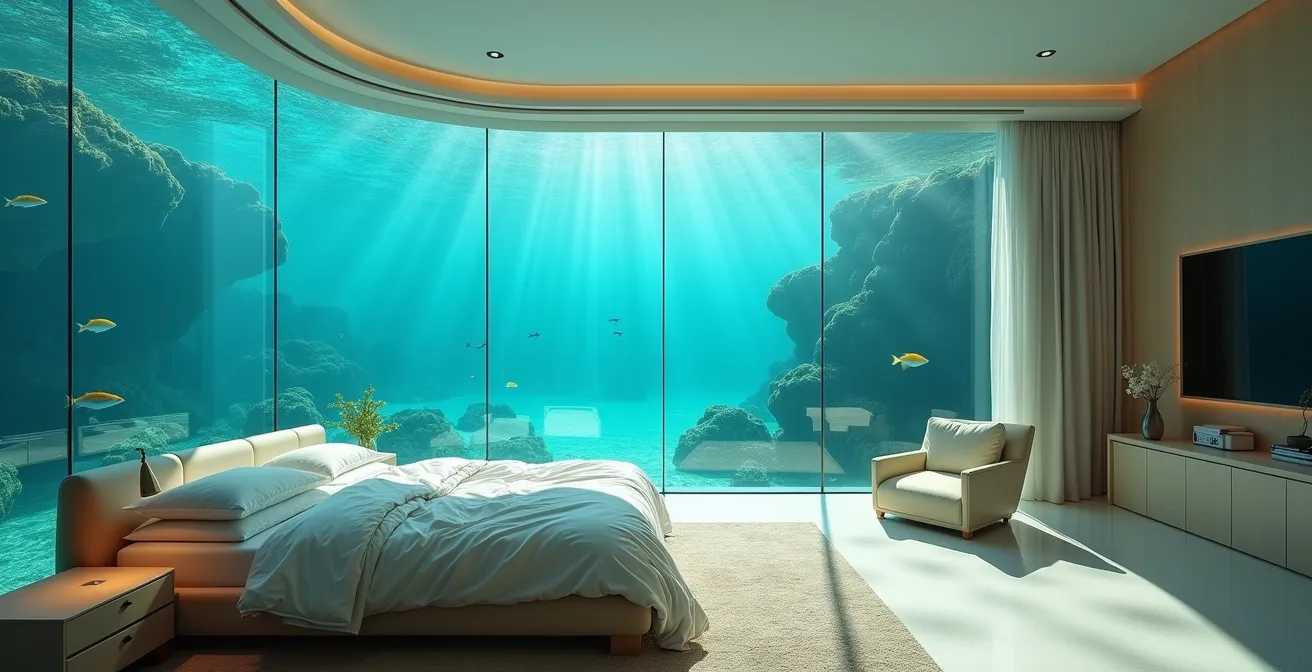
While the marketing for the Floating Seahorse Villas focuses on the fantasy of an underwater bedroom, the reality is far more impressive. This is not simply a house with a submerged floor; it is a sophisticated piece of marine architecture. Its true luxury lies in the advanced engineering that addresses the practical challenges of stability, maintenance, privacy, and ecological integration in an open-sea environment.
The concept of sleeping surrounded by marine life is a powerful one, often depicted in glossy brochures and aspirational social media posts. The Floating Seahorse Villas in Dubai’s World Islands have turned this dream into a tangible reality. For a potential renter or an inquisitive mind, however, the “wow” factor quickly gives way to practical questions. Beyond the breathtaking views, what are the logistics of living on a structure that is, for all intents and purposes, a vessel?
From a marine architect’s perspective, the villa is not a building placed in water, but a purpose-built floating home designed to master its environment. The common concerns—stability during a storm, the logistics of being island-bound, privacy from passing boats, and even the simple task of keeping the underwater windows clean—have all been addressed through specific engineering solutions. The structure’s design transcends mere aesthetics to achieve a symbiotic relationship with its marine ecosystem.
This analysis moves beyond the promotional materials to deconstruct the technical realities. We will examine the hydrodynamic principles ensuring stability, the advanced maintenance protocols for the underwater acrylics, the physics of light that guarantee privacy, and the project’s role as a functional artificial reef. Understanding these elements reveals that the true innovation is not just the view, but the complex engineering that makes that view safely and sustainably possible.
For those who prefer a condensed visual format, the following video provides a summary of the key points and an immersive look at the experience discussed in our guide. It’s a comprehensive overview for getting straight to the point.
To fully appreciate the blend of luxury living and naval engineering, this article breaks down the most pressing logistical and practical questions. The following sections provide factual, descriptive answers to what it truly means to inhabit a Floating Seahorse Villa.
Contents: The Engineering and Logistics of Underwater Living
- What Happens if You Miss the Last Boat to the World Islands?
- Cleaning Windows Underwater: How Do They Remove Barnacles?
- Do Floating Villas Rock During a Shamal Storm?
- Can Passing Yachts See into Your Underwater Bedroom?
- Artificial Reefs: How Floating Homes Affect Local Marine Life?
- Marina View vs Sea View: Which Side Is Quieter on Thursday Nights?
- How Artificial Islands Alter Wave Patterns for Swimmers?
- Why Staying in a Serviced Apartment Saves You $150/Day on Longer Trips?
What Happens if You Miss the Last Boat to the World Islands?
A primary logistical concern for any island residence is transport. The Floating Seahorse Villas are located within The Heart of Europe archipelago, disconnected from the Dubai mainland. This necessitates a complete reliance on water-based transit. The villa development operates a dedicated, 24/7 boat service for residents and their guests, ensuring that access is always available. This is not a public ferry with a fixed last call, but rather an on-demand, private shuttle service akin to a water limousine.
This logistical sovereignty is a core part of the service package. The system is designed to provide seamless connectivity to the mainland at any hour, eliminating the risk of being “stranded.” For broader travel, the city’s RTA network, with its network of more than 40 pick-up points across Dubai, offers extensive coverage, though the primary mode of transit for residents remains the private, dedicated villa service. This ensures that whether for a late-night return from a city dinner or an early morning departure, residents maintain full control over their access schedule.
Therefore, missing the “last boat” is a non-issue. The infrastructure is built around the concept of continuous access, which is fundamental to the luxury and convenience proposition of the project. Security and service staff coordinate these transfers, ensuring both safety and punctuality, effectively making the sea-bound journey an integral and effortless part of the living experience.
Cleaning Windows Underwater: How Do They Remove Barnacles?
The defining feature of the Floating Seahorse is its floor-to-ceiling underwater windows. Maintaining optical clarity against the constant threat of marine growth, known as bio-fouling, is a critical engineering and maintenance challenge. This is not left to chance; a systematic and multi-faceted approach is employed. The process begins with prevention. The acrylic panels and surrounding structures are treated with specialized, eco-friendly coatings that deter the attachment of organisms.
One such technology, Barnacle Stop®, works by creating a surface so slick that the proteinaceous threads used by barnacles and mussels cannot gain a foothold. As confirmed by Mote Marine Laboratory, these advanced coatings are non-toxic and do not harm fish or invertebrates, making them a key part of the villa’s symbiotic design.
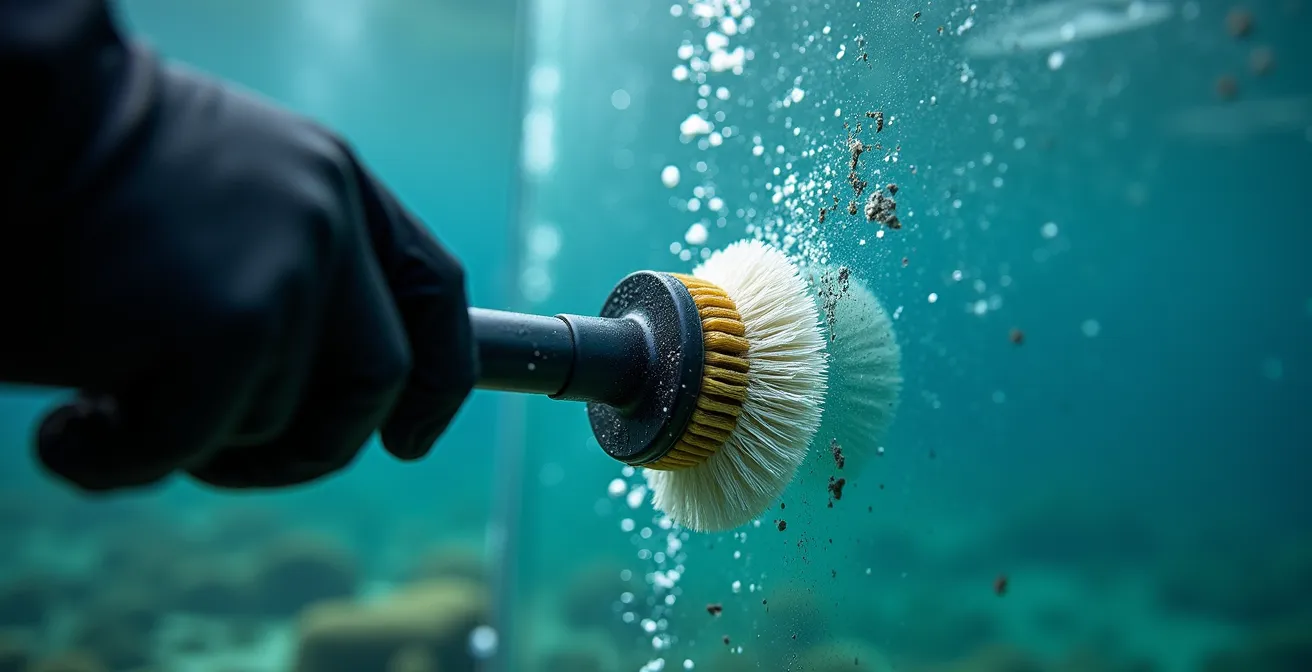
Despite these preventative measures, some bio-fouling is inevitable. To address this, a team of professional divers performs regular cleaning. This process is typically performed every 1 to 3 months for underwater structures, as recommended by professional services, to remove any algae or barnacle remnants before they can obscure the view. The divers use non-abrasive tools, often soft hydraulic brushes, that effectively clean the acrylic without scratching or damaging its surface. This ensures the structural integrity and clarity of the windows are preserved for an uncompromised underwater panorama.
Do Floating Villas Rock During a Shamal Storm?
The stability of a floating structure, especially during a powerful Shamal wind event common to the region, is a paramount concern. From a naval architecture standpoint, the Floating Seahorse is designed for exceptional hydrodynamic stability. Its significant mass—weighing hundreds of tons—provides a tremendous amount of inertia. This means a great deal of force is required to induce any motion. The structure is not a small boat bobbing on the waves; it is a massive, buoyant foundation engineered to remain placid.
Furthermore, the villa’s location within The Heart of Europe archipelago provides a crucial layer of protection. The surrounding artificial islands act as a large-scale breakwater, absorbing and dissipating the energy of open-sea waves before they reach the villas. This process, known as wave attenuation, creates a lagoon-like environment with significantly calmer waters than the surrounding Arabian Gulf. The primary forces acting on the villa during a storm are therefore wind and localized chop, not powerful ocean swells.
The following table, based on the Beaufort Wind Scale, provides a technical perspective on how the villa behaves under various wind conditions.
| Beaufort Scale | Wind Speed | Effect on Vessels | Villa Stability Impact |
|---|---|---|---|
| Force 4-6 | 11-27 knots | Choppy seas, vessel rolls | Minimal sway, barely noticeable |
| Force 7-9 | 28-47 knots | Powerful waves, compromised stability | Low-frequency gentle sway |
| Force 10-12 | 48-64+ knots | Risk of capsize for vessels | Enhanced ballast system activates |
Even during a significant storm (Force 7-9), the sensation inside is described as a low-frequency, gentle sway rather than a jarring rock. The structure is also equipped with an enhanced ballast system that can be adjusted to further increase stability in extreme weather, demonstrating a multi-layered approach to ensuring resident comfort and safety.
Can Passing Yachts See into Your Underwater Bedroom?
Privacy is a natural concern for a residence with floor-to-ceiling glass walls. While the view from inside is a magnificent panorama of marine life, the view from the outside is an entirely different matter. Several factors—physical, optical, and operational—combine to make the underwater bedroom exceptionally private. First, the underwater level is situated several meters below sea level. This depth alone makes casual observation from a passing boat impossible.
Second, the physics of light and water create a natural privacy screen. Due to light refraction and total internal reflection, the water’s surface acts like a one-way mirror. An observer on the surface looking down would see a reflection of the sky and a distorted, darkened view of the water below. It is physically almost impossible to see clearly into a submerged, illuminated space from the bright surface, especially from a distance.
As The National described in a feature, the experience is designed for the occupant’s gaze outward:
The lower level boasts floor-to-ceiling glass walls throughout, with incredible underwater views of the marine life and colourful coral reefs
– The National, Property of the Week feature on Floating Seahorse Villas
Finally, there are strict operational security measures. The area around the villas is a designated no-approach zone for unauthorized private boats and divers. This is enforced by 24-hour security patrols and video surveillance, ensuring that no vessel can get close enough to even attempt to compromise a resident’s privacy. The combination of depth, optical physics, and active security provides a robust, multi-layered privacy solution.
Artificial Reefs: How Floating Homes Affect Local Marine Life?
A remarkable aspect of the Floating Seahorse’s design is its role not as an intruder in the marine environment, but as an active contributor to it. The base of each villa is engineered to function as an artificial reef, a concept known as bio-integration. Rather than displacing marine life, the project aims to create a new, protected habitat to attract and sustain it. This initiative is central to the project’s identity and its name.
The concrete structures at the base provide the hard substrate necessary for coral to grow in an area that was previously sandy seabed. A dedicated coral gardening program is in place, nurturing a protected area where over 40 species of local coral are being cultivated. This transforms the immediate vicinity of the underwater windows into a vibrant, thriving ecosystem, directly enhancing the resident’s viewing experience while contributing to local biodiversity.
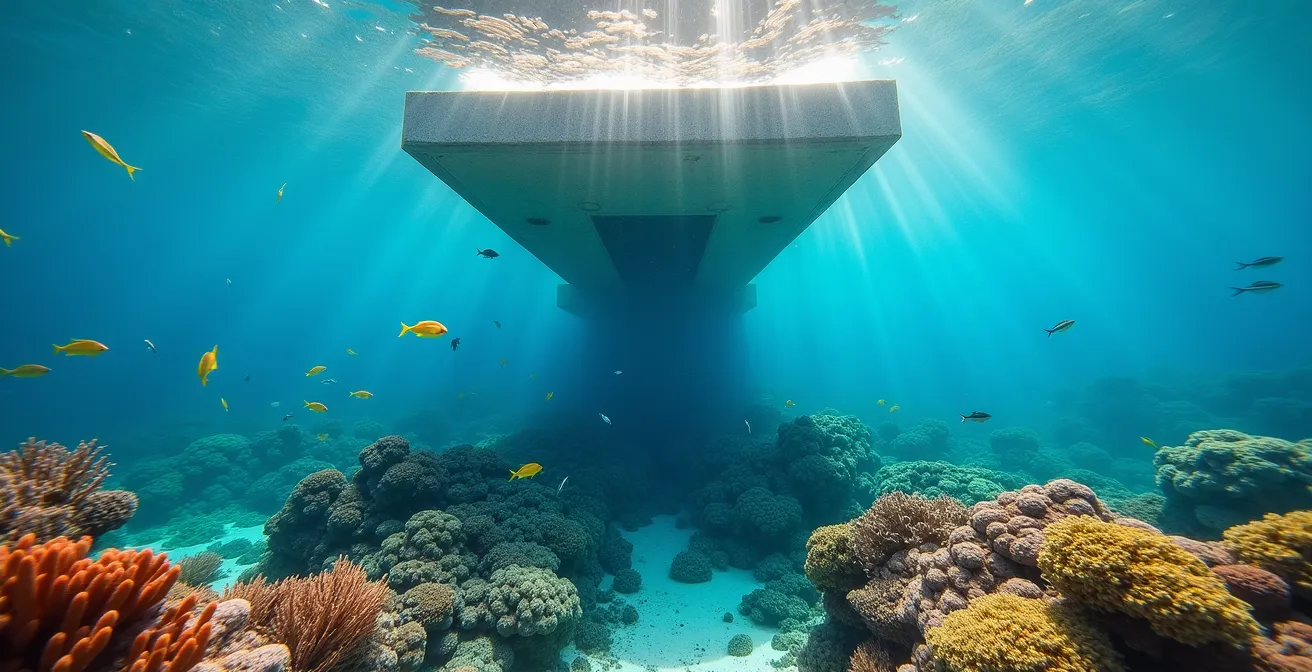
This symbiotic design goes beyond just coral. The project has a specific conservation goal tied to its namesake, as detailed in this case study.
Seahorse Conservation Initiative
A key initiative aims to help restore the local population of endangered seahorses. The artificial coral reef created beneath each luxury retreat offers a protected area, rich with the small crustaceans they feed on, where seahorses can safely live, breed, and shelter from predators. This creates a genuine sanctuary, directly linking the commercial development to a positive ecological outcome.
The result is a closed loop: the structure provides a habitat for the coral, the coral provides a habitat for fish and seahorses, and this thriving marine life creates the “underwater aquarium” view that is the villa’s main attraction. It is a prime example of sustainable luxury, where the experience is directly tied to ecological enrichment.
Marina View vs Sea View: Which Side Is Quieter on Thursday Nights?
The orientation of the villa significantly influences the ambient environment, particularly the soundscape. A key decision for a potential resident is choosing between a “Marina View,” facing the inner waterways of The Heart of Europe, and a “Sea View,” looking out towards the open Arabian Gulf. On a Thursday night, which marks the start of the weekend in Dubai, the difference between these two can be pronounced.
The Marina View side is the hub of social and recreational activity. It experiences higher boat traffic, including residents and guests moving between islands, restaurants, and entertainment venues. This results in sharper, more intermittent sounds, such as boat engines and music, which can be more disruptive. The Sea View, by contrast, faces away from this central hub. Its primary sound source is the distant, low-frequency hum of commercial shipping lanes, which is far more consistent and less intrusive—often described as a form of white noise.
This distinction is summarized in the table below, which analyzes the typical sound profile for each view on a busy evening.
| View Type | Thursday Night Activity | Sound Type | Underwater Bedroom Impact |
|---|---|---|---|
| Marina View | High recreational boat traffic (Dubai weekend start) | Sharp, intermittent engine noises | More disruptive to sleep |
| Sea View | Distant commercial shipping lanes | Constant low-frequency hum | Consistent background noise |
The developer’s vision, as articulated by Josef Kleindienst, Chairman of the Kleindienst Group, acknowledges this lively atmosphere:
This is a tourist project and a second-home destination; we are assuming people come for a nice holiday, a long weekend, a party or a celebration
– Josef Kleindienst, Chairman of Kleindienst Group
Ultimately, the choice is a lifestyle one. A resident seeking vibrant energy and proximity to the social scene may prefer the Marina View. One who prioritizes tranquility and a more contemplative connection to the sea will find the Sea View to be the quieter and more peaceful option, especially on a bustling Thursday night.
How Artificial Islands Alter Wave Patterns for Swimmers?
The construction of The World Islands has fundamentally altered the local hydrodynamics, creating a unique swimming environment. The archipelago functions as a massive breakwater, shielding the inner waters from the full force of the open sea. This creates calm, lagoon-like conditions ideal for swimming, a key benefit for residents. However, the geography of the islands also introduces new, localized water patterns that swimmers should be aware of.
Wave diffraction occurs where waves pass through the gaps between islands, causing them to spread out and change direction. This can create areas of slightly more energetic water near these channels. Additionally, the altered geography can generate localized currents as water flows around the islands. While generally mild, these currents are a factor to consider. The resort management provides daily information on water conditions to ensure safety.
The villas benefit from this wave protection, enjoying tranquil waters right off their private decks. For those venturing further, following resort guidelines is the best practice for a safe and enjoyable experience in this unique, man-made marine environment.
Your Checklist for Safe Swimming Around the World Islands
- Verify designated safe swimming zones marked by the resort, which are situated in the calmest, most protected areas.
- Be mindful of wave diffraction patterns when swimming near the gaps between individual islands.
- Pay attention to any localized currents that may be created by the unique geography of the archipelago.
- Opt for swimming during the calm morning hours when natural wave and wind energy is typically at its lowest.
- Always consult the resort-provided information on daily water conditions, tides, and current patterns before entering the water.
By understanding these simple principles, residents can fully and safely enjoy the exceptionally calm swimming conditions created by the engineering of the islands themselves.
Key takeaways
- The Floating Seahorse is a feat of marine engineering, not just a luxury home, designed for stability, privacy, and ecological integration.
- Stability is ensured by the villa’s massive weight and the wave-attenuating effect of The World Islands archipelago.
- Privacy is guaranteed through a combination of depth, the physics of light refraction, and 24/7 security enforcing no-approach zones.
- The villa acts as a functional artificial reef, actively cultivating coral and supporting marine life, including endangered seahorses.
Why Staying in a Serviced Apartment Saves You $150/Day on Longer Trips?
The headline question, when applied to a property of this caliber, requires a shift in perspective from “saving money” to “understanding value.” With starting prices around AED 22M (approximately $6 million USD), the Floating Seahorse is not a budget-friendly alternative. Instead, it represents a consolidation of experiences that, if booked separately, would far exceed the cost of a typical luxury stay. The value proposition is not in being cheaper, but in being all-encompassing.
A stay here replaces the need to book a luxury hotel suite, charter a private yacht, hire a private chef, or pay for specialized tours. All these elements are integrated into the experience. The “serviced” aspect of this floating villa includes not just housekeeping but a dedicated butler, on-demand use of water toys, and private boat transport. The signature underwater experience is not a one-hour tour; it is a 24/7 ambient reality.
The table below breaks down this “Total Experience Cost,” illustrating the comprehensive value included in a stay.
| Service Component | Separate Booking Cost | Included in Villa |
|---|---|---|
| Luxury Hotel Suite | $2,000/night | ✓ Included |
| Private Yacht Charter | $3,000/day | ✓ On-demand sea toys |
| Private Chef Service | $500/day | ✓ Butler & chef available |
| Underwater Experience Tour | $300/person | ✓ 24/7 underwater bedroom |
| Water Transport | $200/trip | ✓ Included boat service |
Therefore, the financial equation is not about saving a nominal amount per day. It is about accessing a seamlessly integrated, ultra-luxury package where the whole is far greater—and more convenient—than the sum of its parts. The villa is an all-inclusive destination in itself, offering a level of privacy, service, and unique experiences that cannot be replicated through à la carte bookings.
The next logical step for anyone seriously considering this unique living proposition is to arrange for a private viewing, allowing for a firsthand experience of these engineering and service principles in action.
Frequently Asked Questions about Seahorse Villas: Do You Really Sleep Underwater or Is It a Window?
Can boats approach the Floating Seahorse Villas?
No, 24-hour security and video surveillance patrol the villas, enforcing strict no-approach zones for private boats and unauthorized divers.
Is the underwater bedroom visible from the surface?
The physics of light refraction and total internal reflection make it nearly impossible to see inside from the water surface, which acts like a one-way mirror.
What depth are the underwater rooms?
The underwater level sits below sea level with floor-to-ceiling windows, positioned at a depth that ensures both privacy and optimal marine life viewing.