Hotels & Accommodation
Choosing where to stay can fundamentally shape your entire travel experience, yet the accommodation landscape has grown remarkably complex. Beyond the traditional hotel model, travelers now face an expanding array of options—from serviced apartments to overwater bungalows, from family-focused resorts to adult-only sanctuaries. Each choice carries distinct implications for your budget, convenience, and overall satisfaction.
This complexity is compounded by marketing language that often obscures practical realities. Terms like “luxury,” “boutique,” or “resort-style” can mean vastly different things depending on location and property standards. Understanding the fundamental categories of accommodation, the hidden costs embedded in different models, and the strategic timing of bookings empowers you to make informed decisions that align with your specific needs rather than falling prey to clever positioning.
The following sections break down the essential knowledge areas every traveler should master: the core accommodation types and their trade-offs, location considerations that extend beyond proximity to attractions, the real meaning behind room categories, the financial pitfalls to anticipate, and the booking strategies that maximize both value and certainty.
Understanding Your Accommodation Options
The hospitality industry has evolved far beyond the simple hotel model, creating distinct categories that serve different traveler profiles and trip durations. Recognizing these fundamental differences helps you match accommodation type to your specific circumstances.
Traditional Hotels vs Serviced Apartments
Hotels remain the default choice for most travelers, offering daily housekeeping, centralized reception services, and typically prime tourist locations. They excel for short stays where convenience outweighs space, and where you plan to spend minimal time in the room itself. However, the traditional hotel model becomes economically inefficient for stays exceeding five to seven days, particularly for families or groups.
Serviced apartments bridge the gap between hotels and residential rentals, providing kitchenette facilities that can reduce meal costs by 40-60% over a week-long stay. The kitchenette utility extends beyond mere cost savings—it offers dietary control valuable for families with young children, travelers with specific nutritional requirements, or those simply fatigued by constant restaurant dining. The trade-off typically involves less frequent housekeeping (often weekly rather than daily) and locations slightly removed from primary tourist zones.
Unique Lodging Experiences
Specialized accommodation types—overwater structures, converted heritage buildings, or integrated resort communities—introduce additional variables. Overwater lodging, for instance, presents romantic appeal but requires realistic assessment of practical challenges: boat-dependent access limits spontaneity, motion during storms affects those prone to seasickness, and maintenance standards vary dramatically between operators. These options work best when the accommodation itself is a primary attraction rather than simply a place to sleep between activities.
Location Considerations: Geography and Accessibility
The “location versus luxury” equation remains one of accommodation selection’s most critical trade-offs. A modest property with excellent connectivity often delivers superior overall value compared to a luxurious resort requiring extensive transit time to reach key attractions or beaches.
When evaluating location, examine the complete infrastructure ecosystem. Does the area offer reliable transport options—public transit, ride-sharing availability, or walkability to essentials? Geographic features like humidity levels, noise from construction zones, and actual beach access (as opposed to merely beach proximity) significantly impact daily comfort. An apparently well-positioned property near ongoing construction may subject you to noise beginning at dawn, while a beachfront location might require navigating through other resorts to reach quality shoreline if the immediate beach is narrow or poorly maintained.
For island or peninsula developments, understand the geography thoroughly. Properties on artificial islands or remote coastal extensions often promise exclusivity but may create logistical friction that accumulates over a multi-day stay. The twenty-minute journey that seems negligible when booking becomes considerably more burdensome when repeated six times daily with tired children or shopping bags.
Decoding Room Categories and Amenities
Room category nomenclature lacks standardization across properties, making direct comparisons challenging. What one hotel classifies as a “deluxe” room might be equivalent to another’s “standard superior” offering, while terms like “club level” or “executive floor” carry different amenities at different chains.
Choosing the Right Room Type
The fundamental decision between connecting rooms and suites illustrates this complexity. Connecting rooms provide separate spaces with independent bathrooms—valuable for families with teenagers or traveling with extended family—but often cost less than suites offering equivalent square footage in a single space. Suites deliver better sightlines for supervising young children and a more cohesive living area, but sacrifice the privacy that separate rooms provide.
Similarly, the “family versus adult-only zones” designation extends beyond simple age restrictions. Family zones typically feature shallower pool areas, higher ambient noise tolerance, and earlier dining services, while adult-only areas enforce quiet policies and sophisticated atmospheres. Neither is inherently superior; alignment with your travel purpose determines value.
Essential Amenities to Verify
Before confirming any booking, systematically verify specific amenities rather than relying on category assumptions. Key items to check explicitly include:
- In-room climate control (individual thermostats versus centralized systems)
- Actual view guarantees if paying a view premium (many “ocean view” rooms offer only oblique glimpses)
- Blackout curtain quality for families with young children or shift workers
- Electrical outlet placement and USB charging availability
- Coffee/tea facilities and mini-bar stocking policies
These details disproportionately affect daily comfort yet frequently go unmentioned in standard property descriptions.
The Hidden Cost Factor in Accommodation
The displayed nightly rate rarely represents your true accommodation expenditure. Multiple fee structures—some mandatory, others easily triggered—can inflate costs by 20-35% beyond the quoted price.
Mandatory tourism fees or “resort charges” have proliferated globally, adding daily surcharges ostensibly covering WiFi, pool access, or fitness facilities that most travelers reasonably expect as included basics. These fees appear at checkout rather than during booking, creating unpleasant surprises. Always verify total cost including all mandatory fees before confirming reservations.
Deposit policies represent another financial consideration. Many properties now authorize security deposits ranging from one night’s rate to several hundred currency units on your credit card, holding these funds for 7-14 days post-checkout. For travelers managing cash flow or using debit cards, this practice can create unexpected constraints. Luxury properties tend toward higher deposits, ostensibly covering potential minibar charges or incidental damages.
Incidental costs accumulate rapidly in certain property types. Luxury bills frequently include automatic gratuities, service charges distinct from government taxes, premium pricing for in-room dining, and charges for amenities marketed as “complimentary” but carrying hidden limitations. A breakfast described as “included” might cover only continental options while à la carte items incur surcharges, or “free” WiFi might apply only to one device with upgrade fees for additional connections.
Booking Strategies for Maximum Value
Strategic booking timing significantly impacts both price and room quality. The optimal reservation window varies by destination and season, but booking 6-12 weeks in advance for standard travel and 4-6 months for peak holiday periods generally balances availability against pricing.
Extremely early bookings (six-plus months ahead) rarely offer advantages unless you’re targeting properties with limited inventory or specific room types (like overwater bungalows or connecting rooms in family suites). Conversely, last-minute bookings can yield substantial discounts but sacrifice choice—you’ll select from remaining inventory rather than optimal room categories.
For high-end inventory, consider these approaches:
- Compare direct property booking against aggregator platforms, as each occasionally offers exclusive rates
- Request specific room assignments (floor level, proximity to elevators, view direction) in writing at booking
- Verify cancellation terms before confirming, as “non-refundable” rates often save merely 5-10% while eliminating all flexibility
- Check whether loyalty program enrollment (often free) provides rate parity guarantees or upgrade potential
View guarantees merit particular scrutiny. Many properties photograph their single best view, then classify 30% of rooms as offering that “ocean view” or “city view” despite dramatically varying sight lines. Request photographic confirmation of the specific view from your assigned room category, or avoid paying view premiums altogether.
Luxury Services: Reality vs Marketing
Premium services like butler service sound impressive but deliver varying practical value depending on your travel style. Dedicated butlers excel at handling complex requests (restaurant reservations, activity coordination, unpacking services) and can genuinely enhance extended stays at destination resorts where you’re utilizing the property’s full ecosystem. For urban hotels where you’re primarily out exploring, butler service frequently reduces to glorified concierge assistance you’d receive anyway.
Service standards vary dramatically even within supposedly consistent luxury markets. A property’s star rating or luxury classification reflects assessment criteria that may not align with your priorities. Some luxury designations emphasize architectural grandeur or historical significance while accepting service inconsistencies, whereas others maintain service precision in unremarkable buildings. Reading recent guest feedback focused specifically on service responsiveness, problem resolution, and staff knowledge provides better indicators than official classifications.
Practical Logistics and Policies
Several operational policies significantly affect comfort despite receiving minimal attention during booking. Guest policy restrictions in serviced apartments often limit visitor access or prohibit overnight guests entirely—problematic if you’re planning to host local friends or have family joining you mid-trip. Hotels generally allow greater visitor flexibility, though some now require visitor registration for security purposes.
Laundry logistics present another practical consideration. Hotels typically offer expensive valet laundry services, while serviced apartments may provide in-unit washers or access to shared facilities at fraction of hotel costs. For stays exceeding one week, laundry access can influence packing requirements and overall convenience substantially.
For unique accommodation types like overwater structures or remote island properties, factor in maintenance challenge realities. These locations face accelerated wear from environmental exposure, making the age and renovation history of the specific structure critical. A beautifully photographed overwater villa constructed eight years ago without recent refurbishment may show considerable weathering, while eco-impact considerations affect everything from waste management to water quality in sensitive locations.
Understanding these fundamental dimensions of accommodation selection—the core options available, geographic and logistical factors, room category realities, hidden costs, strategic booking approaches, and practical policies—transforms what often feels like overwhelming choice into manageable decision-making. The goal isn’t finding a theoretically perfect property, but rather identifying the accommodation that best aligns with your specific trip purpose, budget parameters, and personal priorities.
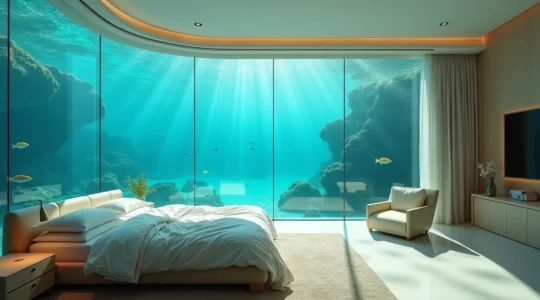
Floating Seahorse Villas: Is the Underwater Bedroom a Window or an Aquarium?
While the marketing for the Floating Seahorse Villas focuses on the fantasy of an underwater bedroom, the reality is far more impressive. This is not simply a house with a submerged floor; it is a sophisticated piece of marine architecture….
Read more
How to Negotiate a Suite Upgrade at Check-In Without Being Rude?
Forget charm and late check-ins; securing a suite upgrade is about understanding the hotel’s operational playbook and making your request financially and logistically easy to approve. The hotel’s decision is based on inventory management and minimizing operational friction, not just…
Read more
Why Staying in a Serviced Apartment Saves You $150/Day on Longer Trips?
For a two-week family trip, a serviced apartment isn’t just an alternative to a hotel; it’s a superior financial system that actively contains your budget, saving upwards of $150 per day. Hotels maximize revenue through high-margin services (laundry, dining), creating…
Read more
How to Distinguish Genuine 5-Star Service from Glorified 4-Star Decor in Dubai?
In Dubai’s luxury hotel market, a 5-star rating and opulent decor are poor indicators of genuine 5-star service; they often conceal a 4-star operational model focused on volume, not you. Operational policies like mandatory breakfast reservations and credit card holds…
Read more
Why Staying on The Palm Jumeirah Is a Commuting Nightmare for Business Travelers
Contrary to the idyllic brochures, The Palm Jumeirah’s design prioritizes aesthetics over daily logistics, creating inherent and unavoidable compromises for long-term residents and business commuters. The island’s single entry/exit point creates a structural bottleneck, making road travel predictably congested during…
Read more