
In Dubai’s luxury hotel market, a 5-star rating and opulent decor are poor indicators of genuine 5-star service; they often conceal a 4-star operational model focused on volume, not you.
- Operational policies like mandatory breakfast reservations and credit card holds are red flags for crowd management, not personalized service.
- The term “private beach” is often a marketing illusion; many are shared with day-pass holders from paid beach clubs, destroying exclusivity.
Recommendation: Analyze a hotel’s operational fine print—from its tax structure to its toiletry brands—to decode its true service philosophy before committing to a honeymoon that values process over people.
For a discerning couple planning the perfect honeymoon, Dubai presents a dazzling paradox. The skyline glitters with architectural marvels promising unparalleled luxury, each hotel lobby grander than the last. You’re sold a dream of 5-star service, reinforced by glossy brochures and astronomical price tags. Yet, a nagging fear persists: are you paying for genuine, personalized care, or simply for gilded interiors and a marketing budget that outspends the staff training program? The common advice—to check online reviews or stick to big-name brands—is tragically flawed. It fails to address the fundamental disconnect between appearance and reality.
As a former hotel General Manager, I can assure you that the secret to identifying true luxury lies not in the thread count of the sheets, but in the operational DNA of the hotel. Genuine 5-star service is, by its nature, gloriously inefficient. It prioritizes the individual guest’s experience over streamlined processes. Conversely, many of Dubai’s most famous resorts have perfected the art of process management, creating a system that can handle thousands of guests with ruthless efficiency, all while maintaining the facade of bespoke luxury. This guide is designed to give you an insider’s toolkit. We will bypass the marketing fluff and teach you how to read the subtle clues—the hidden fees, the amenity choices, the crowd-control policies—that betray a 4-star operation hiding in a 5-star shell. It’s time to stop booking with your eyes and start booking with intelligence.
This article provides a critical framework for evaluating Dubai’s luxury hotel landscape. The following sections will deconstruct the common value propositions and expose the operational realities behind them, empowering you to make a truly informed choice for your honeymoon.
Summary: Deconstructing the Dubai 5-Star Hotel Experience
- Why Your Final Resort Bill Is 25% Higher Than the Booking Price?
- Club Room vs Suite: Which Offers Better Value for Heavy Drinkers?
- The Pool Mistake That Ruins Relaxation for Couples in Family Resorts
- When to Book Your Christmas Stay to Save $1,000 on a Sea View Room?
- How to Verify if the ‘Private Beach’ Is Actually Private Before Arriving?
- Hermès vs Bvlgari Toiletries: Does the Suite Grade Determine the Soap?
- Which Jumeirah Hotels Include Free Wild Wadi Access?
- Why Do Breakfast Reservations in Jumeirah Require a Credit Card Hold?
Why Your Final Resort Bill Is 25% Higher Than the Booking Price?
The first shock for many first-time visitors to Dubai isn’t the heat, but the bill at checkout. The attractive nightly rate you booked online is a fantasy figure. In reality, a cascade of mandatory taxes and fees are systematically added, inflating your final cost significantly. A comprehensive analysis reveals that the cumulative impact is often over 22%, and that’s before any extras. This isn’t an accident; it’s a core part of the revenue model. The headline price is kept artificially low to compete online, with the true cost buried in the fine print.
This structure is the first clue to a hotel’s operational philosophy. A hotel confident in its unique service proposition would be more transparent. A system of hidden, compounded fees signals a volume-driven business that relies on attracting a mass audience with appealing initial numbers. The key components to watch for are the 10% Service Charge (which is not a staff tip but a charge to the hotel), a 7% Municipality Fee, and a 5% VAT applied to the total. Add to this the fixed “Tourism Dirham” fee per night, and you can see how the bill quickly escalates.
For a honeymooning couple, this means your budget must account for this guaranteed overage. A $5,000 booking is, in reality, a $6,250 commitment before you’ve even ordered a cocktail. Understanding this from the start is not just about financial planning; it’s about recalibrating your expectations from “bespoke luxury” to “high-volume tourism.”
Club Room vs Suite: Which Offers Better Value for Heavy Drinkers?
In the world of hotel upgrades, the Suite is often seen as the ultimate prize. It offers more space, a separate living area, and the prestige of a higher room category. However, for a couple on their honeymoon who enjoy a few drinks throughout the day, this is often a poor-value proposition. The real sweet spot, or what we in the industry call value arbitrage, is frequently found in the much less glamorous Club Room.
The primary benefit of a Club Room is access to the Club Lounge. While the room itself may be only marginally better than a standard one, the lounge provides complimentary breakfast, afternoon tea, and, most importantly, an evening “happy hour” with free-flowing alcoholic beverages and canapés. When you consider the exorbitant cost of alcohol in Dubai hotels, the math becomes compelling. A single cocktail can easily cost AED 80 ($22). As the table below illustrates, the daily cost of a Club upgrade can be recouped after just a handful of drinks. A suite, in contrast, offers only space, with no complimentary consumption.
This table demonstrates the breakeven analysis for a couple considering a Club upgrade versus a standard suite.
| Factor | Club Room | Standard Suite |
|---|---|---|
| Average price difference per night | +AED 400-600 | +AED 800-1200 |
| Complimentary drinks timing | 2-4 hour happy hour | None |
| Average hotel bar drink cost | AED 50-80 | AED 50-80 |
| Breakeven point | 5-8 drinks per day | N/A |
| Additional perks | Private breakfast, snacks all day | More space only |
Therefore, for a couple intending to relax and indulge, the Club Room often delivers a far superior return on investment. You are effectively pre-paying for your daily drinks and food at a steep discount. The suite is for those who value square footage above all else, but the Club Room is for the savvy traveler who understands where the real value lies.
The Pool Mistake That Ruins Relaxation for Couples in Family Resorts
One of the most common marketing promises made to couples is the “adults-only pool.” It conjures images of serene tranquility, a quiet oasis away from the joyous chaos of the family splash zone. The reality, however, is often a masterclass in the exclusivity illusion. In many Dubai family resorts, the “adults-only” area is a token gesture—a small, often crowded pool section carved out right next to the main family pool, separated by nothing more than a few potted plants and a hopeful sign.
This design is not an oversight; it’s a deliberate choice driven by the need to maximize guest capacity and appeal to all demographics simultaneously. The hotel gets to tick the “adults-only” box in its marketing materials without sacrificing valuable real estate that could be used for more family-friendly, high-revenue features. For a honeymooning couple seeking genuine peace, the result is disastrous. Your quiet afternoon is punctuated by the distant (and not-so-distant) screams of a water park, and the feeling of exclusivity is shattered every time a child’s inflatable flamingo drifts into your line of sight.
The image below illustrates a common layout, where the proximity between the two zones makes true separation impossible.
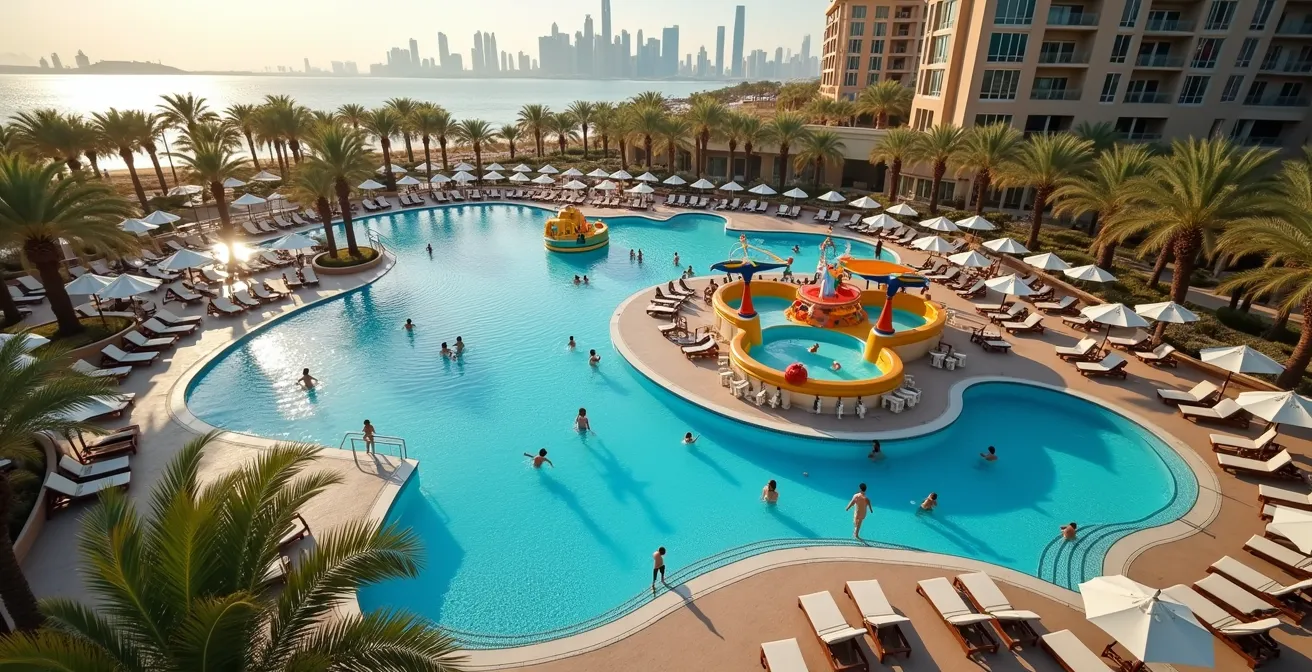
A truly couple-focused resort would have its adults-only facilities in a completely separate wing or location, physically isolated from family areas. When you see an adults-only pool on a hotel map that is merely a different shape in the same general complex as the kids’ pool, you are looking at a clear sign of an operational compromise. It’s a hotel trying to be everything to everyone, which in the world of luxury, means it excels at nothing for anyone in particular.
When to Book Your Christmas Stay to Save $1,000 on a Sea View Room?
Booking a luxury Dubai hotel for the Christmas peak season is a high-stakes game. Demand is immense, and hotels leverage this by dramatically increasing their prices. An internal hotel pricing analysis shows rates increase by 50-65% during this winter peak, turning an expensive stay into a monumental one. Waiting for a last-minute deal is a fool’s errand; the best rooms are gone months in advance, and any late availability comes at an extreme premium. The key to saving a significant amount is not about finding a “deal” but about strategic, multi-phased booking.
The optimal strategy begins almost a year out. By booking a standard room at a refundable rate 10-11 months in advance, you secure your place at the hotel before the peak-season pricing algorithms fully kick in. This is your anchor. The next phase, around 3-5 months before your stay, involves monitoring tour operator block releases. These travel companies often pre-buy rooms and sometimes release their unsold inventory back to the hotel, creating small windows of availability in higher categories.
The final move is the negotiation. About four weeks before your arrival, contact the hotel’s reservations or front office manager directly. Express your excitement for your honeymoon stay and inquire about the possibility of an upgrade to a sea view room. Having a confirmed, long-held booking gives you leverage. You are not a new customer; you are an existing, committed guest. This is often the point where a manager, looking to manage their inventory, will offer a paid upgrade at a much more reasonable rate than if you had booked the sea view room from the start. This multi-step approach requires patience but can easily result in savings of over $1,000 while securing the room you desire.
How to Verify if the ‘Private Beach’ Is Actually Private Before Arriving?
The term “private beach” is one of the most abused in Dubai’s hotel marketing lexicon. For a honeymooning couple, it evokes images of seclusion and exclusivity. For the hotel operator, it can simply mean a cordoned-off section of a very public coastline. The most common way this illusion is maintained is through the operation of on-site “Beach Clubs” like Twiggy or DRIFT. These venues sell expensive day passes to the general public, effectively turning your hotel’s “private” beach into a trendy, crowded, and noisy public hotspot.
You are no longer a valued hotel guest but are now competing for a sun lounger with influencers and partygoers who have no connection to the resort. True privacy requires physical barriers and a single, controlled access point exclusively for hotel guests. Anything less is a compromise. Before booking, you must become a digital detective to verify the hotel’s claims.
Case Study: The Beach Club Deception
An investigation of Dubai’s premier five-star beach resorts revealed a critical distinction. Hotels with integrated but separately branded beach clubs consistently had guest complaints about overcrowding and a lack of available sunbeds. In contrast, resorts like the Burj Al Arab, which maintain strict physical and operational separation, deliver on the promise of privacy. The most effective pre-arrival verification method was not checking the hotel’s website, but analyzing recent, untagged Instagram location stories. These unfiltered guest videos provide real-time evidence of crowd levels and the presence of non-hotel guests, offering a ground-truth assessment that marketing photos can never match.
Use Google Maps Satellite View to examine the physical layout. Are there clear walls or barriers separating the beach from public paths or neighboring properties? How many access points are there? Then, search the hotel’s name along with terms like “day pass” or “beach club access.” If you find a separate website or booking engine for the beach area, you’ve found your red flag. The beach is not for you; it’s a separate profit center.
Hermès vs Bvlgari Toiletries: Does the Suite Grade Determine the Soap?
It may seem trivial, but the small bottles of shampoo and soap in your hotel bathroom are a carefully chosen, powerful signal of the hotel’s positioning and its perception of you as a guest. This isn’t about cleanliness; it’s a silent conversation about luxury. As an insider, I can tell you that the hierarchy of these brands is well-established, and learning to read it gives you another tool to decode the hotel’s true level of luxury.
At the base level of 4- and 5-star properties, you’ll often find brands like Bvlgari. It’s a recognized name, but in the hotel world, it’s an entry-level luxury signal—safe, mass-produced, and expected. Moving up, brands like Acqua di Parma suggest a more classic, sophisticated taste, often targeted at business travelers. Reaching the top tier, you find the truly aspirational brands: Hermès, Diptyque, or even a bespoke scent created exclusively for the hotel. The presence of these indicates a property that is not just spending money, but is curating an experience. It signals a move from mass luxury to aspirational luxury.
However, the brand alone isn’t the full story. The size of the bottles is an even stronger indicator. Standard-issue small bottles are for transient guests. Full-size, retail-style bottles are a sign that the hotel considers you a resident, not a visitor. This is a hallmark of a top-tier suite experience. It’s a gesture of generosity and trust that lower-grade operations are unwilling to make. So, when you enter your suite, look past the marble and check the soap. The hotel is telling you exactly how much it values your stay.
Your Action Plan: Decoding the Toiletry Hierarchy
- Assess the Brand Signal: Is it Bvlgari (entry-level luxury), Acqua di Parma (sophisticated classic), or Hermès/bespoke (top-tier aspirational)? This tells you the hotel’s target demographic.
- Check the Bottle Size: Are they tiny, single-use plastics or substantial, full-size bottles? Full-size indicates a true suite-level gesture of trust and generosity.
- Consult the “Hidden Menu”: Call housekeeping and politely ask if they have any alternative toiletry brands available. Many high-end hotels stock other luxury brands upon request for discerning guests.
- Note the Bathroom Features: The toiletries are part of a package. A walk-in rain shower is standard. A standalone soaking tub, double sinks, and a separate toilet room are signs of a genuinely premium bathroom.
- Compare Against Price: Does the brand and presentation align with the room rate you are paying? Finding Hermès in a surprisingly affordable room is a sign of great value; finding a generic brand in an expensive suite is a red flag.
Which Jumeirah Hotels Include Free Wild Wadi Access?
For families, or couples who are young at heart, the promise of “free access” to the Wild Wadi Waterpark is a major selling point for Jumeirah group hotels. However, like all things in Dubai’s hotel scene, the word “free” comes with significant hidden costs and conditions. The value of this perk is not equal across all properties; it varies dramatically based on one crucial, often overlooked factor: the hidden cost of time and convenience.
The Jumeirah Beach Hotel, located directly adjacent to the waterpark, offers the highest possible value. Guests have direct, private access, allowing them to come and go as they please without queues or transport. This is a seamless and genuinely valuable amenity. At the other end of the spectrum, a hotel like Jumeirah Creekside, while still offering “free” access, is a 25-minute shuttle ride away. This translates to a minimum of one hour of travel time per visit, plus waiting for the scheduled bus. This is a significant logistical hurdle that diminishes the spontaneity and relaxation of a vacation.
The table below provides a “Real Value Score” that accounts for this critical difference in convenience.
| Hotel | Distance to Wild Wadi | Access Method | Real Value Score |
|---|---|---|---|
| Jumeirah Beach Hotel | Direct access | Private entrance | 10/10 |
| Burj Al Arab | 5 min shuttle | Dedicated shuttle | 8/10 |
| Jumeirah Creekside | 25 min shuttle | Scheduled shuttle | 4/10 |
| Time cost calculation | 25-min shuttle = 1 hour roundtrip + waiting = high opportunity cost | ||
Furthermore, guest reports reveal other hidden limitations. Some properties restrict access to a single entry per stay, a far cry from the “unlimited” access implied. Blackout dates can also apply during peak times. Hotels offering shuttle access typically do not provide queue-skipping privileges, meaning guests join the long general admission lines. When choosing a hotel based on this perk, you must ask: am I getting true convenience, or just a free ticket attached to a significant inconvenience?
Key takeaways
- True luxury is revealed in operational details, not just decor. Policies designed for crowd control are a major red flag.
- “Value” is not about the lowest price, but about understanding where to find arbitrage, like a Club Lounge that offsets high ancillary costs.
- Marketing terms like “private” and “free” must be interrogated. Verify claims using third-party tools and consider the hidden cost of time and convenience.
Why Do Breakfast Reservations in Jumeirah Require a Credit Card Hold?
Perhaps no single policy reveals more about a hotel’s operational soul than its breakfast procedure. For many Jumeirah properties, guests are required to make a reservation for their breakfast slot, often with a credit card hold to penalize no-shows. On the surface, the hotel will frame this as a way to “ensure a pleasant experience” and “manage guest flow.” Do not be deceived. This is the ultimate tell-tale sign that you are a cog in a massive, high-volume machine.
A true 5-star service philosophy is built on accommodating the guest’s desires, not forcing the guest to conform to the hotel’s operational schedule. The need for such a rigid system means one thing: the hotel’s capacity is so vast, and its guest volume so high, that it cannot provide a seamless breakfast experience without resorting to strict, impersonal process management. You are not being served; you are being processed. This is particularly jarring on a honeymoon, where spontaneity and leisure should be paramount. The idea that you must commit to a specific time to eat your complimentary breakfast, under threat of a penalty, is the antithesis of luxury.
If a hotel needs this system, it means you are in a massive, high-volume operation. It helps adjust expectations from ‘bespoke service’ to ‘efficient process management’.
– Hotel Industry Analyst, Dubai Hotel Operations Study
This isn’t a critique of the quality of the food or the efficiency of the staff. It’s a critique of the fundamental model. With industry analysis showing Dubai will have over 851 hotels by the end of 2024, the pressure to maximize occupancy and process thousands of guests daily is immense. The breakfast reservation system is a direct symptom of this market reality. When you encounter it, you know with certainty that the hotel has prioritized operational scale over individual guest freedom. For your honeymoon, you must decide if that’s a compromise you’re willing to make.
Armed with this insider’s framework, you are now equipped to look beyond the shimmering facade of Dubai’s luxury hotels. You can dissect their offers, decode their signals, and identify the properties that offer not just opulence, but the genuine, personalized service your honeymoon deserves. Book with confidence, not hope.
Frequently Asked Questions about How to Distinguish Genuine 5-Star Service from Glorified 4-Star Decor in Dubai?
How can I verify beach privacy using Google Maps?
Use satellite view to check for physical barriers, count access points from public roads, and measure sunbed density. True private beaches show clear separation.
What keywords indicate a beach isn’t truly private?
Search reviews for ‘shared with’, ‘walked through from’, ‘day pass available’, ‘beach club’, or ‘couldn’t get a lounger’ – all indicate public access.
Which Instagram features reveal actual beach conditions?
Check location tags and recent stories, not curated posts. Look for crowd levels, neighboring hotel proximity, and vendor presence in unfiltered content.