
The key to a stress-free Aquaventure day isn’t just arriving early; it’s executing a specific counter-flow strategy in the first 60 minutes.
- Prioritize a clockwise route upon entry to hit the Neptune and Poseidon towers before peak crowds arrive.
- Invest in water shoes to navigate scorching concrete, enabling faster movement between attractions without pain.
- Use the lazy river not for leisure, but as a strategic transport system to conserve energy and bypass foot traffic.
Recommendation: Combine the clockwise route strategy with an AquaExpress pass only if your budget allows and your goal is to ride every major slide multiple times during peak hours (11 AM – 4 PM).
The thought of visiting the world’s largest waterpark during school holidays can trigger a wave of anxiety for any parent. Visions of endless queues coiling under the Dubai sun, tired children, and the logistical nightmare of managing belongings are enough to make you reconsider. The standard advice—”arrive early”—is well-intentioned but incomplete. When thousands of other families follow the same tip, you’re merely at the front of an inevitable logistical jam. The generic approach fails to address the core challenges: energy depletion from heat and the chaotic flow of massive crowds.
This guide rejects those platitudes. We will not simply tell you to show up at 10 AM. Instead, we will arm you with a tactical mindset, treating your day like a strategic mission designed to maximize fun and minimize friction. The secret lies not in beating the clock, but in understanding and outsmarting crowd dynamics. This involves a precise ‘first-hour’ sequence, a concept we call the counter-flow trajectory. It’s about moving against the predictable surge of visitors to access the most popular attractions when they are at their quietest.
Forget wandering aimlessly. We will lay out a clear plan covering everything from the controversial AquaExpress pass and critical gear choices to a step-by-step route through the park. By focusing on smart logistics and energy conservation, you can reclaim those lost hours and transform a potentially stressful ordeal into a seamless family adventure. This is your operational playbook for conquering Aquaventure.
This article provides a comprehensive, step-by-step strategy for navigating Aquaventure efficiently. The following sections break down each critical decision point you’ll face, from pre-arrival planning to on-the-ground execution, ensuring you have a clear plan for a successful day.
Summary: A Strategic Approach to Aquaventure’s Busiest Days
- AquaExpress Pass: Is It Worth the Extra $100 for a Family of Four?
- Why Going Barefoot at Aquaventure Is a Painful Mistake in July?
- How to Manage Your Phone and Wallet While Riding the Leap of Faith?
- Smuggling Snacks vs Buying Inside: What Are the Real Security Rules?
- Which Slides Are Off-Limits for Your 1.2m Tall Child?
- Clockwise or Counter-Clockwise: The Best Route Around the Lazy River?
- Which Section of JBR Beach Is Least Crowded for Families?
- How to Conquer the ‘Leap of Faith’ Without Losing Your Swimwear?
AquaExpress Pass: Is It Worth the Extra $100 for a Family of Four?
The AquaExpress pass is the most direct solution to long lines, but at a significant cost, it demands a strategic decision, not an emotional one. For a family of four, the extra expense can approach or exceed $100, so the value proposition must be crystal clear. The pass works by granting access to a separate, much shorter queue on most of the park’s major slides. During peak hours, this can be the difference between a thrilling day and a frustrating one. Visitor data is compelling; during the busiest times, the pass cuts waiting time from 60 minutes to 5 minutes or less.
However, the pass’s value is not constant throughout the day. If your strategy involves arriving at opening and leaving by early afternoon, you may find the standard queues manageable in the first hour. The pass delivers its maximum value between 11 AM and 4 PM, when the park is at its most congested. One family visiting in November noted that while lines exceeded an hour for popular slides, the pass allowed them to ride everything. They also observed that after 4:30 PM, the park naturally quiets down, diminishing the pass’s utility in the last two hours.
The decision hinges on your family’s goals and budget. If your objective is to experience every major attraction multiple times without the stress of watching the clock, and the cost is manageable, the AquaExpress pass is a powerful tool for guaranteeing a premium experience. If you are on a tighter budget or plan a shorter day, a smart park navigation strategy might be a more cost-effective solution.
This table breaks down the time saved during different periods, helping you visualize the pass’s impact.
| Time Period | Regular Queue | AquaExpress Queue | Time Saved |
|---|---|---|---|
| Morning (10-11 AM) | 5-15 minutes | No wait | 5-15 minutes |
| Peak Hours (11 AM-2 PM) | 45-60+ minutes | 5 minutes | 40-55 minutes |
| Afternoon (2-4 PM) | 60+ minutes | 5 minutes | 55+ minutes |
| Late Day (4:30-6 PM) | 30 minutes | 5 minutes | 25 minutes |
Ultimately, the pass is an insurance policy against frustration. For a once-in-a-lifetime trip during the busiest season, it can be the single best investment you make for family harmony.
Why Going Barefoot at Aquaventure Is a Painful Mistake in July?
Underestimating the ground temperature at Aquaventure is a rookie mistake with painful consequences. During peak summer months like July, Dubai’s climate is extreme. It’s not just the air that’s hot; the concrete pathways connecting the rides bake under the sun, reaching temperatures that can easily cause discomfort and even burns on sensitive feet. This is a critical logistical factor often overlooked in the excitement of planning the day. Walking barefoot isn’t just unpleasant; it’s a genuine safety hazard that can slow your family down and sap energy.
With average high temperatures in July reaching 40°C (104°F), the ground can become significantly hotter. This makes the journey between the lazy river and a distant slide tower an agonizing ordeal. As the experts at Dubai Travel Planner advise in their Summer Safety Guide:
Be mindful of hot surfaces (wear flip-flops or non-slip pool shoes everywhere and be VERY careful of touching surfaces).
– Dubai Travel Planner, Summer Safety Guide
This is where a crucial piece of gear comes into play: water shoes. Unlike flip-flops, which you must leave at the base of every slide, water shoes can be worn on most attractions. This simple investment in proper footwear transforms your day. It allows you to move quickly and comfortably across hot surfaces, protecting your family’s feet and conserving precious energy that would otherwise be spent hopping from one sliver of shade to the next. They are a non-negotiable part of your strategic toolkit.
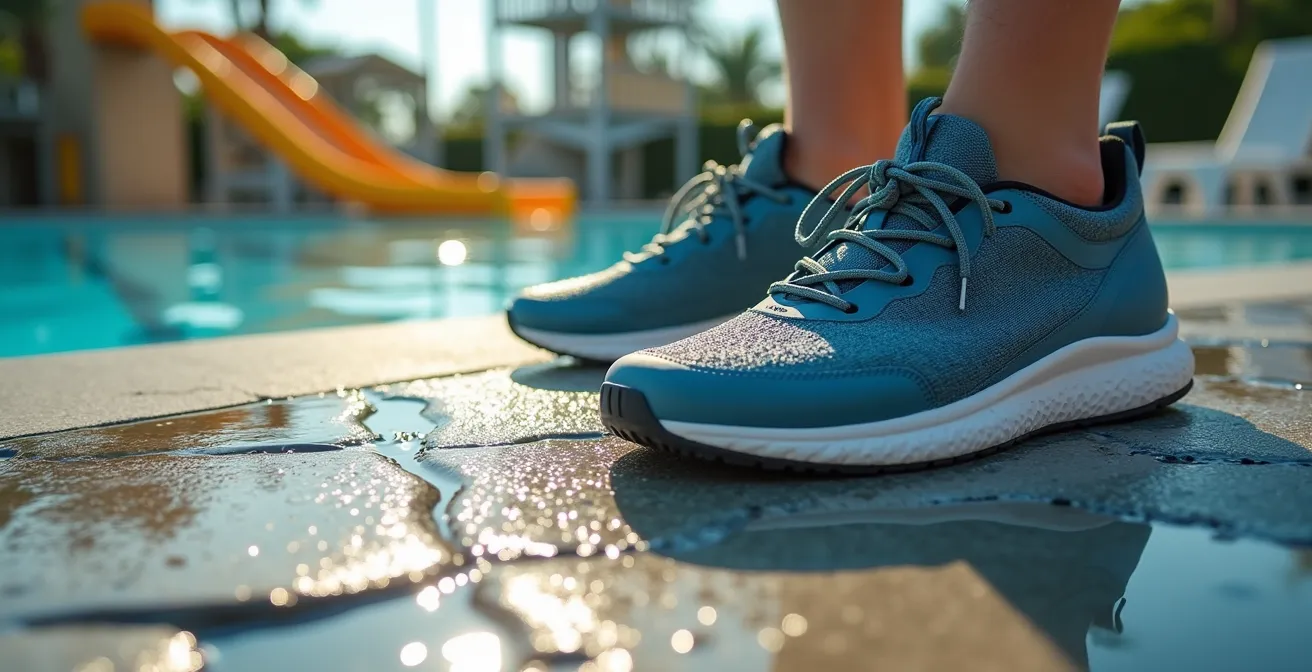
As you can see, the right gear provides a vital barrier against the harsh environment. Investing in a pair of quality water shoes for each family member is a small price to pay for a day of comfort and mobility, enabling you to execute your park navigation strategy without being sidelined by pain.
Think of water shoes not as an accessory, but as essential equipment for your mission. It’s the difference between a tactical advance and a painful retreat.
How to Manage Your Phone and Wallet While Riding the Leap of Faith?
In a waterpark, your valuables become a logistical burden. Carrying a phone for photos and a wallet for purchases is necessary, but they are strictly forbidden on high-intensity slides like the Leap of Faith. This creates a constant dilemma: secure them and lose access, or risk leaving them unattended? The solution is a disciplined asset management strategy centered around the park’s locker system. However, not all lockers are created equal in terms of strategic value.
The park offers lockers for a fee, with prices at the park ranging from £9 for a small locker to £15 for a large one. While some online advice suggests leaving items on a lounger, this is a high-risk gamble in a crowded park. A locker is the only secure option. For optimal logistics, choose a locker in a central location, such as the Atlas Village area. This provides a convenient home base you can return to without making long detours. A small locker is often sufficient if you pack efficiently, bringing only the absolute essentials into the park.
Your in-park kit should be minimalist: a towel, sunscreen, water shoes, and a waterproof phone case on a lanyard. This allows you to capture memories without juggling loose items. Before heading to the first ride, take a photo of your locker number and its location. This simple step prevents a stressful search later in the day. By establishing a secure, central base for your non-essential items, you free yourself to move through the park with speed and confidence, knowing your assets are protected.
This disciplined approach transforms your valuables from a liability into a well-managed part of your day’s logistics, allowing you to focus on the fun, not the fear of loss.
Smuggling Snacks vs Buying Inside: What Are the Real Security Rules?
The high cost of food and drinks inside any theme park tempts families to consider bringing their own. However, at Aquaventure, this is a strategy that is likely to fail and cause unnecessary delays at the entrance. It’s crucial to understand the official rules to avoid having your carefully packed picnic confiscated by security. Wasting time arguing at the gate is a poor start to a day focused on efficiency.
The park’s policy is strict and unambiguous. According to the official rules stated by Atlantis Aquaventure, visitors are not permitted to bring their own food, beverages, or glassware into the waterpark. Security staff are authorized to inspect all bags and will enforce this rule. While exceptions are sometimes made for guests with specific medical needs or for baby food, you should not assume your snacks will be allowed through. Attempting to “smuggle” food is a gamble that can backfire, leading to confiscation and wasted money.
A better strategy is to focus on smart, rule-abiding ways to manage food costs. A disciplined approach can significantly reduce your in-park spending without breaking any regulations. Your most powerful tool is hydration: bring an empty, refillable water bottle for each family member. The park has numerous free water fountains, and staying hydrated is critical for maintaining energy. Additionally, consider these money-saving tactics:
- Eat a very large, late breakfast before you arrive to minimize the need for a full lunch.
- Look for meal package deals or combo tickets that include food vouchers when booking online.
- Inside the park, target shareable options like family-sized pizzas or meal deals, which offer better value than individual meals.
By planning your meals strategically, you can control your budget without the stress and potential embarrassment of having your supplies confiscated at the entrance.
Which Slides Are Off-Limits for Your 1.2m Tall Child?
For a family with children of varying ages and sizes, few things cause more disappointment than waiting in a long line only to be turned away at the top of a slide. Managing expectations is a critical part of a successful family day out, and at Aquaventure, the key benchmark is 1.2 meters (48 inches). This height is the primary threshold for accessing the park’s most thrilling rides, and understanding its implications is essential for planning your day and avoiding on-site frustration.
The park’s safety policy is clear: visitors with a height of under 1.2 metres will have restricted access to the high-intensity slides located in the Neptune and Poseidon towers. This includes iconic attractions like the Leap of Faith and Poseidon’s Revenge. It’s not just about access, but also supervision. As one travel guide points out, the rule is nuanced:
Children who measure shorter than 1.2 meters need adult supervision when accessing particular rides at Aquaventure Waterpark.
– Gokite Travel, Ultimate Guide to Atlantis Water Park
This means that even on some less intense slides, an adult may need to accompany the child. The best strategy is to measure your children before you go. If one child is under the 1.2m mark, frame the day’s adventure around the attractions they *can* enjoy. The vast Splashers Kids’ Play Area, with its own slides, fountains, and climbing structures, is a park within a park designed specifically for younger guests. By setting a positive focus on these areas from the start, you can prevent the feeling of being “left out” and ensure the day is exciting for everyone, regardless of their height.
A well-prepared parent is a relaxed parent. Pre-empting this issue turns a potential point of conflict into a well-managed part of the family’s adventure.
Clockwise or Counter-Clockwise: The Best Route Around the Lazy River?
This is the heart of the entire strategy, the core of the “counter-flow trajectory” that will save you hours. Most families enter Aquaventure and drift towards the closest attraction or follow the crowd in a haphazard way. A strategic team, however, understands that the park’s layout can be used to their advantage. The three main slide complexes—Neptune Tower, Poseidon Tower, and Trident Tower—are spread out. The key is to access the most popular ones before the masses descend.
The optimal route is clockwise. Upon entering the park, resist the urge to stop at the first thing you see. Instead, head immediately right and move in a clockwise direction. This path leads you directly to the Neptune and Poseidon towers, which house legendary slides like the Leap of Faith. By taking this route, you are moving against the bulk of the crowd, which tends to disperse more slowly and randomly. Experienced visitors report that this strategy is essential for conserving energy and maximizing ride time in the crucial first one or two hours of the day.
The impact of this strategy is dramatic. In the first hour after opening, you can experience several major slides with minimal waiting. This is confirmed by data on queue times, which show that wait times at popular slides increase from less than 5 minutes to 30-45 minutes after the first 90 minutes. By hitting these slides early, you “bank” your most desired experiences before the park reaches peak congestion. Later, when the lines are long, you can shift your focus to the lazy river or wave pool, knowing you’ve already conquered the main attractions.
This isn’t just about walking in a certain direction; it’s a deliberate tactical maneuver that puts your family two steps ahead of the crowd from the moment you arrive.
Which Section of JBR Beach Is Least Crowded for Families?
After an intense, action-packed day at Aquaventure, the transition to the evening needs to be seamless and relaxing, not another stressful scramble. Jumeirah Beach Residence (JBR) is a popular choice for its vibrant atmosphere and dining options, but it can be overwhelmingly crowded. For a family looking to decompress, finding a quieter spot is key. The goal is to extend the day’s enjoyment, not trade one type of crowd for another.
The most crowded part of JBR is the central stretch along The Walk. To find a more family-friendly zone, your strategy should be to head towards the far ends of the beach. The section closest to the Bluewaters Island bridge is often significantly less congested. This area provides more space for children to play without being in the middle of a major thoroughfare. Arriving around 4:30 to 5:00 PM is also strategic, as it allows you to miss the peak midday sunbathers and arrive before the evening dinner rush fully kicks in.
Once you’re there, a few simple choices can enhance the experience:
- Identify the locations of public restrooms and changing facilities in your chosen section beforehand.
- Look for quieter cafes set back from the main tourist path for easier and more relaxed snack breaks.
- Utilize the public playgrounds often found in these less-crowded zones to keep children entertained.
Getting from Aquaventure on The Palm to JBR also requires a smart logistical choice. A direct taxi is often the best balance of cost, time, and convenience for a tired family.
This table compares the most common transport methods to help you decide.
| Transport Method | Journey Time | Cost (Family of 4) | Hassle Factor |
|---|---|---|---|
| Taxi Direct | 20 minutes | AED 40-50 | Low – Direct route |
| Palm Monorail + Tram | 45 minutes | AED 40 | Medium – One transfer |
| Private Transfer | 20 minutes | AED 80-100 | Very Low – Premium comfort |
By applying the same strategic thinking to your post-park plans, you guarantee the entire day is a success from start to finish.
Key takeaways
- A clockwise park route in the first hour is the most effective no-cost strategy to beat queues for major slides.
- Water shoes are essential, non-negotiable gear for comfort and mobility on scorching hot concrete surfaces.
- A centralized locker for asset management and a clear understanding of food and height policies prevent logistical delays and disappointment.
How to Conquer the ‘Leap of Faith’ Without Losing Your Swimwear?
The Leap of Faith is more than a water slide; it’s a rite of passage at Aquaventure. It is the ultimate test of nerve and a crowning achievement for any visitor. The challenge is not just psychological but also physical. As one tour operator describes it, this is a near-vertical 27.5-meter plunge that propels riders at speeds approaching 60 km/h. The sheer force of the water and the vertical drop can easily lead to a classic waterpark mishap: a lost or displaced swimsuit. Conquering this behemoth requires both courage and a little bit of practical preparation.

The key to a secure ride lies in two areas: your choice of swimwear and your body position during the descent. Loose-fitting clothing, bikinis with flimsy ties, or regular street clothes are simply not designed to withstand the forces at play. An embarrassing and uncomfortable adjustment at the bottom of the slide can be easily avoided with the right gear and technique. It’s about ensuring your swimwear is as ready for the challenge as you are.
Before you take the plunge, follow a strict protocol to ensure everything stays in place. This isn’t just about dignity; a secure body position is also safer and more hydrodynamic, contributing to a better ride experience. This checklist provides a practical audit for any extreme slide.
Action plan: Swimwear security protocol
- Swimwear Selection: Choose appropriate, non-transparent swimwear. For men, trunks with a reliable drawstring and snug inner mesh are best. For women, athletic one-pieces or secure surf-style tops offer the most security. High-elastane or performance polyester blends work best.
- Pre-Slide Checks: Forcefully tighten all drawstrings. This is the single most important step. Ensure all clips and ties are double-checked and secure.
- Body Position: As you prepare to slide, cross your arms over your chest. This helps keep your upper body stable and protects any bikini tops.
- Core and Leg Form: Lock your ankles together and keep your legs straight. This creates a more streamlined shape, reducing water resistance and the chance of fabric catching.
- Tuck Your Chin: Tucking your chin towards your chest helps maintain the correct posture and prevents your head from snapping back during the steep drop.
Stepping up to the Leap of Faith prepared and confident is the ultimate reward. It transforms the day from a logistical challenge into a personal victory, creating a lasting memory of exhilaration for the whole family.