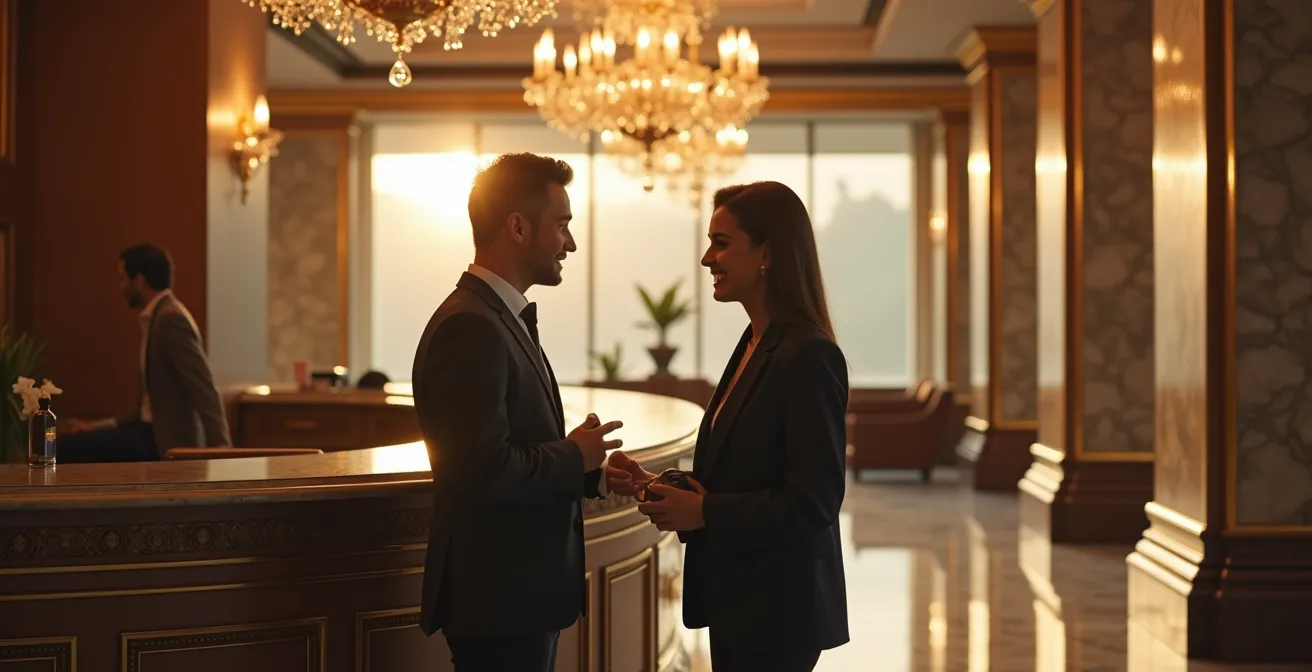
Forget charm and late check-ins; securing a suite upgrade is about understanding the hotel’s operational playbook and making your request financially and logistically easy to approve.
- The hotel’s decision is based on inventory management and minimizing operational friction, not just your special occasion.
- Small details, from the brand of toiletries to the wording of room descriptions, are strategic signals you can decode to understand a hotel’s true value proposition.
Recommendation: Frame your upgrade request not as a favor, but as a mutually beneficial opportunity by showing you understand their business—ask for specific, adjacent room categories instead of a generic “any upgrade available.”
Every traveler celebrating a special occasion dreams of the same magic words at the front desk: “We’ve upgraded you to a suite.” The common advice for chasing this dream is a tired mix of platitudes: dress well, mention your anniversary, be polite, or try the “hundred-dollar-bill sandwich.” While politeness is non-negotiable, these tactics treat the upgrade as a game of chance or a favor to be won. As an insider, I can tell you this is fundamentally wrong. The front desk isn’t a lottery; it’s the nerve center of a complex business driven by inventory, revenue management, and operational efficiency.
To truly master the art of the upgrade, you must stop thinking like a guest and start thinking like a manager. The key isn’t a better story about your birthday; it’s understanding the hidden language of luxury hospitality. It’s about knowing the real difference between “ocean view” and “ocean front,” why a suite requires a staggering credit card hold, and what the brand of soap in the bathroom signals about the hotel’s entire service philosophy. These aren’t just trivia; they are the chess pieces on the board.
This guide pulls back the curtain. Instead of offering flimsy tricks, it provides the foundational knowledge you need to navigate the system. By understanding the hotel’s internal logic, you can position your request not as a hopeful plea, but as an intelligent, low-friction solution for the front desk. This is how you transform your request from a nuisance into an opportunity they are happy to grant. We will decode the components of the luxury hotel experience, giving you the strategic vocabulary to secure the upgrade you deserve.
To help you master this strategic approach, this guide breaks down the essential components of the luxury hotel ecosystem. Below is a summary of the key areas we will explore to build your insider knowledge.
Summary: Understanding the Art of the Hotel Upgrade
- What Can You Actually Ask a 24-Hour Butler to Do?
- 2-Bedroom Suite vs Two Connecting Rooms: Which Is Cheaper for Families?
- Why Luxury Suites Require a $1000 Credit Card Hold?
- Ocean View vs Ocean Front: The Subtle Difference That Changes Everything
- Hermès vs Bvlgari Toiletries: Does the Suite Grade Determine the Soap?
- Club Room vs Suite: Which Offers Better Value for Heavy Drinkers?
- Member Clubs vs Public Beach Clubs: Which Membership is Worth the Fee?
- How to Navigate Dubai’s Ultra-Luxury Scene Without a Concierge Service?
What Can You Actually Ask a 24-Hour Butler to Do?
The concept of a 24-hour butler often evokes images of someone merely unpacking a suitcase or delivering a morning paper. This dramatically underestimates their role. A butler is your personal logistics and experience manager within the hotel ecosystem. Their true value lies in their ability to handle hyper-personalized and complex in-house requests that go far beyond standard concierge duties. While a concierge books your dinner reservations downtown, a butler coordinates with the chef for complex dietary needs and arranges for an in-suite tasting menu.
The most seasoned travelers know to distinguish between these roles. The butler is for tactical, immediate, and in-residence needs. This can range from the practical, like arranging for the pressing of garments for an evening event, to the highly specific, such as sourcing a particular vintage of champagne from the hotel’s cellar for an impromptu celebration. They are also masters of proactive service; a skilled butler will observe your preferences—the type of water you drink, the time you take your coffee—and anticipate them without being asked. Understanding this scope is the first step in maximizing the value of a high-end suite.
Engaging your butler effectively begins before you even arrive. A pre-arrival email with a curated list of preferences sets the stage, signaling that you are a prepared and discerning guest. This allows them to pre-stock your favorite beverages, set the room temperature to your liking, and have your preferred pillow type ready. This isn’t being demanding; it’s enabling them to provide the level of service they are trained for. During your stay, think of them as your single point of contact for optimizing your hotel environment.
Your Action Plan: Leveraging Your Butler Service
- Pre-Arrival Communication: Email your butler 48-72 hours before arrival with a preference list, including pillow type, preferred room temperature, and favorite beverages to establish yourself as a prepared guest.
- Request Specialized Services: Inquire about rarely advertised options like in-suite tailoring, personalized room scent curation, or private mixology sessions using the minibar.
- Utilize Sourcing Power: Ask your butler to source last-minute sold-out items, arrange meetings with local artisans, or coordinate complex dietary requirements directly with the hotel’s executive chef.
- Master In-House Logistics: Use the butler for packing/unpacking services, wake-up calls with coffee delivery, and garment pressing to streamline your schedule.
- Distinguish Roles: Use the butler for all in-house tactical needs, reserving the concierge for external logistics like restaurant bookings or tour arrangements.
2-Bedroom Suite vs Two Connecting Rooms: Which Is Cheaper for Families?
For families or small groups, the choice between a single two-bedroom suite and two connecting standard rooms is a critical financial and logistical decision. The intuitive assumption is that a single suite is the more luxurious, and therefore more expensive, option. While often true in terms of list price, the real calculation of value is far more nuanced. From a hotel manager’s perspective, these two configurations represent entirely different inventory types with distinct impacts on revenue and occupancy.
The primary advantage of two connecting rooms is often cost. Booking two entry-level or mid-tier rooms is frequently cheaper than booking a single, high-category suite. Furthermore, this option provides double the amenities: two full bathrooms, two minibars, and two televisions, which can significantly reduce friction for a family getting ready in the morning. The configuration also offers superior privacy, as the connecting door can be closed and locked, creating two entirely separate spaces. A suite, by contrast, forces everyone into a shared central living area. The architectural reality of hotel floor plans often places connecting rooms at corners or in other strategic locations, which you can sometimes spot on a hotel map.

The table below breaks down the strategic trade-offs. A two-bedroom suite sells at a premium because it is a unique piece of inventory. Conversely, connecting rooms are a feature applied to standard inventory, making them more flexible for the hotel to manage. This also means the potential for an upgrade is often higher when starting with two standard rooms compared to a suite, which is already at the top of the inventory ladder.
This comparative analysis from a recent travel industry report highlights the key decision factors for families. As you can see in the cost-benefit breakdown, the “cheaper” option depends heavily on your priorities.
| Factor | 2-Bedroom Suite | Two Connecting Rooms |
|---|---|---|
| Average Cost | Premium pricing (single high-tier booking) | Often cheaper (two standard rooms) |
| Amenities | Single set of amenities | Double amenities (2 minibars, 2 bathrooms) |
| Privacy | Shared living space | Complete separation possible |
| Upgrade Potential | Lower (already premium) | Higher (upgrade from standard) |
| Space Configuration | Open communal areas | Flexible separation options |
Why Luxury Suites Require a $1000 Credit Card Hold?
One of the most common points of confusion—and sometimes alarm—for guests checking into a luxury suite is the significant credit card authorization hold, often reaching $1000 or more. This is frequently misinterpreted as an upfront charge. In reality, it is a temporary hold, a standard industry practice designed to guarantee funds for potential incidental expenses. For standard rooms, most hotels place credit card holds ranging from $50 to $200 per night to cover things like minibar usage or room service.
So why the dramatic jump for a suite? The amount is calculated based on the room’s rate and its potential for high-cost incidentals. A suite isn’t just a larger room; it’s an environment packed with premium services and amenities. It may feature a full bar instead of a minibar, expensive electronics, original artwork, and access to high-cost services like in-suite dining from a celebrity chef’s restaurant. The authorization hold acts as a service enabler, allowing the hotel staff to fulfill requests instantly and seamlessly without running multiple small transactions for every drink, meal, or movie ordered. It creates a frictionless experience, which is the hallmark of true luxury.
The hotel needs to ensure that a guest who orders a $500 bottle of wine at 2 a.m. has the capacity to pay for it. The hold is a simple, behind-the-scenes verification of that capacity. It’s important to remember that this amount is not debited from your account; it merely reduces your available credit limit for the duration of your stay. The hold is typically released within a few business days after check-out, once the final bill is settled. Understanding this process removes the anxiety and reframes the hold for what it is: a key to an effortless, premium experience.
Understanding the Authorization Hold Process
Hotels calculate hold amounts based on the room rate plus potential incidentals. For a $400 room, they might authorize $500 total—the extra $100 covers potential damages or charges. As an analysis of the process explains, this signals to the hotel that the guest can pay up to $500. At this point, the available funds on the guest’s card decrease by $500 due to the hold, but the guest isn’t actually charged this amount yet. For a $2,000-per-night suite with a fully stocked bar, the potential incidental spend is exponentially higher, justifying a hold of $1,000 or more to enable seamless service.
Ocean View vs Ocean Front: The Subtle Difference That Changes Everything
In the lexicon of hotel bookings, few terms cause more confusion and disappointment than “ocean view” and “ocean front.” They sound similar, but the difference between them can be the difference between a panoramic vista and a sliver of blue seen from the corner of a balcony. Understanding this distinction is crucial when booking and especially when negotiating an upgrade. From an inventory perspective, these are distinct categories with significantly different price points.
An “ocean view” room is any room from which some portion of the ocean is visible from any angle. This is a broad and often creatively interpreted definition. It could mean a full view, or it could mean leaning over your balcony to catch a glimpse between two other buildings. An “ocean front” room, in contrast, is defined by its position: it directly faces the ocean with what should be an unobstructed, head-on view. This is the premium category that commands the highest price.

Herein lies the trap for the unwary traveler: a room can be designated as “ocean front” based on its physical location in the building, yet have its view obstructed by palm trees, architectural elements, or other buildings. In this scenario, you are paying for a premium location without the premium view. This is why it’s critical to be specific in your requests. Instead of asking for an “ocean view,” ask for a “full, unobstructed view.” When negotiating an upgrade, suggesting a move from a partial ocean view to a full ocean front room is a specific, logical request that a front desk manager can easily understand and potentially accommodate if inventory allows.
This is a classic example of how hotels use language to segment their inventory. The ambiguity of “view” allows them to sell rooms with less desirable sightlines at a higher price than a standard room. The informed traveler knows to look past the label and inquire about the quality and nature of the view itself. It’s not just about seeing the ocean; it’s about the experience the view provides.
Hermès vs Bvlgari Toiletries: Does the Suite Grade Determine the Soap?
It might seem like a minor detail, but the brand of toiletries in a hotel bathroom is anything but trivial. From a hotel manager’s perspective, the amenity program is a carefully calibrated part of the brand’s identity and financial strategy. The choice between Hermès, Bvlgari, Le Labo, or an in-house brand is a deliberate signal about the hotel’s positioning in the luxury market. It is, in essence, a promise of the level of quality you can expect throughout the property.
Indeed, the suite grade often determines the soap. Many luxury hotels operate a tiered amenity system. Standard rooms may receive a high-quality but less exclusive brand, while premium suites are stocked with top-tier, globally recognized luxury brands. For instance, a deluxe room might feature L’Occitane, while the presidential suite boasts a full collection from Hermès. This strategy serves two purposes: it creates a tangible sense of upgrade and exclusivity for higher-paying guests, and it manages costs across thousands of rooms. The per-unit cost difference between these brands is significant when scaled across a large property.

This is why an astute traveler can use the toiletries as a quick diagnostic tool. As one luxury hospitality expert noted in an analysis of premium hotel amenities, the generosity and brand of toiletries act as a “service barometer.” A hotel that invests in premium, well-known amenity brands is likely to have a similar philosophy towards its staffing, dining, and overall guest experience. Conversely, a hotel claiming five-star status but providing generic, unbranded amenities may be cutting corners elsewhere. It’s a small detail that speaks volumes about the hotel’s commitment to a truly luxurious guest experience.
The brand and generosity of toiletries indicate the hotel’s overall service philosophy and financial health.
– Luxury Hospitality Expert, Analysis of Premium Hotel Amenities
Club Room vs Suite: Which Offers Better Value for Heavy Drinkers?
For a traveler who enjoys a few cocktails in the evening, the choice between booking a base-level suite or a standard room with Club Lounge access presents a classic value proposition dilemma. A suite offers more space and privacy, but a Club room offers all-day access to complimentary food and, crucially, beverages. The “better value” isn’t a universal answer; it requires a personal break-even calculation.
From a strategic standpoint, the Club Lounge is a hotel’s tool for upselling and fostering loyalty. It offers a semi-exclusive experience at a fixed supplementary cost. The core of the value proposition for a heavy drinker lies in the evening open bar. To determine if it’s worth it, you need to do the math. Calculate the daily cost of the Club upgrade and divide it by the average price of a drink at the hotel’s main bar. This simple formula reveals how many drinks you would need to consume per day to break even. If you and your travel partner plan to have three or four cocktails each evening, Club access is almost certainly a financial win.
However, the calculation goes beyond just the cost of drinks. You must also consider the quality and atmosphere. Club Lounges vary dramatically between hotel chains and even individual properties. Some offer top-shelf spirits and handcrafted cocktails, while others provide basic house wine and beer. Researching the specific offering of your hotel’s lounge is essential. Furthermore, you must weigh the atmosphere trade-off: the convenience of unlimited drinks in a functional (and sometimes crowded) lounge versus the premium experience of enjoying a drink in the privacy and comfort of your own spacious suite.
Your Checklist: The Club vs. Suite Break-Even Calculation
- Calculate Your Break-Even Point: Divide the daily Club upgrade cost by the average price of a drink at the hotel bar to find the number of drinks needed per day to make it worthwhile.
- Research Lounge Quality: Investigate the tier of the hotel’s specific Club Lounge offerings, from the quality of spirits to the variety of wines.
- Consider a Hybrid Approach: Inquire about purchasing daily Club access passes while staying in a base suite to potentially get the best of both worlds.
- Factor in the Atmosphere: Weigh the convenience of an all-inclusive lounge against the more private and premium experience of in-suite room service.
- Evaluate Ancillary Benefits: Don’t forget to include the value of complimentary breakfast, all-day snacks, and evening hors d’oeuvres in your overall cost-benefit analysis.
Key Takeaways
- Negotiating a suite upgrade is a strategic act of understanding and aligning with the hotel’s operational and financial interests.
- The language of bookings (e.g., “Ocean View” vs. “Ocean Front”) and the details of service (e.g., amenity brands) are intentional signals of value.
- Maximizing luxury requires proactive engagement, from pre-arrival communication with a butler to performing a personal cost-benefit analysis on Club Level access.
Member Clubs vs Public Beach Clubs: Which Membership is Worth the Fee?
The allure of a beach club is undeniable, but the landscape is divided into two distinct models: exclusive private member clubs and high-energy public beach clubs. The decision of where to invest your time and money extends beyond the price of a daybed; it’s a choice between long-term social capital and a transient, high-octane experience. From an investment perspective, the “worth” of the fee is measured in entirely different currencies.
Public beach clubs, often found in high-traffic tourist destinations, operate on a transactional model. They sell an experience for a day: loud music, a vibrant “see-and-be-seen” atmosphere, and premium bottle service. However, the true cost is often hidden. The entry fee or minimum spend is just the beginning. Food and beverage prices are typically inflated, and the experience, while fun, is ephemeral. You are a customer for the day, and the relationship ends when you pay the bill.
Private member clubs operate on a relationship model. The membership fee is an entry barrier that curates a community. The value here is not just in the beach access but in the network. These clubs become social and professional hubs for a select group. The economics of this model are fundamentally different; as an analysis of the industry points out, the real benefit often lies in what happens off the sand. For example, a key benefit is access to exclusive reciprocal arrangements with clubs globally, meaning a single membership can unlock venues in other major cities. This transforms a local leisure expense into a global access asset.
Therefore, choosing which fee is “worth it” depends entirely on your goal. If you seek a memorable, high-energy party for an afternoon, a public beach club is a straightforward and effective choice. If you are looking to build a social network, gain access to an exclusive community, and leverage your membership for global travel benefits, the higher upfront cost of a private club can offer a far greater long-term return on investment.
How to Navigate Dubai’s Ultra-Luxury Scene Without a Concierge Service?
While a top-tier hotel concierge is an invaluable asset, the modern luxury traveler is increasingly empowered to navigate even the most complex destinations, like Dubai, independently. The key is to move beyond relying on a single point of contact and instead build your own “digital concierge stack.” This is a curated collection of applications and intelligence sources that gives you direct control over your itinerary, often with greater speed and flexibility than a traditional service.
In a city like Dubai, where the hottest restaurants and events can be booked out weeks in advance, agility is everything. The first layer of your stack should be essential local apps. Platforms like Careem (for everything from luxury transport to food delivery), Zomato, and Reserve Out are non-negotiable for securing restaurant reservations at high-demand venues. These apps provide real-time availability that a concierge, who may be juggling requests from a dozen other guests, might not be able to access as quickly.
The second layer is human intelligence. This doesn’t mean you need a fixer; it means leveraging the network you naturally build. Follow local luxury and food influencers on Instagram for real-time tips on new openings and exclusive events. More importantly, establish a relationship with the maître d’ at your first high-end restaurant. They are gatekeepers to the city’s culinary scene and can often facilitate introductions or reservations at sister venues. Even your premium car service driver can be a valuable source of intel on traffic patterns and authentic local spots that fly under the tourist radar. By combining digital tools with on-the-ground human intelligence, you can craft a bespoke Dubai experience that is perfectly tailored to your tastes.
Action Plan: Building Your Digital Concierge Stack for Dubai
- Download Essential Apps: Install Careem for luxury transport, Zomato for restaurant discovery, and Reserve Out for booking high-demand venues before you land.
- Leverage Social Intelligence: Follow a curated list of local Dubai luxury influencers on Instagram for real-time updates on hot spots and exclusive pop-up events.
- Build Human Networks: Establish a good relationship with the maître d’ at your first high-end restaurant; they can often facilitate introductions to sister venues.
- Use Drivers as Intel Sources: Engage with your premium car service drivers; they are often the best source for real-time traffic advice, new openings, and authentic local recommendations.
- Book a Marquee Experience: Secure one major booking far in advance (e.g., a desert safari or yacht charter) to use as social capital and a fixed point in your flexible itinerary.
Ultimately, navigating the world of luxury travel is a skill. By applying these insider strategies, you shift from being a passive consumer to an active participant, capable of shaping your experience and maximizing the value you receive at every turn. Start by building your own digital concierge stack to take control of your next journey.
Frequently Asked Questions About Hotel Room Categories
What exactly qualifies as an ‘Ocean View’ room?
A room needs only some portion of the ocean visible from any angle to be called ‘ocean view’ – this could be a tiny glimpse between buildings or visible only from the balcony.
How is ‘Ocean Front’ different from ‘Ocean View’?
Ocean front rooms directly face the ocean with uninterrupted frontal views, while ocean view may offer only partial or angled views with potential obstructions.
Can an ocean front room lack an ocean view?
Yes, surprisingly. If palm trees or other architectural elements obstruct the view despite the room’s physical position facing the ocean, you may have an ocean front location without the actual ocean view.