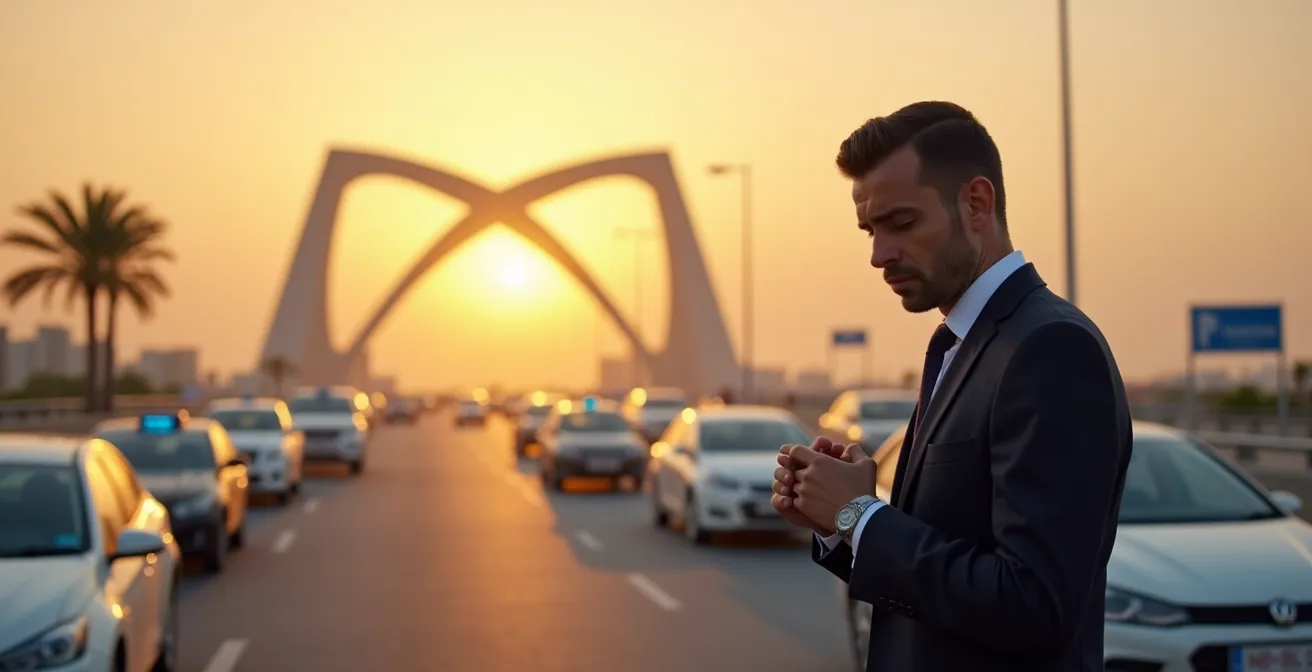
Contrary to the idyllic brochures, The Palm Jumeirah’s design prioritizes aesthetics over daily logistics, creating inherent and unavoidable compromises for long-term residents and business commuters.
- The island’s single entry/exit point creates a structural bottleneck, making road travel predictably congested during peak hours.
- Its unique geography forms a “microclimate trap,” significantly increasing perceived humidity compared to the mainland.
- The promise of exclusivity is often undermined by construction noise, service intrusions, and a complex reality of beach access.
Recommendation: Prioritize a thorough logistical audit—evaluating traffic patterns, noise sources, and microclimate effects—before committing to a long-term stay or residency based on the luxury image alone.
The image of The Palm Jumeirah is globally recognized: a symbol of Dubai’s ambition, synonymous with opulent villas, five-star hotels, and an exclusive waterfront lifestyle. For tourists on a short vacation, it delivers on this promise. However, for a potential resident, a long-stay tourist, or a business traveler debating between The Palm and a mainland hub like Downtown, this glossy image obscures a far more complex logistical reality. The core concern isn’t just about luxury; it’s about the daily friction of living on a man-made marvel that was engineered more for visual impact than for efficient, peaceful living.
Many analyses will point out the obvious: traffic can be heavy, and it’s an expensive location. But these are superficial observations. The real issues are structural and environmental. The very design that makes The Palm iconic—a single trunk feeding numerous fronds and a vast crescent—is also its greatest logistical weakness. This isn’t just a “traffic problem”; it’s a fundamental design flaw for daily commuting. The question is not whether The Palm is luxurious, but whether that luxury compensates for the daily compromises on time, tranquility, and even comfort. This analysis moves beyond the brochures to provide a location scout’s objective assessment of the realities you must confront before making The Palm your base.
This guide will dissect the key logistical and lifestyle challenges of The Palm, providing a clear-eyed view for anyone evaluating it as a residential or accommodation hub. We will examine the real-world trade-offs between different living options, the environmental factors often overlooked, and the practicalities of transport and noise that define daily life on the island.
Summary: The True Cost of Living on The Palm Jumeirah
- Frond Living vs Apartment Living: Which Offers Better Privacy for Families?
- How to Access Private Beaches on The Palm Without a Hotel Reservation?
- Why Humidity Levels Feel 15% Higher on The Crescent in August?
- The Construction Noise Trap: How to Check Your View Before Booking?
- Monorail or Taxi: Which Is Faster to Reach Atlantis from the Trunk?
- Marina View vs Sea View: Which Side Is Quieter on Thursday Nights?
- Living on Bluewaters: Is It Too Noisy for Families?
- How to Distinguish Genuine 5-Star Service from Glorified 4-Star Decor in Dubai?
Frond Living vs Apartment Living: Which Offers Better Privacy for Families?
The choice between a frond villa and a tower apartment on The Palm embodies a central paradox of privacy. The frond villa is marketed as the pinnacle of seclusion, offering a private garden, pool, and direct beach access. This promise of isolation is a primary driver behind the market’s strength, with a recent 25.8% increase in villa prices reflecting intense demand for this perceived exclusivity. Each frond has a single, security-gated entry point, effectively eliminating unsolicited visitors and through-traffic. This creates a secure bubble, which is highly attractive for families.
However, this seclusion comes with its own set of intrusions. The maintenance of a large villa is a constant affair. Gardeners, pool cleaners, and beach maintenance crews are frequent, scheduled visitors. Furthermore, the proximity of villas on the fronds means your private beach is often in direct line of sight of your neighbors. In contrast, a high-floor apartment offers a different kind of privacy: vertical seclusion. While you share a building with hundreds of others, you are elevated above the street-level hustle. Maintenance is consolidated and managed by the building, reducing the frequency of service personnel at your door.
Ultimately, the decision rests on the type of privacy you value more. Frond living provides control over your immediate physical space but requires managing frequent service intrusions. Apartment living outsources this management but means accepting a higher density of neighbors and shared amenities. The privacy is less absolute but often more practical and less demanding to maintain.
How to Access Private Beaches on The Palm Without a Hotel Reservation?
One of the great misconceptions about The Palm is that its entire coastline is a private, inaccessible fortress. While residential fronds and luxury hotels do control vast stretches of sand, a significant portion of the beachfront can be accessed through savvy strategies, bypassing the need for a hotel booking. The most popular area for this is Palm West Beach, a vibrant promenade lined with restaurants and beach clubs that has become a destination in its own right.
For those without a hotel keycard, several methods provide access to the coveted shoreline. These strategies range from paid passes to clever dining choices, allowing non-residents to enjoy the same sun and sea as hotel guests. The key is knowing the options and choosing the one that best fits your budget and desired experience.
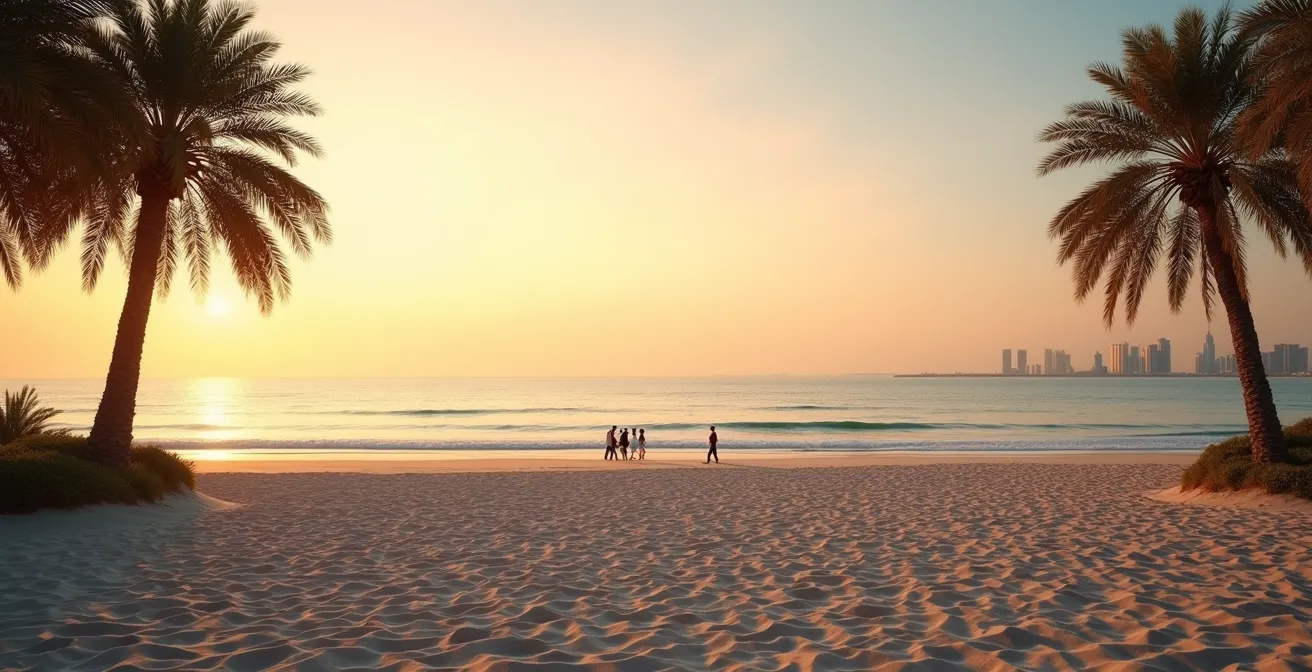
As seen in the bustling atmosphere of Palm West Beach, access is more about strategy than residency. Here are the most effective ways to secure your spot on the sand:
- The “Dine-to-Dip” Strategy: Many restaurants along Palm West Beach offer complimentary beach access to dining patrons. While a minimum spend is often required, this approach combines a meal with a beach day, offering excellent value.
- Day Pass Options: The most direct route is purchasing a day pass. These range from high-end hotel beach clubs with extensive facilities to more relaxed residential clubs like RIVA Beach Club. Compare prices, as they often vary between weekdays and weekends.
- Alternative Water Access: For a more active approach, renting a kayak or paddleboard from a vendor on the public-access sections of the trunk allows you to explore the Palm’s coastline from the water, offering unique views and the freedom to anchor and swim in designated areas.
- Off-Peak Timing: Some establishments offer discounted access or lower minimum spends during weekday mornings or after sunset, providing a more tranquil and budget-friendly experience.
Why Humidity Levels Feel 15% Higher on The Crescent in August?
A factor rarely discussed in real estate brochures is the microclimate. Not all locations in Dubai experience heat and humidity equally, and The Palm’s unique geography creates significant variations. Residents and long-term visitors often report that the Crescent—the outer ring home to Atlantis and other luxury resorts—feels noticeably more humid and stagnant than the mainland, particularly during the peak summer month of August. This isn’t just a feeling; it’s a measurable phenomenon driven by specific environmental factors.
The Crescent’s design, while visually stunning, creates a “microclimate trap.” Its position, surrounded by the waters of the Arabian Gulf on one side and the semi-enclosed water between it and the fronds on the other, drastically reduces wind circulation. Unlike a straight coastline like Jumeirah Beach Residence (JBR), which benefits from better airflow, the Crescent’s shape traps moisture-laden air. This, combined with the heat radiated from extensive construction and asphalt (the urban heat island effect), elevates the perceived humidity.
This comparative analysis breaks down the key environmental factors contributing to the perceived climate differences across The Palm and the nearby mainland.
| Location | Water Exposure | Wind Circulation | Heat Island Effect | Perceived Humidity Increase |
|---|---|---|---|---|
| Crescent | 3 sides | Reduced | High density | +15% |
| Trunk | 2 sides | Moderate | Medium density | +8% |
| Mainland (JBR) | 1 side | Good | Variable | Baseline |
For a business traveler or potential resident, this 15% increase in perceived humidity is not a trivial detail. It directly impacts lifestyle, from the comfort of sitting on a balcony to the cost of air conditioning. It means that an 8 PM walk on the Crescent in August can feel far more oppressive than the same walk in Dubai Marina, a critical consideration for anyone valuing outdoor comfort.
The Construction Noise Trap: How to Check Your View Before Booking?
The most significant and unpredictable threat to a tranquil life on The Palm is not traffic, but construction. Dubai’s skyline is in a state of perpetual evolution, and The Palm is one of its most active canvases. A pristine sea view from a high-floor apartment can, within months, become a direct view onto a new tower being built, complete with the accompanying noise, dust, and light pollution that starts at 6 AM. This “construction noise trap” is a major source of frustration for residents and can ruin a long-term stay.
Hotel and landlord descriptions can be misleading. A “partial sea view” often translates to “a glimpse of water between two construction sites.” Unlike traffic, which is somewhat predictable, a new project can be announced and break ground with little warning to adjacent properties. However, you are not powerless. A proactive due diligence process can significantly mitigate this risk before you sign a lease or make a long-term hotel booking. It requires looking beyond the marketing materials and using available tools to get a clearer picture of the development pipeline.
The following checklist provides a protocol for verifying the stability of your view and assessing the risk of future construction noise. This is the kind of on-the-ground intelligence a location scout uses to protect a client’s investment and quality of life.
Action Plan: Pre-Booking Construction Check
- Review Historical Imagery: Use Google Earth Pro’s timeline slider feature to see how the area around your target property has changed over the last few years. This reveals the pace of development and identifies adjacent empty plots.
- Scan Real Estate Portals: Check major Dubai property portals (like Bayut and PropertyFinder) for announcements of new projects or land sales in the immediate vicinity of your chosen building or villa.
- Request Written Confirmation: Ask the hotel or landlord for a written confirmation stating there are no known development plans for the plots directly adjacent (north, south, east, and west) for the duration of your stay or the next 6-12 months.
- Decode View Descriptions: Be skeptical of vague descriptions. Insist on seeing recent, time-stamped photos or a live video call from the exact unit you are booking. ‘City View’ can often mean facing another tower, which could become a construction site.
- Verify Municipal Timings: Familiarize yourself with Dubai Municipality’s standard construction hours. Knowing that work typically begins early in the morning helps you understand the potential daily disruption.
Monorail or Taxi: Which Is Faster to Reach Atlantis from the Trunk?
The journey from the base of The Palm’s trunk to its apex at Atlantis presents a classic logistical dilemma, encapsulating the island’s transport challenges. The choice is between the Palm Monorail, a purpose-built tourist attraction offering scenic views, and a standard road taxi or ride-sharing service. The “better” option is not straightforward and depends entirely on your priorities: speed, cost, convenience, or experience.
The Monorail offers a traffic-free, elevated journey with spectacular views over the fronds. It is a clean, modern, and predictable ride. However, its primary drawback is frequency and operating hours. Wait times can be up to 15 minutes, and it doesn’t run 24/7. Conversely, a taxi offers door-to-door service and operates around the clock. Its journey time is theoretically shorter, but it is completely at the mercy of the trunk’s infamous traffic, especially during evening and weekend peaks. As one traveler on TripAdvisor noted, for on-demand travel, “Uber to be the easiest way to travel. I downloaded the app and it was really straight forward to use.”

The visual of the elevated monorail track gliding above the congested road below is a powerful metaphor for this choice. The following table provides a direct comparison of the key factors to consider.
| Factor | Palm Monorail | Taxi/Uber |
|---|---|---|
| Journey Time | 10 minutes ride + up to 15 min wait | 5-8 minutes (no traffic) / 20-30+ min (with traffic) |
| Cost (Solo) | AED 15-30 return | AED 25-35 one way |
| Cost (Family of 4) | AED 60-120 return | AED 25-35 total (one way) |
| Operating Hours | 9 AM – 10 PM | 24/7 |
| Experience Value | Scenic views, tourist experience | Direct, efficient, private |
For a solo traveler or a couple outside of peak hours, the monorail is a pleasant experience. For a family of four, a single taxi is significantly more cost-effective and direct. For a business traveler needing to get to a meeting off-island, the taxi’s vulnerability to traffic makes it a high-risk choice. The monorail, while requiring a walk to the station, offers a more predictable timeline.
Marina View vs Sea View: Which Side Is Quieter on Thursday Nights?
For apartments on the trunk of The Palm, the choice of view—facing the open sea or the Dubai Marina skyline—is not just an aesthetic decision. It has a direct and significant impact on your acoustic environment, especially at the start of the weekend on a Thursday night. Each view comes with a distinct noise profile, and understanding this difference is critical for anyone sensitive to sound.
A Marina View offers a spectacular, dynamic cityscape that is dazzling at night, featuring the Ain Dubai observation wheel and the glittering towers of JBR and Dubai Marina. However, this beauty comes at an acoustic price. You are facing a densely populated, active hub. The noise is consistent and human-generated, stemming from the bars and restaurants of Palm West Beach, the general hum of traffic on the trunk, and the promenades across the water. This noise typically peaks between 8 PM and 2 AM on a weekend night.
In contrast, a Sea View offers a vista of open water and the horizon, which is serene and dark during the night. The primary sources of noise are event-based and more distant. You might hear the muffled bass from a beach club on the Crescent or the sound of passing boats. This noise is generally less intrusive and tends to die down earlier, typically by midnight. The key factors to assess are:
- Noise Profile: A Marina view subjects you to a constant, broad spectrum of urban noise. A Sea view exposes you to intermittent, specific sounds.
- Light Pollution: The Marina side is intensely illuminated all night, which can affect sleep quality. The Sea side is significantly darker.
- Thermal Comfort: Sea-facing balconies often benefit from cooling onshore breezes, making them more pleasant to use in the evenings.
- Privacy: A Marina view means your balcony is potentially visible to thousands of people in the towers opposite. A Sea view offers near-total privacy from observation.
For those prioritizing peace and quiet, the Sea View is unequivocally the winner on a Thursday night. The trade-off is a less dynamic, “darker” view compared to the vibrant energy of the Marina skyline. The choice depends on whether you want to watch the city or escape from it.
Living on Bluewaters: Is It Too Noisy for Families?
When considering waterfront living in Dubai, The Palm is not the only option. Bluewaters Island, home to Ain Dubai, presents a compelling alternative, but it comes with its own set of concerns about noise, particularly for families. While The Palm’s noise is diffuse—spread across traffic, construction, and beach clubs—Bluewaters’ noise is highly concentrated. It is designed as a vibrant entertainment hub, and living there means living within the action.
The primary noise sources on Bluewaters are the restaurants, retail outlets, and public spaces that draw large crowds, especially on weekends and during holidays. This creates a predictable but intense period of noise. However, the development was designed with this in mind. Residential buildings on Bluewaters typically feature modern, high-grade acoustic insulation and triple-glazing as standard, which is far more effective at mitigating entertainment noise than the variable standards found in older buildings on The Palm. The noise is also more predictable; you can check the event schedule for Caesars Palace or other venues.
The logistical bottleneck is similar to The Palm, with a single bridge providing access, which can become congested during major events. However, the island’s smaller scale makes it far more walkable. For families, the key difference lies in the nature of the disturbance. The Palm’s unpredictable construction noise can be a chronic, daily issue. Bluewaters’ noise is event-driven and concentrated in the evenings. Many families may find the latter easier to manage, especially if their apartment has effective soundproofing. The development was engineered to blend “urban vibrancy with waterfront serenity,” and superior acoustic design is a key part of that formula.
Key Takeaways
- The Palm’s iconic design is its primary logistical weakness, creating a structural bottleneck with one main road.
- Environmental factors like the “microclimate trap” on the Crescent significantly increase humidity and reduce outdoor comfort.
- The promise of luxury and privacy is constantly challenged by unpredictable construction, service intrusions, and complex beach access rules.
How to Distinguish Genuine 5-Star Service from Glorified 4-Star Decor in Dubai?
Dubai’s hotel landscape is saturated with luxury. With 157 five-star hotels in Dubai as of 2023, the term “5-star” has become so common it risks losing its meaning. Many establishments offer 5-star “hardware”—marble lobbies, lavish decor, and expansive facilities—but fall short on the 5-star “software” that truly defines a luxury experience: impeccable, proactive, and personalized service. For the discerning business traveler or long-term resident, telling the difference is crucial.
The challenge of defining top-tier luxury in a market this dense is not new. As Cavendish Maxwell Research noted in an Arabian Business report:
Dubai’s Burj Al Arab was unofficially labelled the world’s first seven-star hotel when it opened 30 years ago: perhaps an early indication of the need to overhaul existing rating systems.
– Cavendish Maxwell Research, Arabian Business Industry Report
This highlights the need for a more sophisticated method of evaluation. True 5-star service is not about reacting to requests; it’s about anticipating needs. It’s the difference between a staff member who says “hello” and one who remembers your name and how you take your coffee. The Forbes Travel Guide, a gold standard in hotel ratings, emphasizes that service accounts for 70% of a hotel’s final score. Their inspectors test against almost 900 exacting standards, most of which are service-based.
To distinguish genuine luxury from a mere decorative veneer, you must become your own inspector. The following checklist outlines the key signals of true 5-star service:
Audit Checklist: Verifying True 5-Star Service
- Assess Proactive vs. Reactive Service: Do staff anticipate your needs before you ask? (e.g., offering a bottle of water after you return from a run). Or do they only respond when prompted?
- Test Problem Resolution: Create a small, reasonable issue (e.g., a missing item in the room). Can the front-line staff resolve it immediately and gracefully, or do they need to escalate to a manager?
- Look for Personalization Signals: Does the staff make an effort to remember your name, your preferences from a previous stay, or small details from conversations?
- Check for Staff Empowerment: Observe how staff interact. An empowered team can make decisions on the spot to enhance a guest’s experience without rigid adherence to a script.
- Evaluate Beyond the Obvious: Does the hotel demonstrate care in subtle ways? Forbes inspectors check if a room’s design promotes sleep quality or if menu choices support well-being, moving beyond simple aesthetics.
For the professional or long-term resident, choosing The Palm Jumeirah is a significant commitment. While its brand promises a life of unparalleled luxury, the daily reality is shaped by a series of logistical and environmental frictions inherent in its design. The structural bottleneck of its trunk road, the oppressive microclimate of its Crescent, the perpetual risk of construction noise, and the variable quality of its famed service are not minor inconveniences; they are defining features of life on the island. An informed decision requires weighing the aesthetic appeal against these very real, daily compromises. To truly thrive on The Palm, one must embrace it with a clear understanding of its flaws, not just a fascination with its image.